Day 21: Board Meeting, Quiz, & Quantitative Gas Laws

AP Physics 1: Board Meeting

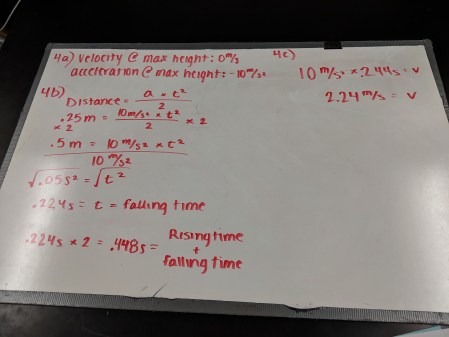
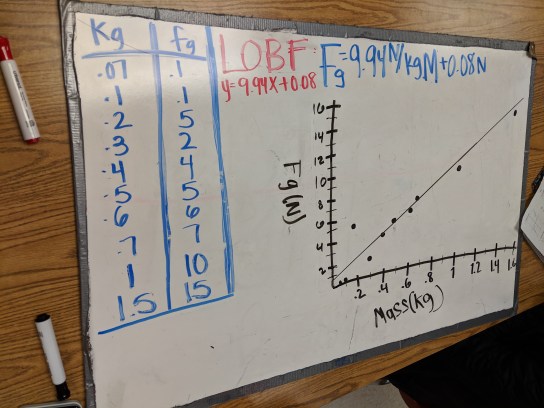
Students finished up their whiteboards for yesterday’s lab and we had our board meeting. Both classes got really nice results and had good discussions. I’m thinking about moving balanced forces to right after constant velocity next year since it gives some really good opportunities for students to be successful on experimental design.
fg whiteboard.jpg

Physics: Quiz

Today was our quiz on representations for constant acceleration. The quiz was pretty short, but I’ve been giving a few minutes before each quiz for students to do a reflection on their collaboration over the past few days. I also spent a few minutes talking with my students about today’s Nobel Prize announcement, and my students had a lot of questions about both this year’s prize and the Nobel Prize in general.

Chemistry Essentials: Quantitative Gas Laws

I am being compensated by Pivot Interactives for participating in a pilot of their chemistry materials.

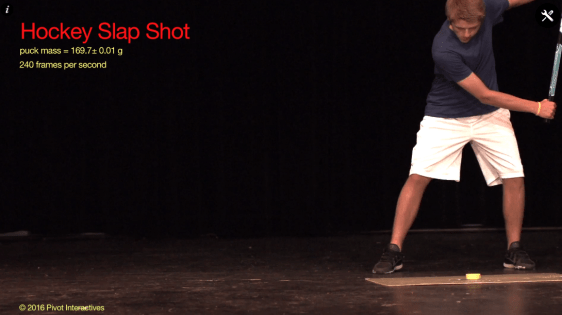
Students used Pivot Interactives to collect data for a relationship between pressure and temperature. There were some minor issues with the computers, but once students got logged in they were pretty successful. We only have one gas pressure sensor in the school, so this particular activity makes it possible to do a quantitative lab we otherwise wouldn’t be able to and is more firmly rooted in reality than a simulation. The activity included some questions I really like the temperature when the pressure is zero; I overestimated how well my students understand the intercept of a graph, so I’ll need to make sure I allow time to discuss those questions tomorrow.

pivot pressure temp.PNG

Day 18: Practice, Card Sort, & Chemical Changes

AP Physics 1: CVPM and MTM Practice

I am being compensated by Pivot Interactives for participating in a pilot of their chemistry materials.

About half of my students were gone today for a field trip, so I decided to do a lab on Pivot Interactives reviewing constant velocity and impulse since that would be an easy option for absent students to make up. Students analyzed the motion of a puck after a slap shot using CVPM, then analyzed the actual slap shot using momentum transfer.

pivot puck.PNG

Physics: Card Sort

A lot of my physics students were also on a field trip today. After a board meeting on the ramp lab, I gave students time to start a Kelly O’Shea’s kinematics card sort. I left out the blank cards and the word cards today so students only had the graphs. Initially, almost every group just put all of the same type of graphs together, so they had a position vs. time graph category, a velocity vs. time graph category, and an acceleration vs. time graph category. I think this was actually helpful to a lot of students, since it drove home that the graphs were telling them different things about the motion. Once groups showed me their initial sorting, I challenged them to come up with another sorting where they could put two or more graphs of the same type together, which lead to great conversations about what the graphs showed and lots of students working on specific language.

card sort.jpg

Chemistry Essentials: Chemical Change

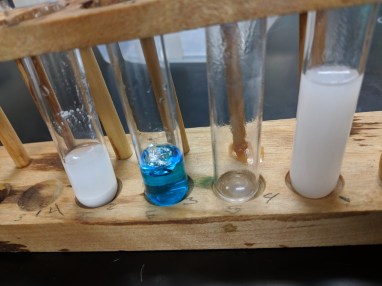
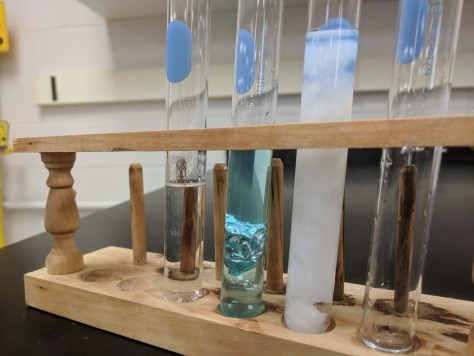
Students did a few different chemical reasons in test tubes to look for signs of chemical changes. I saw some preconceptions coming up that a chemical change should lead to a change in mass, so that is something I need to think about how to address going forward. I think part of that comes from the fact that I referenced burning steel wool as a chemical change early in this unit, when the chemical reaction that formed a precipitate from the same sequence would have been a better choice.

chem change.jpg

Day 14: Board Meeting, Dueling Buggies, & Density Challenge

AP Physics 1: Board Meeting

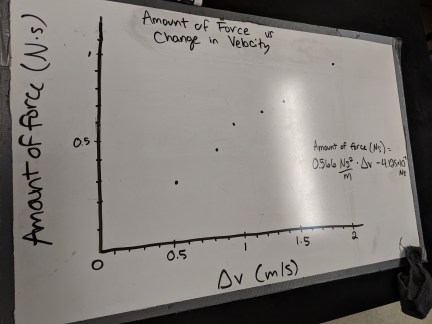
We had a board meeting on the impulse lab students have been working on. There were a few groups with really nice results, but this is a very tough one to get consistently accurate slopes, which made the discussion tough, even though my students did a nice job. It was a little tricky getting to the formula we’ll be using for impulse since the lab had a non-constant force, but the equation assumes a constant one. Next year, I might switch to the half-Atwood machine, rather than saving it for unbalanced forces.

impulse lab.jpg

Physics: Dueling Buggies

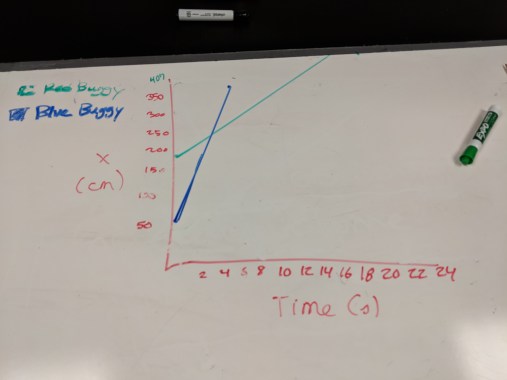
Students finished up the dueling buggies lab practical. I saw a much wider range of approaches than in my AP classes this year; most of my AP students are in the same math classes, which I think encourages them to think about problems in similar ways. My regular classes, meanwhile, have a much wider range of students, so there was a lot of great discussion about different ways to think about this problem.

dueling buggies.jpg

Chemistry Essentials: Density Challenge

I am receiving access to Pivot Interactives this year in exchange for piloting some of their chemistry activities.

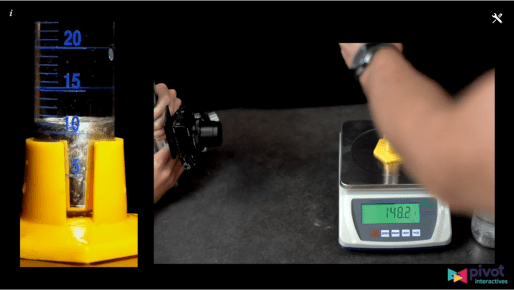
Students used Pivot Interactives to make mass vs. volume graphs to identify unknown liquids by their density. A lot of students had some trouble getting started, but, once I pointed out the similarities to the density of water lab we’d done, they were very successful. The videos don’t zero the balance so that the graph will end up with an intercept; this was the first graph with a non-zero intercept they’ve seen in this class, so it was challenging, but we were able to work through it. I think just about every group picked gallium as their unknown liquid, which is fitting, since it would be the hardest to do in the classroom.

pivot density.PNG

Day 136: Toilet Paper, Snakey Springs, & Limiting Reactants

AP Physics: Toilet Paper

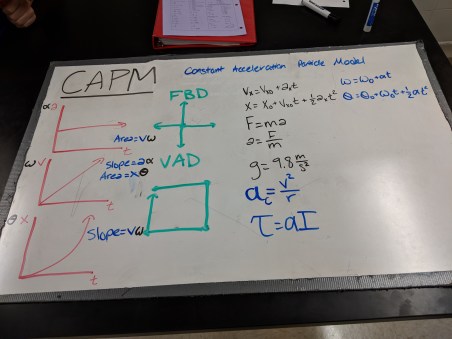
I started by having students whiteboard some model summaries. I started with linear motion, then asked students to add the angular version of each representation. This seemed to help students draw connections between linear and angular motion. Afterward, students started working on a lab practical to predict where to start an unrolling roll of toilet paper so it hits the ground at the same time as a toilet paper roll dropped from a given height.

Maker:S,Date:2017-10-21,Ver:6,Lens:Kan03,Act:Lar02,E-Y

Physics: Snakey Springs

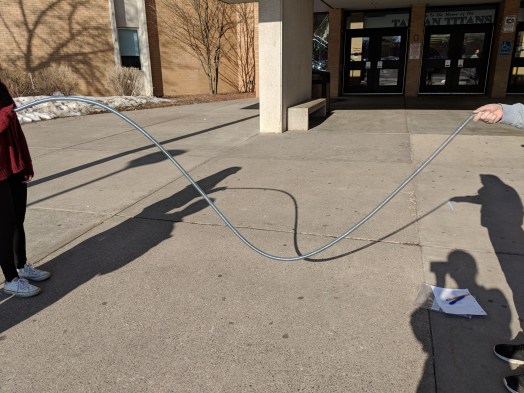
To introduce waves, students played around with snakey springs to look for ways to change the behavior of the waves and get some data for a relationship between wavelength and frequency. Today was one of the first days it was 60 degrees all day and there wasn’t much snow on the ground, so I took the lab outside and a lot of students used sidewalk chalk to help with their measurements. There were also some good observations of the shadows; one group making cycloid waves noticed their shadow looked the same as the shadow for 2D waves.

snakey.jpg

Chemistry Essentials: Limiting Reatants

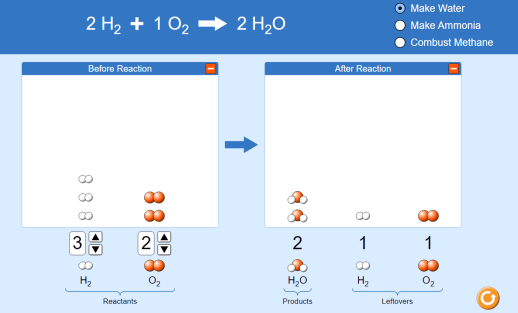
Students used a PhET simulation to start building some ideas about limiting reactants. The class was much rowdier than usual; the class meets the last period of the day, and I think the nice weather was making a lot of them restless. The concrete visualizations did seem to help a lot of students start making sense of limiting reactants.

limiting ract.PNG

Day 132: Angular Momentum, Lab Practical, & Popcorn

We had a snow day yesterday. Students (and teachers!) are getting restless for spring; after seeing the grass and even a few dandelions sprout last week, it was tough to get another 18 inches of snow.

AP Physics: Angular Momentum

Students used Pivot Interactives to explore angular momentum using a collision between a marble and a block. I started by having students determine whether the location of the impact changed whether linear momentum was conserved, which lead to some great conversations. A few students needed some reminders about linear momentum, but that wasn’t surprising given I haven’t done a great job of spiraling back to earlier topics this term.

pivot ang momentum.PNG

Physics: Lab Practical

I gave students some springs we haven’t worked with yet and asked them to make a graph with period on one axis where the slope could be used to find the spring constant. This was the first time I’ve had students go backwards from an equation to picking a graph to make, so it was a little tricky, but students had some great conversations about the relationships they were working with. Next year, I’d like to try to get more lab practicals that focus on graphs rather than just calculations.

spring practical.jpg

Chemistry Essentials: Popcorn

Students determined the percent yield for a bag of popcorn by finding how many kernels remained unpopped. It was messy, but it gave students a nice, concrete foundation for what percent yield means. It also came up in the discussion why some of the popcorn kernels didn’t pop, which could make this lab something to come back to when students want to blame less than 100% yield on doing the lab wrong or (shudder) human error.

popcorn.jpg

Day 123: Universal Gravitation, Pendulums, & State Testing

Today, sophomores and juniors are taking state tests, so freshmen and seniors have an off-campus learning day. This is the first time we’ve done something like this and the guidelines were pretty flexible. Both of my physics courses are mostly seniors.

AP Physics: Universal Gravitation

Students finished graphing their data from yesterday’s lab using exoplanet data. I started a thread on Google Classroom for students to post questions to try and encourage some virtual discussion, though it didn’t get any action as students opted to e-mail me, instead. Most of the questions I got related to uncertainty, which is not surprising. There were some great conversations yesterday about uncertainty, including why some measurements had different values for the plus and minus.

Physics: Pendulums

Students worked on graphing and linearizing their data from yesterday’s pendulum lab. I usually give students time in class to linearize their graphs so they talk to me or their group members, but they’ve had enough experience at this point that it shouldn’t be a huge leap to do it independently. A few groups didn’t collect all their data yesterday, so I posted a link to PhET’s pendulum lab so they could still be on track for tomorrow’s board meeting.

pendulum lab

Chemistry Essentials: State Testing

My chemistry students are juniors, so they took the ACT today to meet state testing requirements and were off the hook for the off-campus learning day.

Day 118: Board Meeting, Projectile Problems, & Balancing

AP Physics: Board Meeting

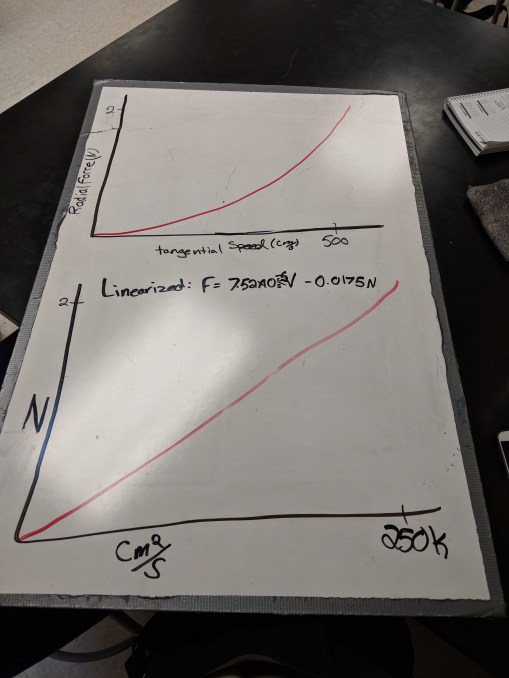
We had our board meeting for yesterday’s lab on centripetal force. I approached it as three mini board meetings since students had done experiments for how three different variables affect the force. The units on slope ended up being a very powerful way for students to see the connections between their three graphs. It was especially exciting when we got to the force vs. mass graph and students saw the connections to Newton’s 2nd Law. One class noticed the slope on the force vs. 1/radius graph has units of Joules, but I’m not sure of the significance of that yet.

force vs t.jpg

Physics: Projectiles

Students whiteboarded yesterday’s problems for a gallery walk. They are consistently viewing free-fall as just a special case of models we’ve already covered, which made the problems pretty easy.  Afterward, students started working problems for horizontal projectiles.

projectile prob.jpg

Chemistry Essentials: Balancing Reactions

After some discussion about the labs from the past few days, students worked on some problems balancing chemical equations. The students who started by sketching a particle diagram were generally very successful at seeing how to balance. A few students got tripped up determining when individual letters in a formula represent individual atoms, especially when the formula included a polyatomic ion, but were getting the hang of it after a couple problems.

balancing prob 1.jpg

Day 117: Central Net Force, Free Fall, & Balancing Equations

AP Physics: Central Net Force

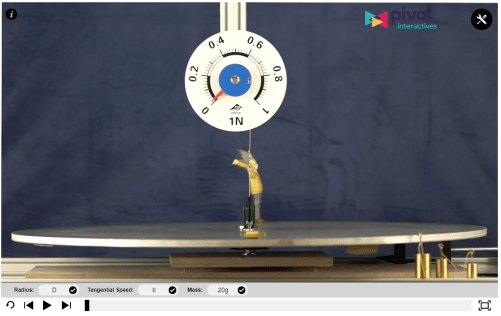
Students worked on an activity in Pivot Interactives to find how speed, mass, and radius affect the centripetal force. One of the great things about this time of year is my students not only have a lot of skills, they are very confident in those skills, so I got to listen to good conversations about experimental design, uncertainty, and linearization without stepping in to do any coaching.

pivot central net force.PNG

Physics: Free Fall

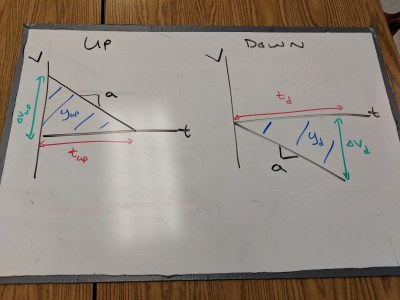
Students worked on some free-fall problems. There was a pretty even split between groups who relied on velocity vs. time graphs and groups who relied on energy. For the first time, I had a couple of groups draw separate v-t graphs for when the object was rising and when it was falling, which helped them organize their thinking.

ud split.jpg

Chemistry Essentials: Balancing Equations

Students used the PhET Balancing Chemical Equations sim to start exploring what it means for a chemical equation to be balanced. This not only seemed to help students make sense of balancing, but to do some retroactive meaning-making on the work we’ve been doing on representing reactions.

balancing eqn.PNG

Day 99: Kirchoff’s Laws, Impulse, & Mistakes Game

AP Physics: Kirchoff’s Laws

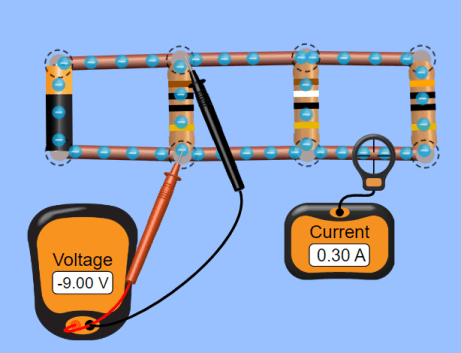
Students used PhET’s circuit construction kit to look for patterns in the current and potential difference in both series and parallel circuits. I usually do the PhET version before the real-world version we started yesterday, but testing season makes it tricky to reserve a computer lab right now. I overheard some students making good connections to their work yesterday and noticing the key things I wanted them to notice.

circuit kit parallel

Physics: Impulse

Students re-did the impulse lab from earlier this week. This time, I spent more time discussing with them why we care about the change in velocity, rather than the velocity at a specific moment. Students were more visibly attentive when I walked through how to get the change in velocity on a LabQuest than they were earlier in the week; I think it helped that they knew we were re-doing the lab because their earlier results came out poorly. I also had groups assign someone to plot their data as it was collected, which had them thinking about whether their results make sense throughout the lab. One section got beautiful results, while the other still had slopes all over the place; I’m not quite sure what happened in the second section.

Maker:S,Date:2017-10-21,Ver:6,Lens:Kan03,Act:Lar02,E-ve

Maker:S,Date:2017-10-21,Ver:6,Lens:Kan03,Act:Lar02,E-ve

Chemistry Essentials: Mistakes Game

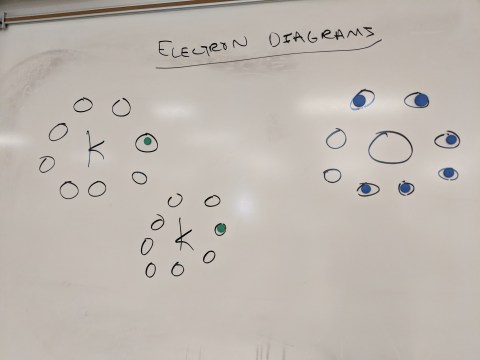
Students whiteboarded yesterday’s problems using the Mistakes Game. The students who are using the electron diagrams as a thinking tool are pretty quickly getting the hang of things.

electron diagra.jpg

Day 96: Circuit Basics, Cart Catching, & Chemical Changes

AP Physics: Circuit Basics

Students used the PhET circuit construction kit to start exploring basic circuit properties and develop Ohm’s Law. It was a lot of fun to listen to students as they discovered new features in the simulation and discussed details they noticed.

circuit kit.PNG

Physics: Cart Catching

To introduce momentum, we borrowed the idea of “chalk-smashing ability” used to introduce energy in the PUM curriculum and had students play with how they could make it harder to catch a cart on a dynamics track. I got excited when a couple of groups took advantage of the plunger carts to see how catching the plunger end felt different than catching the other end, which will be a great lead-in to impulse.

cart catch.jpg

Chemistry Essentials: Chemical Changes

Students did several different chemical reactions to identify signs of chemical changes. There were lots of good observations during the lab.

chem change