Day 162: CTSR & Ancient Minnesota

AP Physics: CTSR

Students took the CTSR today so that I can have some data to help decide whether to use that or the FCI next year, though I’m leaning towards the FCI since the responses on individual questions is much more meaningful. In the past I gave the CTSR because I was in a PLC with a chemistry teacher, so we wanted an assessment we could both use, and it lead to great conversations about how to build reasoning skills across grade levels. I think if all of the science classes gave the CTSR each spring, especially if we developed some common language using materials like Sayer & Addy’s Curriculum Analysis Taxonomy and the NGSS Science Practices, there is the potential for some really interesting department-wide vertical alignment.

Earth Science: Ancient Minnesota

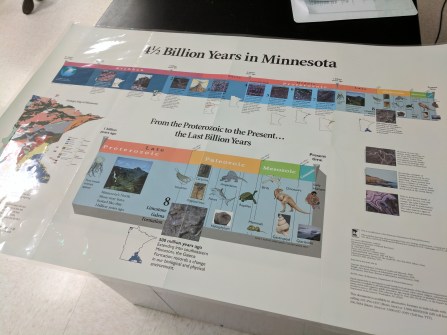
Students examined a poster of Minnesota’s geologic history to reinforce the relative lengths of time and see how the geology has changed over time. Afterwards, I gave students some information about Minnesota’s Paleozoic geology so they could complete an activity similar to Friday’s look at Precambrian Minnesota.
timeline.jpg

Day 157: FCI & Review

AP Physics: FCI

Students took the FCI today. I didn’t get my act together to give anything as a pre-test this year, but I want to start doing a pre- and post-test again next year and am trying to decide whether I’d rather use the FCI or the CTSR. To help decide, I’m going to see if one test correlates better to my students’ scores on the AP Physics 1 exam.

Earth Science: Review

I had students whiteboard their answers from Friday’s review for discussion. On a question about what causes different types of volcanoes, I realized students were having trouble separating characteristics of the different types from what causes the different types, so we spent some time discussing that. Next time I teach this course, I need to think about how to shift this unit (and several others) to help students more clearly separate cause and effect.

wb (5).jpg

Day 110: Fun Test & Presentations

AP Physics: Assessment

Students took their energy assessment. For the first time, I had multiple students tell me the test was fun, which was especially good to hear since I included a free-response problem from the 2016 AP exam. My PLC has been focused on experimental design this year, and I’m enjoying seeing that payoff in my students not only doing well with that skill, but feeling confident enough that they can enjoy applying it.

Physical Science: Presentations

Students worked on presentations to make the case for their cargo carrier design. I gave students a template a colleague made last year to help students make sure they are connecting the science to their design, but, after watching them work, it feels like too much scaffolding. I made much better use of a graphic organizer for evidence-based reasoning than in the past and did more to embed that skill throughout the course, and I think framing the presentation as evidence-based reasoning on a bigger scale may have been enough. I need to think about what that might look like next year.

Day 87: Assessment & EM Spectrum

AP Physics: Assessment

Students took an assessment over momentum. On the last few assessments, I’ve had a fair number of students use the full class period, when normally I try to keep the weekly assessments closer to half a class period. I need to take a look at my assessments compared to the AP exam to decide if I should shorten the weekly assessments, put a time limit on them so students have to practice pacing themselves, or stick with what I’ve been doing and let them take the time they take.

Physical Science: EM Spectrum

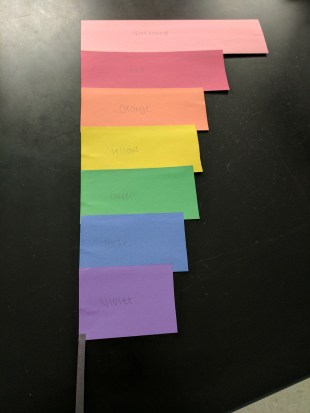
Students worked on a model of part of the EM spectrum, cutting paper to scale to represent the wavelength of some different types of waves. I started this activity when I included more calculations in the course, so it was partly a chance to practice working with scientific notation and switching between wavelength and frequency, but I’ve been taking out a lot of the calculation in the course and the only conceptual ideas this activity gets at is comparing the wavelengths. The standard this activity goes with is about identifying parts of the EM spectrum, so I need to spend some time looking for other activities that can meet the standard better.

spectrum

Day 79: Whiteboarding & Snakey Springs

I spaced out and didn’t take any pictures today.

AP Physics: Whiteboarding

Students worked on whiteboarding elements of the two problems they worked on yesterday. One of the problems involved a block that slides up a ramp and became a projectile; students were either nailing the projectile portion, or completely lost. With an AP test looming, I need to remember to keep spiraling those old concepts back.

Physical Science: Snakey Springs

Students made standing waves and looked for a pattern in how many wavelengths “fit” on the spring. I found a lot of groups missed some of the standing waves, so we made a list as a class of the number of wavelengths they could make a standing wave with and students quickly recognized the pattern.

We also talked a little bit about assessments. After the magnetism quiz yesterday, a lot of students told me they thought it hadn’t gone well, but the most vocal students had perfect scores and the class average was 85%. After talking to students, I think this is related to my challenges engaging students this tri. The earth science assessments they took 1st tri put a lot of emphasis on factual recall, so the reasoning questions I shoot for are big shift for students. I need to think about how I can make it less intimidating to face a new scenario and need to take some time to think on the test.

Day 78: Flying Pig & Quiz

AP Physics: Flying Pig

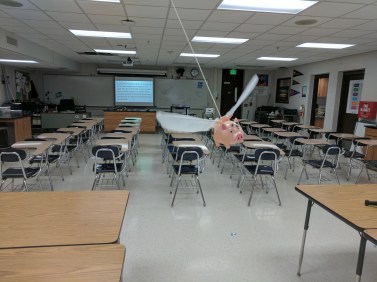
Today, I got out the flying pig for a lab practical. I had students measure the length of the string and the height of the cone, then use what they know about forces and circular motion to predict the time for the pig to make 10 revolutions.

pig

Physical Science: Quiz

Students took a quiz on magnetism. Afterward, we took a few minutes to review vocabulary for talking about waves that students learned during first trimester. It was pretty teacher directed, but I didn’t want to spend much time on terms students should have mastered earlier this year.

Day 71: Quiz & Circuits

Today was our last day of classes before break!

AP Physics: Quiz

Students took a quiz on projectile motion. My collaborative team’s goal is related to experimental design, to I included a problem to give my students some practice and feedback on designing on an experiment entirely on paper. I planned to have them play with some Mystery Tubes after the quiz, but it went longer than I expected, so I will save those for another day.

Physical Science: Circuits

I got out the light bulbs and batteries for students to build real-life circuits and see if the models they developed with the simulation still work. Not all of our light bulbs are identical, and I didn’t check the kits before class, so some groups had bulbs with different resistances. Next year, it could be interesting to use that as a feature, rather than a bug, and ask students to rank the resistance of their light bulbs based on qualitative observations.

circuit

Day 43: Assessment Reflection & Movie

I was chaperoning a field trip today, so no photos and lessons that were easy to leave for a sub.

AP Physics: Assessment Reflection

Students took a test combining forces and constant acceleration today. On tests and quizzes, I’ve been asking students to rate themselves on each learning target and write a short reflection, so I took a few minutes to read over the reflections after the field trip. I like getting a sense of where my students feel confident and where they are struggling before I grade the whole test. It was also fun to see what students wrote. I’ve been trying to improve how explicit I am about what is included in a given model, so I was really pleased to see several students tell me that they started each problem by identifying what models apply, then thinking of the “toolbox” that goes with that model. I also was really excited to see a student who has been struggling write that, moving forward, he wants to shift from trying to understand what they answer is to trying to understand why its the answer.

Earth Science: Movie

The earth science curriculum calls for another movie this unit (I think I’ve shown more movies in Earth Science this year than I’ve shown in physics the last several years combined), and I went with it since that’s an easy thing for a sub. I’ve been using the existing worksheets to go with the movies, which have very factual questions in the order they appear in the movie. The next time I show a video, I might try getting the students to do a little more thinking by adapting some reading response techniques like four square notes or a 3-2-1 response.

Day 31: Quiz & Human Impacts

AP Physics: Quiz

I missed my AP Physics classes today to chaperone a field trip. they took a quiz on system schema and free-body diagrams, then worked on some 2nd Law problems. It was around this time last year that it finally clicked for me what system schema are for, so this is the first group of students I’ve had that really “get” that representation and truly find it useful. Based on their quizzes, we do need to spend some more time on internal vs. external forces, as well as how to pick your system when the problem doesn’t specify.

Earth Science: Human Impacts on Climate

Students used several different representations of emissions to answer some questions about pollution and its effects. The activity gave students a lot of opportunities to practice reading data tables and graphs, but I found my students did pretty superficial interpretation. My students also made pretty limited connections to the earth science content, and I think finding ways to go deeper on the data interpretation will help with the content connections.

Day 23: Test & Problem Scoping

AP Physics: Test

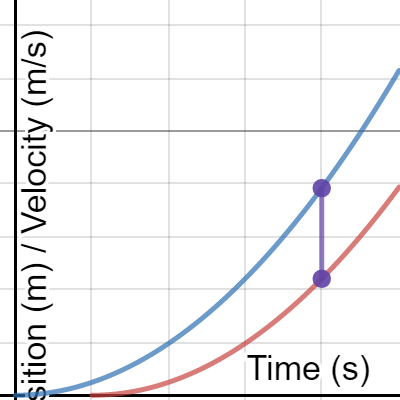
I use standards-based grading and this year, I’m giving each student two scores on each standard. What I’m calling the tier 1 score is from an assessment similar to what I gave in honors physics and the tier 2 score is from a full-period test with problems modeled on the AP Physics 1 exam. Today was the first tier 2 test. I’m not very focused today, so I spent too much time playing with a solution I made in Desmos to one of the multiple choice problems.

Earth Science: Problem Scoping

We’re starting a unit on wind that includes an engineering design challenge to plan a wind farm, so I decided to take a project-based learning approach to this unit. Today, I introduced the design challenge using a problem scoping process I picked up at EngrTEAMS. Students read a short memo from our “client”, then wrote individual answers to some questions about the specifics of the design challenge. We ran out of time for students to meet with their groups, so on Monday, they’ll share those answers in their groups and record a group answer in their notebook alongside the individual answers.