Day 56: Final Exams

Final exams are today and tomorrow.

AP Physics: Mini AP Exam

Since I mostly give short, weekly assessments, finals are a good time to give my students something longer. The other AP Physics teacher and I modified a practice exam to cut the content we haven’t covered yet and get it down to 90 minutes. This is their first assessment with a time limit, so I’m curious to see how they do with pacing.

Physics: Two-Stage Exam

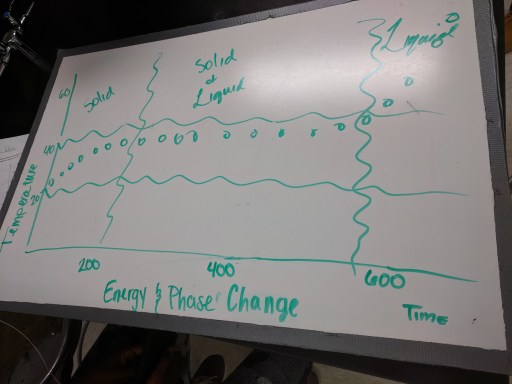
The other physics teacher and I agreed on a hybrid approach to the final. The first half, worth 75% of the exam grade, is a pretty traditional written final with some problems from throughout the trimester. The second half, worth 25% of the exam grade, is a lab practical that students are completing with a partner. During the lab portion, I overheard several groups talking about whether their answer is reasonable and how they know, which got me really excited since students have struggled to connect physical meaning to the math this year.

phys final.jpg

Chemistry Essentials: Written Exam

I’m giving a pretty traditional written exam. My students said they were hoping for multiple choice, but I stuck with short answer so the questions will read more like the other assessments they’ve taken. A few of my students are annoyed because they say multiple choice is easier, but I have never had it go well when I suddenly use multiple choice at the end.

Pretty consistently when I teach this course, all of my students finish with about 30 minutes left in the final block, regardless of the length of the test. As usual, I had a significant number of students who left large portions of the test blank. I think my finals in this course run short not because I don’t make them long enough, but because a lot of students have trouble focusing on a written test for 90 minutes (honestly, I have trouble focusing on a written test for 90 minutes). This reinforces that it is worth moving away from a traditional final in this course.

Day 55: Design a Practical & Review

AP Physics: Design a Practical

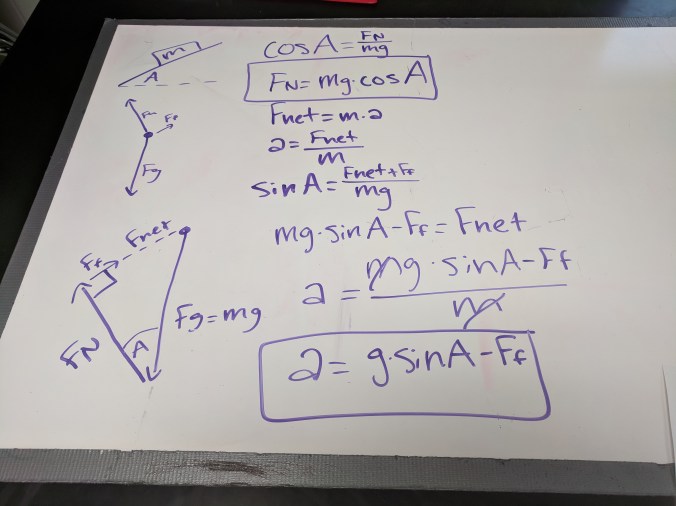
Groups set up the lab practicals they’d planned yesterday, then got a chance to try the lab practicals other groups had come up with. It was a lot of fun seeing how much pride students took in watching their peers complete a practical they’d designed. A lot of students said they enjoyed this approach to review, and I liked the thinking it took to design a good practical.

Physics: Review

Students finished up the review assignment they got yesterday, then were able to check answers against my key. Its not my favorite way to review, but it is familiar and comfortable for my students, which I think helped them feel more confident going into the final exam.

Chemistry Essentials: Review

I also went pretty traditional in this class today, giving them some questions to review atomic models and formula writing, especially since we haven’t had a stand-alone quiz on this topic.

Day 55: Design a Practical, Review, & Quiz Jigsaw

AP Physics: Design a Practical

I decided to try something new for my review this year and tasked each group with picking at least one model from this tri, and designing a lab practical. Today, they worked on coming up with an idea and trying it out in the lab. I’m having a lot of fun seeing what students are coming up with; I need to make sure I get photos of all of them tomorrow. The main challenge was I did a lot of running around between classrooms to find lab equipment for students, so next time I’ll try to do a better job of having most of the equipment we’ve used in the room already.

Physics: Review

Students worked on some review worksheets from the Modeling Instruction curriculum. As students worked, there were several I talked to who are feeling very overwhelmed right now, so we talked a little about the worst case scenario as a sort of pep talk. I will probably take a few minutes tomorrow to do that with the whole class.

Chemistry Essentials: Quiz Jigsaw

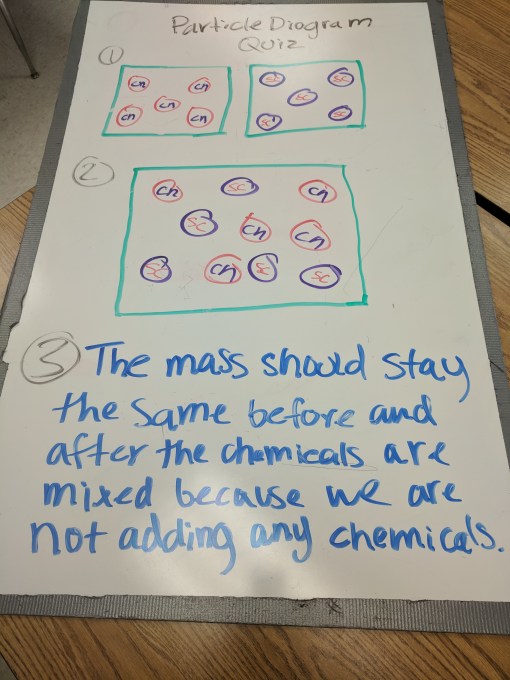
Groups presented the whiteboards they worked on yesterday. Most students no longer had their old quizzes, which made it tough for them to take full advantage of this; next time, I might give them a full set of blank quizzes as a review packet. I asked groups to pick what they thought were the hardest problems off their quiz to whiteboard, and most groups picked problems that the majority of students got wrong on their original quiz, which was great!

chem jig.jpg

Day 54: Model Summaries & Quiz Jigsaw

Final exams are this week, so all three of my classes are doing some review the next few days.

AP Physics: Model Summaries

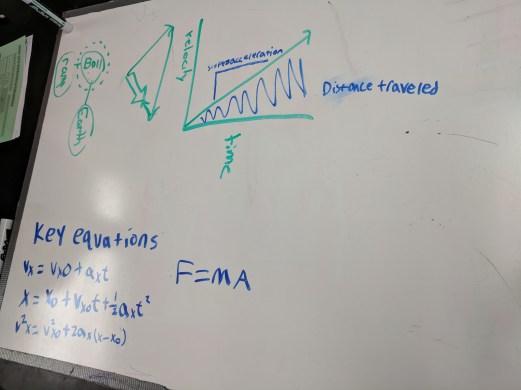
I gave each group one of the four models we’ve covered this trimester, and asked them to whiteboard examples of the key representations for their model, including diagrams, graphs (with notations about what has physical meaning), and equations. Once whiteboards were ready, we took a few minutes to do a gallery walk. A really cool surprise was just about every group included some force representations, regardless of which model they were whiteboarding.

ap capm summary.jpg

CAPM summary

Physics: Model Summaries

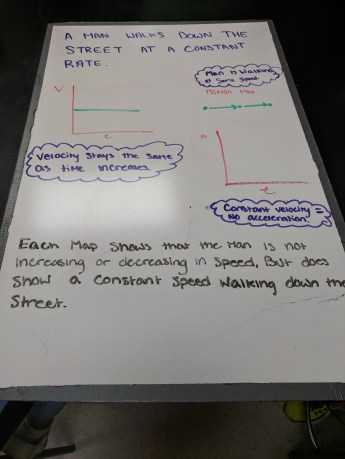
My physics classes also worked on model summaries, but I used a different structure. First, rather than giving each group a different model, I had the whole class whiteboard the same model, then we did a gallery walk before moving on. Second, to make things a little more concrete, I asked each group to come up with a scenario where the model applied, then to sketch representations and give some written descriptions. I think a lot of students didn’t see as much value in this as I’d hoped; I have a lot of students who have been trying to memorize the diagrams, rather than using them as meaning-making tools, and spending time thinking about the relationships between the diagrams doesn’t contribute to that approach. With a new tri starting next week and most of my students either switching hour or switching teacher, I’ve got a good opportunity to think about how I can re-calibrate my classroom culture towards more meaning-making.

cvpm summary.jpg

CVPM summary

Chemistry Essentials: Quiz Jigsaw

I gave each group an old quiz and asked them to work through it. Once groups started to finish, I asked them to pick the hardest problem or problems and prep a whiteboard with their solutions. The big challenge is I had a lot of students checking out today, which is pretty typical for what I see during finals week with this course; for most of my students, whether or not they pass is more important than their letter grade, and are aware that a final that is 10% of their grade will have little impact on whether they pass. I need to spend some time thinking about final exams that students are more likely to find more intrinsically meaningful.

chem quiz wb

A problem that almost everyone got wrong on the quiz

Day 53: Multiple Choice, Quiz, & Polyatomic Ions

AP Physics: Multiple Choice

Students took their last quiz for the trimester, then we spent the rest of the hour using Plickers to practice multiple choice questions. Final exams are next week, so the multiple choice also served as a way to start reviewing for the exam. I continued my usual routine of having students answer individually, then talk to a classmate before answering again and both classes had some good conversations about the problems.

img_2398

Physics: Quiz

Students took their last quiz of the trimester over balanced force. A lot of students have been struggling to identify the direction of forces, and that is showing up on the quiz. When working on problems or labs, students were pretty successful when they went back to the language of the interaction stations we’d done, but the students who are struggling usually need prompting to think in those terms. I do some fairly general reflection in the course, but I’m thinking about how I can improve that next tri to help students recognize useful ways of thinking.

Chemistry Essentials: Polyatomic Ions

Students worked on writing formulas based on names that include polyatomic ions. Today, I added having students sketch particle diagrams for each compound, which helped them focus on the meaning of the various numbers. Yesterday’s activity with the Lewis dot beans also helped students think through today’s problems. Next tri, I think that will be my starting point for bonding.

Day 52: UBFPM Practical, CAPM Problems, & Lewis Dot Beans

AP Physics: UBFPM Practical

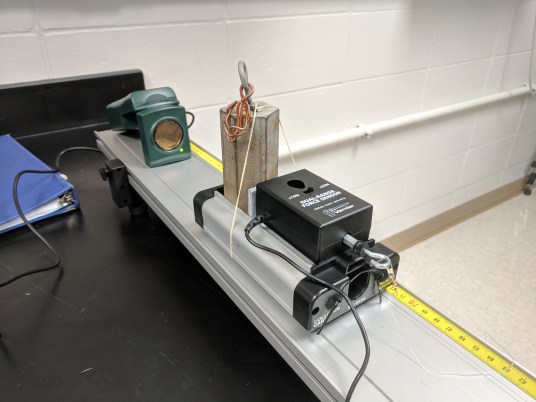
Students were tasked with finding the inertial mass of a lump of metal. While I left it open, students pretty quickly settled in to following the steps from their 2nd Law lab. In one of my classes, a lot of groups initially used the unknown mass to provide the force on their half-Atwoods setup, which has me thinking they were losing track of the significance of the measured quantities; I skipped over having them do an interaction diagram and free-body diagram on the original lab, which I’m betting would have helped.

ubfpm practucal.jpg

Physics: CAPM Problems

Students used whiteboards to revisit an earlier quiz on CAMP problems. I had them go through piece by piece, rotating who had the marker for each step. That seemed to help students feel a lot more confident on the problems. Tomorrow we’ll see if they can do them independently.

capm prob

Chemistry Essentials: Lewis Dot Beans

Yesterday, when we worked on formula writing, students were losing track of what the various numbers represented. One of the other chemistry teachers suggested I try Lewis dot structures with a manipulative, so today students used beans to check their answers to yesterday’s problems.

lewis dot beans

Day 51: Friction on Ramps, CAPM Card Sort, & Naming Compounds

AP Physics: Is Friction Negligible?

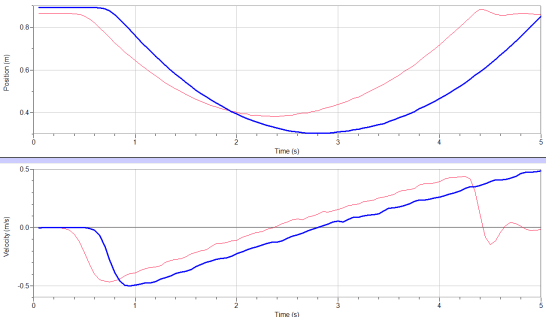
Students sketched free-body diagrams and vector addition diagrams for a cart on a ramp with friction, then were tasked with determining whether friction is negligible using a set of graphs recorded in LoggerPro. There were lots of great conversations connecting the force representations to the motion ones.

friction on ramp grpahs

Physics: CAPM Card Sort
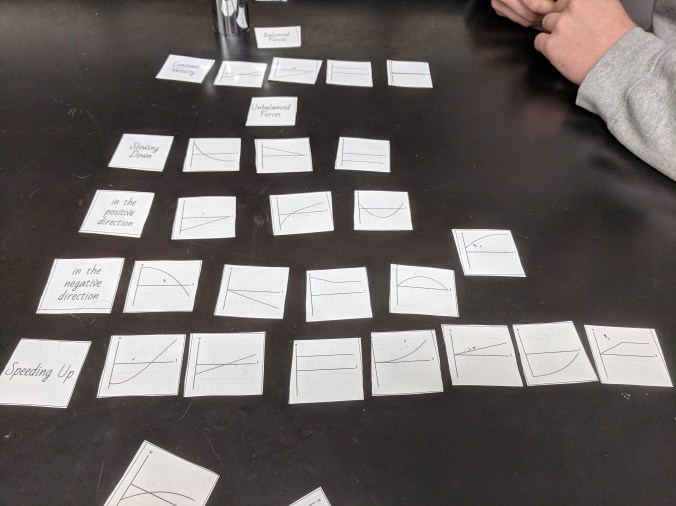
I want to revisit CAPM this week, so we started with Kelly O’Shea’s card sort. A lot of groups needed some nudging to differentiate between constant velocity and constant acceleration on the velocity-time and acceleration-time graphs, but that was no surprise. While students were bothered by the idea that there was no one right answer, they had some great conversations. I think it also helped that I assigned them to random groups, which interrupted some of the usual patterns.

card sort 5.jpg

Chemistry Essentials: Naming Compounds

Students worked on going between formulas and names for compounds. A few groups asked if they could use the cards from Friday to help figure out how many of each atom a compound needs, and I happily got them out. I think a lot of students lost track of what is going on conceptually with the bonding, so I need to think about better ways to reinforce that.

bonding cards.jpg


Day 50: Whiteboarding, Problems, & Bonding

AP Physics: Whiteboarding

Students whiteboarded their problems from the last few days. I tried to keep the focus on the diagrams and initial setup, since there’s where the physics is. With the end of the term looming and students doing pretty well with these, I had them do a gallery walk rather than taking the time for a more involved whole class discussion.

Physics: Problems

Students started using vector addition diagrams to solve problems with balanced forces in 2D. I saw a lot of groups working much more effectively together than a few weeks ago and students were doing a nice job of playing around with strategies to find their way to an answer.

Chemistry Essentials: Bonding

Now that students have some ideas about the structure of an atom and periodic trends, students used cards similar to puzzle pieces (that I forgot to take a picture of) to explore bonding. Students seemed to be getting a lot of ideas in place about which elements are more likely to give up electrons and why the atomic ratios are what they are.

Day 49: Numberless Problems, Vector Addition Diagrams, & Bohr Model

AP Physics: Numberless Problems

Students have been feeling pretty good about the unbalanced force problems so far, so I gave them some problems without any numbers. It took some time to get through the first one, then things went very smoothly, even as the problems got tougher.

Physics: Vector Addition Diagrams

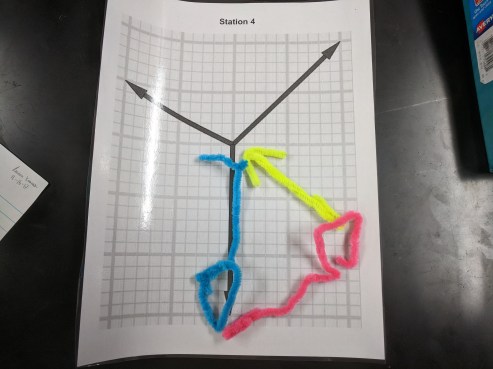
Students did an activity I got from Casey Rutherford using pipe cleaners to translate between free-body diagrams and vector addition diagrams. Students had some good conversations about the difference between balanced forces and equal forces.

vad.jpg

Chemistry Essentials: Bohr Model

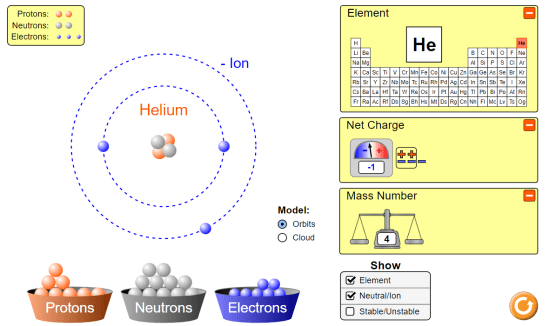
Students finished exploring PhET’s Build an Atom simulation. They were able to recognize all of the patterns I wanted them to and were very successful on the questions I had connecting the simulation to their periodic tables. I was also pleased by how quickly students picked up on the fact that the simulation only gave whole number masses, while their periodic table has lots of decimals.

phet atom

Day 48: Unbalanced Forces, Quantitative Interactions, & Bohr Model

AP Physics: Unbalanced Force Problems

Students started some problems on unbalanced forces. I started by having a group demonstrate their success on last week’s lab practical, then asked students what should happen if we swapped out a lighter marble. Once we tried it, we used vector addition diagrams to find the acceleration of each marble and show the mass doesn’t matter.

Physics: Quantitative Interactions

I borrowed an idea from Kelly O’Shea (I think she’s planning a blog post) and, instead of doing balanced force problems on a worksheet or out of the textbook, I gave students 5 different stations to work through. Several groups went back to their force of gravity lab to figure out the first station, which was great for reinforcing that the labs and problems are connected. The downside is I used a mass today that many used on their lab, so they were able to just read off their data table.

Chemistry Essentials: Bohr Model

Students used PhET’s Build an Atom simulation to play with the Bohr model. The activity took a little longer than I thought, so no one was able to finish, but students were having some good questions about the changes as they added pieces to their atoms and how that fit with patterns on the periodic table. At the end of the hour, I got out the gas tubes and diffraction gratings so students could see some of the evidence for the Bohr Model. They had a lot of questions we didn’t have time to answer, but I’m hoping that will make for a good way to start class tomorrow. I’ve been trying to put something engaging and thought-provoking at the end of the hour to combat students trying to line up at the door or slip out of the classroom in a positive way, and its had the side effect of making it easier to start class the next day since students show up with questions they are excited about answering.

gas tube