Day 128: Wave Superposition & Molar Mass in Reactions

I’m out today, so I’ll find out tomorrow how things actually went.

Physics: Wave Superposition

Students used a Direct Measurement Video to start exploring wave superposition. Since I’m not there to listen in on their conversations, I’m having them submit answers to some questions in Google Classroom so I can look over what my students are thinking before class on Wednesday.
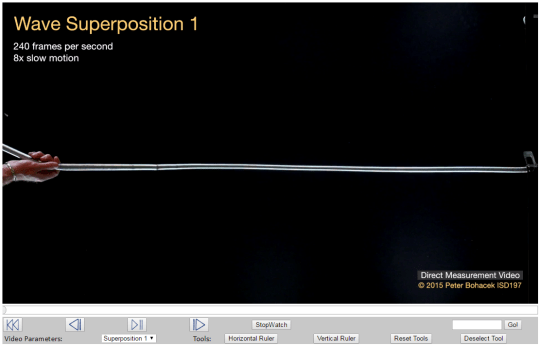
Wave DMV

Chemistry: Molar Mass in Reactions

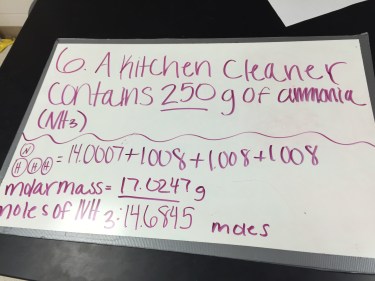
Students went back to the nuts, bolts, and washers to introduce the idea of stoichiometry. I made up a “reaction” using those three elements and provided a total mass available for one of the reactants. Students used the hardware as manipulatives to determine how much of the other reactants would be needed along with how much of the product would be produced. When I did this last tri, students tended to ignore the manipulatives, so I reworked some of the questions to try and emphasize how the physical nuts, bolts, and washers can be used to check an answer.

IMG_1599

Day 127: Wave Equation & Molar Mass

Physics: Wave Equation

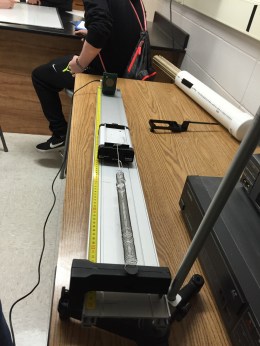
Students used snakey springs data for a relationship between wavelength and frequency and made graphs. I’d hoped to share the graphs today, but there just wasn’t enough time. They spent a lot longer than last year’s students figuring out how to measure the wavelength. Last year, the weather was nice enough to do the lab outside, and a lot of groups found ways to use their spring’s shadow to mark key points on the ground. Today, we had snow, so were stuck doing the lab inside. Students were quick to recognize, based on the units, that the slope of their linearized graph was the speed of the wave.

Chemistry: Molar Mass Practice

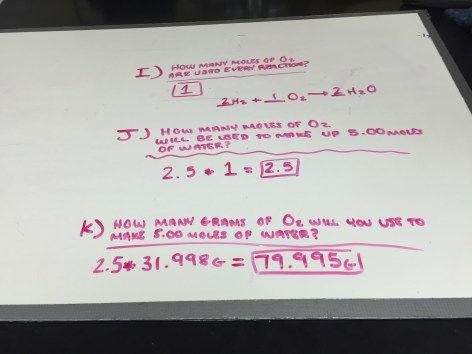
Students worked on some practice molar mass problems, then whiteboarded solutions for a gallery walk. A lot of students initially struggled going from a measured mass to a number of moles, but when I asked students to think back to the lab they did a few days ago and tell me how they would figure out how many bolts I had if all they knew was the mass, things clicked pretty quickly.

IMG_1782

Day 126: Snakey Springs & Molar Mass

Physics: Snakey Spring Waves

Students used the snakey springs to start exploring properties of mechanical waves. Today, they found ways to affect the speed of the wave and made observations about what happens when a pulse reaches the end of the spring.

IMG_1776.JPG

Chemistry: Molar Mass

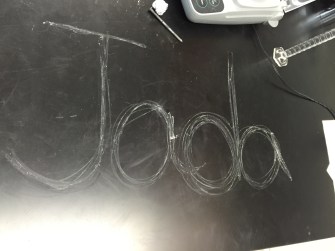
Today molar mass got a little more abstract as students calculated the molar mass for actual chemical formulas and answered questions like how many moles of chalk it takes to write their names on a lab table. A lot of students sketched diagrams of the formulas to help figure out what they had to add or multiply to get the molar mass and most felt pretty confident by the end of the hour.

IMG_1774

Day 125: Mistakes Game & Molar Mass

Physics: Mistakes Game

Students whiteboarded yesterday’s problems including at least one mistake. Its been a little while since I last had students do this, and a lot of students were excited to do it again.

IMG_1771

Since everything we’ve done so far has been vertical springs, I sent up a ramp with a cart attatched to a spring so we could look at position vs. time graphs compare the period at different angles as a way to see how “changing gravity” affects the spring’s period. In spite of having the equation, a lot of students expected gravity to matter because they thought there had to be a force to de-compress, not recognizing that the spring could exert that force since we’ve mostly looked at stretching springs.

IMG_1770

Chemistry: Molar Mass Introduction

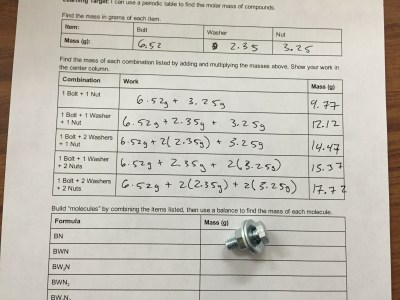
Students got the mass of individual nuts, bolts, and washers, then predicted the masses of various combinations. Compared to last trimester, I took some extra time debriefing after the lab and tried to be very explicit that the hardware was being used to represent individual atoms, since we can’t observe individual atoms directly.

IMG_1768

Day 88: Ohm’s Law & Limiting Reactants

Physics: Ohm’s Law

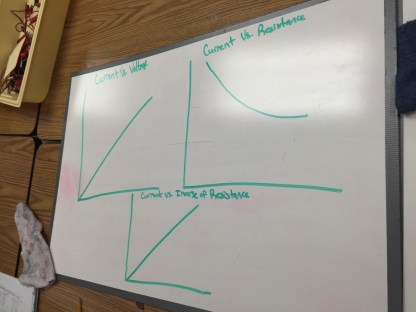
Students wrapped up using the PhET circuit construction kit to develop Ohm’s Law. Students were able to pretty easily reason out the formula based on their graphs. Looking back, I wish I’d had students put their experimental conditions and equations on the boards, as well. I usually try to keep the boards pretty simple since I have some big classes, but I think that information would have added a lot of value to the conversation in this case.

IMG_1610

Chemistry: Limiting Reactant Practice

Today, students did some limiting reactant problems where the given and desired information is in grams, rather than moles. I was really pleased at how easily most of them worked through the problems. A lot of my students were struggling to connect ideas between different days earlier in the trimester, so it was great to see how many readily pulled out earlier skills and problem solving strategies to help today. I also saw a big jump in the quality of the questions I’m getting from my students; one student in particular was really focusing on the why when she was talking to me, when in the past she seemed most interested in getting something to write down. I’ve been having a lot of conversations with this class about how learning works and sharing why I do things the way I do, and I’m hoping I can get students to continue with the things I saw today.

Day 87: Ohm’s Law & Limiting Reactants

Physics: Ohm’s Law

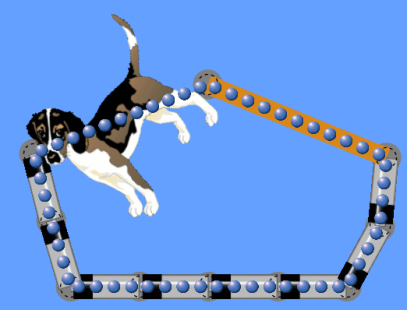
Students used PhET’s circuit construction kit to do a short activity based on the PUM materials to help orient them to the sim, then started looking for a relationship between current and potential difference. I loved it when, during the orientation activity, several groups got curious about the mysterious resistors in the kit, and immediately tried adding them to a circuit to see what they do, without any prompting or intervention on my part. There was also some great discussion and debate in one class about what exactly the blue dots represent. There were also many attempts to electrocute the dog.

dog circuit

Chemistry: Limiting Reactants

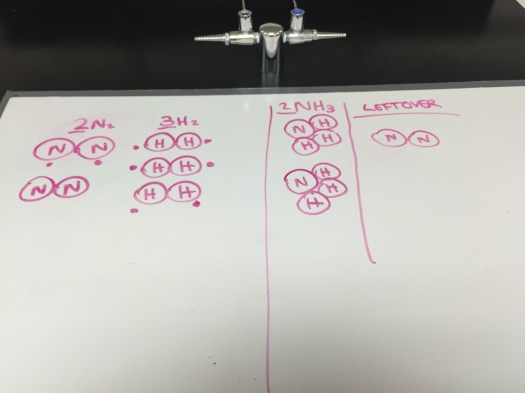
After a short percent yield quiz, we had some class discussion to formalize what students found in yesterday’s PhET sim on limiting reactants. I picked some reactant quantities for one of the reactions in the simulation, then had students get into groups and try to predict what they would produce and what the leftovers would be. Before students went to their groups, we had some conversation about what I was looking for. I tried to emphasize that I wasn’t after right answers; instead, I wanted them to share different approaches so we could decide on some useful ways to think about this kind of problem. There was a nice mix of students who focused on the equation given for the reaction and students who sketched diagrams.

IMG_1609

Day 86: Intro to Circuits & Limiting Reactants

Physics: Intro to Circuits

I gave each group a bag with a mix of various items and asked them to use those items to try and light up an LED. In the past, I’ve told students their task is to light up the bulb, but they should keep track of what doesn’t work. This year, I was more conscious of stating the goal was simply to document what does and does not work so we could look for patterns, and I was much happier with how the exploration went. This was also the first time I used LEDs for this lab, instead of miniature incandescent light bulbs, and I liked the opportunity to reinforce that current has a direction. As an added bonus, the LEDs I have required two AA batteries, which gave the students more options to try. We wrapped up by watching a short excerpt from from the Private Universe series of MIT and Harvard grads trying a similar task.

IMG_1608

Chemistry: Limiting Reactants

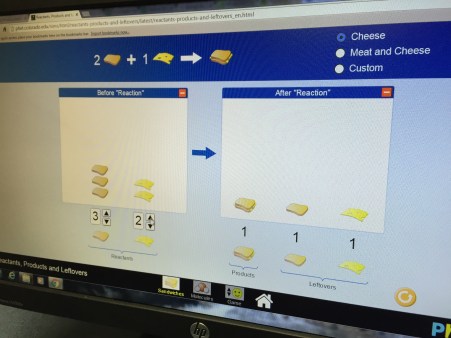
Students worked through PhET’s Reactants, Products, and Leftovers simulation to introduce the idea of limiting reactants. I found a lot of students were looking for confirmation that their answers were right, even when the simulation showed the answer. When I talk to many of them, it sounds like they’ve gotten into the habit of assuming they are wrong in school. I need to continue to work on building a culture where my students feel like their ideas have value and to work on strategies to help students analyze their answers, right or wrong.

IMG_1607

Day 85: Whiteboarding & Percent Yield

Physics: Whiteboarding

Students whiteboarded their answers to Friday’s questions. There were a few questions where students had some good discussion and connected some questions back to the lab where they’d mapped electric potential. I still need to work on getting students to talk to each other more than they talk to me.

IMG_1606

Chemistry: Percent Yield

Students worked on some problems calculating percent yield. While they can do the calculations pretty easily, the concept seems pretty abstract to them. I need to find a good lab to make percent yield more concrete.

Day 84: Electric Potential & Whiteboarding

Physics: Electric Potential vs. Gravitational Potential

Students worked on a worksheet from the Modeling Instruction curriculum that draws analogies between gravitational potential and electric potential. Several students commented that relating electric potential to something more tangible helped them make sense of what we’ve been doing. I also had a very good conversation with a student about how last trimester, she really liked how connected the mechanics topics were, but doesn’t have the same sense with electricity. This confirms that I need to keep working on my storyline for this trimester, but it was great to hear some of the metacognition the student was doing and I consider it a sign of a good class climate that a student was willing to have that conversation.

Chemistry: More Whiteboarding

Students used whiteboards to work through another stoichiometry problem. A lot of students left with much more confidence than they’d started the day with.

Day 83: Electric Potential Difference & Whiteboarding

Physics: Electric Potential Difference

In the past, I’ve motivated the need for electric potential difference in addition to electric potential purely through analogies to gravitational potential energy. Today, I tried an extension of the Modeling Instruction lab to map electric potential. I had students measure the voltage along a line in their tray of water with the multimeter’s ground attached to the negative lead of the power supply, then repeat with the ground attached to the power supply’s positive lead and the ground held somewhere in the middle. In the discussion, students agreed that the change in voltage is more meaningful than the specific value.

IMG_1604

Chemistry: Whiteboarding Problems

Students struggled with the stoich problems I left them yesterday, so we took some time to go through the first part of one. I tried to be very explicit and specific in bringing up previous labs or activities that used each skill, and that seemed to help students make connections. Students then continued the problem in small groups working on whiteboards. I need to do more whiteboarding problems in this class; the whiteboards really helped students function as a cohesive group, which is really not surprising.

IMG_1603