Day 124: Levers, Pendulums, & Molar Mass

AP Physics: Levers

Most students did not finish their data collection on the Universal Gravitation lab, so I decided to postpone the discussion. A lot of students prioritized data collection on Monday, then ran into trouble doing calculations in a spreadsheet and weren’t comfortable asking for help electronically since they don’t have much experience with that. It was great to see, however, how many students were enthusiastic about trying their hand at spreadsheets.

In place of the discussion, we jumped ahead to levers to introduce torque. Students first placed the clamps at set positions and found a relationship between the mass hanging from one side and the force required to balance the lever. Next, students picked two masses to use and found a relationship between the distances from each mass to the pivot required to balance the lever. One student commented the second part of the lab reminded her of using a triple beam balance.
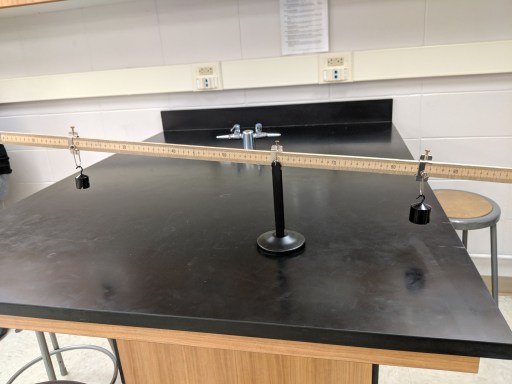
lever.jpg

Physics: Pendulums

Students predicted the period of a pendulum at the main entrance using their data from Monday. A lot of groups used a linear fit and predicted a larger period as a result. We didn’t get to the board meeting today, so tomorrow we’ll have a chance to get into why that happened.
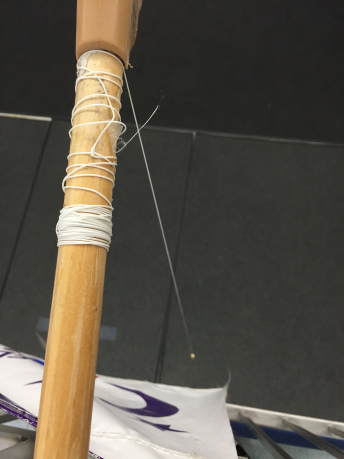
pendulum big

Chemistry Essentials: Molar Mass

Students practiced finding molar mass and the number of moles in a sample. When students get stuck, particle diagrams have been a huge help since they force students to break down what the formula actually represents.

Day 115: Mistakes Whiteboarding

AP Physics: Rotation Whiteboarding

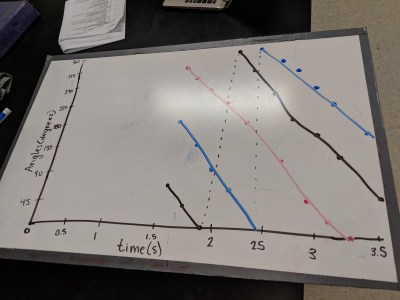
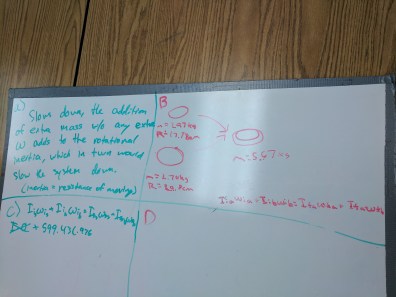
Students did mistakes whiteboarding with yesterday’s problems on rotational kinematics. Several of the mistakes lead to some great conversations about what information angular motion graphs do and do not convey.

rot wb.jpg

Physics: Projectile Whiteboarding

These classes also did mistakes whiteboarding with yesterday’s problems on velocity vs. time graphs for projectiles. There were a lot of good mistakes, but a lot of long silences. I need to keep working on making sure my classroom is a comfortable place for intellectual risks.

projectile wb.jpg

Chemistry Essentials: Representing Reactions

I finished out a day of mistakes whiteboarding with some problems going between equations, statements, and particle diagrams for chemical reactions. The main challenge was keeping the class in a single conversation since so many students had questions about the whiteboards, which is a great problem to have. Students also started consciously seeking out new voices when they realized one student was finding most of the mistakes, which was also great.

chem mistake.jpg

Day 113: Board Meeting, Projectiles, & Formula Writing Review

AP Physics: Board Meeting

Students whiteboarded the results of yesterday’s lab. Students were very successful making key connections to linear motion. I didn’t specify when students should set time equal to zero or how they should handle it when a dot passed zero radians, so there was some variation in the graphs, but students were able to make sense of those differences.

Maker:S,Date:2017-10-21,Ver:6,Lens:Kan03,Act:Lar02,E-Y

Physics: Projectiles

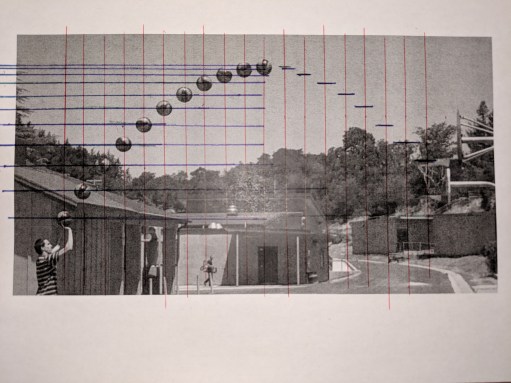
Today, I used an activity Kelly O’Shea came up with based on a post from Dan Meyer. I gave students printouts of an image showing half the path of a basketball, then had them draw lines to see the horizontal and vertical motion of the ball. Students were once again very successful at making the connections I was after.

Maker:S,Date:2017-10-21,Ver:6,Lens:Kan03,Act:Lar02,E-Y

Chemistry Essentials: Formula Writing Review

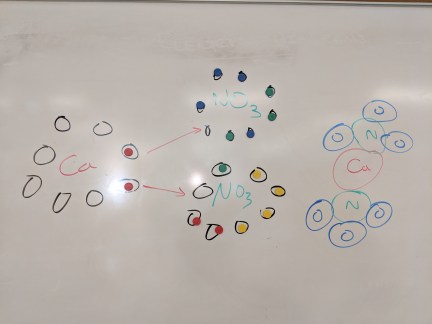
To prep students for translating between representations of chemical reactions, we reviewed writing chemical formulas based on the name. I reviewed electron diagrams, but did not require students to sketch them. However, most students chose to sketch them as a way of thinking through the formulas, which was great.

electron diagram.jpg

Day 100: Rotational Energy & Weight

AP Physics: Rotational Energy

Students whiteboarded yesterday’s problems and we spent some time discussing how changing the system changes the LOL diagram. I picked a problem where a block on a spring becomes an upward projectile and a second where a block is launched by a spring up a track; I really liked using this pair since it drives home that path is irrelevant in conservation of energy.

Afterward, I had students use conservation of energy to predict the velocity of a marble at the bottom of a ramp, then we measured with photogates. Their prediction was off by about 60%, which I used as motivation to introduce rotational kinetic energy to account for the “missing” energy at the bottom. When students saw the actual velocity, they were quick to attribute the difference to friction, even after seeing the percent difference, so now I’m wondering if there are other good ways to rule out friction. Maybe time the marble down the track, then compare the acceleration to the component of gravity along the track?

marble

Physical Science: Weight vs. Mass

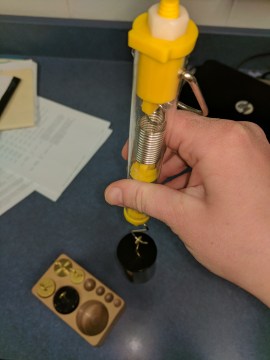
Students weighed hanging masses on spring scales to find a relationship between weight and mass. We moved this to the start of the unit since its the one thing we do with forces that doesn’t fit with our engineering project, but I feel like weight ended up separated from other important ideas from forces. As we dig more deeply into forces this week, I’ll make sure I circle back to the concepts of weight and mass, so I may decide this sequence was okay after all.

weight

Day 96: Angular Momentum & Average Velocity

Today, I was chaperoning a field trip so I missed most of my classes.

AP Physics: Angular Momentum Quiz

Students took a quiz on angular momentum, then worked on finishing yesterday’s lab. One of the problems is based on a story that before jumping a motorcycle over the Snake River Canyon, Evel Knievel said his biggest fear was accidentally hitting the brakes in mid-air. I was back in time for 4th hour, so I showed students a demo of the problem using an RC motorcycle.

Physical Science: Average Velocity

Students worked on some problems interpreting position vs. time graphs. One of the questions asks them to invent average velocity by coming up with multiple ways to define the average velocity, then use each approach to make a prediction and decide which definition is the most useful.

Day 93: Whiteboards & More Whiteboards

AP Physics: Whiteboarding Angular Momentum

Thanks to a reminder from Dan Burns, I kicked class off with a clip from The Simpsons where Principal Skinner uses conservation of angular momentum to save Ralph. Afterwards, students whiteboarded and discussed yesterday’s problems. I focused on the conceptual problems, and I was pleased by how many students opted to use tools like SOS diagrams to guide their thinking, whether or not the problems asked for them. I also had some groups use analogies to linear momentum to answer questions since they found it easier to visualize. I got really excited when a couple of groups used Newton’s 3rd Law to solve one of the problems, though I didn’t think to take a photo of their boards.12th.jpg

Physical Science: Whiteboarding Motion Graphs

Students whiteboarded their video analysis results for constant velocity. This was the first time I’ve had them talking about graphs, and they made a lot of great observations. After the discussion, we used Logger Pro to look at a constant speed buggy in front of a motion detector and refine some some of the things we saw in the video analysis; after seeing me change the axes on the v vs. t graph from the motion detector, most groups looked at the scale on their v vs. t graphs and decided they should be horizontal lines. It was also fun to see the expressions on some faces when I found the slope of the buggy’s x vs. t graph and they saw it was the speed.

9th

Day 92: Angular Momentum & Motion Graphs

AP Physics: Angular Momentum

Students took a  quiz on conservation of momentum, then we finished yesterday’s discussion to introduce the idea of angular momentum. I showed them a Direct Measurement Video of two people on carts pushing off each other, followed by one of a rotating iPod to get a clear analogy for conservation of angular momentum. I think this would be worth taking the time to make a more student-centered discussion with students whiteboarding explanations next time around.ipod-rotates

Physical Science: Motion Graphs

Students used Vernier Video Physics to do some simple video analysis of a mini hover disk and start looking at position vs. time and velocity vs. time graphs. I had them stay in Video Physics to view the graphs, but students are struggling to make sense of their graphs for constant velocity with the auto scale. I’m debating how I want to change it for next year. I’m leaning towards spending 1-2 days doing constant velocity with a low-tech, breadcrumb approach. I’d probably have students calculate the speed over each interval to make a velocity vs. time graph. Then, we can switch over to video analysis for constant acceleration.

ramp

Day 91: Whiteboarding & Engineering

AP Physics: Whiteboarding

Students whiteboarded some problems from Friday and yesterday’s Direct Measurement Video. There was some good discussion about a problem about a collision between a Hummer and a VW Bug, comparing the force, the change in momentum, and the acceleration of each. A lot of students did some really good wrestling with the conceptual distinctions between those ideas. There was also some good discussion about whether momentum is conserved when an object starts rotating. All the groups that said rotation takes some momentum had a calculation, while the groups who said rotation does not impact conservation of momentum used a few different approaches, which gave a nice opportunity to talk not only about uncertainty, but the value of multiple lines of evidence.

Physical Science: Engineering

I decided to expand the big engineering project we have this trimester to include both motion and forces, so today we introduced the project. We spent some time talking about what engineers do, and I was very excited that collaborate was the first thing a student mentioned. We also did some problem scoping, where I gave students a fictitious memo from our “client” and had them use the information to describe the problem, the criteria for success, and the constraints we’ll have to work within, as well as start brainstorming some of the science knowledge they will need for the project. I’ve tended to skip problem scoping, since a fake client feels cheesy to me, but it was interesting to see students really analyze the fairly short text of the memo; it was also interesting that students are thinking about the constraints as reasonable client requests instead of arbitrary obstacles I imposed (at least for now).

engineers

Day 90: Angular Momentum & Mirror Mazes

AP Physics: Angular Momentum

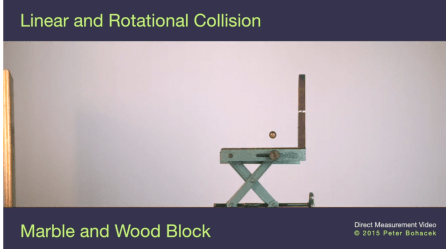
Students used a Linear and Rotational Collision Direct Measurement Video to get some practice with conservation of momentum. In the first question, I asked students to determine whether momentum was conserved in a certain collision using a calculation, and I was surprised by how many students struggled to understand the question. I might change up wording on some of the problems we did to explicitly have them state whether momentum is conserved or if there is an external force, similar to how I approach force problems by first asking students whether the forces are balanced.

I also asked some questions about whether momentum is conserved in collisions where the block starts to spin, and I heard some great conversations about uncertainty, external forces, and other big ideas that have me really looking forward to tomorrow’s discussion.

momentum-dmv

Physical Science: Mirror Mazes

Students used what they know about refection to solve some mirror mazes. I had some where students were given the placements of the mirrors and had to place the target and others where they were given the target’s location and had to place the mirrors. Since we haven’t done much with ray diagrams, this seemed to really solidify what I mean by the path of light.

obstacle

Day 78: Flying Pig & Quiz

AP Physics: Flying Pig

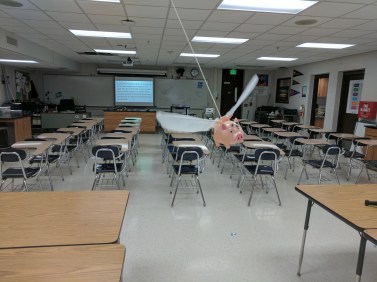
Today, I got out the flying pig for a lab practical. I had students measure the length of the string and the height of the cone, then use what they know about forces and circular motion to predict the time for the pig to make 10 revolutions.

pig

Physical Science: Quiz

Students took a quiz on magnetism. Afterward, we took a few minutes to review vocabulary for talking about waves that students learned during first trimester. It was pretty teacher directed, but I didn’t want to spend much time on terms students should have mastered earlier this year.