Day 60: Kinetic Energy, 3rd Law, & Melting Mass

AP Physics: Kinetic Energy

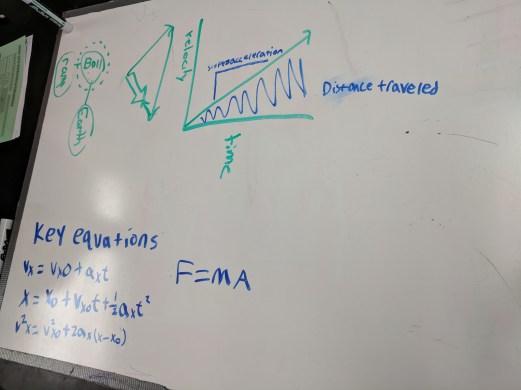
To introduce kinetic energy, I had students work through a Pivot Interactives activity to find a relationship between the starting height of a puck and its velocity at the bottom of a ramp. I ran out of time to have a pre-lab discussion yesterday, so tried to have one in the computer lab today. I had more students then usual struggling with what to measure or what to graph, and I think that was because a lot of them started the activity rather than fully engaging in the discussion. Once they got rolling however, students warmed up to the interface pretty quickly.

pivot ke.PNG

Physics: 3rd Law

We collided carts with force sensors to check the predictions students made yesterday. I spent more time than usual talking about why I asked them to make predictions I know are likely to be wrong since confidence has been such an issue for students this year.


\

Chem Essentials: Melting Mass

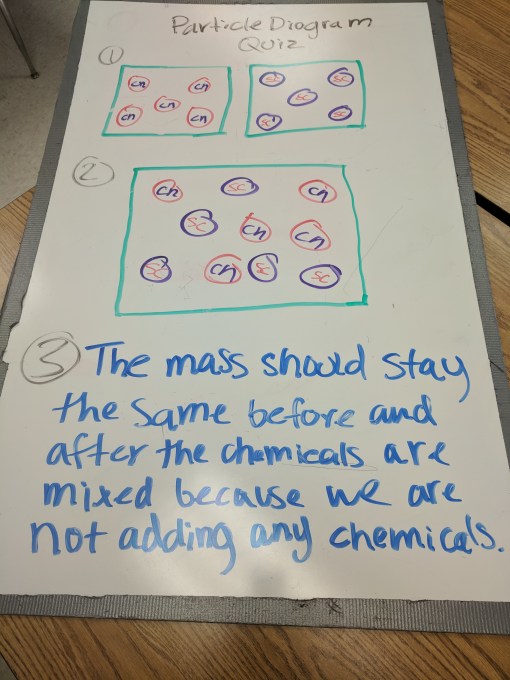
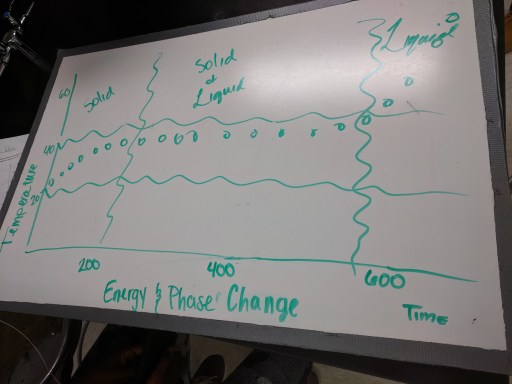
Students continued the Modeling Instruction mass and change labs. Today, they melted ice and mixed sodium carbonate with calcium nitrate; a lot of students really liked that reaction and were observing close enough to notice the precipitate causing the cloudiness. I added a mini-exploration of the zero button on the balance, which I was pretty happy with. A lot of the students in the course struggle with mathematical reasoning, and taking a few minutes to play with the zero button and the readings on the balance seemed to help make its purpose more concrete.

mass change.jpg

Day 59: Energy, 3rd Law, & CER

AP Physics: Intro to Energy

Students measured the average force and the displacement required to give a cart the same change in height on several different ramps. They sketched the force vs. displacement graphs, which I used to introduce gravitational potential energy and work.

peg lab.jpg

Physics: 3rd Law

We ran out of time to hit Newton’s 3rd Law during last tri’s unit on balanced forces, so today we dove in. I showed students a pair of carts, then asked them to draw interaction diagrams and free body diagrams for various collisions, as well as to predict which cart will experience a larger force. One group gave me a hard time about how deadpan I was when they asked if their prediction was right, so we talked a little about Clever Hans the Math Horse.

3rd law.jpg

Chemistry Essentials: CER

As part of the follow-up on yesterday’s lab, I introduced students to the CER framework. I had students identify the claim and evidence in a car commercial, then come up with some potential reasoning for the evidence before they started a CER on whether the mass of steel wool should change.


Day 58: Scoring Guide, Broken Circles, & Steel Wool

AP Physics: Scoring Guide

The tri 1 final exam included some free response problems off past AP tests, so today I gave students the scoring guides and some student samples to make sense of the scoring before letting them see their own tests. One of the problems was problem 3 off the 2016 free response and, inspired by a participant in Greg Jacob’s AP Summer Institute, I used rubber bands to make a bumpy ramp so we could actually try out the experiment in the problem. The class had some good discussion about key takeaways, like the importance of explaining EVERYTHING. Students also noticed that the student samples with high scores had a lot of marking the text.

Physics: Broken Circles

I struggled to get the class culture I wanted in my physics class last trimester and, with students shuffling between hours and about half coming from the other physics teacher, the new tri is a great opportunity to try again. Students worked on a broken circles activity from Designing Groupwork  by Lotan & Cohen, then we had some discussion about what it took to succeed and how that fits with what effective groups in physics look like.

broken circles.jpg

Chemistry Essentials: Steel Wool

This course is two trimesters long, and we only offer the second half during tri 3, so I’m restarting the first half of the course with a new group of students. Students measured the mass of steel wool before and after pulling it apart. To help students focus on good lab practice, I had them do the experiment once with minimal instructions. Then, we had a brief discussion to get at some sources of error before students completed the lab again with a handout and a paper plate to help catch stray bits of steel wool. Just like tri 1, I made a class histogram with Post-Its, but the results were much nicer this time.

chem histo


Day 57: Tri 1 Reflections

Today is our second day of finals, so its a good time for me to look back on the trimester.

AP Physics

My biggest change this year was starting with momentum. I like that momentum is my students’ default lens and they are very naturally looking for how new topics connect to it. My students also see calculus as less of a prerequisite than previous classes since no one had a leg up on the first unit. However, the impulse lab I did was very rough; I think there was just too much going on for the first quantitative lab. Next year, I’m thinking about putting constant velocity before momentum so I can introduce key skills in a simpler context.

I also started giving students at least two in-class assessments over each learning target. I like that this pushed back against the test and forget that a lot of students are used to and it helped normalize reassessment as part of the learning process. As a result, students seem less stressed about my assessments and I’ve seen more students taking advantage of out of class reassessment.

Physics

We started the year with a two week unit on designing experiments and interpreting graphs. I’m not thrilled with how the unit went; I rushed through the labs we did, partly to keep up with the other physics teacher and partly to avoid spending too long on the unit. I think students would have benefited more from the unit if I’d fleshed out the pre-lab and post-lab discussions, even if that meant we didn’t do every lab originally planned on. I shortchanged the predictions students were supposed to make with each lab, and I think that helped give my students the expectation that their graphs are a box to check rather than a tool to use. The mass vs. volume lab was also a tricky place to start since students had to calculate the volume and it was tough for them to pick out relevant control variables. Next year, if I do this unit, I will probably start with bouncy balls, instead.

Its also been a much bigger challenge to get students comfortable with the modeling approach than in past years. Going into tri 2, many students are switching hours and about half of my students will be coming to me from the other physics teacher, so it is a good time to build a better foundation. I’ve been reading Designing Groupwork by Cohen and Lotan, I’m going to try starting the new trimester with one of their cooperative training exercises. I may also do the mystery tubes or a similar activity to reinforce the value of meaning-making over answer getting.

Chemistry Essentials

This was my first time teaching the first half of Chemistry Essentials. I started switching the curriculum over to a version of Modeling Instruction, and am happy with where that is going. The particle diagrams in particular have been incredibly valuable in helping students wrap their heads around what is actually going on. The modeling curriculum has fewer chemistry-looking labs than my department typically does, so one of my challenges going forward is to work on integrating more of those. I also had or expand some topics to match state standards, and those are definitely much clumsier. Finally, I’d like to get a better storyline in the class; right now, each unit feels pretty distinct from the others. I want to spend some time this summer working on understanding how the big ideas are related and revising my materials accordingly.

Day 56: Final Exams

Final exams are today and tomorrow.

AP Physics: Mini AP Exam

Since I mostly give short, weekly assessments, finals are a good time to give my students something longer. The other AP Physics teacher and I modified a practice exam to cut the content we haven’t covered yet and get it down to 90 minutes. This is their first assessment with a time limit, so I’m curious to see how they do with pacing.

Physics: Two-Stage Exam

The other physics teacher and I agreed on a hybrid approach to the final. The first half, worth 75% of the exam grade, is a pretty traditional written final with some problems from throughout the trimester. The second half, worth 25% of the exam grade, is a lab practical that students are completing with a partner. During the lab portion, I overheard several groups talking about whether their answer is reasonable and how they know, which got me really excited since students have struggled to connect physical meaning to the math this year.

phys final.jpg

Chemistry Essentials: Written Exam

I’m giving a pretty traditional written exam. My students said they were hoping for multiple choice, but I stuck with short answer so the questions will read more like the other assessments they’ve taken. A few of my students are annoyed because they say multiple choice is easier, but I have never had it go well when I suddenly use multiple choice at the end.

Pretty consistently when I teach this course, all of my students finish with about 30 minutes left in the final block, regardless of the length of the test. As usual, I had a significant number of students who left large portions of the test blank. I think my finals in this course run short not because I don’t make them long enough, but because a lot of students have trouble focusing on a written test for 90 minutes (honestly, I have trouble focusing on a written test for 90 minutes). This reinforces that it is worth moving away from a traditional final in this course.

Day 55: Design a Practical & Review

AP Physics: Design a Practical

Groups set up the lab practicals they’d planned yesterday, then got a chance to try the lab practicals other groups had come up with. It was a lot of fun seeing how much pride students took in watching their peers complete a practical they’d designed. A lot of students said they enjoyed this approach to review, and I liked the thinking it took to design a good practical.

Physics: Review

Students finished up the review assignment they got yesterday, then were able to check answers against my key. Its not my favorite way to review, but it is familiar and comfortable for my students, which I think helped them feel more confident going into the final exam.

Chemistry Essentials: Review

I also went pretty traditional in this class today, giving them some questions to review atomic models and formula writing, especially since we haven’t had a stand-alone quiz on this topic.

Day 55: Design a Practical, Review, & Quiz Jigsaw

AP Physics: Design a Practical

I decided to try something new for my review this year and tasked each group with picking at least one model from this tri, and designing a lab practical. Today, they worked on coming up with an idea and trying it out in the lab. I’m having a lot of fun seeing what students are coming up with; I need to make sure I get photos of all of them tomorrow. The main challenge was I did a lot of running around between classrooms to find lab equipment for students, so next time I’ll try to do a better job of having most of the equipment we’ve used in the room already.

Physics: Review

Students worked on some review worksheets from the Modeling Instruction curriculum. As students worked, there were several I talked to who are feeling very overwhelmed right now, so we talked a little about the worst case scenario as a sort of pep talk. I will probably take a few minutes tomorrow to do that with the whole class.

Chemistry Essentials: Quiz Jigsaw

Groups presented the whiteboards they worked on yesterday. Most students no longer had their old quizzes, which made it tough for them to take full advantage of this; next time, I might give them a full set of blank quizzes as a review packet. I asked groups to pick what they thought were the hardest problems off their quiz to whiteboard, and most groups picked problems that the majority of students got wrong on their original quiz, which was great!

chem jig.jpg

Day 54: Model Summaries & Quiz Jigsaw

Final exams are this week, so all three of my classes are doing some review the next few days.

AP Physics: Model Summaries

I gave each group one of the four models we’ve covered this trimester, and asked them to whiteboard examples of the key representations for their model, including diagrams, graphs (with notations about what has physical meaning), and equations. Once whiteboards were ready, we took a few minutes to do a gallery walk. A really cool surprise was just about every group included some force representations, regardless of which model they were whiteboarding.

ap capm summary.jpg

CAPM summary

Physics: Model Summaries

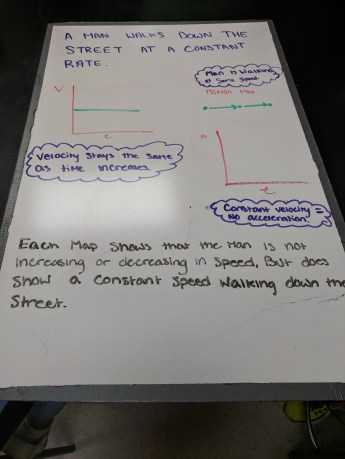
My physics classes also worked on model summaries, but I used a different structure. First, rather than giving each group a different model, I had the whole class whiteboard the same model, then we did a gallery walk before moving on. Second, to make things a little more concrete, I asked each group to come up with a scenario where the model applied, then to sketch representations and give some written descriptions. I think a lot of students didn’t see as much value in this as I’d hoped; I have a lot of students who have been trying to memorize the diagrams, rather than using them as meaning-making tools, and spending time thinking about the relationships between the diagrams doesn’t contribute to that approach. With a new tri starting next week and most of my students either switching hour or switching teacher, I’ve got a good opportunity to think about how I can re-calibrate my classroom culture towards more meaning-making.

cvpm summary.jpg

CVPM summary

Chemistry Essentials: Quiz Jigsaw

I gave each group an old quiz and asked them to work through it. Once groups started to finish, I asked them to pick the hardest problem or problems and prep a whiteboard with their solutions. The big challenge is I had a lot of students checking out today, which is pretty typical for what I see during finals week with this course; for most of my students, whether or not they pass is more important than their letter grade, and are aware that a final that is 10% of their grade will have little impact on whether they pass. I need to spend some time thinking about final exams that students are more likely to find more intrinsically meaningful.

chem quiz wb

A problem that almost everyone got wrong on the quiz

Day 53: Multiple Choice, Quiz, & Polyatomic Ions

AP Physics: Multiple Choice

Students took their last quiz for the trimester, then we spent the rest of the hour using Plickers to practice multiple choice questions. Final exams are next week, so the multiple choice also served as a way to start reviewing for the exam. I continued my usual routine of having students answer individually, then talk to a classmate before answering again and both classes had some good conversations about the problems.

img_2398

Physics: Quiz

Students took their last quiz of the trimester over balanced force. A lot of students have been struggling to identify the direction of forces, and that is showing up on the quiz. When working on problems or labs, students were pretty successful when they went back to the language of the interaction stations we’d done, but the students who are struggling usually need prompting to think in those terms. I do some fairly general reflection in the course, but I’m thinking about how I can improve that next tri to help students recognize useful ways of thinking.

Chemistry Essentials: Polyatomic Ions

Students worked on writing formulas based on names that include polyatomic ions. Today, I added having students sketch particle diagrams for each compound, which helped them focus on the meaning of the various numbers. Yesterday’s activity with the Lewis dot beans also helped students think through today’s problems. Next tri, I think that will be my starting point for bonding.

Day 51: Friction on Ramps, CAPM Card Sort, & Naming Compounds

AP Physics: Is Friction Negligible?

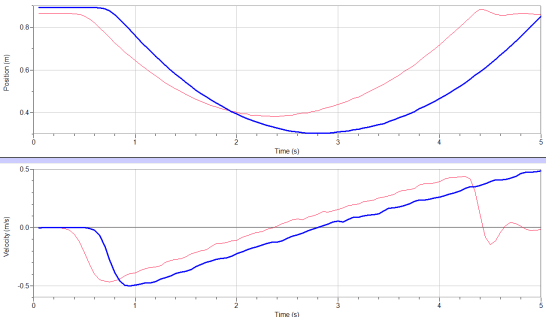
Students sketched free-body diagrams and vector addition diagrams for a cart on a ramp with friction, then were tasked with determining whether friction is negligible using a set of graphs recorded in LoggerPro. There were lots of great conversations connecting the force representations to the motion ones.

friction on ramp grpahs

Physics: CAPM Card Sort
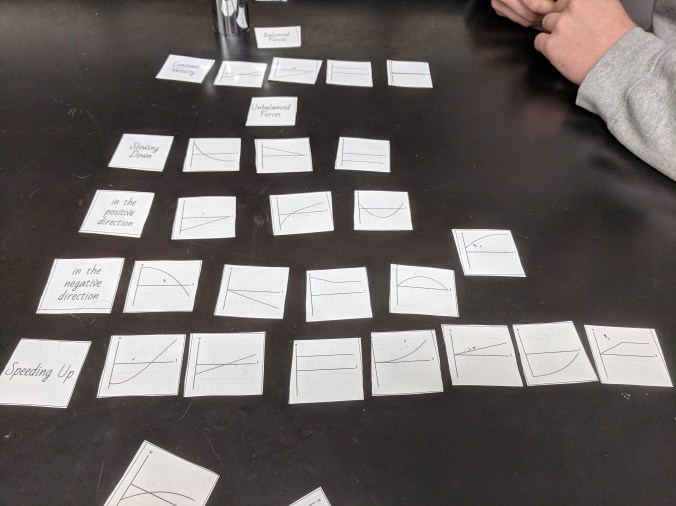
I want to revisit CAPM this week, so we started with Kelly O’Shea’s card sort. A lot of groups needed some nudging to differentiate between constant velocity and constant acceleration on the velocity-time and acceleration-time graphs, but that was no surprise. While students were bothered by the idea that there was no one right answer, they had some great conversations. I think it also helped that I assigned them to random groups, which interrupted some of the usual patterns.

card sort 5.jpg

Chemistry Essentials: Naming Compounds

Students worked on going between formulas and names for compounds. A few groups asked if they could use the cards from Friday to help figure out how many of each atom a compound needs, and I happily got them out. I think a lot of students lost track of what is going on conceptually with the bonding, so I need to think about better ways to reinforce that.

bonding cards.jpg