Day 19: Assessment, Card Sort, & Vocab

AP Physics 1: Assessment

Students took a quiz on impulse which took a lot longer than I expected; a lot of students spent a lot of time staring in confusion. I think spending Tuesday and Wednesday on forces lead a lot of students to forget how to do impulse and momentum, which tells me I need to work on helping them firm up that model.

Physics: Cart Sort Part 2

Students continued Kelly O’Shea’s kinematics card sort. Today, I added in the word cards and had them record a few of their sorts in their packet.

Chemistry Essentials: Vocab

Before today’s quiz, I had each group prepare a whiteboard with a particle diagram for a  different vocabulary term, then had students do a gallery walk.

chem vocab.jpg

Day 18: Practice, Card Sort, & Chemical Changes

AP Physics 1: CVPM and MTM Practice

I am being compensated by Pivot Interactives for participating in a pilot of their chemistry materials.

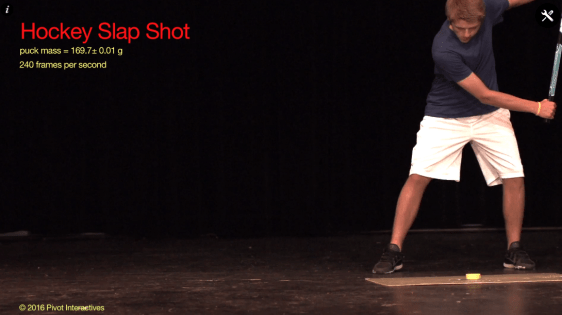
About half of my students were gone today for a field trip, so I decided to do a lab on Pivot Interactives reviewing constant velocity and impulse since that would be an easy option for absent students to make up. Students analyzed the motion of a puck after a slap shot using CVPM, then analyzed the actual slap shot using momentum transfer.

pivot puck.PNG

Physics: Card Sort

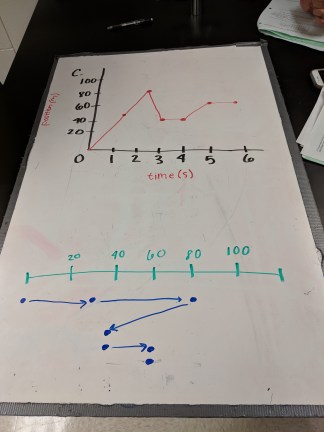
A lot of my physics students were also on a field trip today. After a board meeting on the ramp lab, I gave students time to start a Kelly O’Shea’s kinematics card sort. I left out the blank cards and the word cards today so students only had the graphs. Initially, almost every group just put all of the same type of graphs together, so they had a position vs. time graph category, a velocity vs. time graph category, and an acceleration vs. time graph category. I think this was actually helpful to a lot of students, since it drove home that the graphs were telling them different things about the motion. Once groups showed me their initial sorting, I challenged them to come up with another sorting where they could put two or more graphs of the same type together, which lead to great conversations about what the graphs showed and lots of students working on specific language.

card sort.jpg

Chemistry Essentials: Chemical Change

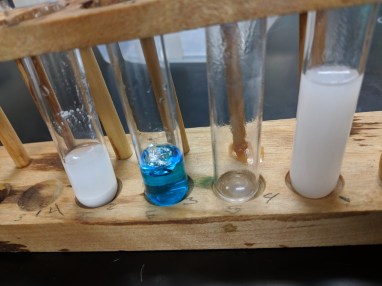
Students did a few different chemical reasons in test tubes to look for signs of chemical changes. I saw some preconceptions coming up that a chemical change should lead to a change in mass, so that is something I need to think about how to address going forward. I think part of that comes from the fact that I referenced burning steel wool as a chemical change early in this unit, when the chemical reaction that formed a precipitate from the same sequence would have been a better choice.

chem change.jpg

Day 15: SOS Diagrams, Ramp Lab, & Density Representations

AP Physics 1: SOS Diagrams

I took a few minutes to introduce SOS diagrams for momentum and impulse, then had students whiteboard some problems. The biggest challenge was thinking through what are useful snapshots to use but, once students wrapped their heads around that, things seemed to go very smoothly.

sos.jpg

Physics: Ramp Lab

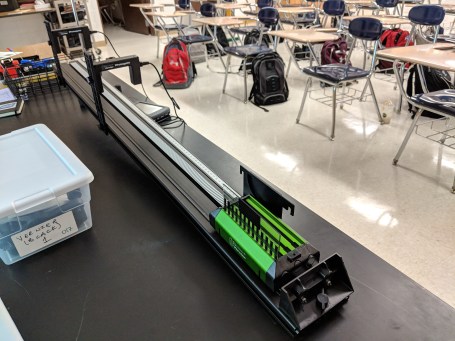
Students started collecting data to make position vs. time graphs for a cart on a ramp. This was their first time using the tracks and their first time using LabQuests, so it was a lot to take in. Several groups commented the first data point was the hardest to get, but, once they knew what they were doing, the data collection was quick and easy.

ramp lab.jpg

Chemistry Essentials: Density Representations

Today was the density quiz, so we started by using whiteboards to review some different ways to represent density. Most students seem pretty solid on the particle diagrams, but mass vs. volume graphs are challenging for a lot of them. In general, graphs have been challenging for a lot of my chemistry students this year, largely because I overestimated their prior knowledge and haven’t adapted as well as I’d like.

density particle.jpg

Day 14: Board Meeting, Dueling Buggies, & Density Challenge

AP Physics 1: Board Meeting

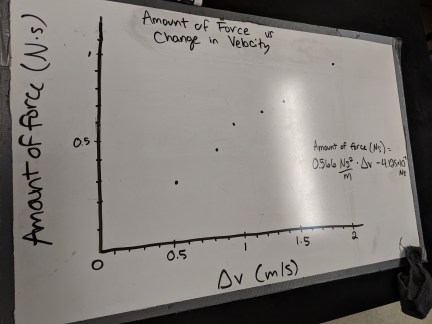
We had a board meeting on the impulse lab students have been working on. There were a few groups with really nice results, but this is a very tough one to get consistently accurate slopes, which made the discussion tough, even though my students did a nice job. It was a little tricky getting to the formula we’ll be using for impulse since the lab had a non-constant force, but the equation assumes a constant one. Next year, I might switch to the half-Atwood machine, rather than saving it for unbalanced forces.
impulse lab.jpg

Physics: Dueling Buggies

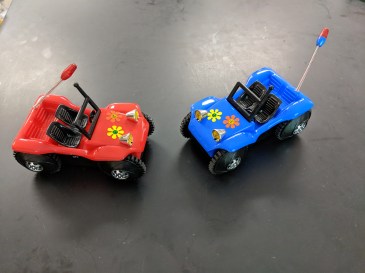
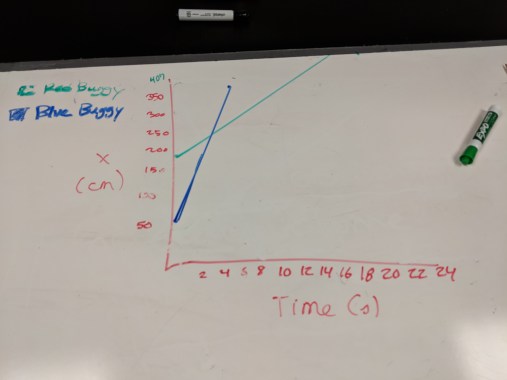
Students finished up the dueling buggies lab practical. I saw a much wider range of approaches than in my AP classes this year; most of my AP students are in the same math classes, which I think encourages them to think about problems in similar ways. My regular classes, meanwhile, have a much wider range of students, so there was a lot of great discussion about different ways to think about this problem.
dueling buggies.jpg

Chemistry Essentials: Density Challenge

I am receiving access to Pivot Interactives this year in exchange for piloting some of their chemistry activities.

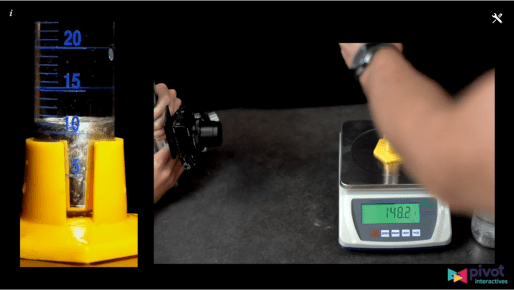
Students used Pivot Interactives to make mass vs. volume graphs to identify unknown liquids by their density. A lot of students had some trouble getting started, but, once I pointed out the similarities to the density of water lab we’d done, they were very successful. The videos don’t zero the balance so that the graph will end up with an intercept; this was the first graph with a non-zero intercept they’ve seen in this class, so it was challenging, but we were able to work through it. I think just about every group picked gallium as their unknown liquid, which is fitting, since it would be the hardest to do in the classroom.
pivot density.PNG

Day 13: Impulse, Dueling Buggies, & Mistakes Whiteboarding

AP Physics 1: Impulse

Students finished up their data collection for the impulse lab. Some groups have really nice looking data, while other groups have graphs where the pattern is much less clear. I need to spend some time trouble-shooting this lab to see about getting more consistent results. Most of the groups did a nice job of taking turns operating the LabQuest, even without me explicitly directing them to.

IMG_20180919_100054.jpg

Physics: Dueling Buggies

Students wrapped up yesterday’s mistakes whiteboarding, then started work predicting where two buggies would collide. My classes, especially my 1st hour, are taking very quickly to mistakes whiteboarding, so the conversations were much better than I usually expect at this time of year.

dueling buggiea.jpg

Chemistry: Density Mistakes Whiteboarding

We only got through one problem yesterday, so we finished doing mistakes whiteboarding for some density problems. Yesterday, it was very tough to get students to speak up, so today I had students spend a minute or two talking to a neighbor about each whiteboard before we shifted to whole class discussion, which helped a little. The biggest factor was a few students who were gone yesterday were very eager to participate and, once they asked some questions, other students seemed more comfortable speaking up.

Day 12: Impulse & Mistakes Whiteboarding

AP Physics 1: Impulse

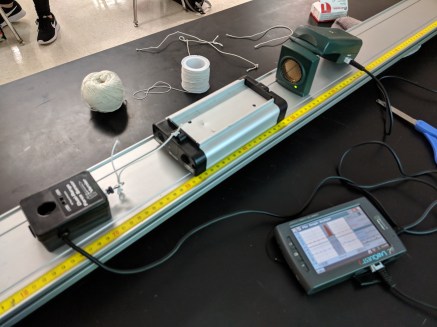
We started by discussing the idea that both the magnitude of a force and the amount of time its applied seem to matter for changes in momentum to get to the idea that we could compare the area of a force vs. time graph to the change in velocity. Students used elastic strings to connect carts to force sensors and started collecting data. This was the first lab where students used the dynamics track and where they collected quantitative data from the LabQuests, but students seemed to get comfortable with the equipment pretty quickly.

impulse.jpg

Physics: CVPM Mistakes Whiteboarding

Students did mistakes whiteboarding with yesterday’s quantitative CVPM problems. In my 1st hour, a lot of groups were very vocal about picking a mistake one of them had made, and I love the way this places a value on their mistakes and gives them the opportunity to conquer the mistake.

phys mistake.jpg

Chemistry Essentials: Density Mistakes Whiteboarding

This was my chemistry class’s first experience with mistakes whiteboarding. I started the hour with a short vocabulary review that seemed to help cement the key concepts we’re working with. The class was very quiet during the whiteboard presentations, so we only go through one. I think tomorrow I’ll have them do some talking to a neighbor about each board before we shift to whole class.

chem mistake.jpg

Day 10: p-t Graphs, Groupwork Reflection, & Density

AP Physics: p-t Graphs

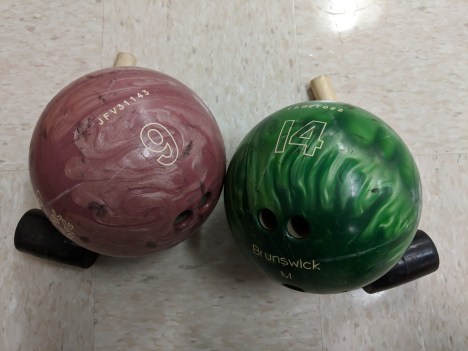
Students sketched momentum vs. time graphs for bowling balls hit with various combinations of taps, then we got out billiard balls and motion detectors to transition to true momentum vs. time graphs. It was a little tricky for students to predict what the graph would look like when the billiard ball reversed direction, but we got there by the end of the hour.

Physics: Groupwork Reflection

Today we had a few whiteboards to finish from Friday and a quiz to take. One of my goals this year is to improve the quality of the collaboration in my classroom, so we also took a few minutes to talk about some of the different abilities students needed to complete the problems and mistakes whiteboarding, then I asked students to complete a short reflection based on a list of things effective groups do I got from Scot Hovan at a modeling workshop. I haven’t had a chance to read the reflections yet, but it looked like students were giving it some good thought and I overheard several students showing their reflection to a peer they’d used as a positive example.

Chemistry Essentials: Density

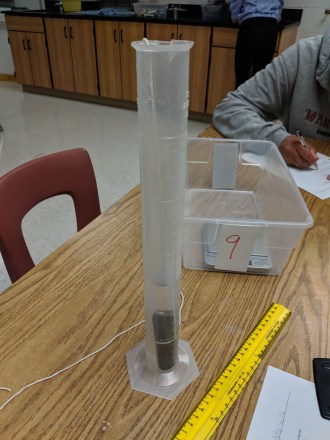
We got out the metal dowels from last week’s volume lab to find their density. I asked groups to design their own experiment, and wished I’d taken the time for a little more discussion on what makes a good experiment. The worksheet I used started with questions about what variables they needed and how to measure those variables, but a lot of students had trouble with articulating how they would get a variety of values for the data table.

volume.jpg

Day 9: Momentum, Mistakes Whiteboarding, & Board Meeting

AP Physics 1: Momentum

We discussed what students saw in yesterday’s bowling ball lab to get to a rule for how taps affect motion. Yesterday, a lot of groups started having conversations about how the size of the tap and the mass of the bowling ball plays into how much the motion changes, so I took advantage of that to introduce the definition of momentum, which lead smoothly into framing Newton’s 1st Law in terms of changes in momentum.

bowling ball race.jpg

Physics: Mistakes Whiteboarding

I introduced mistakes whiteboarding today with some photos from the first time I made fried mozzarella with nectarines and balsamic glaze so we could have some discussion about which photo did more for my learning. Students then whiteboarded yesterday’s problems and had some great discussion about the problems.

Chemistry Essentials: Board Meeting Continued

Today, we picked up discussing yesterdays lab on density. Since we’d made a good list of observations about the graphs yesterday, today I had students whiteboard “for every” statements describing their slopes, which, along with particle diagrams, lead nicely into a definition of slope. For next time, I’d love to find a second liquid that gives a pretty nice slope so students can contrast the two.

Day 134: Problems Galore

I had a sub today, so no pictures. All three of my classes worked on problems.

AP Physics: Angular Momentum

I gave students some angular momentum problems. Its been a while since we hit linear momentum hard, so I’ll be curious to see how it went shaking the dust off and translating to angular scenarios. I also threw in some torque problems; on the last quiz, a lot of students weren’t sure what an extended free-body diagram is, so that is something I needed to make sure to revisit.

Physics: Springs & Pendulums

Students did some problems using the equations for the period of a spring and period of a pendulum. Earlier this week, some students were having trouble distinguishing the two formulas, but I think the lab practicals helped. I’m hoping that shows up in how the problems went.

Chemistry Essentials: Percent Yield

Students did some percent yield problems. They look very similar to the stoichiometry problems we’ve been doing, with a step added at the end to calculate percent yield. When I got to school for parent-teacher conferences, I was able to connect with my sub and the para who supports the class, and both told me the problems went very well for the majority of students; they are seeing the connections between what we’ve done previously and the new material. The para also reminded me I need to crack down on students showing their work; a lot of students are frustrated because looking back at their old work isn’t helpful, but they don’t yet see that writing out their work would change that.

Day 108: Experimental Design, Collisions, & Particle Diagrams

AP Physics: Experimental Design

Yesterday, students worked on an experimental design problem from the 2017 AP exam. Today, they exchanged work and used the scoring guide to assign points and give each other feedback. A lot of students were pretty nervous about giving their work to someone else; I think the simple act of recording points on a very tough problem raised the stakes more than I expected. Students still said they found the activity useful, so that may help ease the discomfort if we trade papers again.

Physics: Collisions

Students whiteboarded some of yesterday’s problems before taking a quiz on conservation of momentum. I had some students who actually consider conservation of momentum easier than impulse on a single object; one student told me its just like energy, but they don’t have to think about the different types.

mom wb.jpg

Chemistry Essentials: Whiteboarding

Students have been struggling with what particle diagrams are intended to show, so we started by brainstorming a list of characteristics of a good particle diagram and having some discussion about why they are useful. Afterward, we whiteboarded yesterday’s problems and did a gallery walk. This seemed to help reinforce the purpose of a particle diagram for a lot of students.