Day 66: Board Meeting, Momentum Representations, & Density

AP Physics 1: Kinetic Energy Board Meeting

I am being compensated by Pivot Interactives as part of their Chemistry Fellows program.

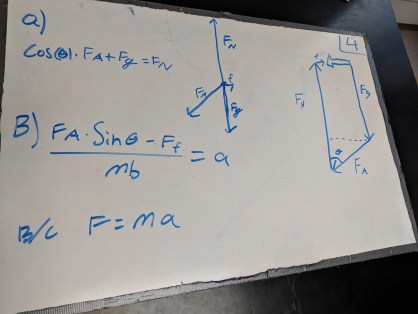
Students whiteboarded their results from this week’s Pivot Interactives activity with a puck on a ramp to get to a definition for kinetic energy. I definitely wish I’d done energy bar charts prior to this lab, but conservation of energy is emphasized enough across our science curriculum that it wasn’t too big of a leap for students to recognize the energy transformation happening. Students were really pleased when they realized their slope worked out to equal 1/(2g), which is exactly what the formulas predict.

ke lab.jpg

Physics: Momentum Representations

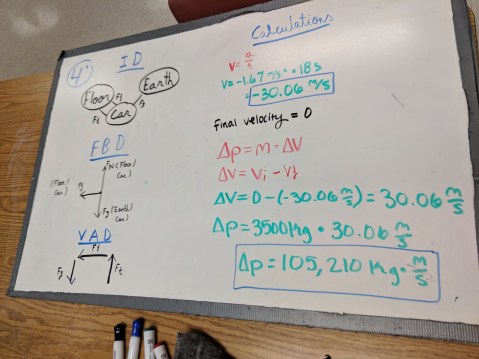
Students worked on representing momentum transfer using sketches, bar charts, and velocity vs. time graphs. The use of velocity vs. time graphs was influenced by Brian Frank’s work on momentum representations, and I really like the way it connects momentum to tools we’ve used earlier in the year. I’ve got one section with 30 students and one section with 8, and I’m quickly figuring out I need to be conscious about hanging back in my small class to encourage them to talk to each other about the problems before they talk to me.

Chemistry Essentials: Density

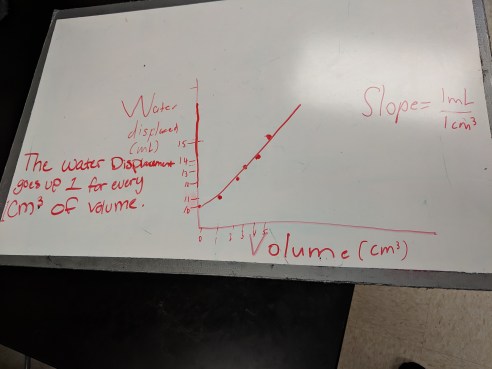
Students worked on finding a relationship between the mass and volume of water. Today really stretched my students since I had them design their own experiment and we started a board meeting on the lab, but students rose to the challenge. I’ve been having them use fill int he blank “for every” statements to talk about their slope, and that has been a big help for students to get a conceptual understanding of what their slope means. Yesterday, we had to pause the board meeting to define what the intercept of a graph is, so I got really excited when students not only brought up that groups had intercepts of either 0 g or 10 g, but came up with the idea that the intercept came down to whether groups hit tare after putting their graduated cylinder on the balance.

Day 65: Spring Energy & Board Meetings

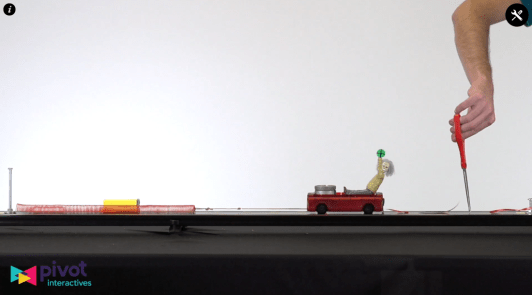
AP Physics 1: Spring Energy

I am being compensated by Pivot Interactives as part of their Chemistry Fellows program.

Students collected data for a relationship between a spring’s stretch and the final velocity of an attached cart using a lab in Pivot Interactives. While I took more time than yesterday on a pre-lab discussion, I think students were still a little confused since we haven’t talked much about energy types yet. I think it would have helped if we’d done the board meeting for yesterday’s lab prior to this activity. I’m also thinking about doing bar charts before these equations next time around.

pivot epe.PNG

Physics: Explosions Board Meeting

Students whiteboarded their results from yesterday’s lab to introduce conservation of momentum. This was a tricky discussion for a lot of my students since we were dealing with four variables simultaneously, but students did well with it. It was a nice reminder of the progress my students have made so far this year.

explosion board.jpg

Chemistry Essentials: Volume Board Meeting

Students whiteboarded their results from yesterday’s lab. I really hit “for every” statements about the slope hard, and that seemed to help students attach some conceptual meaning to the slope. There were a few groups who graphed the actual water level, rather than the water displaced, which gave a great opportunity to talk about what the intercept tells us in this lab. I think next time, I’ll make sure a couple of groups do that.

group 3.jpg

Day 63: Work, Quiz, & Histogram Interpretation

AP Physics 1: Work

To introduce work, I had students pull a cart up a ramp to a consistent height, but changing the angle. They then sketched force vs. distance graphs and saw the area was pretty consistent.

f-d graphs.jpg

Physics: Quiz

We wrapped up Friday’s mistakes whiteboarding, then moved into a quiz on impulse. I’m finding students are loosing track of the different variables we have, which is making it tough to use the equations accurately. I think we might take some time soon to do a “glossary” of all the variables we’ve gotten so far this year to see if having a reference like that helps.

Chemistry Essentials: Histogram Interpretation

To wrap up Friday’s labs on mass and change, I projected some histograms of the class results. The discussion ended up being a lot of me asking a question, followed by one student responding, which is not what I like to go for. I need to spend some time thinking about better prompts I can use on these graphs to get more student-to-student discussion going.

histogram.PNG

Day 62: Quiz Day, Mistakes Whiteboarding, & Burning

AP Physics 1: Quiz Day

Students took their unbalanced forces quiz. I included an experimental design problem from the 2016 AP Physics 1 exam but told students I was essentially using it as a pre-test since I haven’t had them try any of that sort of problem yet and want to see how well they are translating what they’ve done in the lab to written problems.

Physics: Mistakes Whiteboarding

Students did some mistakes whiteboarding with yesterday’s problems. I was wary of how it would go in my 6th hour, since I only have eight students and they chose to work in one large group yesterday. There was a lot of great conversation yesterday, but it turns out a lot of students had written down steps without being clear on why they were taking that step, so this was a good opportunity for students to clarify those gaps.

impulse mistake.jpg

Chemistry Essentials: Burning

Students carried out the experiments they’d planned yesterday to see how mass changes during dissolution. Afterward, they burned steel wool on a balance to get one more example. On Monday, we’ll discuss the results. I collected all of the changes in mass in a spreadsheet to produce class histograms of the results that we’ll also discuss on Monday.


Day 61: Mistakes Whiteboarding, Impulse Problems, & Designing Experiments

AP Physics 1: Mistakes Whiteboarding

Students did some mistakes whiteboarding with yesterday’s problems. A few students said they feel like unbalanced forces are easier than balanced, which I made sure to point out is a great indicator of how much they’ve grown in using free-body diagrams and vector addition diagrams.

ap mistake.jpg

Physics: Impulse Problems

Students worked on some problems using yesterday’s results on impulse. Overall, the problems seemed to go well, but I need to think about how to handle whiteboarding. I’ve got one section of 30, where I’ll be able to handle whiteboarding the way I normally would. My other section is only 8 students, and they ended up gathered around a single table having a lot of great discussion about how to do the problems. I’m not sure how much a whiteboarding session will add to their understanding.

Chemistry Essentials: Designing Experiments

We spent some time talking about the graphs I made of yesterday’s lab results, then moved on to starting the next set of mass and change labs. I asked students to plan their own procedure for finding the change in mass for sugar dissolving in water and Alka-seltzer dissolving in water. This turned out to be harder than I expected, so we ended with some whole-class discussion to figure out what steps we needed and why.

Day 60: Problems, Board Meeting, & Conservation of Mass

AP Physics 1: Problems

Students worked some unbalanced force problems. The set I gave them is mostly what I call “alphabet soup problems”, were there are only variables, no numbers. My students still get nervous about those problems, but they did very well with them, nonetheless. They are also starting to feel more comfortable relying on diagrams to set up their math, which is fantastic and lead to some great conversations during the problems today.

Physics: Board Meeting

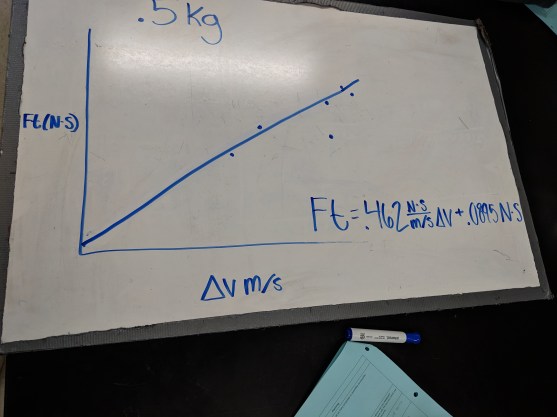
We had our board meeting for yesterday’s impulse lab. The results were the best I’ve seen with this lab to-date, which was great to see. My students this year are more comfortable with the LabQuests than the students I had last year and I spent significantly more time on the pre-lab discussion than I had in the past, and the result was a lot more groups than usual where their slope came convincingly close to the mass of their cart.

impulse board.jpg

Chemistry Essentials: Conservation of Mass

Today students looked at the change in mass in two scenarios, ice melting into water and two liquid solutions getting mixed together. As soon as I started to preview the lab, students started sharing their predictions for what would happen to the mass completely unprompted, so I decided to take a few minutes to let them discuss their predictions. I planned to have students get the initial mass of the ice, then work on mixing solutions together while the ice melted, but it turned out to be challenging for a lot of students to shift between two different experiments. I think it may be better to just use hot plates to help the ice melt so students can do one scenario completely before shifting to the other.

chem lab.jpg

Day 59: Board Meeting, Impulse, & Particle Diagrams

AP Physics 1: Board Meeting

We had a board meeting for yesterday’s lab on Newton’s 2nd Law. Overall, students got very nice results and were very successful at making sense of what they saw.

Physics

n2l board.jpg

This group added some notation to their graph to find the units on their slope

Physics: Impulse

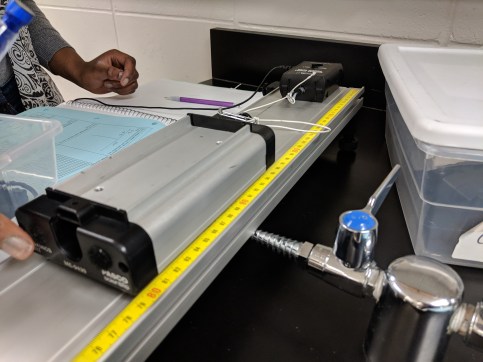
Students used an elastic string to tie a cart to a force sensor in order to find a relationship between the cart’s change in velocity and the area of the force vs. time graph. I’ve tried this lab a few times without great results, so spent a lot more time on the pre-lab than I had in the past and its looking like results will come out fairly nice.

impulse.jpg

Chemistry Essentials: Particle Diagrams

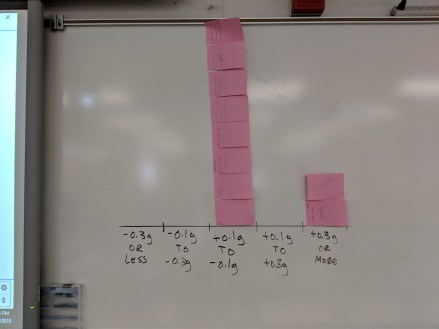
Students looked at the change in mass as they spread out a piece of steel wool and started drawing particle diagrams. My co-teacher and I agreed we want to ramp up the graph interpretation in the course, so we made a histogram of the class results and spent a fair amount of time discussing them. Students had some great observations about the graph.

histo.jpg

Day 56: Final Exams

Today was our first day of final exams.

AP Physics 1: Practice Exam

I don’t actually have any AP Physics sections until tomorrow, but they will be taking roughly half of a practice exam. I trimmed it to fit into the 90 minute blocks we have for final exams, rather than 3 hours, as well as to limit it to material we’ve covered so far this year.

Physics: Lab Practical

Students took an individual final, then completed the “Catch the Loot” practical in small groups. Time was tight, so I didn’t have any groups today that were able to test their calculation. Given how satisfying this result is, it will be worth looking at how to adjust the timing if we repeat this lab next year. A lot of students will switch hours when the new term begins Monday, with many students even switching between me and the other physics teacher, so unfortunately it won’t be practical to give them the opportunity to try their prediction when the new term starts Monday.


Chemistry Essentials: Density Practical

Students took a short individual test, then did a density practical in groups. After finding the volume of a cylinder turned out to be a major barrier for a lot of students on a lab in September, I ordered some plastic centimeter cubes thinking they might make the lab more accessible. I decided the final would be a good opportunity to test out using them for the density lab and the results came out very nicely.

Day 55: Practicals, Multi-Model Problems, & Whiteboarding

AP Physics 1: Practicals

To review for final exams, I set up a couple of different lab practicals and let students choose which combination they’d like to work on.

Physics: Multi-Model Problems

Students worked on some problems that required them to use multiple models to prepare for the final exam. Last spring, the other physics teacher and I talked about trying to do a better job of spiraling content and, while we’ve taken what I consider some good steps, I could tell this is something we still need to improve on based where I saw students struggling today.

Chemistry Essentials: Whiteboarding

Each group picked a section of the review to be the class experts on. They white boarded their answers to the revenant problems and answered questions from classmates who were stuck on that section. The students who made use of the time seemed to leave feeling very good about the review.


Day 54: Model Summaries & Review

AP Physics 1 & Physics: Model Summaries

In both courses, I started the review by asking students to whiteboard model summaries for what we’ve covered so far this year. I asked them to sketch examples of the main diagram types, key formulas we used, and anything else they thought was important. It helped to frame each model as a tool kit and the model summary as a reminder of what tools are in each kit.


Chemistry Essentials: Review

In this class, I stuck with a pretty traditional review with a selection of problems from each topic so far this year.