Day 61: Mistakes Whiteboarding, Impulse Problems, & Designing Experiments

AP Physics 1: Mistakes Whiteboarding

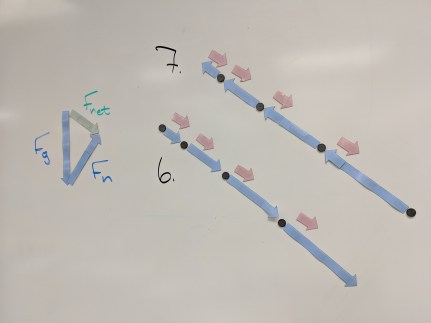
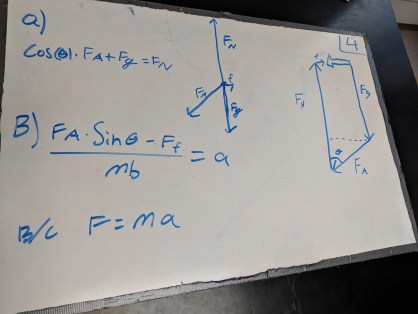
Students did some mistakes whiteboarding with yesterday’s problems. A few students said they feel like unbalanced forces are easier than balanced, which I made sure to point out is a great indicator of how much they’ve grown in using free-body diagrams and vector addition diagrams.
ap mistake.jpg

Physics: Impulse Problems

Students worked on some problems using yesterday’s results on impulse. Overall, the problems seemed to go well, but I need to think about how to handle whiteboarding. I’ve got one section of 30, where I’ll be able to handle whiteboarding the way I normally would. My other section is only 8 students, and they ended up gathered around a single table having a lot of great discussion about how to do the problems. I’m not sure how much a whiteboarding session will add to their understanding.

Chemistry Essentials: Designing Experiments

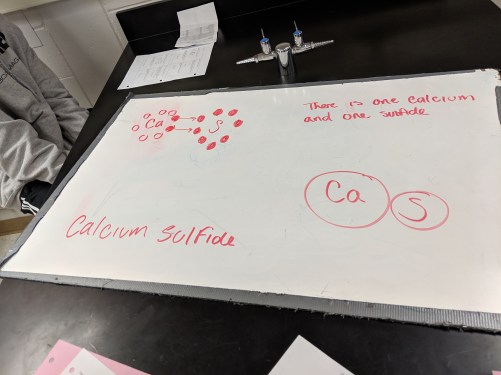
We spent some time talking about the graphs I made of yesterday’s lab results, then moved on to starting the next set of mass and change labs. I asked students to plan their own procedure for finding the change in mass for sugar dissolving in water and Alka-seltzer dissolving in water. This turned out to be harder than I expected, so we ended with some whole-class discussion to figure out what steps we needed and why.
Day 60: Problems, Board Meeting, & Conservation of Mass

AP Physics 1: Problems

Students worked some unbalanced force problems. The set I gave them is mostly what I call “alphabet soup problems”, were there are only variables, no numbers. My students still get nervous about those problems, but they did very well with them, nonetheless. They are also starting to feel more comfortable relying on diagrams to set up their math, which is fantastic and lead to some great conversations during the problems today.

Physics: Board Meeting

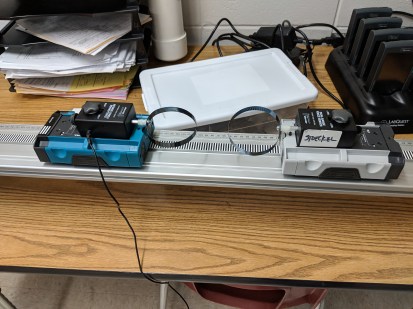
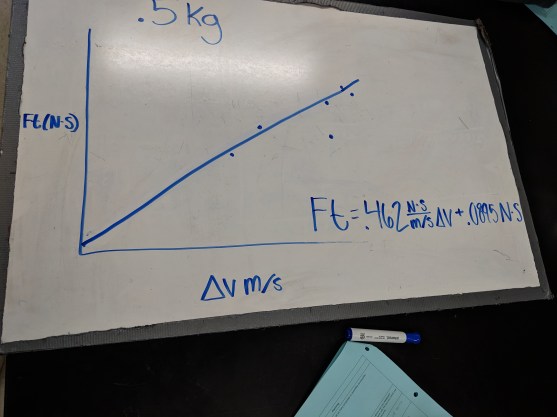
We had our board meeting for yesterday’s impulse lab. The results were the best I’ve seen with this lab to-date, which was great to see. My students this year are more comfortable with the LabQuests than the students I had last year and I spent significantly more time on the pre-lab discussion than I had in the past, and the result was a lot more groups than usual where their slope came convincingly close to the mass of their cart.

impulse board.jpg

Chemistry Essentials: Conservation of Mass

Today students looked at the change in mass in two scenarios, ice melting into water and two liquid solutions getting mixed together. As soon as I started to preview the lab, students started sharing their predictions for what would happen to the mass completely unprompted, so I decided to take a few minutes to let them discuss their predictions. I planned to have students get the initial mass of the ice, then work on mixing solutions together while the ice melted, but it turned out to be challenging for a lot of students to shift between two different experiments. I think it may be better to just use hot plates to help the ice melt so students can do one scenario completely before shifting to the other.

chem lab.jpg

Day 59: Board Meeting, Impulse, & Particle Diagrams

AP Physics 1: Board Meeting

We had a board meeting for yesterday’s lab on Newton’s 2nd Law. Overall, students got very nice results and were very successful at making sense of what they saw.

Physics

n2l board.jpg

This group added some notation to their graph to find the units on their slope

Physics: Impulse

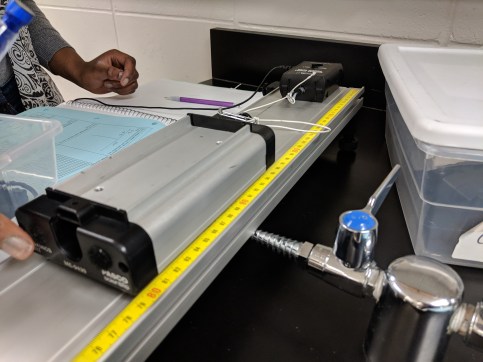
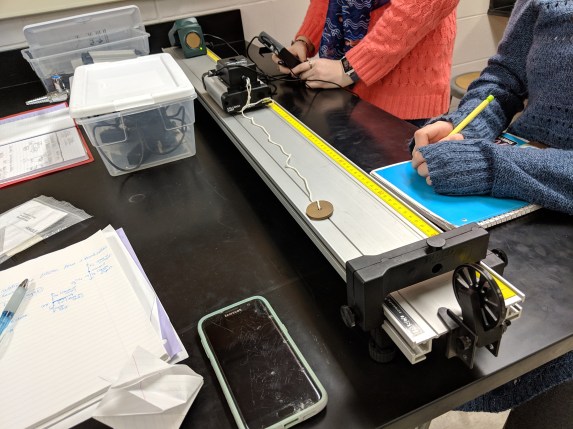
Students used an elastic string to tie a cart to a force sensor in order to find a relationship between the cart’s change in velocity and the area of the force vs. time graph. I’ve tried this lab a few times without great results, so spent a lot more time on the pre-lab than I had in the past and its looking like results will come out fairly nice.

impulse.jpg

Chemistry Essentials: Particle Diagrams

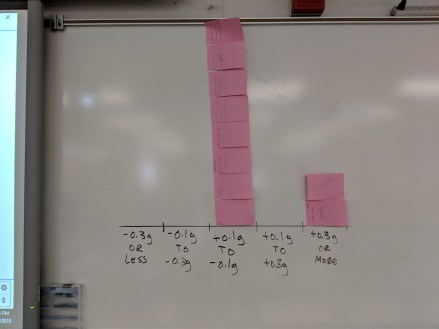
Students looked at the change in mass as they spread out a piece of steel wool and started drawing particle diagrams. My co-teacher and I agreed we want to ramp up the graph interpretation in the course, so we made a histogram of the class results and spent a fair amount of time discussing them. Students had some great observations about the graph.

histo.jpg

Day 58: N2L, Momentum Intro, & Mystery Tubes

AP Physics 1: Newton’s 2nd Law

Students worked on collecting data for a relationship between force and acceleration. It was a lot of fun to see students able to just dive right in to a lab like this; it was a good reminder of the growth students have made so far this year.

n2l.jpg

Physics: Momentum Intro

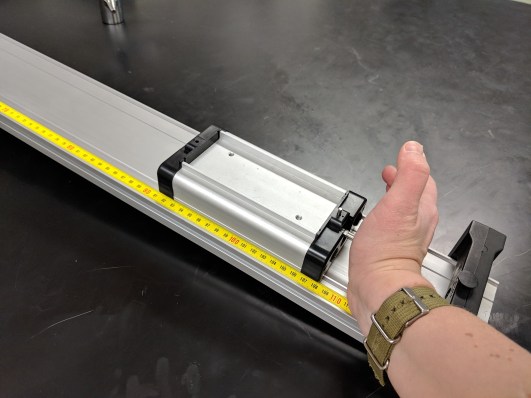
Students worked on a lab my colleague came up to introduce momentum. Students caught a cart at the bottom of the ramp, then came up with as many ways as they could to make it tougher to catch the cart, similar to the chalk smashing analogy used in the Physics Union Mathematics curriculum to introduce energy.

cart catch.jpg

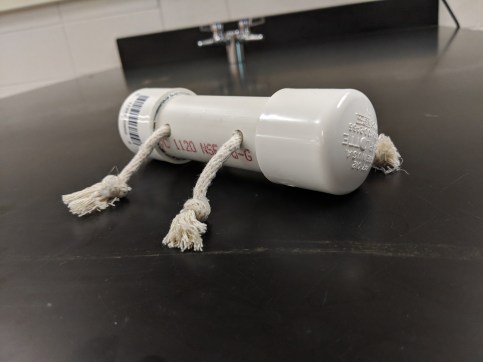
Chemistry Essentials: Mystery Tubes

This trimester, I’m re-teaching the first half of the course to a brand-new group of students. We started today by getting out the mystery tubes. There was a lot of great conversation, both in small groups and in the whole-class, which was a lot of fun, especially since we really struggled to get that in the class last trimester. I’m really excited for this group of students.

mystery tube

Day 53: Day Before Break

Today was the last day to submit work or complete retakes before the end of the term and our last day of classes before Thanksgiving break, so it was a very chaotic day.

AP Physics 1: Whiteboarding

Students wrapped up presenting the whiteboards from yesterday. There was some really great discussion, with students making use of the matter model and connecting to the collisions we’d tested out a few days ago.

matter model.jpg

Physics: Whiteboarding

This class also worked on wrapping up whiteboarding some problems. My 6th hour had a really tough time focusing, which was not surprising the last hour of the day before a break. While we still got where we needed to, I don’t think a whiteboard discussion of problems was the right call for today.

Chemistry Essentials: Quiz

Students took their quiz on naming and formula writing for ionic and covalent bonds. Since it was fairly short, we spent some time before the quiz whiteboarding a few practice problems. A few students were focused on last-ditch efforts to raise their grade, and it was tough to re-direct them to the day’s activities. This will be something to think about at the end of next trimester.

Day 52: Mistakes Whiteboarding &Binary Compounds

AP Physics 1: Mistakes Whiteboarding

We started looking at some force problems involving Newton’s 3rd Law by doing some mistakes whiteboarding. There was a lot of good discussion on the directions of normal forces in problems where the normal doesn’t just go straight up.

ap wb (1).jpg

Physics: Mistakes Whiteboarding

This class also did mistakes whiteboarding, even with the same problems as in AP. Once again, there was a lot of good discussion on the direction of the normal forces.

reg wb.jpg

Chemistry Essentials: Binary Compounds

Students practiced translating between names and formulas for binary compounds. Most students took to this pretty quickly and easily, which was great to see.

Day 51: Problems, 3rd Law, & Covalent Bonds

AP Physics 1: Problems

Students worked some problems on balanced forces, with an emphasis on Newton’s 3rd Law. We also started talking a little bit about the final exam, which will be a modified practice AP exam.

Physics: 3rd Law

Students predicted how the forces would compare during a series of collisions, then we tested teach collision out using a a pair of force sensors with hoop springs attached. Partway through the testing, a few students made the connection to Newton’s 3rd Law, which was fun to see.

n3l

Chemistry Essentials: Covalent Bonds

I introduced students to covalent bonding today. We aren’t going into much depth on figuring out the formulas, but we did take some time today to sketch electron diagrams (simplified Lewis dot structures) to get at what is going on during a covalent bond.

11.19 Covalent Bonding Example.jpg

Day 50: 3rd Law, Elevator, & 2 Truths

AP Physics 1: 3rd Law

We took some time for students to generate a rule based on the collisions we observed yesterday. A few students connected the results to Newton’s 3rd Law and we were able to connect the results to the system schema, showing there was a single interaction between the carts.


Physics: Elevator

We finished discussing a video of a balance during an elevator ride to figure out which way the elevator was moving. At first, a few students thought I might have ridden the elevator down, then up to get the two different accelerations, but the class was very successful at working through why a single ride needs two different accelerations.


Chemistry Essentials: 2 Truths & a Lie

To continue practicing formula writing and naming, we played “Two Truths & a Lie”. Each group prepped a whiteboard with two correct names and formulas, and one name and formula with an error. This class struggles with whole-class discussion, but this has produced some good small-group discussion. One student came up to me during class to say she really likes the formula writing since it’s allowing her to talk more like a chemist and understand what the formulas mean, which was cool to hear.

2 truths.jpg

Day 49: Newton’s 3rd Law, Whiteboarding, & Polyatomic Ions

AP Physics 1: Newton’s 3rd Law

Students predicted the relative forces on two carts in various collisions, then we tested them using a pair of carts with force sensors. I really like using hoop springs for this since it gives a very clear visual in addition to the force vs. time graphs.


Physics: Whiteboarding

Students whiteboarded the problems they worked on yesterday for a gallery walk. We set up the packet to re-use the problems we had that just deal with representations.

phys force prob.jpg

After discussing the problems, I showed students a video I’d recorded on our elevator and asked them to write a CER for whether I took the elevator up or down.


Chemistry Essentials: Polyatomic Ions

We added polyatomic ions to the formula writing we’ve been doing. Students seem to be getting the hang of how to figure out the formula. Some students have figured out the “flop and drop” strategy, and others are opting to draw the simplified Lewis dot structures we’ve been using when they get stuck.

11.15 Polyatomic Ion Example.jpg

Day 48: Mistakes Whiteboarding, Problems, & Mistakes Worksheet

AP Physics 1: Mistakes Whiteboarding

We did mistakes whiteboarding for yesterday’s problems. I had students focus on the diagrams and the set-up for their whiteboards, rather than worrying about getting all the way to a correct answer during the discussion. I overheard a lot of students who wanted to get the answer on their whiteboards comment they couldn’t do the problem without a correct diagram, which tells me they are seeing how to use the diagrams.

Physics: Problems

Students worked on some calculations with unbalanced forces. I’m really liking the pairing of motion maps with vector addition diagrams; this has been a light bulb moment for me of why motion maps are useful.

vad mm.jpg

Chemistry Essentials: Mistakes Worksheet

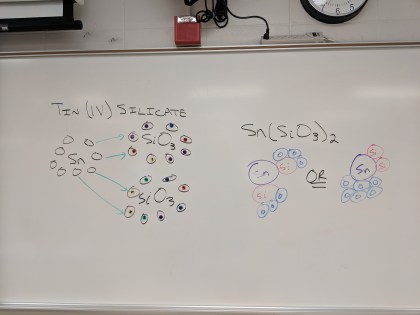
Students worked on some written problems where they had to determine whether a given formula was reasonable. I intentionally included some metals with multiple possible charges, so they would have to consider each possibility before ruling out the formula. After students had worked, they whiteboarded the problems for a gallery walk.

chem wb