Day 130: Plickers & Dam Removal

AP Physics: Plickers & Quiz

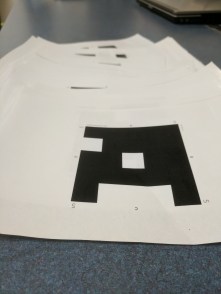
We continued our routine of Plickers to practice some multiple choice questions, followed by a quiz on this week’s new material. I’m continuing to have students pick an answer individually, then discuss and vote again. There were a couple where students struggled to identify useful representations and, once I gave a nudge, they quickly got to the correct answer. I’m thinking about working in a step where students identify applicable models before they pick an answer to help with that.

plicker

Earth Science: Dam Removal

Students used stream tables and a foam model of part of the Salmon River to get some background knowledge for their engineering project. They conducted some observational experiments on sediment transport and deposition, first in a natural, unblocked river, next in a river with a dam, and finally when the dam is removed with a “blow-and-go” approach, where the entire dam structure is removed at once.

dam.jpg

Day 129: Period & River Features

AP Physics: Period

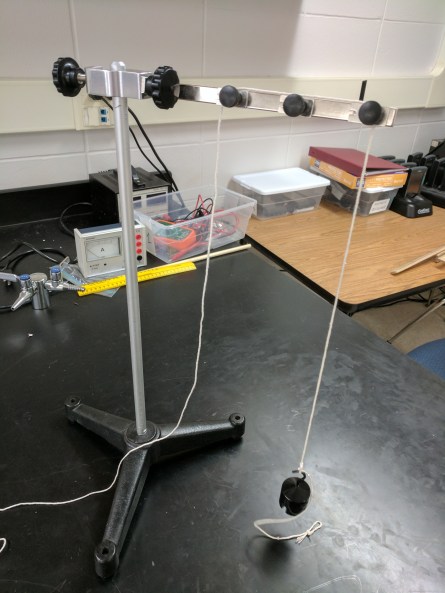
Half the class did experiments to model the period of a pendulum, while the other half did experiments to model the period of a spring. We have three types of springs, and their spring constants are different enough that you can’t test all three with the same mass. Next year, I might have students start by using one spring to test how amplitude and mass affect period, then check their model with a second spring.

pend

Earth Science: River Features

Today, the curriculum called for notes on typical river features, followed by students looking for those features in topographic maps to classify rivers as young or old. Before we did any notes, I had students sort the rivers based on their own categories. They based their categories on things like width or windiness that resulted to very similar sorts to young and old and lead nicely into the vocabulary. When students went back to their groups to sort the rivers by age, I noticed students got less accurate, largely because they interpreted small curves as meanders, making rivers seem older.

topo

Day 128: SHM Energy & Floods

My classes had a sub while I chaperoned a field trip today, so no photos.

AP Physics: SHM Energy

Students worked on some problems on the role of energy in simple harmonic motion. While there aren’t any circular motion problems today, I’ve been liking the connections we’ve made to circular motion and I’m spending the bus ride thinking about if and how I want to connect today’s work to circular motion.

Earth Science: Floods

Students watched a video and answered some questions on flooding.

Day 127: Oscillating Particle Model & Problem Scoping

AP Physics: Oscillating Particle Model

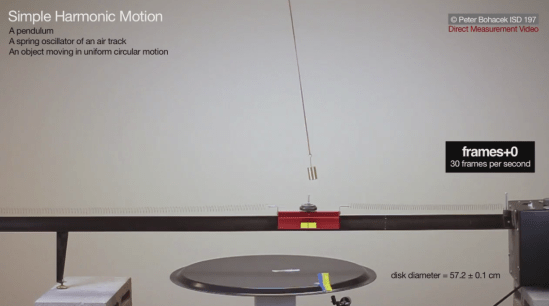
Students whiteboarded their video analysis results for the trio of objects in simple harmonic motion. I haven’t done a lot of circular motion in the past, so when we discussed the spinning disk, I was intrigued by how many students were convinced the angle in the video was responsible for the changing velocity. On a whim, I had students sketch the disk from directly above, then had them sketch velocity vectors, including components, at a few points around the disk, which nicely convinced students that they would see similar graphs for the horizontal motion no matter what the viewing angle.

shm trio

Earth Science: Problem Scoping

This unit includes an engineering project to plan removing a dam from a river. I gave students a memo from their imaginary client and had them do some problem scoping. One of the questions I ask is what background knowledge they will need, which can nicely set up a unit, but students did not identify anything about rivers or erosion as useful knowledge on this project. The memo mentions sediment transport as a major challenge in removing the dam, but I don’t think students saw that as something that would require background knowledge to understand. Even when I handed out the unit’s learning targets, students did not name the target about describing river behavior as one that will be useful. I need to think about how I will address that during the unit.

Day 126: SHM Trio & Water

AP Physics: SHM Trio

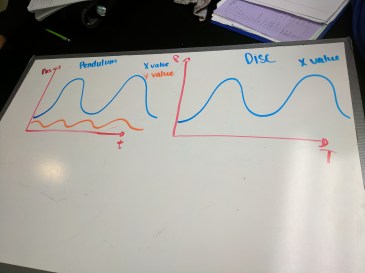
Students downloaded a Direct Measurement Video of three objects in simple harmonic motion and did some video analysis. There was lots of great discussion about why the pendulum’s y-position vs. time graph showed a different period than the x-position vs. time graph. I also really liked the conversations students had about whether the net force on each object is constant. My favorite moment was when a student called me over for help, and the person sitting next to her said “You need to think about it first!” The second student then started asking questions to help the first student figure out the answer she needed. Yay, students!

SHM Trio

Earth Science: Where is Earth’s Water?

Students filled beakers with their prediction for how Earth’s water is distributed, then got the actual distribution and compared. I liked how doing their own prediction first made it much more dramatic when they got the actual results, and saw just how little of Earth’s water is in a form we can really use.

water.jpg

Day 125: Plickers & Earth Resources

AP Physics: Plickers & Quiz

Between now and the AP exam, my plan is to spend Fridays on multiple choice practice, followed by a quiz. We used Plickers again, with students first voting on answers individually, then talking to a peer before voting again; its really interesting to see how their answers shift with this process. I picked several problems where thinking in terms of a system’s center of mass is useful, and students seemed to grasp that idea, though we will need to revisit to make sure it is solid. There were a lot of great conversations along the way.

plicker

Earth Science: Earth’s Resources

I ended up doing some pretty traditional notes to address the learning targets on Earth’s resources. I’d love to put together an activity where students have to argue whether a certain mine or pollution source is worth it (come to think of it, the proposed PolyMet mine near the BWCA would have made for a great Socratic seminar or philosophical chairs), but I ran out of time to prepare something for this year. My students didn’t mind the notes; it turns out several of them had a test next hour in AP Human Geography over a lot of the same material.

Day 124: Mystery Boxes & Metamorphic Rocks

AP Physics: Mystery Boxes

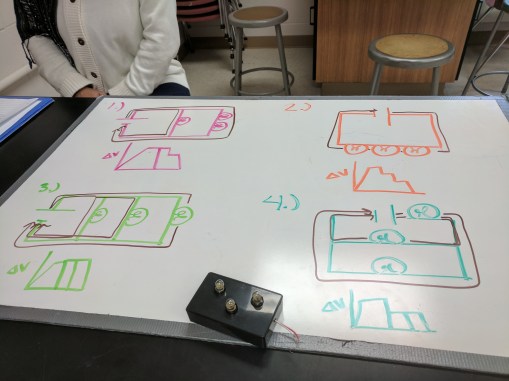
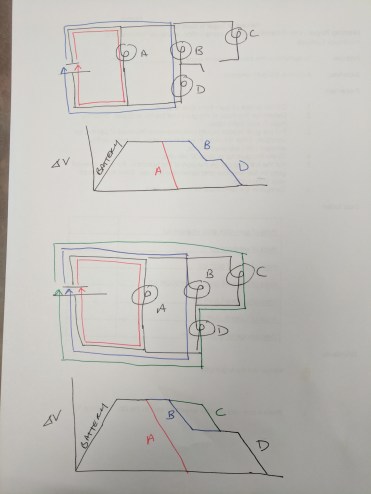
Today, students worked through an activity I got from The Physics Teacher. Groups were given a black box with three light bulbs and had to figure out how the bulbs were wired without opening the boxes. I front-loaded some thinking by having students sketch the four possible circuits and do some KVL diagrams and arrows to show currents, which students were then very successful at applying to interpret the behavior of their boxes. The main issue I ran into is many students students initially wanted to treat equivalent circuits with slightly different arrangements as different circuits. For example, groups often drew one parallel circuit with one bulb on the first branch and two on the second, then a second parallel circuit with two bulbs on the first branch and one on the second. The KVL diagrams provided a nice tool for showing why those circuits are equivalent.

mystery

Thanks, Lotze, for drilling holes in all the boxes!

Earth Science: Metamorphic Rocks

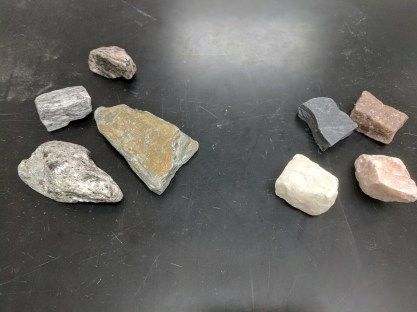
Students identified metamorphic rocks today. Similar to the igneous rock lab earlier this week, I started by having students sort the rocks based on visible properties. Most groups went with whether the rocks were layered, which lead nicely into foliation. A few groups when with sheen, which is the other major property used to identify rocks on this key. Students struggled to tell the difference between marble and quartzite using the key. After the lab, I talked a little about hardness and the acid test, but it would be nice to give students some tools they can use during the lab to differentiate those two.

met rocks

Day 123: Mistakes Game & Sedimentary Rocks

AP Physics: Mistakes Game

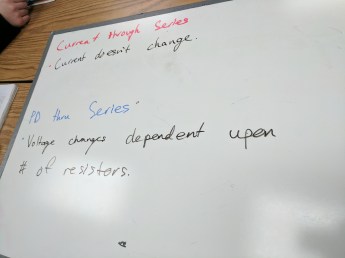
Students played the Mistakes Game with some electric circuit problems. I noticed students who drew arrows to represent the possible current paths tended to be much more successful, so in my 4th hour I explicitly made that part of the instructions. I also took a few minutes in that hour to give students a series and a parallel circuit to have students rank the resistances to solidify that idea. I think I will start with that in 2nd hour tomorrow.

wb

Earth Science: Sedimentary Rocks

Student worked on identifying sedimentary rocks using a key. There were some good discussions in lab groups about the fuzzy boundaries between some of the rock types. I struggled a bit with what thinking students could do to go beyond just using the identification key. I think I’m going to run into the same issue tomorrow with the metamorphic rock lab.

sed rocks

Day 122: KVL Diagrams & Igneous Rocks

AP Physics: KVL Diagrams

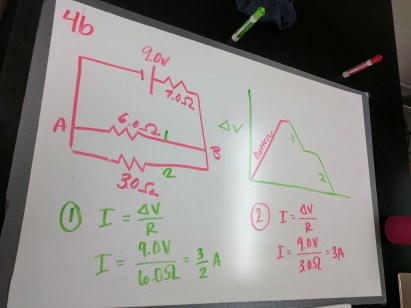
I introduced students to Trevor Register’s KVL diagrams and had students start working some problems. I also have students trace the possible current paths on the circuit diagram to give students a visual for Kirchoff’s Current Law. We also had a quiz today, so most groups only got through the problems that were purely series or purely parallel, but there was a lot of great conversation with students pushing each other to be specific in their use of vocabulary.

kvl

Earth Science: Igneous Rocks

Students worked on identifying different types of igneous rocks. The identification key starts with texture and uses some technical terms for the textures, so before students got the key, I had them group their samples by similar texture. This seemed to help students make sense of terms like “grained” and “frothy” as they apply to rocks. It felt a bit disconnected from the work we’ve done on the rock cycle, which feels disconnected from what we did on Earth’s layers, so I’d like to work on a clearer storyline for this unit.

ig rocks

Day 121: Kirchoff’s Laws & Rock Cycle

AP Physics: Kirchoff’s Laws

Students attempted to apply their patterns to some fill-in-the-blank circuits and whiteboarded statements to describe the patterns they’d found using both the simulation and the real-world lab. It definitely felt more challenging than last year, but I think it was because of how I broke things down to get into a computer lab. Next year, I will get laptops or tablets instead so we can stay in the classroom, then do both the simulation and physical lab for series one day, then do both versions of the parallel lab the next day. That should reduce how much information students are trying to keep track of to make this series of labs more manageable.kvl wb.jpg

Earth Science: Rock Cycle

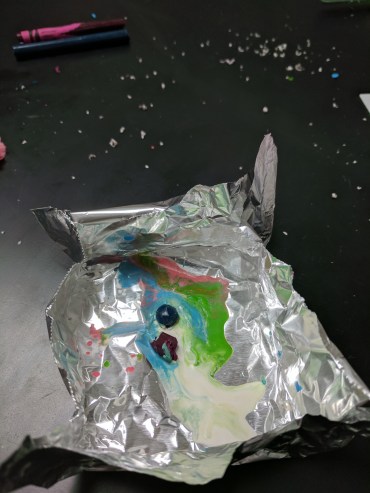
I modified an activity from the middle school Modeling Instruction curriculum using crayons to look at the rock cycle. I had students make some shavings to represent weathering and erosion, then squish the shavings together for a sedimentary rock. Students then melted their sedimentary rock and let it cool to make an igneous one. Next time, I think I’ll have them use higher pressure, maybe from a stack of books, to get metamorphic rocks in there.

crayon