Day 13: Board Meeting, Motion Maps, & Density

AP Physics: Board Meeting

We whiteboarded the spring lab from yesterday. In both my sections, students had great observations and did a nice job of starting to talk about what the graphs mean with out too much prodding. There was a lot of great discussion about the limits of this model, as we tried to figure out whether the intercept on these graphs should be zero. One student also raised the point that if you overstretch a spring, it bounces back, so we was wondering if the linear relationship would still work. I might have them try it with rubber bands.
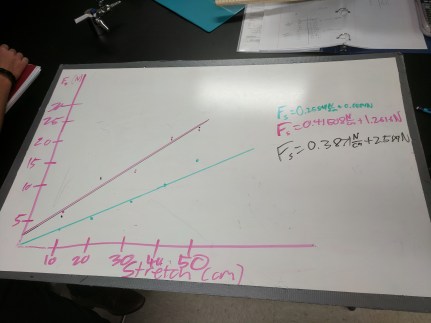
hooke wb.jpg

Physics: Motion Maps

We whiteboarded the buggy lab. I had a lot of trouble keeping students engaged in the large group discussion, I think partly because students didn’t use the ideas we developed in board meetings during the first unit, setting the tone that board meetings aren’t important. One thing that helped a lot was a student who was extremely willing to ask questions about what groups had done when their graphs were different from her group’s, which pulled a lot of students back into the discussion.

After the board meeting, I got out my Fridge Rover, a magnetic wind-up toy that maintains a pretty constant velocity, to introduce motion maps. I made marks on the board showing the rover’s position at regular time intervals, which drives home the connections between motion maps and the buggy lab students just did.
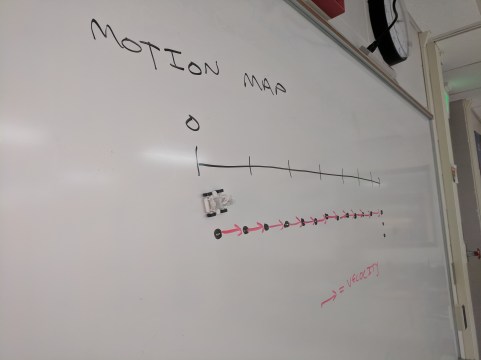
motion map

Chemistry Essentials: Density

Students found a relationship between mass and volume for water, which I used to introduce density. This was one of the times I really liked particle diagrams, since it made density much more concrete than an equation would. A lot of groups skipped finding the slope of their line, so I need to keep reinforcing that the slope is important.
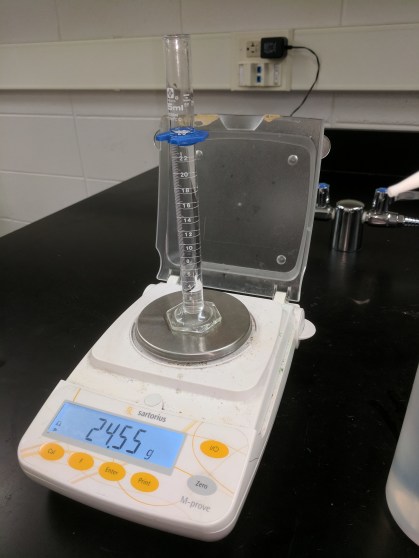
water density.jpg

Day 12: Springs, Buggies, & Board Meeting

AP Physics: Springs

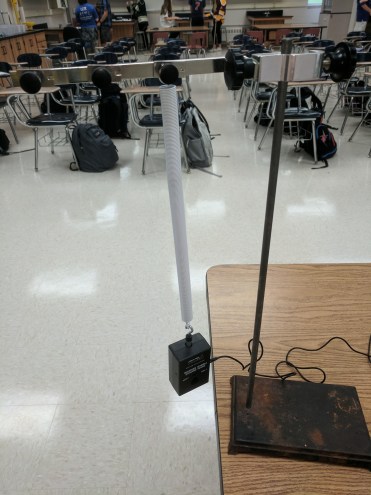
Students pulled on springs with force sensors to get data for Hooke’s Law. I usually have students who expect a horizontal spring to behave differently than a vertical one, so I took advantage of the force sensors to have students collect data for one of their springs in both orientations. When groups started to notice they have the same slope in both orientations, many of them started talking about whether that makes sense, which was fantastic.

spring.jpg

Physics: Buggies

Students finished their data collection and prepped whiteboards for the buggy lab. One student came up to tell me he was thinking about how he could use the data from this lab. In particular, he wants to give the slow buggy a head start, then figure out where the fast buggy will pass it. I let him know that will be our next lab practical.

I’ve got a decent number of students who are struggling with math skills, such as finding slope or plotting negative values, and I need to adjust how I’m addressing that. I’ve been giving small group instruction as needed, but I’m spending a lot of time with just a few groups and missed others who were on the wrong track with this lab until pretty late. I’m toying with some options like providing math “cheat sheets” or having some mini lessons during the class for groups who need help, but I’d really like to develop a culture where students are relying on each other for some of that.

buggy wb2.jpg

Chemistry Essentials: Board Meeting

Today went pretty smoothly; I think yesterday’s work on norms helped, though I need to make sure it doesn’t feel like a punishment next time. When I reviewed the norms at the start of class, a student asked if I actually like about teaching them, so I spent a few minutes sharing some examples of when I’ve really enjoyed their energy.

Students whiteboarded their results from this week’s volume lab. There are a big range of math skills in the class, but once groups compared the values on their data tables, they had an easier time getting at what the slope means. We hadn’t talked about the thickness of the sides, so I was excited when a student asked how it would change the results if the shapes were made of much thinner plastic.

vol wb2.jpg


Day 11: Uncertainty, Buggies, & Norms

AP Physics: Uncertainty

We had a board meeting on yesterday’s force of gravity lab, and the discussion was better than I expected at this point in the year. As we were talking about the slope, one student claimed “Gravity doesn’t change”, which lead nicely into what we mean by that and how we know. In response, another student shared that yesterday one of her group members said “The force goes up 10 N for every 1 kg of mass”; after finally reading Arons this summer, one of my goals is to have students make “for every” statements about slope, and I was thrilled it came up naturally.

I also introduced uncertainty during the board meeting. Students had a lot of great observations about the relative precision of measurements and how much mass it took to change the reading on the scale, which gave them a sound conceptual basis. I rushed the discussion since the end of the hour was coming, and it ended up more teacher-directed than I’d like, but I’m pleased with how the basic approach worked.

fg wb.jpg

Physics: Buggies

Students collected data for the buggy lab. Since when I ask for observations, there is usually a student who says the buggy is moving at a constant speed, I took a page from Michael Lerner and framed the lab as seeing how we can find out. A few groups are starting to make “for every” statements about their slope, which I did not see during the introductory unit and is great to see. I think the relationship is more obvious here than it was in the intro labs.

buggy.jpg

Chemistry Essentials: Norms

I’ve been struggling with classroom management. This is a very high-energy group, and there are a lot of things that are a lot of fun, but I’ve been having trouble keeping them on task and getting them to voices besides their own. I decided to pause today to spend some time developing norms as a class. I think a lot of students felt it was punitive, but many also agree that things aren’t working at the moment.

Day 10: Force of Gravity, Lab Practical, & Volume

AP Physics: Force of Gravity

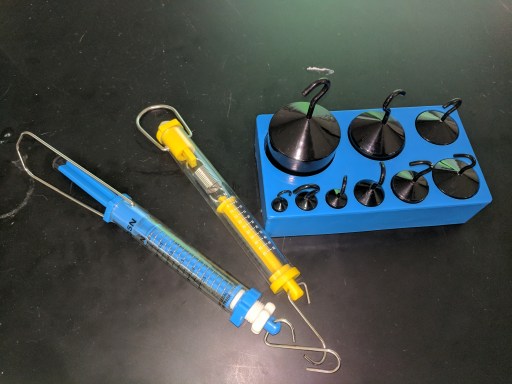
Students collected data to plot the force of gravity on an object vs. its mass. I had different groups use spring scales with two different ranges. Tomorrow, I’ll use the different levels of precision to motivate a discussion of uncertainty. Groups with the 50 N spring scale have already noticed that the smallest hanging masses don’t noticeably change the scale’s reading, which is exactly the kind of observation I was hoping for.

mass.jpg

Physics: Lab Practical

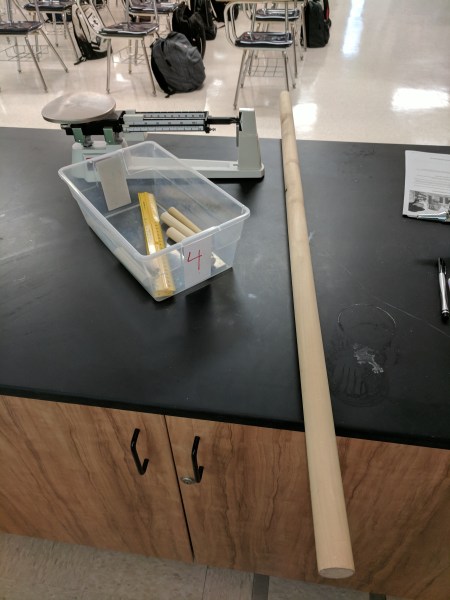
Students revisited the dowel lab, this time as a group assessment. Their results on the original lab weren’t as good as I was hoping, but they are looking much better now that students have had an opportunity to discuss the flaws in their original approach.

dowela.jpg

Chemistry Essentials: Volume

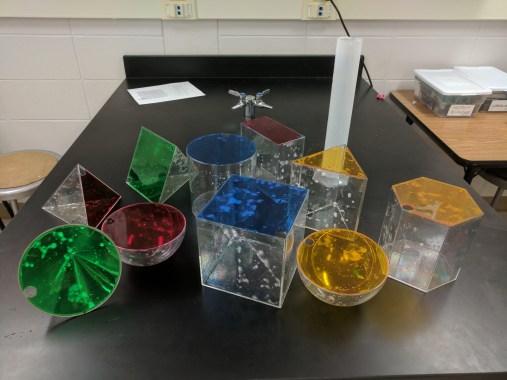
Students found the volume of several different shapes, then measured how much water was needed to fill each one. Some groups got beautiful results, but other groups struggled. I think the groups that struggled had trouble matching up their measurements to the formulas on the cheat sheet I gave them or the Google calculators I showed them. A lot of students also also had trouble measuring the amount of water they put into the shape. The groups that struggled with these measurements were also the groups that were the least focused, but I’m not quite sure which issue is the chicken and which is the egg.

shapes.jpg

Day 9: More F-t Graphs & Board Meetings

AP Physics: More F-t Graphs

We discussed some of yesterday’s problems. To help with a few of the conceptual problems, we got out the force plate and had someone jump, once with their knees stiff and once bending their knees as they landed. Looking back, I wish I’d started this week’s impulse lab more qualitatively to set them up for some similar realizations to the ones we had today.

impulse jump

Physics: Board Meeting

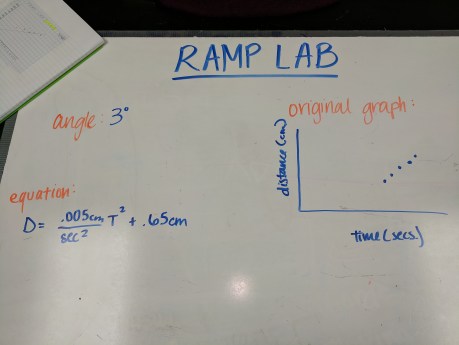
We had a board meeting for this week’s ramp lab. I struggled a bit with what I wanted students to have as their takeaway since we are still on an introductory unit, and the discussion suffered a bit as a result. The other physics teacher had his students focus on a qualitative relationship between ramp angle and slope, and was happy with how things went, so I need to do a better job of identifying opportunities like that if I do a similar intro unit next year. On Monday, however, we are on to actual physics!

ramp wb

Chemistry Essentials: Board Meeting

Students whiteboarded their particle diagrams for yesterday’s lab, along with a CER for whether a gas has any mass based on this lab. They did a nice job on preparing the whiteboards, but the class discussion was tough; a lot of students had trouble staying focused on the conversation at the end of the day on a Friday. I usually keep my class norms pretty broad, but I think it would be worth having the class develop some more specific norms for class discussions.

particle.jpg

Day 8: Board Meeting, Ramps, & Mass of a Gas

AP Physics: Board Meeting

We had a board meeting on this week’s impulse lab. I had one section where about half of the groups changed the mass of their cart for each trial, so I need to make sure I revisit experimental design concepts, like how to tell what variables should remain constant. Students still recognized all of the relevant patterns and we were able to get to the impulse equation nicely.

Physics: Ramps

Students finished collecting data for distance and time down a ramp to see a quadratic relationship. The results weren’t as clean as I hoped, largely because a lot of groups started their cart a fair distance behind the first photogate. It takes some background knowledge to understand why that matters, and with the cognitive load required to learn to use the photogates and set up the dynamics track, they lost track of that detail. If I do a graphing unit next year, I might give more traditional written directions rather than relying on discussion and expecting students to make the notes they need to help ease them in a little more.

Chemistry Essentials: Mass of a Gas

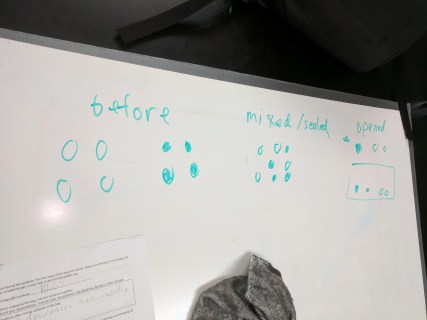
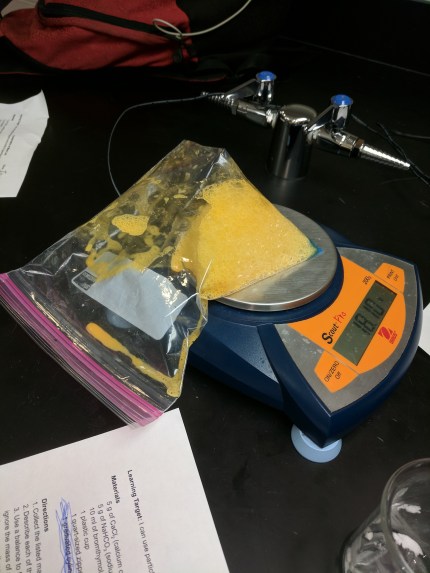
Earlier this week, a student asked what would have happened with the dissolving Alka Seltzer if we had a way to trap the gas and the rest of the class was very excited to discuss their ideas. Today, to answer that question, I had them mix calcium chloride and sodium bicarbonate, along with some indicator, in a Ziploc bag. Things were chaotic enough that I didn’t get much chance to listen to students reason about the reaction, but part of the chaos was a lot of groups were excited to tell me about their observations, which was a great kind of chaos to have.

gas.jpg

Day 7: Impulse, Ramps, & Particle Diagrams

AP Physics: Impulse

Students graphed their data from yesterday. Since I was also introducing them to Desmos and my expectations for their lab portfolios, we ran out of time for the board meetings. The slopes are not coming out as nicely as I’d hoped, which I think is because this is their first quantitative lab and it always takes some time for students to get back into those careful practices. I’m trying to decide whether a different setup might be more forgiving.impulse wn

Physics: Ramps

Students started collecting data to find a relationship between distance and time down a ramp. A major purpose of this lab was to give students an introduction to dynamics tracks and LabQuests, so we had them set everything up from scratch at the start of each hour. Most groups only got one or two data points, but they now see how pieces attach to the dynamics track and have a sense of how to use the LabQuests, so tomorrow should move pretty quickly.
ramp.jpg

Chemistry Essentials: Particle Diagrams

Students worked on a worksheet from the Modeling Instruction curriculum on drawing particle diagrams. I had to do a lot of prompting about what a particle diagram is supposed to show, so I need to think about how to help students connect the name for the diagram to what they should draw. I think students are also struggling to see why the particle diagrams are useful, so I need to think about how to solidify that.

Day 6: Impulse, Big Pendulum, & Alka Seltzer

AP Physics: Impulse

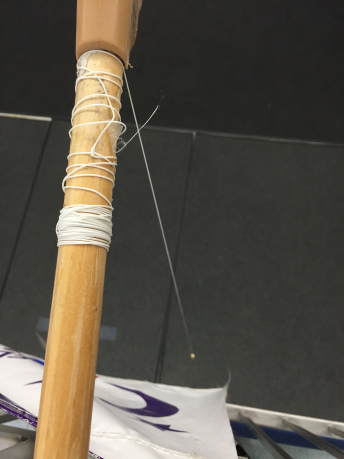
Students did a lab I saw at a Modeling Instruction workshop over the summer. They connected a cart to a force sensor with an elastic string, and used motion detectors to produce velocity vs. time graphs. They collected data to make a graph comparing the area of the force vs. time graph to the change in velocity over the same time period. Introducing the lab felt pretty hand-wavy, so I need to think about how to do a better job of motivating the lab, but the data tables are looking good.

impulse

Physics: Big Pendulum

My big goal today was to motivate relationships besides linear. Since the data collected in the classroom for the pendulum lab tends to look pretty linear, I had students predict the period for a pendulum about 5 m long, then we went to a spot in the school where we could test it out. Since the period was shorter than expected, we started looking for other flaws in the linear fit, which lead to some good discussion on the intercepts of the linear graphs before we took a look at some other relationships and learned how to linearize.

pendulum big

Chemistry Essentials: Alka Seltzer

Today, I replaced beakers with plastic cups and we looked at the change in mass of Alka Seltzer in water before sketching some particle diagrams. Every group connected the fizzing in the water to the loss of mass, which lead nicely into the idea that gas has mass. There was some great discussion afterward; students were not only eager to ask interesting questions like what would happen if we had a way to trap the gas, they were also excited to share their ideas about what should happen and why. I usually start the second half of this course with a chemical reaction in a plastic bag to show conservation of mass, but I’m thinking about moving it up since it addresses questions that students are excited and curious about right now.

alka.jpg

Day 5: Mistakes Game, Pendulums, & Dissolving

AP Physics: Mistakes Game

On Friday, as students finished the FCI, they picked up some problems translating between momentum vs. time graphs, motion maps, and written descriptions. Today, we went over them using the Mistakes Game.  Students pretty readily embraced this approach, which was great to see. I did notice a lot of students were not clear on whether arrows between the dots on a motion map represent the momentum vector or a “tap”, which I think goes back to how I introduced the bowling ball lab. Asking students about the spacing on the motion map got them to think about whether there should be a tap, which seemed to help.

mistakes

Physics: Pendulums

Students worked on finding a relationship between the length and period of a pendulum. On Friday, we’d measured a single period as a class to motivate the need to measure multiple periods. Today, I verbally reminded students of that discussion, but, once in the lab, a lot of students were unclear about what it meant to measure multiple periods; I think it would have been useful to demo that to help with their language. Most groups were able to get a graph done, and have done a linear fit with a nice big intercept, which will lead nicely into motivating the need for other relationships tomorrow.

pendulum.jpg

Chemistry Essentials: Dissolving

We continued the mass and change sequence from the Modeling Instruction chemistry curriculum. My plan was to get through both sugar and Alka Seltzer dissolving in water, but I wasn’t thinking when I grabbed beakers this morning and ended up with way more mass than the balances could handle. I ended up having my students do a lot of math, which many found overwhelming, especially since they had to add some blanks to the handout I’d made. If I’d been thinking, I would have pulled out some lightweight plastic cups to replace the beakers. Tomorrow, I’ll use those for the Alka Seltzer lab.

Day 4: Concept Inventories Galore!

Today, all of my classes took some kind of concept inventory. Physics and AP Physics took the FCI while Chemistry Essentials took the CCI. The other Physics teacher and I talked about giving the FCI on day 1, but I’m glad we waited since it gave me a chance to start establishing a classroom culture before I gave students something I knew they’d get low scores on. Waiting also meant I could use the first few days to set the tone for what my classes should look like.

concept inventories.jpg

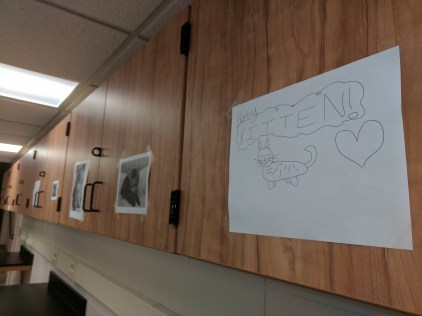
On a side note, I hid a line in my syllabus this year asking students to find or draw me a kitten picture once they’ve read it. As the pictures come in, I’m posting them in my room without comment. So far, I’m up to 5 kittens, which is a better response rate than last year!

kittens2