Day 29: Collisions, Card Sort Part 2, & Board Meeting

AP Physics 1: Collisions

Students started working on a lab to compare the momentum before and after a collision between two carts. This was their first time using photogates, so the first data point took some time, but then students were able to get data pretty quickly. One student pointed out I’d posted “spoiler alert” instead of a learning target, so we took a few minutes to talk about why I don’t always want to post a learning target at the beginning of a new lab.

spoilet

Physics: Cart Sort Part 2

We did some whiteboarding Kelly O’Shea’s balanced forces card sort. Students seem to be doing well with what each representation shows. Students are having some trouble with the direction of the normal force, so I took some inspiration from Joe Cossette and did a quick demo where I put a balance on a board, then slowly lifted one end.

Chemistry Essentials: Board Meeting

We whiteboarded the results of last week’s lauric acid phase change lab. Students pretty readily recognized the flat sections of their graphs that occurred during a phase change. I haven’t spent a lot of time setting up the concept of energy in this class, so I think they had some trouble with the idea that the water baths were still changing the energy of the lauric acid when the temperature wasn’t changing, but I think we’ll get there.

lauric

Day 27: Problems, Interaction Stations, & States of Matter

I had a sub today.

AP Physics 1: Problems

It was a little tricky figuring out what I could leave for students to work on. I ended up giving them some additional problems on impulse and quantitative force diagrams. I ended up giving them their first taste of a goal-less problem and I’m looking forward to seeing what they do.

Physics: Interaction Stations

I usually avoid leaving anything equipment intensive when I have a sub, but we had Brian Frank’s interaction stations on deck for today. The other physics teacher and I try to stay within a day or so of each other, so we set the stations up in his room, then his classes and mine will switch places the hours I have physics.

Chemistry Essentials: States of Matter

Plan A was for my co-teacher to introduce phase changes by having students do a lab making a temperature vs. time graph for lauric acid as it melts and re-freezes. Then, on Tuesday, we found out a fire drill was scheduled for the start of this hour. Since a lot of students in the class really struggle with transitions and with changes to the routine, a sub, plus a fire drill, plus a lab just seemed like a disaster. I ended up putting together a reading assignment from the textbook introducing the three states of matter we’ll be working with.

Day 26: Problems, Bowling Balls, & Assessment

AP Physics 1: Problems

Students worked on a mix of problems on impulse and on using formulas for types of forces. During the second part of class, students whiteboarded problems for a gallery walk.

ap wb

Physics: Bowling Balls

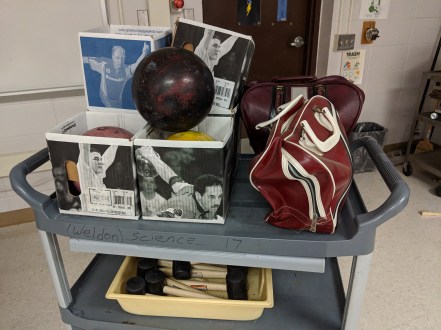
Today was bowling ball day! Students worked through Frank Noschese’s bowling ball and mallet activity.  After getting a class rule so far for taps and bowling ball motion, a few students commented it reminded them a lot of Newton’s 1st Law from 9th grade physical science. Imagine that!

bowling balls.jpg

Chemistry Essentials: Assessment

Students took their gas laws quiz today. Last year, I was pretty good about planning some kind of activity for after the assessment. About half my students take the assessments in a pull-out setting and many of them need more time than the students who stay in the classroom, so I did a lot of nature of science-type activities with students in the classroom while pull out students finished their assessments. I’ve been dropping the ball on that and need to get back into that routine. The students who stayed in the classroom weren’t getting into trouble when they finished, but I’d prefer to have something worthwhile for them to do.

Day 25: Friction, Groupwork Reflection, & Pressure

AP Physics 1: Friction

Students whiteboarded the friction lab from yesterday.  There was some good discussion and I can tell students are getting more comfortable talking about graphs. Its been a couple of years since I last did this lab, and the results are as messy as I remember, but students already seem to have a clearer idea of what the coefficient of friction is telling them, so I think it was worth the time.

friction lab.jpg

Physics: Groupwork Reflection

Today was a quiz day and the routine has become to spend the first part of the hour on an assessment doing some groupwork reflection. I spent some time on discussions about what skills students had used working on certain tasks to reinforce the value of multiple abilities. I have one class that seems to be buying in to valuing multiple abilities more than the other, but I think progress is happening on that front.

Chemistry Essentials: Pressure

To wrap up gas laws, I did a few demos. Before each one, I had students whiteboard a CER with their prediction. My favorite is a demo where I put a pipe between a large and a small balloon with each balloon clamped shut. Students have to predict what will happen when I remove the clamps. The version I first saw calls for putting a very small amount of air in the little balloon, so it isn’t stretching much, which forces air into the big balloon when you remove the clamps. I prefer inflating the small one enough that the rubber has stretched and, when the clamps are removed, the air just stays put in both.

pressure demo

Day 24: Friction, Mistakes Whiteboarding, & Gas Law Problems

AP Physics: Friction

Students worked on collecting data for variables that affect the force of friction. I have some friction blocks with a fuzzy side and a plain wood side, and asked students to make a graph of friction force vs. mass for each side, then prepare a CER for whether surface area and speed matter. A few groups opted to add a graph of friction force vs. mass for the narrow side of the block to answer whether surface area matters, and got beautiful results where the slope matched for both sides covered in the same material.

friction.jpg

Physics: Mistakes Whiteboarding

We did mistakes whiteboarding with Thursday’s problems. I dropped the ball on taking pictures, but there were some fantastic mistakes, especially on problems where neither the final nor the initial velocity is zero. I’m also seeing some great things emerge in the way my students approach discussion; in my 1st hour, there is one student who tends to be one of the most vocal, but both he and the rest of the class were very conscious of finding opportunities for other students to speak up.

Chemistry Essentials: Gas Law Problems

Students worked on some problems doing calculations with the gas laws. Since a lot of my students have very weak algebra skills, we are doing these problems proportionally. While my students worked, my co-teacher and I conferenced with each student about their grade and their progress so far.

Day 23: Board Meeting, Annotating Graphs, & Gas Laws

Today was students’ last day before a 3-day weekend and our homecoming pepfest, so classes were short and students were more energetic than usual.

AP Physics: Board Meeting

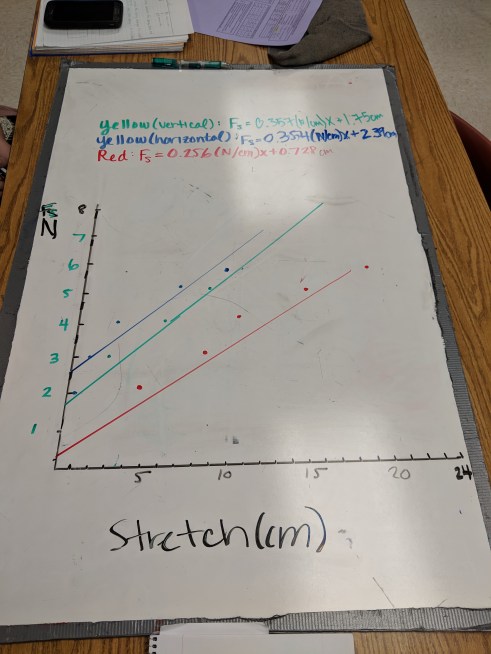
We had a board meeting for the spring force lab. Students initiated some good discussion about the intercepts in both sections, but I had to do a little coaxing to get them thinking about the values of the slopes. One of the challenges was a lot of groups hadn’t distinguished between mass and force of gravity, which tells me I should have done a little more pre-lab discussion, especially since that distinction was just introduced earlier this week.

spring wb.jpg
Physics: Annotating Graphs

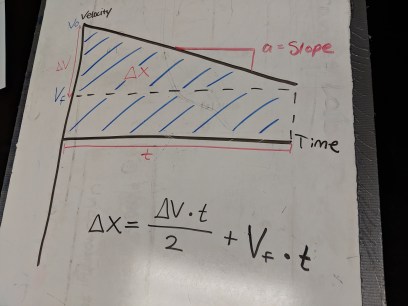
Students whiteboarded yesterday’s problems for a short gallery walk before trying some calculations. I think this is the first year where I didn’t have any students opt to use the formula for the area of a trapezoid on any of their graphs; it just felt more natural to most of my students to split the graph into a triangle and rectangle (which is what I usually do). When students started working with numbers, I had a lot of students independently start talking about specific times and velocities as coordinate pairs, which I haven’t seen students do before and was pretty great.

annot wb.jpg

Chemistry Essentials: Gas Laws

Students sketched their graphs from the past few days for a simplified board meeting. One of the things I really appreciate about this group is I have some students who are really willing to speak up when they are confused about something; one of my students was struggling to see how the graphs fit with the qualitative relationships we found earlier this week and didn’t hesitate to say so, which lead to some valuable discussion about how to read a graph.

gas laws wb.jpg

Day 21: Board Meeting, Quiz, & Quantitative Gas Laws

AP Physics 1: Board Meeting

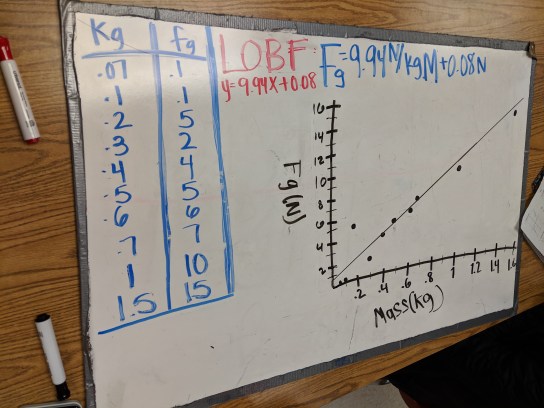
Students finished up their whiteboards for yesterday’s lab and we had our board meeting. Both classes got really nice results and had good discussions. I’m thinking about moving balanced forces to right after constant velocity next year since it gives some really good opportunities for students to be successful on experimental design.

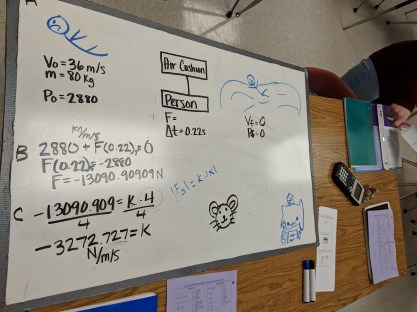
fg whiteboard.jpg

Physics: Quiz

Today was our quiz on representations for constant acceleration. The quiz was pretty short, but I’ve been giving a few minutes before each quiz for students to do a reflection on their collaboration over the past few days. I also spent a few minutes talking with my students about today’s Nobel Prize announcement, and my students had a lot of questions about both this year’s prize and the Nobel Prize in general.

Chemistry Essentials: Quantitative Gas Laws

I am being compensated by Pivot Interactives for participating in a pilot of their chemistry materials.

Students used Pivot Interactives to collect data for a relationship between pressure and temperature. There were some minor issues with the computers, but once students got logged in they were pretty successful. We only have one gas pressure sensor in the school, so this particular activity makes it possible to do a quantitative lab we otherwise wouldn’t be able to and is more firmly rooted in reality than a simulation. The activity included some questions I really like the temperature when the pressure is zero; I overestimated how well my students understand the intercept of a graph, so I’ll need to make sure I allow time to discuss those questions tomorrow.

pivot pressure temp.PNG

Day 19: Assessment, Card Sort, & Vocab

AP Physics 1: Assessment

Students took a quiz on impulse which took a lot longer than I expected; a lot of students spent a lot of time staring in confusion. I think spending Tuesday and Wednesday on forces lead a lot of students to forget how to do impulse and momentum, which tells me I need to work on helping them firm up that model.

Physics: Cart Sort Part 2

Students continued Kelly O’Shea’s kinematics card sort. Today, I added in the word cards and had them record a few of their sorts in their packet.

Chemistry Essentials: Vocab

Before today’s quiz, I had each group prepare a whiteboard with a particle diagram for a  different vocabulary term, then had students do a gallery walk.

chem vocab.jpg

Day 18: Practice, Card Sort, & Chemical Changes

AP Physics 1: CVPM and MTM Practice

I am being compensated by Pivot Interactives for participating in a pilot of their chemistry materials.

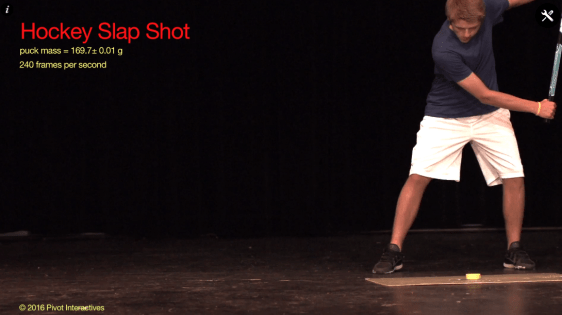
About half of my students were gone today for a field trip, so I decided to do a lab on Pivot Interactives reviewing constant velocity and impulse since that would be an easy option for absent students to make up. Students analyzed the motion of a puck after a slap shot using CVPM, then analyzed the actual slap shot using momentum transfer.

pivot puck.PNG

Physics: Card Sort

A lot of my physics students were also on a field trip today. After a board meeting on the ramp lab, I gave students time to start a Kelly O’Shea’s kinematics card sort. I left out the blank cards and the word cards today so students only had the graphs. Initially, almost every group just put all of the same type of graphs together, so they had a position vs. time graph category, a velocity vs. time graph category, and an acceleration vs. time graph category. I think this was actually helpful to a lot of students, since it drove home that the graphs were telling them different things about the motion. Once groups showed me their initial sorting, I challenged them to come up with another sorting where they could put two or more graphs of the same type together, which lead to great conversations about what the graphs showed and lots of students working on specific language.

card sort.jpg

Chemistry Essentials: Chemical Change

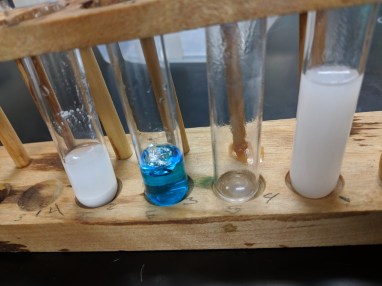
Students did a few different chemical reasons in test tubes to look for signs of chemical changes. I saw some preconceptions coming up that a chemical change should lead to a change in mass, so that is something I need to think about how to address going forward. I think part of that comes from the fact that I referenced burning steel wool as a chemical change early in this unit, when the chemical reaction that formed a precipitate from the same sequence would have been a better choice.

chem change.jpg

Day 17: Free Body Diagrams, Whiteboard Prep, & Describing Substances

AP Physics 1: Free Body Diagrams

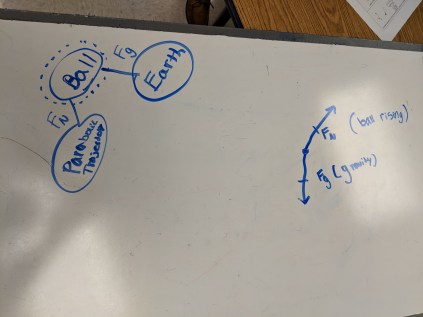
Students started working on some free body diagrams by diving straight into some mistakes whiteboarding. There was a lot of great conversation about the problems where an object was moving with a constant velocity as students did the expected wrestling with how an object is moving forward without a force in that direction. One of my classes also had some surprisingly good conversation about systems with a problem about an object at rest.

ap mistake (1).jpg

Physics: Whiteboard Prep

Students worked on their graphs and prepped whiteboards to discuss the ramp lab. With this being their first experience linearizing and their first time using Desmos, it took some time to get the boards ready. I think next year I’d like to introduce Desmos with the buggy lab so there is a little less new material going on in the ramp lab.

Chemistry Essentials: Describing Substances

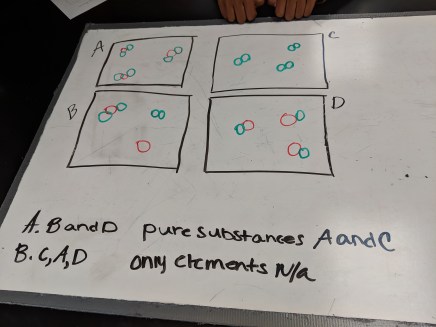
Students did a worksheet to practice with yesterday’s vocabulary, then I had them prep whiteboards and do a gallery walk to check their work.

chem paeti le.jpg