Day 119: Whiteboarding

AP Physics: Central Force Whiteboarding

Students whiteboarded some problems dealing with a central net force. My students who have taken Astronomy are pretty excited with the connections they are seeing to orbits. I also pulled up a simulation of Newton’s Cannon to talk about a problem that asks why the ISS doesn’t crash into the earth.

Physics: Projectile Motion Mistakes

We did the mistakes game, focusing on the diagrams and initial set-up for problems rather than all of the math. There are a lot of long silences, so I might try giving students some structure for additional pre-discussion with their lab groups next time. Maybe students could do a gallery walk and jot down some potential questions for each whiteboard. There are a lot of groups opting to use “vertical” energy to solve for key values, which is pretty cool.

Maker:S,Date:2017-10-21,Ver:6,Lens:Kan03,Act:Lar02,E-Y

Chemistry Essentials: Balancing Mistakes Game

We did the mistakes game with yesterday’s problems on balancing chemical equations. I’ve got the opposite problem of my physics class, where lots of students have things to say, which leads to too many people talking at once. Most of my contributions end up being to re-focus the discussion or redirect students, rather content-related questions to move things along. I’m okay with this problem, even if I’m not sure how to solve it yet.

2.jpg

Day 118: Board Meeting, Projectile Problems, & Balancing

AP Physics: Board Meeting

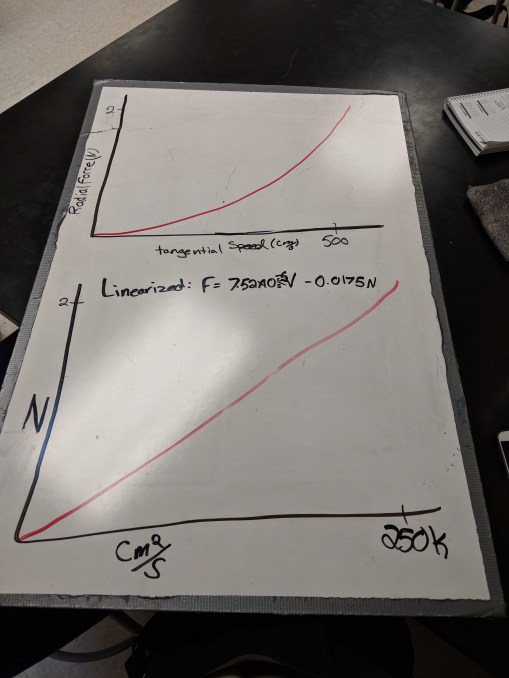
We had our board meeting for yesterday’s lab on centripetal force. I approached it as three mini board meetings since students had done experiments for how three different variables affect the force. The units on slope ended up being a very powerful way for students to see the connections between their three graphs. It was especially exciting when we got to the force vs. mass graph and students saw the connections to Newton’s 2nd Law. One class noticed the slope on the force vs. 1/radius graph has units of Joules, but I’m not sure of the significance of that yet.

force vs t.jpg

Physics: Projectiles

Students whiteboarded yesterday’s problems for a gallery walk. They are consistently viewing free-fall as just a special case of models we’ve already covered, which made the problems pretty easy.  Afterward, students started working problems for horizontal projectiles.

projectile prob.jpg

Chemistry Essentials: Balancing Reactions

After some discussion about the labs from the past few days, students worked on some problems balancing chemical equations. The students who started by sketching a particle diagram were generally very successful at seeing how to balance. A few students got tripped up determining when individual letters in a formula represent individual atoms, especially when the formula included a polyatomic ion, but were getting the hang of it after a couple problems.

balancing prob 1.jpg

Day 117: Central Net Force, Free Fall, & Balancing Equations

AP Physics: Central Net Force

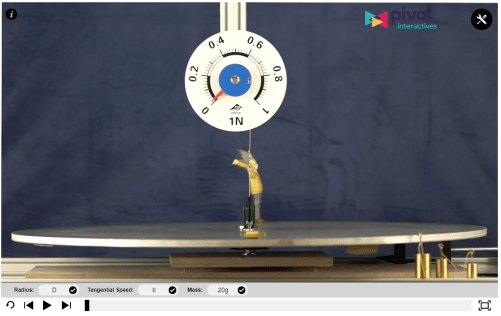
Students worked on an activity in Pivot Interactives to find how speed, mass, and radius affect the centripetal force. One of the great things about this time of year is my students not only have a lot of skills, they are very confident in those skills, so I got to listen to good conversations about experimental design, uncertainty, and linearization without stepping in to do any coaching.

pivot central net force.PNG

Physics: Free Fall

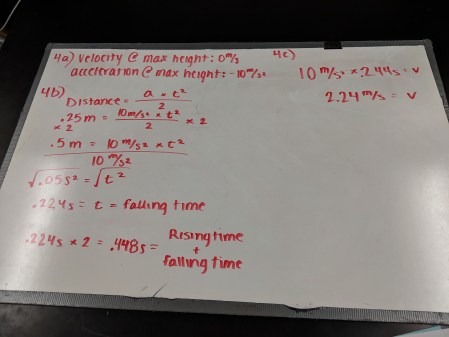
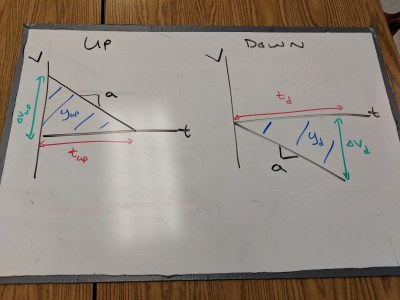
Students worked on some free-fall problems. There was a pretty even split between groups who relied on velocity vs. time graphs and groups who relied on energy. For the first time, I had a couple of groups draw separate v-t graphs for when the object was rising and when it was falling, which helped them organize their thinking.

ud split.jpg

Chemistry Essentials: Balancing Equations

Students used the PhET Balancing Chemical Equations sim to start exploring what it means for a chemical equation to be balanced. This not only seemed to help students make sense of balancing, but to do some retroactive meaning-making on the work we’ve been doing on representing reactions.

balancing eqn.PNG

Day 116: Multiple Choice, Reaction Time, & Conservation of Mass

AP Physics: Multiple Choice

Students took a quiz on rotational kinematics and we fired up Plickers to discuss some multiple choice problems a lot of students got wrong on the final. There were a lot of great conversations and students generally felt very comfortable pointing out errors in their own thinking. There were a few problems that most students got right on their first try today, which was interesting. I asked my students about it, and they said they were feeling pretty mentally fried during their final, especially since it was on the second day of exams, which makes sense.

img_2398

Physics: Reaction Time

Students dropped rulers to calculate their reaction times. Students were pretty successful at designing an experiment and sketching a velocity vs. time graph for the ruler, but annotating and setting up equations was much more challenging than I’d hoped.  Doing the math with v-t graphs just isn’t sticking for a lot of students this year. I think the problem is a lot of them are not attaching meaning to the variables or numbers, which makes the annotations on the graphs and the formulas we use something to memorize. I need to keep working on supporting my students in using the graphs and other diagrams as tools for meaning-making.

ruler.jpg

Chemistry Essentials: Conservation of Mass

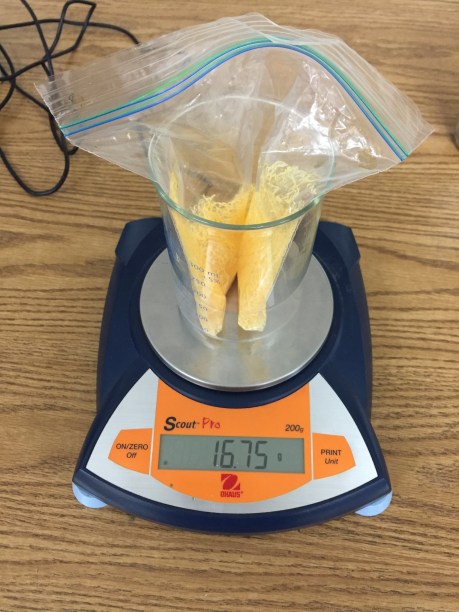
Students did a chemical reaction in a plastic bag to see the conservation of mass and practice translating between different representations of chemical reactions. Time got a little tight because I was not able to have a balance at every table; next time, I would be better off delaying the lab if another class needs the balances on the same day. Students still got a kick out of the chemical reaction.

IMG_1737

Day 115: Mistakes Whiteboarding

AP Physics: Rotation Whiteboarding

Students did mistakes whiteboarding with yesterday’s problems on rotational kinematics. Several of the mistakes lead to some great conversations about what information angular motion graphs do and do not convey.

rot wb.jpg

Physics: Projectile Whiteboarding

These classes also did mistakes whiteboarding with yesterday’s problems on velocity vs. time graphs for projectiles. There were a lot of good mistakes, but a lot of long silences. I need to keep working on making sure my classroom is a comfortable place for intellectual risks.

projectile wb.jpg

Chemistry Essentials: Representing Reactions

I finished out a day of mistakes whiteboarding with some problems going between equations, statements, and particle diagrams for chemical reactions. The main challenge was keeping the class in a single conversation since so many students had questions about the whiteboards, which is a great problem to have. Students also started consciously seeking out new voices when they realized one student was finding most of the mistakes, which was also great.

chem mistake.jpg

Day 114: Rotation Problems, v-t Graphs, & Representing Reactions

Today’s walkout happened to fall during homeroom, so it didn’t have much impact on my classes. A group of senior students organized a short march around the school, and I was very proud watching students march past the windows of my classroom.

All three of my classes were doing problems on a worksheet, so I failed to get good pictures of their work.

AP Physics: Rotation Problems

Students worked through some problems on angular motion with an emphasis on angle vs. time and angular velocity vs. time graphs. The problems went very smoothly; I can most likely count on not needing the whole period to whiteboard the problems tomorrow.

Physics: v-t Graphs

Students worked on some conceptual problems sketching and interpreting velocity vs. time graphs for projectiles. Students are feeling very confident about projectile motion, which is good to see. There are also a lot of great conversations where groups are self-correcting their answers, which is exactly what I’m after.

Chemistry Essentials: Representing Reactions

I introduced students to the notation for chemical reactions and had them practice translating between equations, statements, and particle diagrams. Some students are struggling to keep track of all the details, which is what I expect when they first see the equations.

Day 113: Board Meeting, Projectiles, & Formula Writing Review

AP Physics: Board Meeting

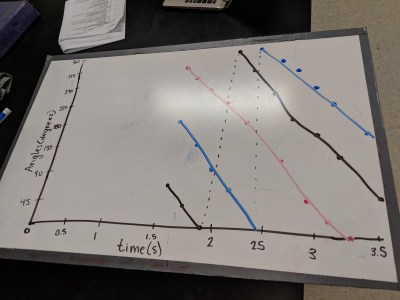
Students whiteboarded the results of yesterday’s lab. Students were very successful making key connections to linear motion. I didn’t specify when students should set time equal to zero or how they should handle it when a dot passed zero radians, so there was some variation in the graphs, but students were able to make sense of those differences.

Maker:S,Date:2017-10-21,Ver:6,Lens:Kan03,Act:Lar02,E-Y

Physics: Projectiles

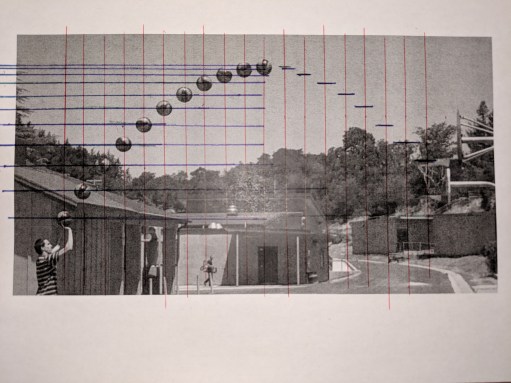
Today, I used an activity Kelly O’Shea came up with based on a post from Dan Meyer. I gave students printouts of an image showing half the path of a basketball, then had them draw lines to see the horizontal and vertical motion of the ball. Students were once again very successful at making the connections I was after.

Maker:S,Date:2017-10-21,Ver:6,Lens:Kan03,Act:Lar02,E-Y

Chemistry Essentials: Formula Writing Review

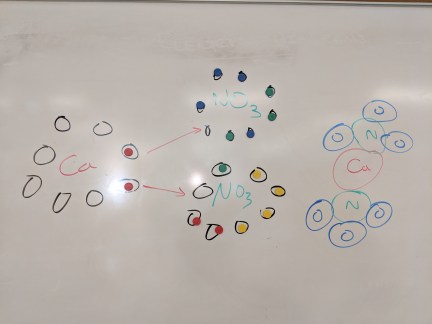
To prep students for translating between representations of chemical reactions, we reviewed writing chemical formulas based on the name. I reviewed electron diagrams, but did not require students to sketch them. However, most students chose to sketch them as a way of thinking through the formulas, which was great.

electron diagram.jpg

Day 96: Circuit Basics, Cart Catching, & Chemical Changes

AP Physics: Circuit Basics

Students used the PhET circuit construction kit to start exploring basic circuit properties and develop Ohm’s Law. It was a lot of fun to listen to students as they discovered new features in the simulation and discussed details they noticed.

circuit kit.PNG

Physics: Cart Catching

To introduce momentum, we borrowed the idea of “chalk-smashing ability” used to introduce energy in the PUM curriculum and had students play with how they could make it harder to catch a cart on a dynamics track. I got excited when a couple of groups took advantage of the plunger carts to see how catching the plunger end felt different than catching the other end, which will be a great lead-in to impulse.

cart catch.jpg

Chemistry Essentials: Chemical Changes

Students did several different chemical reactions to identify signs of chemical changes. There were lots of good observations during the lab.

chem change

Day 149: Whiteboarding & Equilibrium

Physics: Whiteboarding

I had all of my students for the first time this week! We did some abbreviated whiteboarding of the labs and problems from this week as a way to summarize the big ideas we’ve been working on.

IMG_1861

Chemistry: Equilibrium

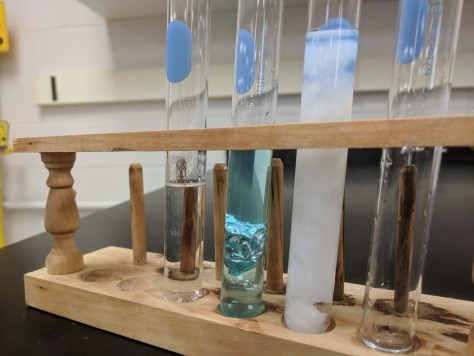
Students set up a reversible reaction in several test tubes, then experimented with how to change the equilibrium. Afterward, we spent some time discussing the role energy plays in why some of the methods to disturb equilibrium worked.

IMG_1860

Day 148: Intensity Problems & Equilibrium

Physics: Intensity Problems

Today is the last day I’ll be missing a significant number of students for AP testing. The students who were in class worked on some problems using the intensity relationship they found earlier this week. One class had a question I need to do some digging on. They were wondering if, when photons are released, they are already travelling at the speed of light, or if they have to accelerate from rest.

Chemistry: Equilibrium

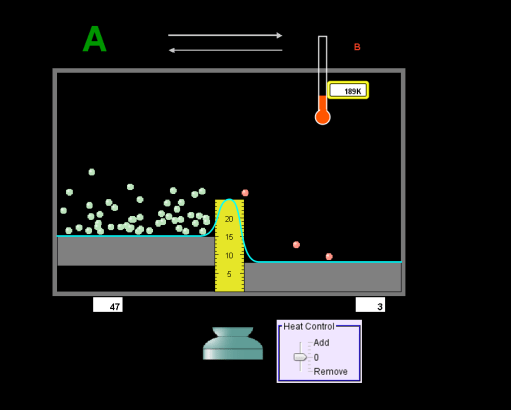
Students spend a little time with the textbook working on vocabulary for equilibrium and reversible reactions. We also spent some time playing with the PhET sim on reversible reactions and they had a lot of great observations and ideas to try.

reversible phet