Day 80: Exploding Carts & Sound

AP Physics: Exploding Carts

Today’s quiz took longer than I expected. One of my classes had some time to start collecting data on two carts in a mechanical explosion. They are plotting the ratio of the cart masses to the ratio of their speeds after a spring-loaded plunger launches them apart. I thought about using some probeware to measure the velocity, but went low-tech and had them use the ratio of the distances when the carts reached the end simultaneously. I like that this approach encourages students to start looking for patterns as they collect their data.

explosion

Physical Science: Sound

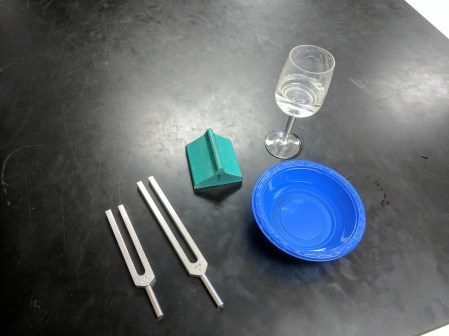
Students used tuning forks and wine glasses to explore some ideas about sound. Students made a lot of great observations and had good discussions with their lab groups and were able to bring some of that back to the whole-class discussion. One of the instructional coaches came by to give some input on helping my students adjust to my approach, and he had a couple of ideas I want to try. Since I keep relationships very qualitative in 9th grade, I ask a lot of questions with limited options, such as whether a variable increases, decreases, or stays the same when another variable changes. The coach suggested I have students physically move to a specific part of the room based on their answer to make it harder to opt out and to facilitate some additional conversations between students. I also like this because it is more obvious to students that we’re doing something different than going over answers like they’re used to. I tend to skip whiteboards in 9th grade, but my conversation with the coach has me thinking they would have some of the same benefits. I need to give some thought to how I can make time for whiteboards in a very tight curriculum.

I also got an idea from grading notebooks this afternoon. I use interactive notebooks, but have gotten very lazy about doing the left side/right side stuff. One of my students has started having a page for each lab, then using the facing page for a summary of the big ideas. That was a good reminder that the left side/right side can actually fit pretty well with what I’m trying to do in the class and I should be having students do those lab summaries.
sound

Day 79: Whiteboarding & Snakey Springs

I spaced out and didn’t take any pictures today.

AP Physics: Whiteboarding

Students worked on whiteboarding elements of the two problems they worked on yesterday. One of the problems involved a block that slides up a ramp and became a projectile; students were either nailing the projectile portion, or completely lost. With an AP test looming, I need to remember to keep spiraling those old concepts back.

Physical Science: Snakey Springs

Students made standing waves and looked for a pattern in how many wavelengths “fit” on the spring. I found a lot of groups missed some of the standing waves, so we made a list as a class of the number of wavelengths they could make a standing wave with and students quickly recognized the pattern.

We also talked a little bit about assessments. After the magnetism quiz yesterday, a lot of students told me they thought it hadn’t gone well, but the most vocal students had perfect scores and the class average was 85%. After talking to students, I think this is related to my challenges engaging students this tri. The earth science assessments they took 1st tri put a lot of emphasis on factual recall, so the reasoning questions I shoot for are big shift for students. I need to think about how I can make it less intimidating to face a new scenario and need to take some time to think on the test.

Day 50: Extending Torque & Light Intensity

AP Physics: Extending Torque

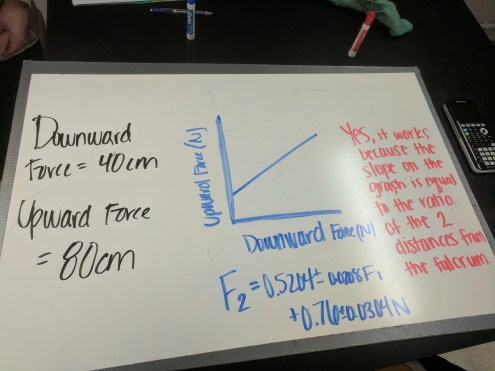
We had a board meeting to discuss yesterday’s lab with second class levers. On the lab, I simply asked whether the model we’d developed so far for a balanced lever also worked for this new type. Since the question is a bit ambiguous, groups that got similar results disagreed on whether the answer should be yes or no, which lead to some great discussion on what are the key elements of the model. I was also pleased with the way students talked about uncertainty to decide whether or not they could ignore the intercept. Over all, I’m really excited about how discussions with this group are going. I feel like I’m getting to take more of a backseat and listen to students talk to each other, rather than relying on me to guide the conversation.

wb-2

Earth Science: Light Intensity

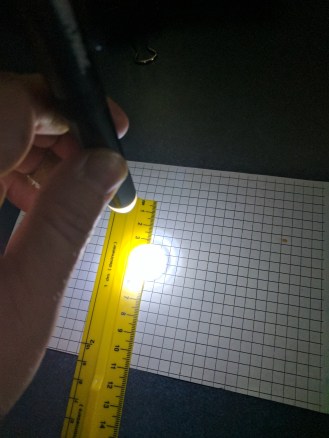
Students graphed the diameter of a light beam vs. the distance from a light source, making some qualitative observations about brightness along the way. We used the results as the basis of a discussion about why an astronomer would want a big telescope to observe very distant objects. I also did some having students observe the pen light itself from different distances to get across the idea that, even though the light beam spreads out, the light source doesn’t look any bigger.

img_20161118_102045

Day 48: Torque & Lenses

AP Physics: Torque

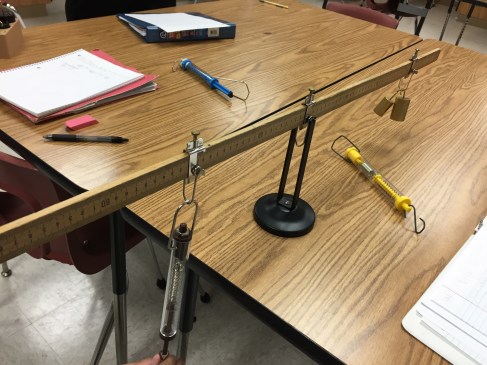
Students found a relationship between the distances masses had to be at on a lever in order to balance. Using two different masses, they picked a spot to place one mass, then moved the other until the lever balanced. Data collection went quick enough that we also had time to whiteboard and discuss the combined results of this lab and yesterday’s lab comparing forces on either side of a lever. I was pleased at how quickly students picked up the ratio hidden in the slope of each graph. I’m also continuing to take more of a background role in the discussions as students get more skilled and comfortable at talking physics.


Earth Science: Lenses

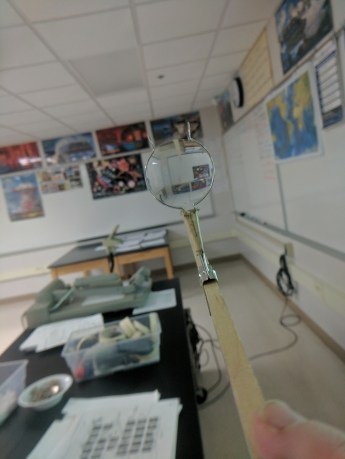
Today, we added refracting telescopes to our repertoire of astronomy observing tools. Students started by making observations through lenses of different focal lengths individually, then both simultaneously. My students are getting better at picking up on little observations, like distortions at the edges of the lends, or asking interesting questions, like whether the image will always be upside down with two lenses, and I’m getting better at responding with the question “How could you find out?”

telescope-lens

Day 47: Torque & Spectra

AP Physics: Torque

Students started the classic lever lab to start building some ideas about torque, though we haven’t used the term yet. Today, I had them work on a relationship between the forces on either side of the lever, and encouraged different groups to use different distances from the fulcrum.

img_2488

Earth Science: Spectra

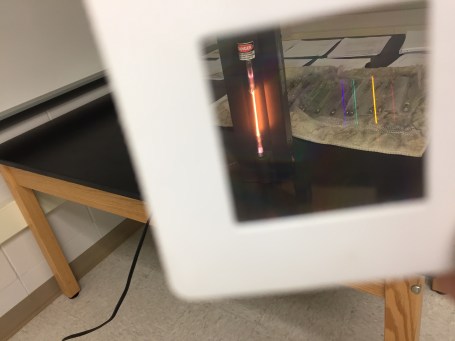
To introduce why spectroscopes are useful in astronomy, students played with diffraction gratings. We started by looking at some of the regular light sources in the classroom, and they were quick to come up with interesting observations and ideas to explain their observations. Then, we shifted to observing gas lamps. We only have one power supply, so we did those observations as a whole class. Then, in their lab groups, I had students look for patterns in where colors appear to get the idea that the same color always has the same distance, then to try to identify the gasses we’d observed.

img_2487

Day 46: Mistakes Game & Reflecting Telescopes

AP Physics: Mistakes Game

We played Kelly O’Shea’s Mistakes Game using some problems with a central net force. Its great to see my students getting more skilled at discussing physics, which means I’m doing very little to keep the conversation moving. We had some particularly good discussions about a problem about the forces on a roller coaster car as it goes over a hill and about the forces on a yo-yo as it swings in a vertical circle.

img_2482

A whiteboard for the roller coaster problem

Earth Science: Reflecting Telescopes

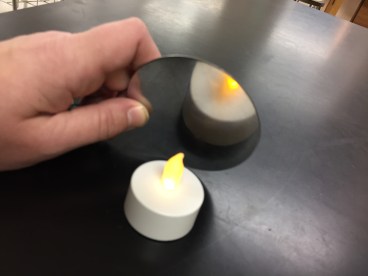
Students played with curved mirrors to get some ideas about how mirrors are used in telescopes. I also got out some electric candles and tasked students with projecting the candle on a sheet of paper. They struggled with that step, but it was great to see their reactions when they got a nice, sharp image of the candle “flame”.

img_2484

Day 162: Snell’s Law & Half Life

Physics: Snell’s Law

I got out the refraction dishes and showed students how to use them to find a refracted angle. Then, I asked them to get me a graph where the slope is the index of refraction of water. This is the first time I asked students to start with an equation (in this case, Snell’s law) and pick their axes to get a certain value as the slope, but they were pretty successful.

IMG_1899

Chemistry: Half Life

Students measured the “decay” of pennies by shaking them up, then setting aside any that came up tails. Each group make a graph of pennies remaining vs. half lives and submitted their results via a Google Form so we could produce a graph of the class average. Tomorrow, we’ll use that to have some conversations about randomness.

Day 160: Lens Misconceptions & Solubility

Physics: Lens Misconceptions 

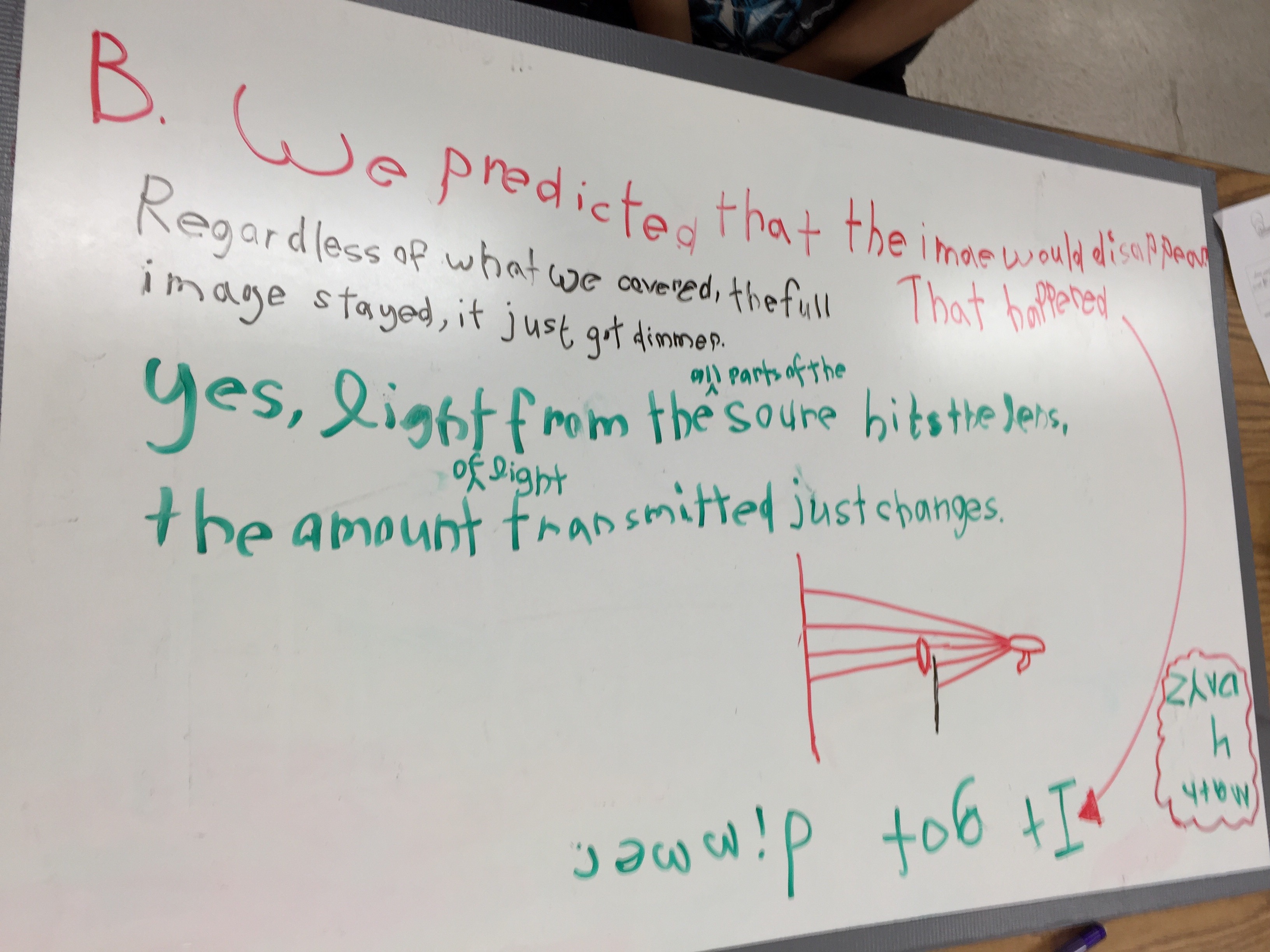
Students whiteboarded and discussed the results of Friday’s lab. I’m always intrigued by the conversations about the image formed when part of the lens is covered up. Students consistently express the common misconception that blocking the lens will block part or all of the image with very little analysis of that idea. Once they saw the full image, however, they quickly and easily made connections to partially covered mirrors to declare a dimmer, but whole image is exactly what they should see. Without the unexpected observations in the lab, my students felt no need to consider related observations or apply tools like ray diagrams to challenge their ideas. I know this is exactly how misconceptions tend to play out (Derek Mueller’s video on Newton’s 3rd law is a great example), but there’s seeing this process happen always fascinates me.

Chemistry: Solubility

Students did a simple solubility lab where they measured how much sugar could be dissolved in water at different temperatures.

Day 159: Lenses & Concentration

Tonight is Tartan’s Relay for Life event, which the majority of our students participate in, so my students were definitely wound up, but still managed to focus on some science.

Physics: Lenses

We did a whiteboard gallery walk on yesterday’s problems, then got out some lenses to make some observations. I based my activity on a packet of optics activities originally written by Dewey Dykstra of Boise State University, which walks students through some things to try, like blocking part of the lens, and asks them to make observations. Students were surprised by a lot of the results and several were really vocal that they were glad I had them try it themselves because they would not have believed it if I told them.

IMG_1893

Chemistry: Concentration of Solutions

I introduced students to the idea of concentration and gave them some time to work through some problems.