Day 70: Systems and Bar Charts, Conservation of Momentum Problems, & Pivot Interactives

AP Physics 1: Systems and Bar Charts

Students worked on whiteboarding some problems switching between different systems for energy bar charts. Students were doing a nice job of switching smoothly between different systems.
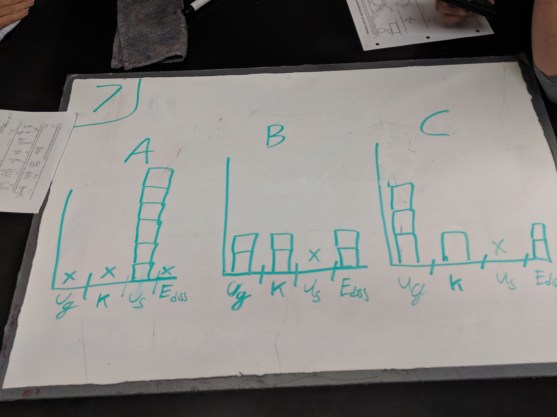
ap bar chart

Physics: Conservation of Momentum Problems

Students worked on calculations with conservation of momentum. This is the first year I’ve really used momentum bar charts, and its also the first time I’ve had students call conservation of momentum easy. The best part was I overheard a lot of students talking about whether their answer was reasonable based on their bar charts. When one of my AP sections came in, I still had some bar charts on the whiteboard and my AP students asked why I didn’t teach them momentum bar charts since it made the problem seem much easier. I’m sold and will be bringing bar charts into AP next year.

Chemistry Essentials: Pivot Interactives Density

I am as part of Pivot Interactive’s Chemistry Fellows program.

Students worked on an activity in Pivot Interactives to identify materials based on their density. I ended up giving students a handout to record their work, rather than having them answer in Pivot’s interface, since something about writing on paper seems to feel more comfortable for a lot of my students. I was really excited about how many students on their own tried to decide between multiple materials with similar densities by paying attention to what they could see about the material. It was also nice to be able to easily split up the class to look at different liquids so we can have some conversation tomorrow about who should have similar answers and who should have different answers, and why.

pivot density.PNG

Day 67: Board Meeting, Representations Jeopardy, & Density of a Solid

AP Physics 1: Board Meeting

Students whiteboarded their results for the elastic potential energy lab we’d done earlier this week.

Physics: Representations Jeopardy

In both my sections, we started with mistakes whiteboarding for yesterday’s problems. My 6th hour is about 1/3 the size of my other section, so they got through the mistakes whiteboarding very quickly. I tried what I called Representations Jeopardy: each group came up with a scenario, and whiteobarded a set of representations, minus the sketches and any labels that would identify what the objects involved are. Then, groups traded whiteboards and had to come up with a scenario that matched the whiteboard they received. Students said they really liked that they had to think differently in order to work backwards from the diagrams.

phys mistake

From mistakes whiteboarding

Chemistry Essentials: Density of a Solid

Students worked on finding the density of some metal dowels. I realized belatedly this is the first lab we’ve done where they didn’t need a container when measuring the mass, so it was actually a tricky leap for them to not tare something out on the balance.

volume

Day 65: Spring Energy & Board Meetings

AP Physics 1: Spring Energy

I am being compensated by Pivot Interactives as part of their Chemistry Fellows program.

Students collected data for a relationship between a spring’s stretch and the final velocity of an attached cart using a lab in Pivot Interactives. While I took more time than yesterday on a pre-lab discussion, I think students were still a little confused since we haven’t talked much about energy types yet. I think it would have helped if we’d done the board meeting for yesterday’s lab prior to this activity. I’m also thinking about doing bar charts before these equations next time around.

pivot epe.PNG

Physics: Explosions Board Meeting

Students whiteboarded their results from yesterday’s lab to introduce conservation of momentum. This was a tricky discussion for a lot of my students since we were dealing with four variables simultaneously, but students did well with it. It was a nice reminder of the progress my students have made so far this year.

explosion board.jpg

Chemistry Essentials: Volume Board Meeting

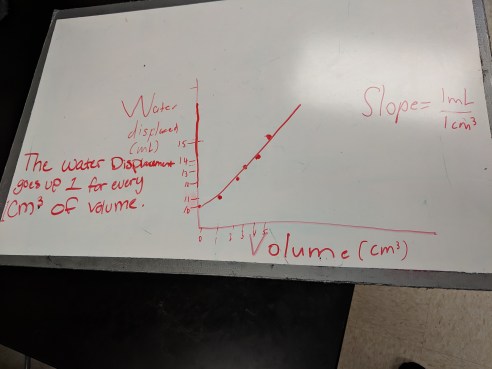
Students whiteboarded their results from yesterday’s lab. I really hit “for every” statements about the slope hard, and that seemed to help students attach some conceptual meaning to the slope. There were a few groups who graphed the actual water level, rather than the water displaced, which gave a great opportunity to talk about what the intercept tells us in this lab. I think next time, I’ll make sure a couple of groups do that.

group 3.jpg

Day 64: Kinetic Energy, Exploding Carts, & Volume

AP Physics 1: Kinetic Energy

I am being compensated by Pivot Interactives as part of their Chemistry Fellows program.

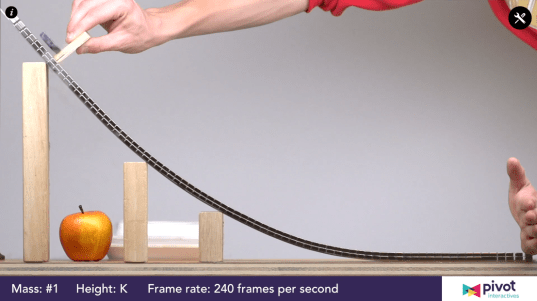
Students used Pivot Interactives to collect data for a relationship between an object’s starting height and its velocity at the bottom of a ramp to work toward a relationship for kinetic energy. Because the activity included directions for how to make each measurement, I got complacent and rushed through the pre-lab discussion, which meant some students were lost on the goal of the activity. I think I would have been better off taking a little more time, and pointing out connections between the directions in the activity and the measurements we discussed.

pivot ke.PNG

Physics: Exploding Carts

To start working toward momentum conservation, students launched pairs of carts off each other and plotted the ratio of the masses and the ratio of the velocities. Rather than measuring the velocity, we worked out that since the carts have a pretty constant velocity after the explosion, if they hit the end stops simultaneously, the ratio of the distances is the same as the ratio of the velocities. I like that this forces students to start making some predictions about how they need to adjust the distance, rather than waiting until the end to come up with a model.

explosion.jpg

Chemistry Essentials: Volume

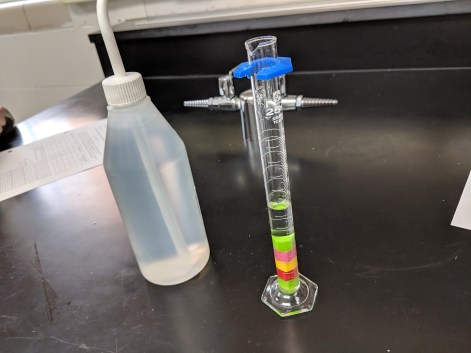
The Modeling Instruction chemistry curriculum has a lab I really like to show that 1 cm3 = 1 mL, but I’ve struggled to make it work for my students. Both when I’ve used empty geometric solids and a selection of cylinders, doing the math to calculate the volume in cubic centimeters has been a huge hurdle. Today, I tried the lab using plastic cubes that are 1 cm on each side and it finally went smoothly. Students were actually paying attention to the relationship, rather then getting lost in the math to calculate the solid volume.

volume.jpg

Day 30: Center of Mass, Whiteboarding, & Energy Bar Charts

AP Physics 1: Center of Mass

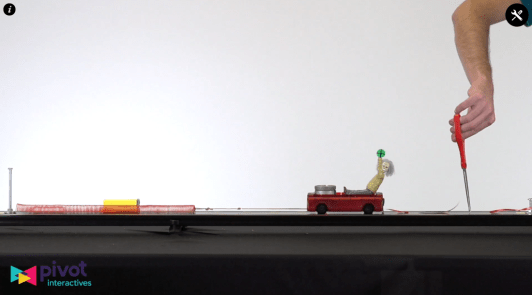
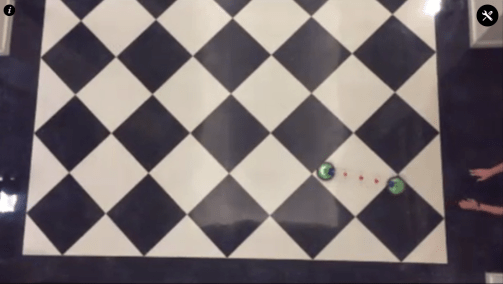
Students worked on a video analysis of two air pucks attached by a rod from the article by Taylor Kaar, Linda Pollack, Michael Lerner, and Robert Engles in The Physics Teacher. In the past, I’ve used LoggerPro, but there have been delays on getting it installed on student computers, so I took advantage of the video upload feature in Pivot Interactives. Pivot has a ruler with an adjustable length to get measurements to scale, but it was tricky to find a nice alignment, so students ended up skipping scaling the ruler and coming up with a conversion factor, instead.

2body.PNG

Physics: Whiteboarding

Students whiteboarded some problems on drawing free body diagrams. In my 1st hour, we did mistakes whiteboarding; I was a little disappointed that no groups put a forward force on the objects moving forward, but not a lot of students made that mistake while they were working on the problems in the first place. My 6th hour is a little behind, so they mostly worked on the problems today and will do some abbreviated whiteboarding tomorrow.

Chemistry Essentials: Energy Bar Charts

Students worked on some LOL diagrams for energy transformations during phase changes. They had some trouble with the system flow part of the diagram, mostly because they are getting tripped up by the idea that it needs to list specific objects.

Day 22: Spring Force, Annotating Graphs, & Pressure vs. Volume

AP Physics 1: Spring Force

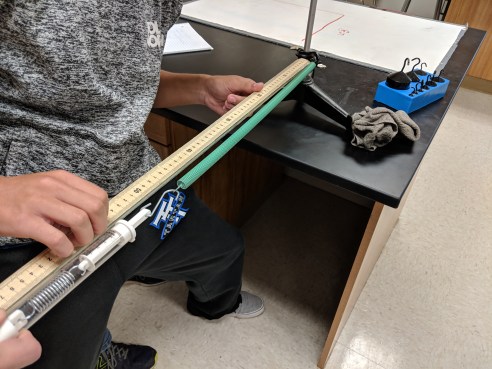
Students collected data for a relationship between the force on a spring and how much it stretches. I have them collect data for at least two different springs hanging vertically, then pick a spring where they also collect data by pulling it horizontally. I love the moment when groups call me over because something is “wrong” with their graphs because the line for when the spring is vertical matches the line for when the spring is horizontal.

spring lab.jpg

Physics: Annotating Graphs

As a stepping stone to graphical solutions for constant acceleration, students worked on annotating velocity vs. time graphs and building equations from the slope and intercept. Last year, this was really tough, so I changed some of the language I used to try and connect the annotations to the visible features of the graph a little more clearly, and it seemed to click for a lot of students.

graphical soln.jpg

Chemistry Essentials: Pressure & Volume

I am being compensated by Pivot Interactives for participating in a pilot of their chemistry materials.

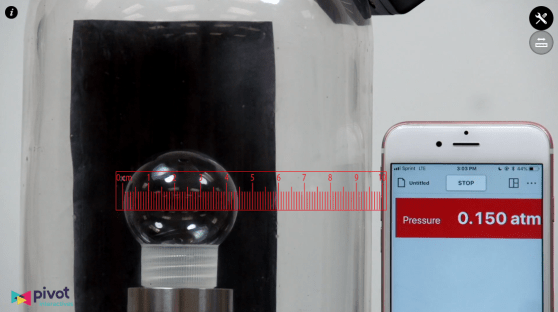
Students used another Pivot Interactives activity. This one used a bubble in a vacuum chamber to allow students to find a relationship between pressure and volume. In a previous lab on volume, finding the volume of a cylinder was a big hurdle for a lot of my students, so it was really nice for them to be able to use the tools in Pivot to do that number crunching without getting hung up on the math.

pivot pressure vol.PNG

Day 21: Board Meeting, Quiz, & Quantitative Gas Laws

AP Physics 1: Board Meeting

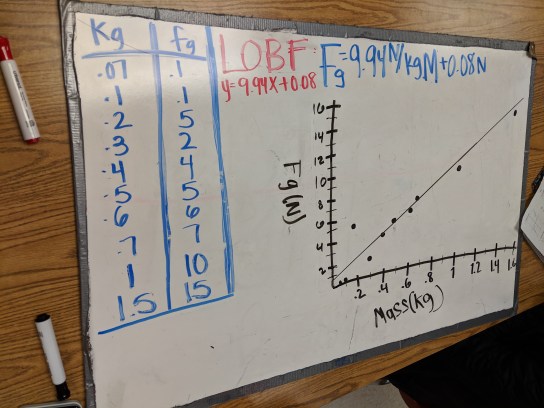
Students finished up their whiteboards for yesterday’s lab and we had our board meeting. Both classes got really nice results and had good discussions. I’m thinking about moving balanced forces to right after constant velocity next year since it gives some really good opportunities for students to be successful on experimental design.

fg whiteboard.jpg

Physics: Quiz

Today was our quiz on representations for constant acceleration. The quiz was pretty short, but I’ve been giving a few minutes before each quiz for students to do a reflection on their collaboration over the past few days. I also spent a few minutes talking with my students about today’s Nobel Prize announcement, and my students had a lot of questions about both this year’s prize and the Nobel Prize in general.

Chemistry Essentials: Quantitative Gas Laws

I am being compensated by Pivot Interactives for participating in a pilot of their chemistry materials.

Students used Pivot Interactives to collect data for a relationship between pressure and temperature. There were some minor issues with the computers, but once students got logged in they were pretty successful. We only have one gas pressure sensor in the school, so this particular activity makes it possible to do a quantitative lab we otherwise wouldn’t be able to and is more firmly rooted in reality than a simulation. The activity included some questions I really like the temperature when the pressure is zero; I overestimated how well my students understand the intercept of a graph, so I’ll need to make sure I allow time to discuss those questions tomorrow.

pivot pressure temp.PNG

Day 18: Practice, Card Sort, & Chemical Changes

AP Physics 1: CVPM and MTM Practice

I am being compensated by Pivot Interactives for participating in a pilot of their chemistry materials.

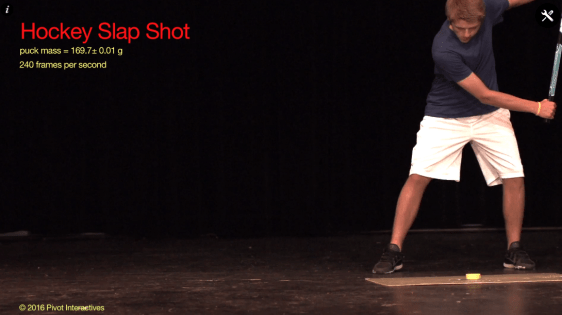
About half of my students were gone today for a field trip, so I decided to do a lab on Pivot Interactives reviewing constant velocity and impulse since that would be an easy option for absent students to make up. Students analyzed the motion of a puck after a slap shot using CVPM, then analyzed the actual slap shot using momentum transfer.

pivot puck.PNG

Physics: Card Sort

A lot of my physics students were also on a field trip today. After a board meeting on the ramp lab, I gave students time to start a Kelly O’Shea’s kinematics card sort. I left out the blank cards and the word cards today so students only had the graphs. Initially, almost every group just put all of the same type of graphs together, so they had a position vs. time graph category, a velocity vs. time graph category, and an acceleration vs. time graph category. I think this was actually helpful to a lot of students, since it drove home that the graphs were telling them different things about the motion. Once groups showed me their initial sorting, I challenged them to come up with another sorting where they could put two or more graphs of the same type together, which lead to great conversations about what the graphs showed and lots of students working on specific language.

card sort.jpg

Chemistry Essentials: Chemical Change

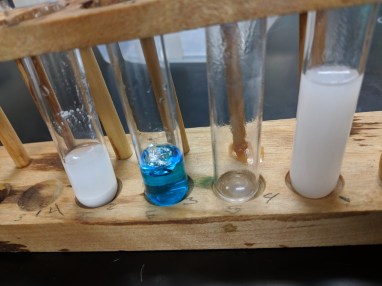
Students did a few different chemical reasons in test tubes to look for signs of chemical changes. I saw some preconceptions coming up that a chemical change should lead to a change in mass, so that is something I need to think about how to address going forward. I think part of that comes from the fact that I referenced burning steel wool as a chemical change early in this unit, when the chemical reaction that formed a precipitate from the same sequence would have been a better choice.

chem change.jpg

Day 14: Board Meeting, Dueling Buggies, & Density Challenge

AP Physics 1: Board Meeting

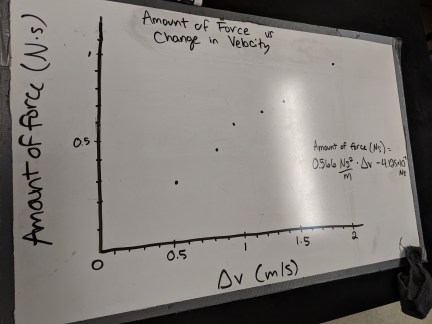
We had a board meeting on the impulse lab students have been working on. There were a few groups with really nice results, but this is a very tough one to get consistently accurate slopes, which made the discussion tough, even though my students did a nice job. It was a little tricky getting to the formula we’ll be using for impulse since the lab had a non-constant force, but the equation assumes a constant one. Next year, I might switch to the half-Atwood machine, rather than saving it for unbalanced forces.

impulse lab.jpg

Physics: Dueling Buggies

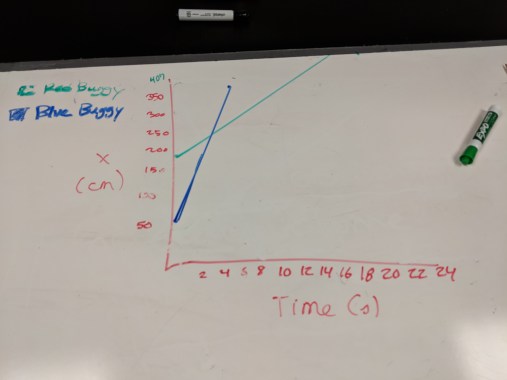
Students finished up the dueling buggies lab practical. I saw a much wider range of approaches than in my AP classes this year; most of my AP students are in the same math classes, which I think encourages them to think about problems in similar ways. My regular classes, meanwhile, have a much wider range of students, so there was a lot of great discussion about different ways to think about this problem.

dueling buggies.jpg

Chemistry Essentials: Density Challenge

I am receiving access to Pivot Interactives this year in exchange for piloting some of their chemistry activities.

Students used Pivot Interactives to make mass vs. volume graphs to identify unknown liquids by their density. A lot of students had some trouble getting started, but, once I pointed out the similarities to the density of water lab we’d done, they were very successful. The videos don’t zero the balance so that the graph will end up with an intercept; this was the first graph with a non-zero intercept they’ve seen in this class, so it was challenging, but we were able to work through it. I think just about every group picked gallium as their unknown liquid, which is fitting, since it would be the hardest to do in the classroom.

pivot density.PNG

Day 132: Angular Momentum, Lab Practical, & Popcorn

We had a snow day yesterday. Students (and teachers!) are getting restless for spring; after seeing the grass and even a few dandelions sprout last week, it was tough to get another 18 inches of snow.

AP Physics: Angular Momentum

Students used Pivot Interactives to explore angular momentum using a collision between a marble and a block. I started by having students determine whether the location of the impact changed whether linear momentum was conserved, which lead to some great conversations. A few students needed some reminders about linear momentum, but that wasn’t surprising given I haven’t done a great job of spiraling back to earlier topics this term.

pivot ang momentum.PNG

Physics: Lab Practical

I gave students some springs we haven’t worked with yet and asked them to make a graph with period on one axis where the slope could be used to find the spring constant. This was the first time I’ve had students go backwards from an equation to picking a graph to make, so it was a little tricky, but students had some great conversations about the relationships they were working with. Next year, I’d like to try to get more lab practicals that focus on graphs rather than just calculations.

spring practical.jpg

Chemistry Essentials: Popcorn

Students determined the percent yield for a bag of popcorn by finding how many kernels remained unpopped. It was messy, but it gave students a nice, concrete foundation for what percent yield means. It also came up in the discussion why some of the popcorn kernels didn’t pop, which could make this lab something to come back to when students want to blame less than 100% yield on doing the lab wrong or (shudder) human error.

popcorn.jpg