Day 40: Mistakes Whiteboarding & Build an Atom

Today was one of those days, and I did not manage to take any pictures.

AP Physics 1: CAPM Mistakes Whiteboarding

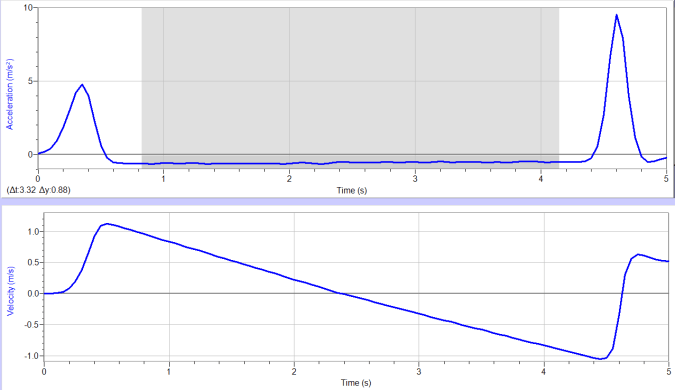
We spent some time discussing the graphs for a set of problems about marbles on ramps. The one with a marble that goes up a ramp, then comes back down, lead to some good discussion. Afterward, students started prepping whiteboards for some mistakes whiteboarding with stacks of kinematic graphs.
cart on ramp.PNG

Physics: Mistakes Whiteboarding

Students did some mistakes whiteboarding for balanced force problems. They are having some trouble connecting the trig to the problems, but are making progress.

Chemistry Essentials: Build an Atom

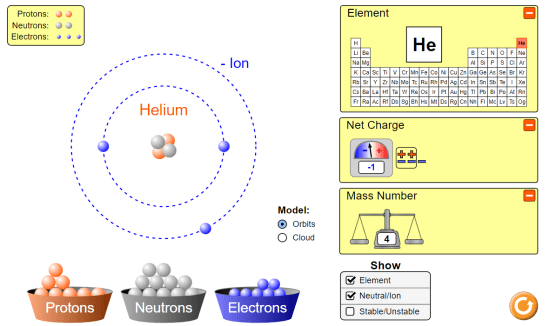
We had a short quiz today and I had students work on PhET’s Build an Atom simulation to start connecting the Bohr model to the periodic table. The students who worked on it were very successful at getting the ideas I was after, but it was very tough to get students to work on the simulation after their quiz.

build an atom.PNG

Day 136: Toilet Paper, Snakey Springs, & Limiting Reactants

AP Physics: Toilet Paper

I started by having students whiteboard some model summaries. I started with linear motion, then asked students to add the angular version of each representation. This seemed to help students draw connections between linear and angular motion. Afterward, students started working on a lab practical to predict where to start an unrolling roll of toilet paper so it hits the ground at the same time as a toilet paper roll dropped from a given height.

Maker:S,Date:2017-10-21,Ver:6,Lens:Kan03,Act:Lar02,E-Y

Physics: Snakey Springs

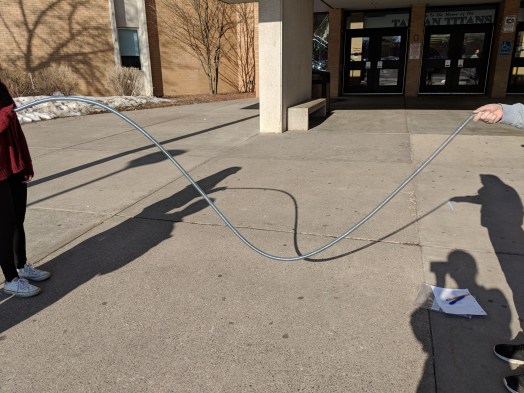
To introduce waves, students played around with snakey springs to look for ways to change the behavior of the waves and get some data for a relationship between wavelength and frequency. Today was one of the first days it was 60 degrees all day and there wasn’t much snow on the ground, so I took the lab outside and a lot of students used sidewalk chalk to help with their measurements. There were also some good observations of the shadows; one group making cycloid waves noticed their shadow looked the same as the shadow for 2D waves.

snakey.jpg

Chemistry Essentials: Limiting Reatants

Students used a PhET simulation to start building some ideas about limiting reactants. The class was much rowdier than usual; the class meets the last period of the day, and I think the nice weather was making a lot of them restless. The concrete visualizations did seem to help a lot of students start making sense of limiting reactants.

limiting ract.PNG

Day 123: Universal Gravitation, Pendulums, & State Testing

Today, sophomores and juniors are taking state tests, so freshmen and seniors have an off-campus learning day. This is the first time we’ve done something like this and the guidelines were pretty flexible. Both of my physics courses are mostly seniors.

AP Physics: Universal Gravitation

Students finished graphing their data from yesterday’s lab using exoplanet data. I started a thread on Google Classroom for students to post questions to try and encourage some virtual discussion, though it didn’t get any action as students opted to e-mail me, instead. Most of the questions I got related to uncertainty, which is not surprising. There were some great conversations yesterday about uncertainty, including why some measurements had different values for the plus and minus.

Physics: Pendulums

Students worked on graphing and linearizing their data from yesterday’s pendulum lab. I usually give students time in class to linearize their graphs so they talk to me or their group members, but they’ve had enough experience at this point that it shouldn’t be a huge leap to do it independently. A few groups didn’t collect all their data yesterday, so I posted a link to PhET’s pendulum lab so they could still be on track for tomorrow’s board meeting.

pendulum lab

Chemistry Essentials: State Testing

My chemistry students are juniors, so they took the ACT today to meet state testing requirements and were off the hook for the off-campus learning day.

Day 117: Central Net Force, Free Fall, & Balancing Equations

AP Physics: Central Net Force

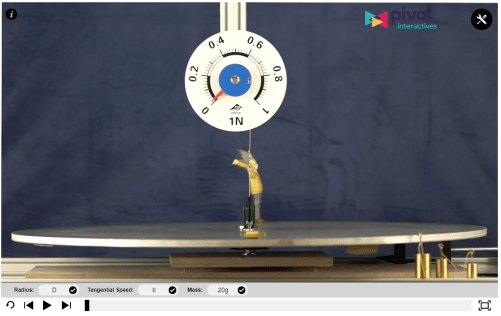
Students worked on an activity in Pivot Interactives to find how speed, mass, and radius affect the centripetal force. One of the great things about this time of year is my students not only have a lot of skills, they are very confident in those skills, so I got to listen to good conversations about experimental design, uncertainty, and linearization without stepping in to do any coaching.

pivot central net force.PNG

Physics: Free Fall

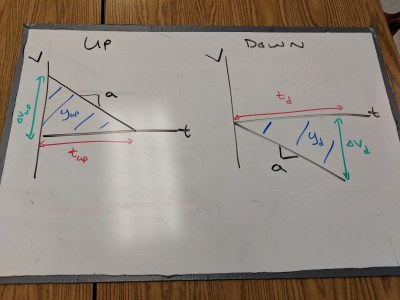
Students worked on some free-fall problems. There was a pretty even split between groups who relied on velocity vs. time graphs and groups who relied on energy. For the first time, I had a couple of groups draw separate v-t graphs for when the object was rising and when it was falling, which helped them organize their thinking.

ud split.jpg

Chemistry Essentials: Balancing Equations

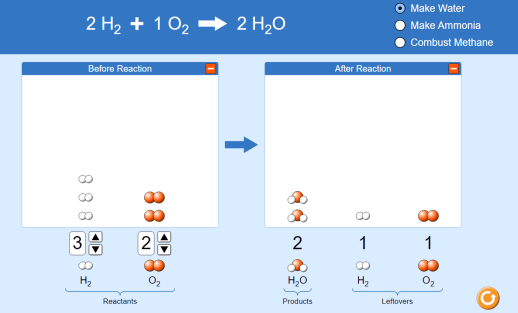
Students used the PhET Balancing Chemical Equations sim to start exploring what it means for a chemical equation to be balanced. This not only seemed to help students make sense of balancing, but to do some retroactive meaning-making on the work we’ve been doing on representing reactions.

balancing eqn.PNG

Day 99: Kirchoff’s Laws, Impulse, & Mistakes Game

AP Physics: Kirchoff’s Laws

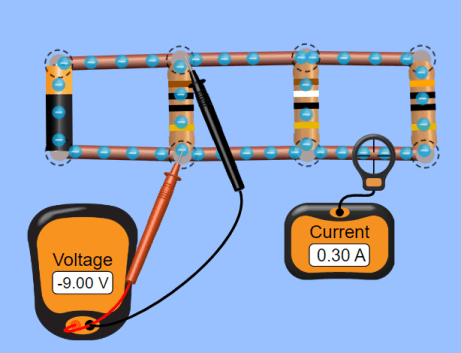
Students used PhET’s circuit construction kit to look for patterns in the current and potential difference in both series and parallel circuits. I usually do the PhET version before the real-world version we started yesterday, but testing season makes it tricky to reserve a computer lab right now. I overheard some students making good connections to their work yesterday and noticing the key things I wanted them to notice.

circuit kit parallel

Physics: Impulse

Students re-did the impulse lab from earlier this week. This time, I spent more time discussing with them why we care about the change in velocity, rather than the velocity at a specific moment. Students were more visibly attentive when I walked through how to get the change in velocity on a LabQuest than they were earlier in the week; I think it helped that they knew we were re-doing the lab because their earlier results came out poorly. I also had groups assign someone to plot their data as it was collected, which had them thinking about whether their results make sense throughout the lab. One section got beautiful results, while the other still had slopes all over the place; I’m not quite sure what happened in the second section.

Maker:S,Date:2017-10-21,Ver:6,Lens:Kan03,Act:Lar02,E-ve

Maker:S,Date:2017-10-21,Ver:6,Lens:Kan03,Act:Lar02,E-ve

Chemistry Essentials: Mistakes Game

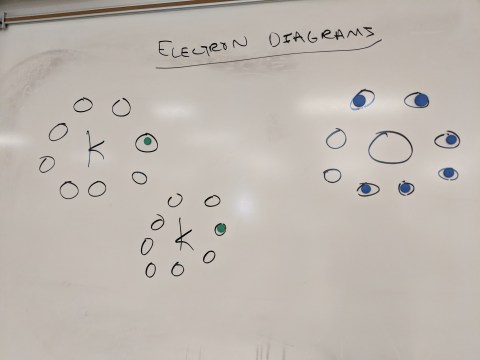
Students whiteboarded yesterday’s problems using the Mistakes Game. The students who are using the electron diagrams as a thinking tool are pretty quickly getting the hang of things.

electron diagra.jpg

Day 96: Circuit Basics, Cart Catching, & Chemical Changes

AP Physics: Circuit Basics

Students used the PhET circuit construction kit to start exploring basic circuit properties and develop Ohm’s Law. It was a lot of fun to listen to students as they discovered new features in the simulation and discussed details they noticed.

circuit kit.PNG

Physics: Cart Catching

To introduce momentum, we borrowed the idea of “chalk-smashing ability” used to introduce energy in the PUM curriculum and had students play with how they could make it harder to catch a cart on a dynamics track. I got excited when a couple of groups took advantage of the plunger carts to see how catching the plunger end felt different than catching the other end, which will be a great lead-in to impulse.

cart catch.jpg

Chemistry Essentials: Chemical Changes

Students did several different chemical reactions to identify signs of chemical changes. There were lots of good observations during the lab.

chem change

Day 74: Projectiles, Energy Transfer, & Quantitative Gas Laws

AP Physics: Projectiles

Students worked on some problems for projectile motion. I overheard a lot of students talking about the labs and demos from last week (which Brian Frank’s post on labs had me listening for!). They could use some more practice justifying answers with physics principles, along with lab results, but that will come.

Physics: Energy Transfer

I used a lab I got from Twitter (I wish I could remember who; if its you, I’m happy to give you credit!). To introduce energy, I had students measure the force and displacement required to pull a cart up ramps with different angles. Then, they sketched force vs. displacement graphs and found the areas.

energy transfer.jpg

Chemistry Essentials: Quantitative Gas Laws

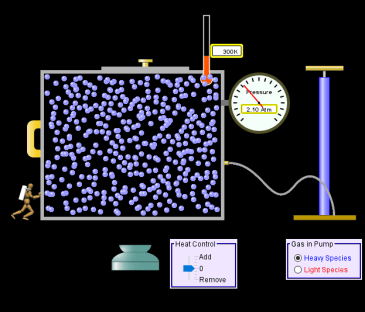
Students used PhET’s Gas Properties simulation to get quantitative relationships between temperature and pressure as well as volume and pressure. There were a lot of great observations about the movement of the particles and one student even pointed out the temperature skyrockets when you add gravity, which should feed nicely into tomorrows discussion.

Gas Laws Sim

Day 49: Numberless Problems, Vector Addition Diagrams, & Bohr Model

AP Physics: Numberless Problems

Students have been feeling pretty good about the unbalanced force problems so far, so I gave them some problems without any numbers. It took some time to get through the first one, then things went very smoothly, even as the problems got tougher.

Physics: Vector Addition Diagrams

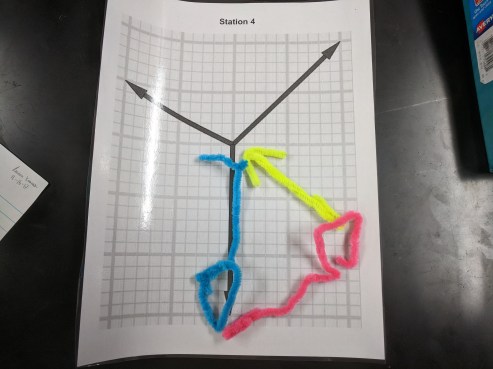
Students did an activity I got from Casey Rutherford using pipe cleaners to translate between free-body diagrams and vector addition diagrams. Students had some good conversations about the difference between balanced forces and equal forces.

vad.jpg

Chemistry Essentials: Bohr Model

Students finished exploring PhET’s Build an Atom simulation. They were able to recognize all of the patterns I wanted them to and were very successful on the questions I had connecting the simulation to their periodic tables. I was also pleased by how quickly students picked up on the fact that the simulation only gave whole number masses, while their periodic table has lots of decimals.

phet atom

Day 48: Unbalanced Forces, Quantitative Interactions, & Bohr Model

AP Physics: Unbalanced Force Problems

Students started some problems on unbalanced forces. I started by having a group demonstrate their success on last week’s lab practical, then asked students what should happen if we swapped out a lighter marble. Once we tried it, we used vector addition diagrams to find the acceleration of each marble and show the mass doesn’t matter.

Physics: Quantitative Interactions

I borrowed an idea from Kelly O’Shea (I think she’s planning a blog post) and, instead of doing balanced force problems on a worksheet or out of the textbook, I gave students 5 different stations to work through. Several groups went back to their force of gravity lab to figure out the first station, which was great for reinforcing that the labs and problems are connected. The downside is I used a mass today that many used on their lab, so they were able to just read off their data table.

Chemistry Essentials: Bohr Model

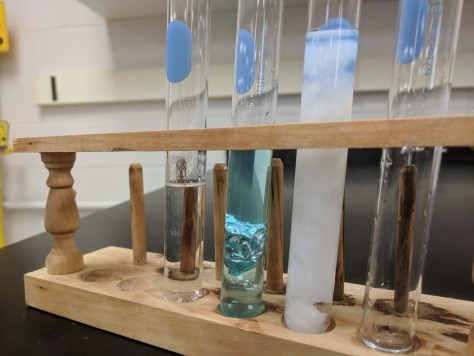
Students used PhET’s Build an Atom simulation to play with the Bohr model. The activity took a little longer than I thought, so no one was able to finish, but students were having some good questions about the changes as they added pieces to their atoms and how that fit with patterns on the periodic table. At the end of the hour, I got out the gas tubes and diffraction gratings so students could see some of the evidence for the Bohr Model. They had a lot of questions we didn’t have time to answer, but I’m hoping that will make for a good way to start class tomorrow. I’ve been trying to put something engaging and thought-provoking at the end of the hour to combat students trying to line up at the door or slip out of the classroom in a positive way, and its had the side effect of making it easier to start class the next day since students show up with questions they are excited about answering.

gas tube

Day 152: Project & Mountain-Building

AP Physics: Project

Students continued work on their projects. Both of my classes are wrapping up the theory and planning portions of the project, and the different personalities of those classes is incredibly apparent. In my 2nd hour, there was a lot of noise and chaos as students worked through their ideas out load as they typed or wrote. In my 4th hour, you could hear a pin drop as students worked out their ideas independently.

Earth Science: Mountain-Building

Today was one of those days in my earth science class. I’d put together an activity on mountain-building and volcano formation in PhET’s Plate Tectonics simulation that I was pretty excited about. When my students fired up the laptops, only thee out of 35 were able to get the simulation running. Plan B was to demo the activity on the SMARTBoard, but the teacher computer failed to load the simulation with a different error. With half the period gone, I resorted to notes. Our tech guy got the issue fixed, so now I have to decide whether I want to try again, or hold on to the activity for the next time I teach earth science.