Day 92: Board Meeting, Dissipated Energy, & Mistakes Game

AP Physics: Board Meeting
Students whiteboarded their results from a Pivot Interactives activity on Coulomb’s Law. There was some debate over whether inverse or inverse-square was the right linearization; I usually don’t have students sketch their points on their whiteboards, but I think that would have been helpful today. Students did a nice job connecting their results to Newton’s Laws and their knowledge from chemistry.

force charge lab.jpg

This group ran out of space for their linearization, but I found their set of graphs very satisfying.

Physics: Dissipated Energy

We continued prep for determining which interaction causes a bouncy ball to dissipate energy (my article about this activity was published in the January issue of The Science Teacher) by whiteboarding key points of yesterday’s work. Today really seemed to help a lot of students see the connections between the energy bar charts, free-body diagrams, and velocity vs. time graphs, which is exactly what I was going for.
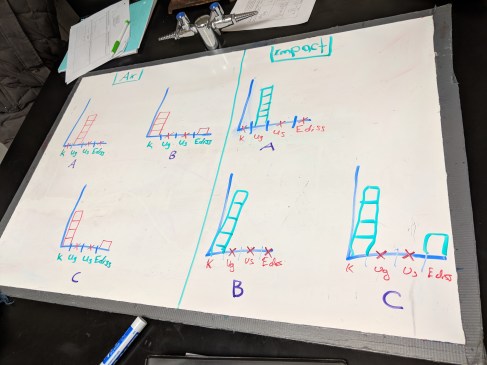
bouncy lol.jpg

Chemistry Essentials: Mistakes Game

We used the mistakes game to go over yesterday’s problems. There was some great discussion, but it was very tough to keep students from breaking into side conversations. Next time, I should spend a little more time making sure behavior expectations are explicit as possible and helping students see the value in those expectations. There were also some students who were extremely engaged and clearly developed a lot of confidence in sketching Borh models today, which was awesome.
Day 91: Coulomb’s Law, Bouncy Balls, & Bohr Model

AP Physics: Coulomb’s Law

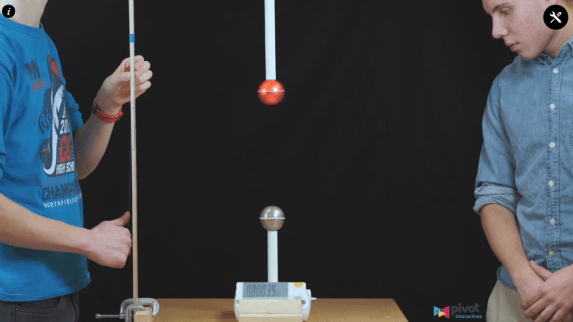
Students worked on a Pivot Interactives activity to find a relationship between the force between two charged spheres and the distance between them. A few students started wondering about the limits of the model since they recognized an infinite force doesn’t make sense, which lead to some good discussion about what it would take to make the distance zero.

pivot force dist.PNG

Physics: Bouncy Balls

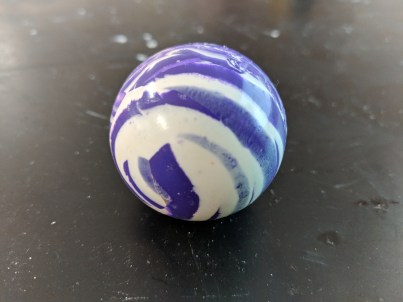
Students started working a lab to determine what interaction is dissipating energy for a bouncy ball (my article about this activity was published in the January issue of The Science Teacher). Today, students worked on sketching representations of the bouncy ball’s motion, including energy bar charts, free-body diagrams, and velocity vs. time graphs for each possible explanation in order to identify useful evidence they can get from video analysis of the bouncy ball. To scaffold this process, I had students sketch the representations on a worksheet today rather than going straight to whiteboards.

bouncy ball.jpg

Chemistry Essentials: Bohr Model

We talked about the results of last week’s simulation to find the links between the Bohr model and the periodic table, then students worked on a worksheet sketching Bohr models from the periodic table. I skipped over revisiting static electricity (which the Modeling Chemistry curriculum calls for) to help establish the concept of charge, but I think next time I’d like to make time for it.

Day 90: Multiple Choice, Practical, & Bohr Model

AP Physics: Multiple Choice

Students took a quiz, then we used Plickers to practice some multiple choice. I intentionally picked some problems that go back to topics from earlier this year. I also spent some time reviewing what it looks like to take full advantage of this activity, and saw students more engaged than last time. I think doing multiple choice less often was a good call.

img_2398

Physics: Practical

Students wrapped up the energy practical they started yesterday. I added a couple of conceptual questions to the task, and was pleased with the conversations I overheard. I think next time I’ll make explaining your group’s answer to those questions part of testing out the result.

Maker:S,Date:2017-10-21,Ver:6,Lens:Kan03,Act:Lar02,E-ve

Chemistry Essentials: Bohr Model

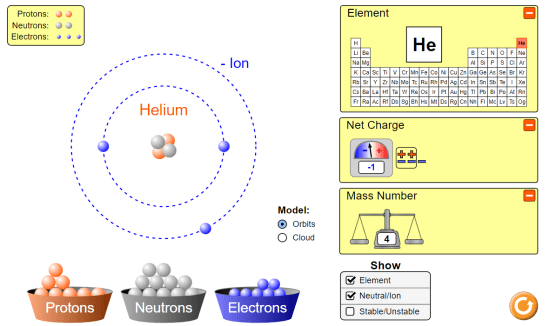
Students used PhET’s Build an Atom simulation to play with the Bohr model and explore how it connects to the periodic table. A few students wanted to know why we are using the Bohr model when the quantum model from yesterday’s reading is more complete, which is a great opener for conversation about what makes a useful scientific model.

build atom.PNG

Day 89: Superposition, Energy Practical, & Atomic Models

AP Physics: Superposition

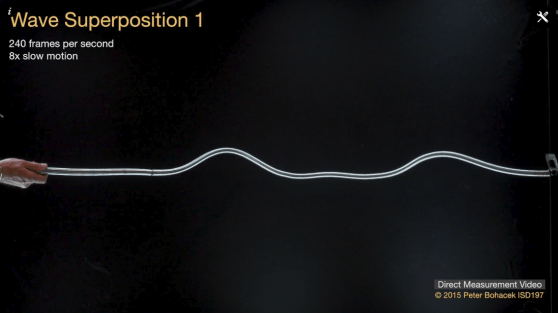
After a little playing with the snakey springs, students went to Pivot Interactives to explore wave superposition. There was a lot of great discussion about whether the wave pulses passed through each other or bounced off each other with students making some pretty detailed observations of the pulses.

pivot superposition.PNG

Physics: Energy Practical

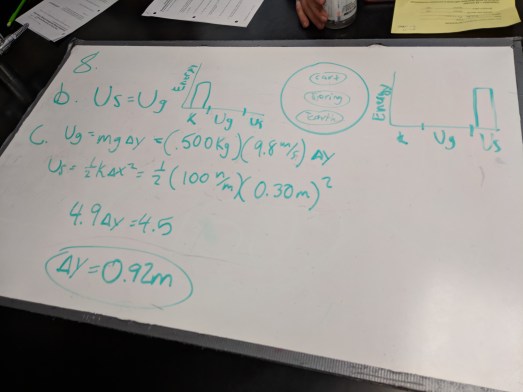
Students worked on using conservation of energy to determine where to place a photogate on a ramp to get a cart moving at a certain velocity. A lot of groups had trouble interpreting their height measurements; I think a lot of them were not keeping track of where they placed the reference height. One group recognized this is pretty similar to the kinetic energy lab we did and used their lab results to confirm today’s calculation.

MVIMG_20180131_131952.jpg

Chemistry Essentials: Atomic Models

I still haven’t found a way I’m really happy with to address the state standard about the evolution of atomic models, but today was the day I tried. I used a POGIL activity where students read some summaries of the major steps in the atomic model and answered some questions. A few students felt overwhelmed by the length of the reading, so we talked about how to use the section headings to make it more manageable. I liked this better than last tri’s jigsaw since doing the full reading seemed to help more of them see the different models as part of the same story.

Day 88: Board Meeting, Energy CERs, & Periodic Trends

AP Physics: Board Meeting

Students whiteboarded their results from the standing waves lab and the wave equation came nicely out of the discussion. I usually give students a minute or two to pre-discuss with their lab group once we circle up with the boards, but I think I can skip that time in my 2nd hour; they dove immediately into asking questions and making comments across groups, which is a great sign of how comfortable with each other and with talking physics.

waves wb.jpg

Physics: Energy CERs

Students wrote CERs with their lab groups to make qualitative predictions about objects like the seismic accelerator and a ballistic pendulum. A lot of groups struggled a lot with what good reasoning looks like, which is not surprising. We’ve backed away from reasoning tasks in Physics this year because many students are struggling on the quantitative problems, but I need to remind myself that students need the reasoning tasks to practice the sensemaking we want them to do on problems.

nrg cer.jpg

Chemistry Essentials: Periodic Trends

Students used yesterday’s cards alongside their periodic tables to start looking at the patterns in the periodic table. Students made a lot of good observations and started asking questions about the legs used to represent valence electrons, which should make for a nice lead in to atomic structure.

card sort 2

Day 87: Standing Waves, Whiteboards, & Elements Card Sort

AP Physics: Standing Waves

Between parent teacher conferences and a bad cold, I failed to actually assign the Pivot Interactives activity I’d planned for Friday to any classes, which made it a little tricky for them to complete. Today, I actually assigned it and they collected data to find a relationship between the wavelength and frequency of a standing wave. The upside is my students had a very self-directed activity while I was still not at 100%.

standing waves pivot.PNG

Physics: Whiteboarding

The majority of my students attempted the problems I left for them to do with Friday’s sub, which is a nice sign of progress. Today, we spent some time whiteboarding the problems, mostly using gallery walks. I gave each problem to at least two different groups so they could compare answers and approaches before the gallery walk, which helped build some confidence. In another sign of progress, in one group that is usually pretty quick to ask for help, one member insisted that today, they would discuss every question before they asked me and told me to wait several times when her groupmates called me over. In the end, they were able to reason their way through every question they had.

lol wb (1).jpg

Chemistry Essentials: Elements Card Sort

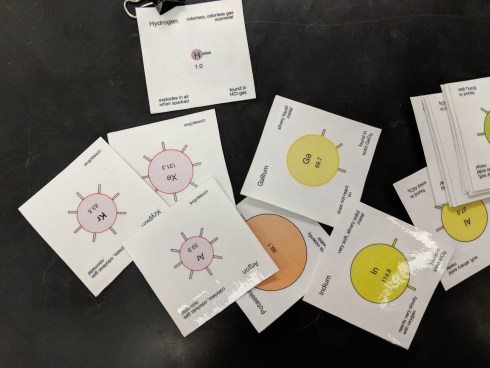
Students worked on a card sort activity loosely based on Mendeleev’s process for developing the periodic table. Each group picked two properties to sort by (one for columns and one for rows), and quickly noticed that other patterns started popping out. I also got a lot of students eager to know what some of the features of the cards represent, so it will be nice to tie some upcoming activities back to this one. Though, I need to brush up on my history a little bit to explain how Mendeleev knew some of these properties.

card sort (1).jpg


Day 50: Whiteboarding, Problems, & Bonding

AP Physics: Whiteboarding

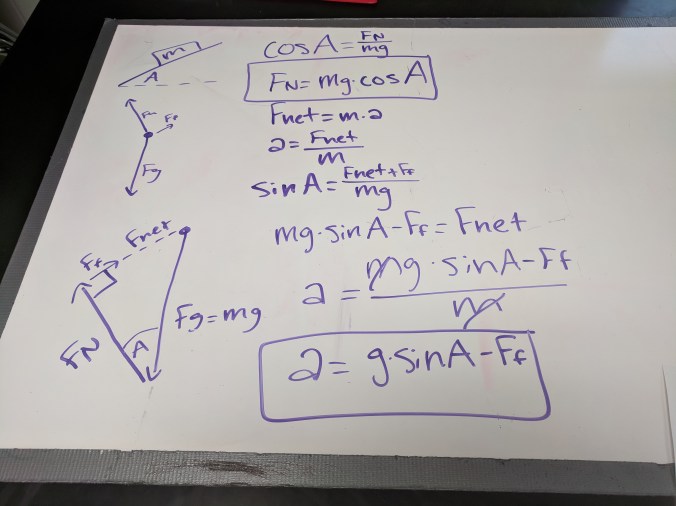
Students whiteboarded their problems from the last few days. I tried to keep the focus on the diagrams and initial setup, since there’s where the physics is. With the end of the term looming and students doing pretty well with these, I had them do a gallery walk rather than taking the time for a more involved whole class discussion.

Physics: Problems

Students started using vector addition diagrams to solve problems with balanced forces in 2D. I saw a lot of groups working much more effectively together than a few weeks ago and students were doing a nice job of playing around with strategies to find their way to an answer.

Chemistry Essentials: Bonding

Now that students have some ideas about the structure of an atom and periodic trends, students used cards similar to puzzle pieces (that I forgot to take a picture of) to explore bonding. Students seemed to be getting a lot of ideas in place about which elements are more likely to give up electrons and why the atomic ratios are what they are.

Day 49: Numberless Problems, Vector Addition Diagrams, & Bohr Model

AP Physics: Numberless Problems

Students have been feeling pretty good about the unbalanced force problems so far, so I gave them some problems without any numbers. It took some time to get through the first one, then things went very smoothly, even as the problems got tougher.

Physics: Vector Addition Diagrams

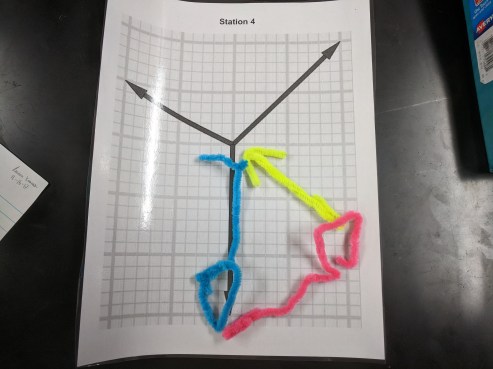
Students did an activity I got from Casey Rutherford using pipe cleaners to translate between free-body diagrams and vector addition diagrams. Students had some good conversations about the difference between balanced forces and equal forces.

vad.jpg

Chemistry Essentials: Bohr Model

Students finished exploring PhET’s Build an Atom simulation. They were able to recognize all of the patterns I wanted them to and were very successful on the questions I had connecting the simulation to their periodic tables. I was also pleased by how quickly students picked up on the fact that the simulation only gave whole number masses, while their periodic table has lots of decimals.

phet atom

Day 48: Unbalanced Forces, Quantitative Interactions, & Bohr Model

AP Physics: Unbalanced Force Problems

Students started some problems on unbalanced forces. I started by having a group demonstrate their success on last week’s lab practical, then asked students what should happen if we swapped out a lighter marble. Once we tried it, we used vector addition diagrams to find the acceleration of each marble and show the mass doesn’t matter.

Physics: Quantitative Interactions

I borrowed an idea from Kelly O’Shea (I think she’s planning a blog post) and, instead of doing balanced force problems on a worksheet or out of the textbook, I gave students 5 different stations to work through. Several groups went back to their force of gravity lab to figure out the first station, which was great for reinforcing that the labs and problems are connected. The downside is I used a mass today that many used on their lab, so they were able to just read off their data table.

Chemistry Essentials: Bohr Model

Students used PhET’s Build an Atom simulation to play with the Bohr model. The activity took a little longer than I thought, so no one was able to finish, but students were having some good questions about the changes as they added pieces to their atoms and how that fit with patterns on the periodic table. At the end of the hour, I got out the gas tubes and diffraction gratings so students could see some of the evidence for the Bohr Model. They had a lot of questions we didn’t have time to answer, but I’m hoping that will make for a good way to start class tomorrow. I’ve been trying to put something engaging and thought-provoking at the end of the hour to combat students trying to line up at the door or slip out of the classroom in a positive way, and its had the side effect of making it easier to start class the next day since students show up with questions they are excited about answering.

gas tube

Day 44: Practical, Spring Force, & Vocab Review

AP Physics: CAPM Practical

Students figured out where to start a buggy so that a marble rolling down a ramp would land in it. Some groups had some trouble translating their strategies for yesterday’s problems to this lab practical, which has been pretty common this year. However, once students got going, there was a lot of success!

Physics: Spring Force

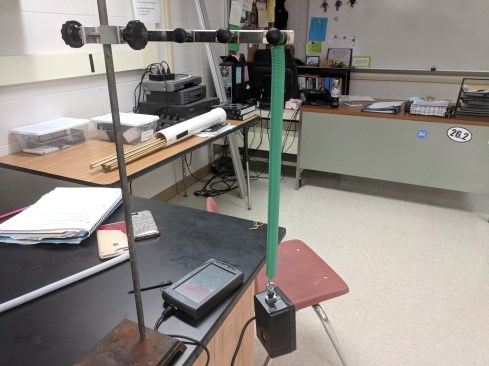
Students worked through the spring force lab I’d previously done with my AP Physics classes. We used force sensors to stretch the spring instead of spring scales or hanging masses so that students could pick one of their springs to also stretch horizontally. From what I saw in notebooks, results are coming out pretty nicely.

spring.jpg

Chemistry Essentials: Vocab Review

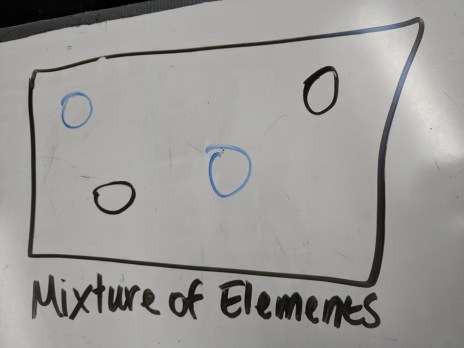
This unit has had more vocabulary and factual knowledge than many of the others, so we took some time to review key terms and reinforce connections between the different ideas.

chem vocab.jpg