Day 96: Circuit Basics, Cart Catching, & Chemical Changes

AP Physics: Circuit Basics

Students used the PhET circuit construction kit to start exploring basic circuit properties and develop Ohm’s Law. It was a lot of fun to listen to students as they discovered new features in the simulation and discussed details they noticed.

circuit kit.PNG

Physics: Cart Catching

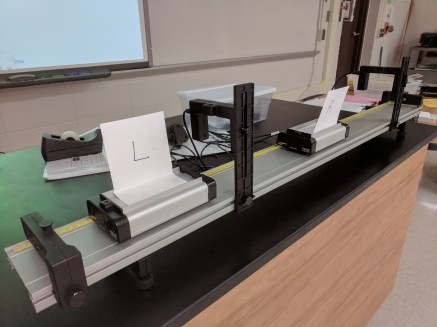
To introduce momentum, we borrowed the idea of “chalk-smashing ability” used to introduce energy in the PUM curriculum and had students play with how they could make it harder to catch a cart on a dynamics track. I got excited when a couple of groups took advantage of the plunger carts to see how catching the plunger end felt different than catching the other end, which will be a great lead-in to impulse.

cart catch.jpg

Chemistry Essentials: Chemical Changes

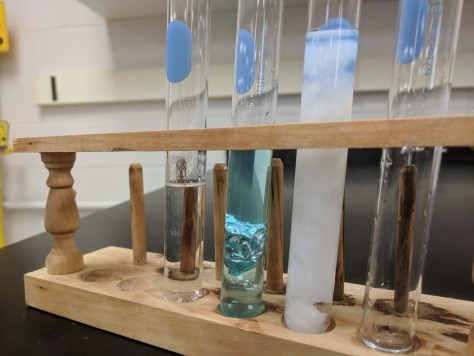
Students did several different chemical reactions to identify signs of chemical changes. There were lots of good observations during the lab.

chem change

Day 32: Whiteboarding Galore

Between having a sub on Wednesday and no school on Thursday or Friday, today was all about getting my classes back on track.

AP Physics: Conservation of Momentum Problems

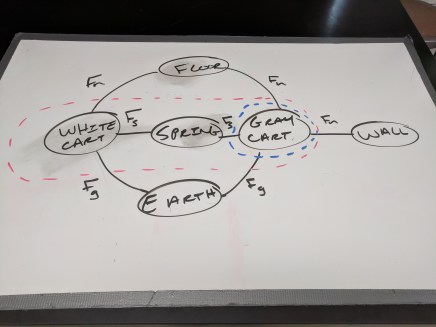
Students whiteboarded the conservation of momentum problems from last Tuesday. Many of the problems require students to shift between thinking about the system as a whole and thinking about individual objects, and interaction diagrams (or system schema) proved to be incredibly powerful tools. The first year I used the Modeling Instruction curriculum, I didn’t quite get them and, as a result, my students never really saw the value, but my students and I are now huge fans.

interaction.jpg

Physics: Constant Acceleration Problems

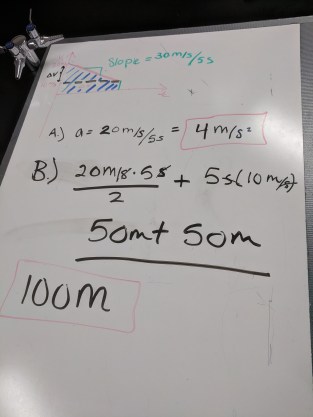
On Wednesday, I left my students some problems that included several that started with graphs they’d already sketched and annotated. My students admitted that they made very little progress on Wednesday, partly because they got confused and shut down. This has been pretty common with my students this year, so we spent some time discussing alternative strategies for when they are stuck. Afterward, students whiteboarded the problems for a gallery walk. They are making good progress on connecting the features of the graph to the physical meaning it represents.

phys graph soln.jpg

Chemistry Essentials: Phase Change Bar Charts

On Wednesday, students watched a short video lecture where I talked about the results of Tuesday’s phase change lab and introduced energy bar charts. While students got nice graphs from the lab, they were confused by the video lecture, so we spent most of the hour discussing it. It turns out the main issue is we haven’t spent much time on what the particles are doing during a phase change, so they weren’t willing to accept that explanation for the constant temperature in the lab without some additional convincing. I fired up a PhET simulation, which seemed to fill in some of the necessary gaps and allowed students to take a much more successful second shot at Wednesday’s bar chart problems.

phase change phet.PNG

Day 30: Problems, Annotating Graphs, & Boiling Ice

AP Physics: Problems

Students worked on some conservation of momentum problems. When students asked for help, I could tell pretty quickly who had sketched interaction diagrams. Especially now that I’m embedding center of mass, they have become an incredibly powerful tool. I also demonstrated exploding carts on a balanced track and was pleased at how easily students used the center of mass of the system to explain why it stayed balanced, even when the carts had different masses.


Physics: Annotating Graphs

Students whiteboarded their solutions to yesterday’s problems. I’m pleased to see a lot of students starting to make sense of the physical meaning of the graphs. I was surprised by some students who struggled to differentiate between initial velocity and maximum velocity, but I think they were able to clear up their confusion by the end of the hour.

graph soln

Chemistry Essentials: Boiling Ice

Students recorded temperatures as ice melted and eventually boiled. A lot of students where quick to say their results didn’t make sense when they saw minimal temperature changes during the phase changes, which was great.

ice melting.jpg

Day 29: Conservation of Momentum, Annotating Graphs, & Temperature vs. Heat

AP Physics: Conservation of Momentum

We had a board meeting on last week’s conservation of momentum lab. As part of their whiteboards, I asked students to write a CER on whether their results made sense and encouraged them to use Newton’s Laws in their thinking. The 1st Law was a much more popular approach than the 3rd Law, but I was pleased at the connections were making.

ap cons.jpg

Physics: Annotating Graphs

Students started working on some problems to annotate velocity vs. time graphs and write equations for the area. I think this is helping some of my students to make more connections to what the graph actually represents, which will be an important stepping stone to solving problems. I also added some problems that just ask students to sketch and annotate a v-t graph from the kind of written description that would start a problem.

phys anno

Chemistry Essentials: Temperature vs. Heat

We took some notes on heat and temperature, then I asked students to predict whether there would be a larger temperature change when I added a small amount of boiling water or a large amount of warm water to a large beaker of room temperature water. Students seemed to wrap their heads around the difference and were able to explain why the warm water produced a bigger temperature change after the demo.

chem temp.jpg

Day 27: Collisions, Graph Stacks, & Linked Balloons

AP Physics: Collisions

Students started collecting data for the momentum before and after a series of different collisions to discover conservation of momentum. Several groups had a lot of trouble with what we meant by before or after the collision, which showed up as trouble both in filling out the table I gave them and in seeing how to place the carts and photogates appropriately. I wonder if having students draw an SOS diagram for the first collision would have helped with that.

collisions.jpg

Physics: Graph Stacks

We used the motion encoder to check the graphs students drew for objects on ramps earlier this week. Afterward, students started working on translating between our different representations for accelerated motion. A lot of my conversations with students today have me thinking that many of them are memorizing shapes of graphs without understanding what they represent. I need to keep working on ways to help students attach meaning to the shapes.

Chemistry Essentials: Pressure

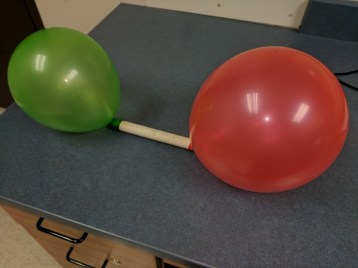
I put a large balloon and a small one on opposite ends of a PVC pipe, using alligator clips to close both. Students sketched particle diagrams to predict what should happen when I removed the clips; I wish I’d had them write CERs instead to encourage more interpretation of the particle diagrams. After I showed students both balloons stays the same size, I had them do a second round of particle diagrams to explain why. There was some great conversation about pressure, but I think that phase also would have been better served with a CER.

balloons

Day 26: CoM Board Meeting, Breaking Down Problems, & Gas Laws

AP Physics: Center of Mass Board Meeting

We had a board meeting to discuss the results of the video analysis from the last few days. I asked students to write a CER for whether the forces on each system of pucks were balanced or unbalanced. This lead nicely into some conversation about what exactly we mean by the two -puck system. I ended up wishing students had more experience interpreting position vs. time graphs prior to this discussion; we’ve mostly worked with velocity vs. time graphs so far, and the various uncertainties piled up to make it look like the velocity was changing. The position vs. time graphs were much more convincing, but students weren’t as likely to look at those.

Afterwards, we played with the coupled carts from Kaar, Pollack, Lerner, and Engles’ The Physics Teacher article. The graphs were very satisfying.

Physics: Breaking Down Problems

On the last quiz, a lot of students really struggled to interpret the problems, so we spent some time today on how to break down a physics problem. As we discussed how to approach a problem, we took time for students to apply each step to the problems on the most recent quiz.

quiz tips

Chemistry Essentials: Gas Laws

We used the results of yesterday’s simulation to develop the gas laws. I’ve found a lot of my students really struggle with algebra, so, rather than developing equations, we came up with statements using proportional reasoning which students then applied to some problems. Some of my students who really struggled to manipulate the density equation were very successful with today’s gas laws problems, so I think this approach was a success.

Day 8: Board Meeting, Ramps, & Mass of a Gas

AP Physics: Board Meeting

We had a board meeting on this week’s impulse lab. I had one section where about half of the groups changed the mass of their cart for each trial, so I need to make sure I revisit experimental design concepts, like how to tell what variables should remain constant. Students still recognized all of the relevant patterns and we were able to get to the impulse equation nicely.

Physics: Ramps

Students finished collecting data for distance and time down a ramp to see a quadratic relationship. The results weren’t as clean as I hoped, largely because a lot of groups started their cart a fair distance behind the first photogate. It takes some background knowledge to understand why that matters, and with the cognitive load required to learn to use the photogates and set up the dynamics track, they lost track of that detail. If I do a graphing unit next year, I might give more traditional written directions rather than relying on discussion and expecting students to make the notes they need to help ease them in a little more.

Chemistry Essentials: Mass of a Gas

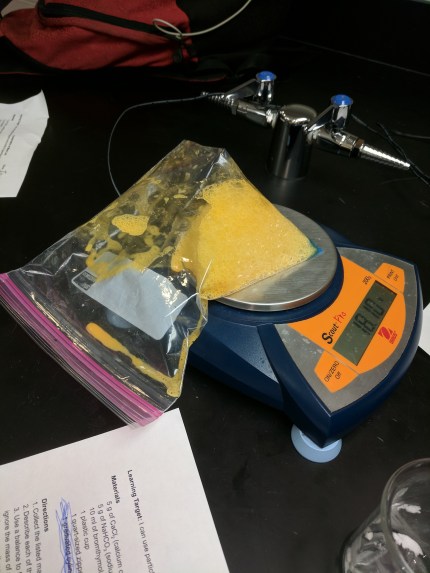
Earlier this week, a student asked what would have happened with the dissolving Alka Seltzer if we had a way to trap the gas and the rest of the class was very excited to discuss their ideas. Today, to answer that question, I had them mix calcium chloride and sodium bicarbonate, along with some indicator, in a Ziploc bag. Things were chaotic enough that I didn’t get much chance to listen to students reason about the reaction, but part of the chaos was a lot of groups were excited to tell me about their observations, which was a great kind of chaos to have.

gas.jpg

Day 7: Impulse, Ramps, & Particle Diagrams

AP Physics: Impulse

Students graphed their data from yesterday. Since I was also introducing them to Desmos and my expectations for their lab portfolios, we ran out of time for the board meetings. The slopes are not coming out as nicely as I’d hoped, which I think is because this is their first quantitative lab and it always takes some time for students to get back into those careful practices. I’m trying to decide whether a different setup might be more forgiving.impulse wn

Physics: Ramps

Students started collecting data to find a relationship between distance and time down a ramp. A major purpose of this lab was to give students an introduction to dynamics tracks and LabQuests, so we had them set everything up from scratch at the start of each hour. Most groups only got one or two data points, but they now see how pieces attach to the dynamics track and have a sense of how to use the LabQuests, so tomorrow should move pretty quickly.
ramp.jpg

Chemistry Essentials: Particle Diagrams

Students worked on a worksheet from the Modeling Instruction curriculum on drawing particle diagrams. I had to do a lot of prompting about what a particle diagram is supposed to show, so I need to think about how to help students connect the name for the diagram to what they should draw. I think students are also struggling to see why the particle diagrams are useful, so I need to think about how to solidify that.

Day 6: Impulse, Big Pendulum, & Alka Seltzer

AP Physics: Impulse

Students did a lab I saw at a Modeling Instruction workshop over the summer. They connected a cart to a force sensor with an elastic string, and used motion detectors to produce velocity vs. time graphs. They collected data to make a graph comparing the area of the force vs. time graph to the change in velocity over the same time period. Introducing the lab felt pretty hand-wavy, so I need to think about how to do a better job of motivating the lab, but the data tables are looking good.

impulse

Physics: Big Pendulum

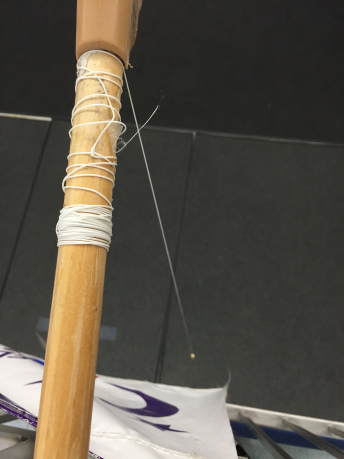
My big goal today was to motivate relationships besides linear. Since the data collected in the classroom for the pendulum lab tends to look pretty linear, I had students predict the period for a pendulum about 5 m long, then we went to a spot in the school where we could test it out. Since the period was shorter than expected, we started looking for other flaws in the linear fit, which lead to some good discussion on the intercepts of the linear graphs before we took a look at some other relationships and learned how to linearize.

pendulum big

Chemistry Essentials: Alka Seltzer

Today, I replaced beakers with plastic cups and we looked at the change in mass of Alka Seltzer in water before sketching some particle diagrams. Every group connected the fizzing in the water to the loss of mass, which lead nicely into the idea that gas has mass. There was some great discussion afterward; students were not only eager to ask interesting questions like what would happen if we had a way to trap the gas, they were also excited to share their ideas about what should happen and why. I usually start the second half of this course with a chemical reaction in a plastic bag to show conservation of mass, but I’m thinking about moving it up since it addresses questions that students are excited and curious about right now.

alka.jpg

Day 5: Mistakes Game, Pendulums, & Dissolving

AP Physics: Mistakes Game

On Friday, as students finished the FCI, they picked up some problems translating between momentum vs. time graphs, motion maps, and written descriptions. Today, we went over them using the Mistakes Game.  Students pretty readily embraced this approach, which was great to see. I did notice a lot of students were not clear on whether arrows between the dots on a motion map represent the momentum vector or a “tap”, which I think goes back to how I introduced the bowling ball lab. Asking students about the spacing on the motion map got them to think about whether there should be a tap, which seemed to help.

mistakes

Physics: Pendulums

Students worked on finding a relationship between the length and period of a pendulum. On Friday, we’d measured a single period as a class to motivate the need to measure multiple periods. Today, I verbally reminded students of that discussion, but, once in the lab, a lot of students were unclear about what it meant to measure multiple periods; I think it would have been useful to demo that to help with their language. Most groups were able to get a graph done, and have done a linear fit with a nice big intercept, which will lead nicely into motivating the need for other relationships tomorrow.

pendulum.jpg

Chemistry Essentials: Dissolving

We continued the mass and change sequence from the Modeling Instruction chemistry curriculum. My plan was to get through both sugar and Alka Seltzer dissolving in water, but I wasn’t thinking when I grabbed beakers this morning and ended up with way more mass than the balances could handle. I ended up having my students do a lot of math, which many found overwhelming, especially since they had to add some blanks to the handout I’d made. If I’d been thinking, I would have pulled out some lightweight plastic cups to replace the beakers. Tomorrow, I’ll use those for the Alka Seltzer lab.