Day 93: Whiteboards & More Whiteboards

AP Physics: Whiteboarding Angular Momentum

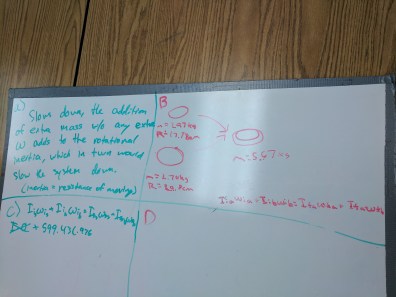
Thanks to a reminder from Dan Burns, I kicked class off with a clip from The Simpsons where Principal Skinner uses conservation of angular momentum to save Ralph. Afterwards, students whiteboarded and discussed yesterday’s problems. I focused on the conceptual problems, and I was pleased by how many students opted to use tools like SOS diagrams to guide their thinking, whether or not the problems asked for them. I also had some groups use analogies to linear momentum to answer questions since they found it easier to visualize. I got really excited when a couple of groups used Newton’s 3rd Law to solve one of the problems, though I didn’t think to take a photo of their boards.12th.jpg
Physical Science: Whiteboarding Motion Graphs

Students whiteboarded their video analysis results for constant velocity. This was the first time I’ve had them talking about graphs, and they made a lot of great observations. After the discussion, we used Logger Pro to look at a constant speed buggy in front of a motion detector and refine some some of the things we saw in the video analysis; after seeing me change the axes on the v vs. t graph from the motion detector, most groups looked at the scale on their v vs. t graphs and decided they should be horizontal lines. It was also fun to see the expressions on some faces when I found the slope of the buggy’s x vs. t graph and they saw it was the speed.

9th

Day 91: Whiteboarding & Engineering

AP Physics: Whiteboarding

Students whiteboarded some problems from Friday and yesterday’s Direct Measurement Video. There was some good discussion about a problem about a collision between a Hummer and a VW Bug, comparing the force, the change in momentum, and the acceleration of each. A lot of students did some really good wrestling with the conceptual distinctions between those ideas. There was also some good discussion about whether momentum is conserved when an object starts rotating. All the groups that said rotation takes some momentum had a calculation, while the groups who said rotation does not impact conservation of momentum used a few different approaches, which gave a nice opportunity to talk not only about uncertainty, but the value of multiple lines of evidence.

Physical Science: Engineering

I decided to expand the big engineering project we have this trimester to include both motion and forces, so today we introduced the project. We spent some time talking about what engineers do, and I was very excited that collaborate was the first thing a student mentioned. We also did some problem scoping, where I gave students a fictitious memo from our “client” and had them use the information to describe the problem, the criteria for success, and the constraints we’ll have to work within, as well as start brainstorming some of the science knowledge they will need for the project. I’ve tended to skip problem scoping, since a fake client feels cheesy to me, but it was interesting to see students really analyze the fairly short text of the memo; it was also interesting that students are thinking about the constraints as reasonable client requests instead of arbitrary obstacles I imposed (at least for now).

engineers

Day 80: Exploding Carts & Sound

AP Physics: Exploding Carts

Today’s quiz took longer than I expected. One of my classes had some time to start collecting data on two carts in a mechanical explosion. They are plotting the ratio of the cart masses to the ratio of their speeds after a spring-loaded plunger launches them apart. I thought about using some probeware to measure the velocity, but went low-tech and had them use the ratio of the distances when the carts reached the end simultaneously. I like that this approach encourages students to start looking for patterns as they collect their data.

explosion

Physical Science: Sound

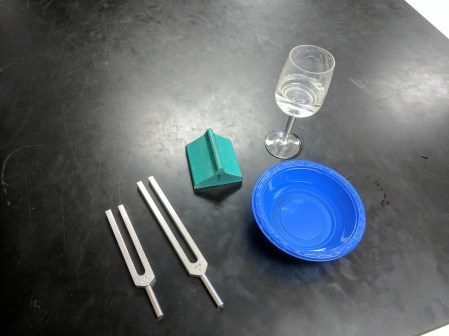
Students used tuning forks and wine glasses to explore some ideas about sound. Students made a lot of great observations and had good discussions with their lab groups and were able to bring some of that back to the whole-class discussion. One of the instructional coaches came by to give some input on helping my students adjust to my approach, and he had a couple of ideas I want to try. Since I keep relationships very qualitative in 9th grade, I ask a lot of questions with limited options, such as whether a variable increases, decreases, or stays the same when another variable changes. The coach suggested I have students physically move to a specific part of the room based on their answer to make it harder to opt out and to facilitate some additional conversations between students. I also like this because it is more obvious to students that we’re doing something different than going over answers like they’re used to. I tend to skip whiteboards in 9th grade, but my conversation with the coach has me thinking they would have some of the same benefits. I need to give some thought to how I can make time for whiteboards in a very tight curriculum.

I also got an idea from grading notebooks this afternoon. I use interactive notebooks, but have gotten very lazy about doing the left side/right side stuff. One of my students has started having a page for each lab, then using the facing page for a summary of the big ideas. That was a good reminder that the left side/right side can actually fit pretty well with what I’m trying to do in the class and I should be having students do those lab summaries.

sound

Day 79: Whiteboarding & Snakey Springs

I spaced out and didn’t take any pictures today.

AP Physics: Whiteboarding

Students worked on whiteboarding elements of the two problems they worked on yesterday. One of the problems involved a block that slides up a ramp and became a projectile; students were either nailing the projectile portion, or completely lost. With an AP test looming, I need to remember to keep spiraling those old concepts back.

Physical Science: Snakey Springs

Students made standing waves and looked for a pattern in how many wavelengths “fit” on the spring. I found a lot of groups missed some of the standing waves, so we made a list as a class of the number of wavelengths they could make a standing wave with and students quickly recognized the pattern.

We also talked a little bit about assessments. After the magnetism quiz yesterday, a lot of students told me they thought it hadn’t gone well, but the most vocal students had perfect scores and the class average was 85%. After talking to students, I think this is related to my challenges engaging students this tri. The earth science assessments they took 1st tri put a lot of emphasis on factual recall, so the reasoning questions I shoot for are big shift for students. I need to think about how I can make it less intimidating to face a new scenario and need to take some time to think on the test.

Day 76: Unbalanced Forces & Motors

AP Physics: Unbalanced Forces

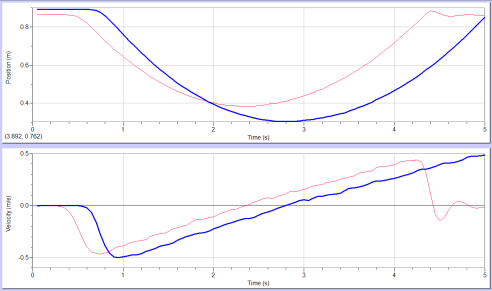
I borrowed an activity from my AP Summer Institute where students get a position vs. time graph and a velocity vs. time graph for a cart on a ramp. At the institute, we were tasked with finding the angle of the ramp and force of friction, but I decided to take a more conceptual approach and tasked students with writing an argument on whether friction is negligible. This was a little ambitious for their first experience with 2D unbalanced forces; I think it would have gone smoother if we’d spent some time practicing free-body diagrams and vector-addition diagrams for unbalanced 2D forces first.

cart-on-ramp

Physical Science: Motors

Students built electric motors, then did some simple experiments to drive home the connection between electric currents and magnetic fields. They seemed to get the connection between today’s lab, the electromagnet lab from Friday, and basic electricity generation.

I also took some time during class to talk with my students about what I want from them during a post-lab discussion and what I’m trying to accomplish during those discussions. I saw a lot more students participating in today’s discussion, both by raising their hands and by adding to their notebook entries. I’m planning to keep reminding them of what the post-lab time should look like, as well as share a little more about why I do things differently than the other 9th grade teachers. I need to remind myself that even if I’ve been in this routine for a full trimester, this is still new to most of my students.


Day 75: Whiteboarding & Electromagnets

AP Physics: Whiteboarding

Most of my students were on a field trip today, so classes were pretty small. We whiteboarded some problems from earlier in the week on balanced forces in 2D. While the problems had a lot of calculations, I just had students whiteboard their diagrams and set-up, including some intentional mistakes. Later, I’ll post correct answers to the class website so students can check their calculations.


Physical Science: Electromagnets

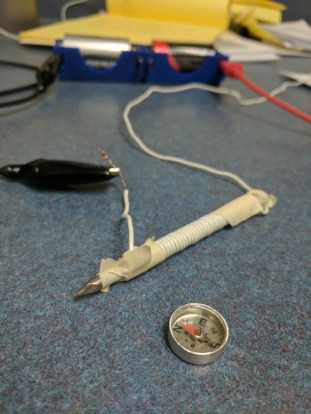
Students built electromagnets, then made some observations about the magnetic field and strength of the magnet.To visualize the field, most groups opted for the compass over the filings, which reinforces my thinking earlier this week that I should start students with the compasses to see the bar magnet’s field.

This week, I’ve been thinking a lot about the fact that I’m really struggling to engage students the way I’d like, especially in post-lab discussions. The last couple of years, I’ve been able to get almost immediate buy-in from my 9th graders, but I think that’s because I only taught them during 1st trimester, when I got to set their expectations for high school science. Most of my students right now had a different teacher 1st tri, so I’m upending their expectations just when they were starting to get comfortable with high school and need to be much more intentional about helping students adjust. On Monday, I want to start with some conversation with the class about my observations and why I do things differently than their other science teachers. I’m also going to start thinking about how I can smooth the transition 3rd trimester, when about 2/3 of the class will be new to me again.

electromagnet

Day 68: Mistakes Game & Light the Bulb

AP Physics: Mistakes Game

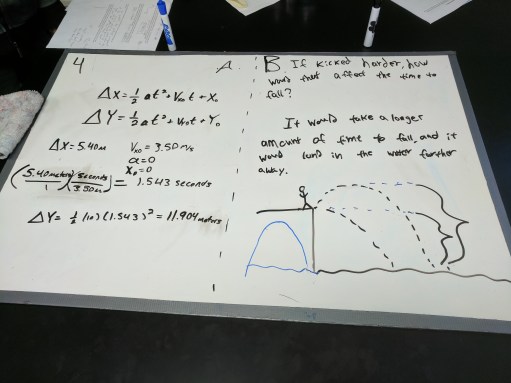
My students LOVE using the mistakes game to go over problems (a few have even decided to sneak in mistakes when they whiteboard problems in calculus), but it doesn’t lend itself nicely to complicated calculations like projectiles. To get around that, I tried having students whiteboard just the set-up to Friday’s problems for the mistakes game. Students embraced it and we had some good discussions about the physics without getting bogged down in the algebra. Since students did not see full solutions to the problems during class, I posted the answers, along with my complete solution to one of the problems, on Google Classroom.

wb

The artist made sure I saw the person on the bottom floor (where they physics room is) is happy and focused, while the history student on the top floor is angry enough to throw a book

Physical Science: Light the Bulb

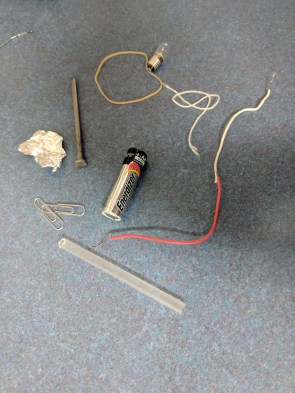
Students were given an assortment of materials and tasked with lighting a light bulb. Afterward, we watched a clip from Minds of Our Own of MIT graduates attempting the same task. Students were pretty successful at picking out some of the key ideas about what a circuit is. Tomorrow, we’re using the PhET circuit construction kit, and I’ll probably have them start with the same task in the sim to reinforce that a circuit is a closed path since its not obvious with the light bulb.

bulb-lab

Day 64: Mistakes Game & Bar Charts

AP Physics: Mistakes Game

We whiteboarded yesterday’s problems using the Mistakes Game. Most groups came up with their mistake by either talking about what they thought the most common wrong answer would be or by picking a mistake they made on the way to solving the problem. The highest math class had a field trip today, so a fair number of students were missing, but some students who are normally very quiet stepped up and spoke quite a bit, so I didn’t have to say much during either discussion. I was also pretty happy when the group presenting pointed to the “momentum force” on their free-body diagram and another student quoted Inigo Montoya from The Princess Bride.

IMG_20161213_093130.jpg

Physical Science: Bar Charts

Students worked on drawing energy bar charts. Some students are struggling with how to tell which types of energy are present, but most got the hang of it once they revisited the definitions of the different types of energy. I do want to keep thinking about how I introduce energy in that class

Day 60: v-t Graphs & Marshmallow Debrief

AP Physics: v-t Graphs

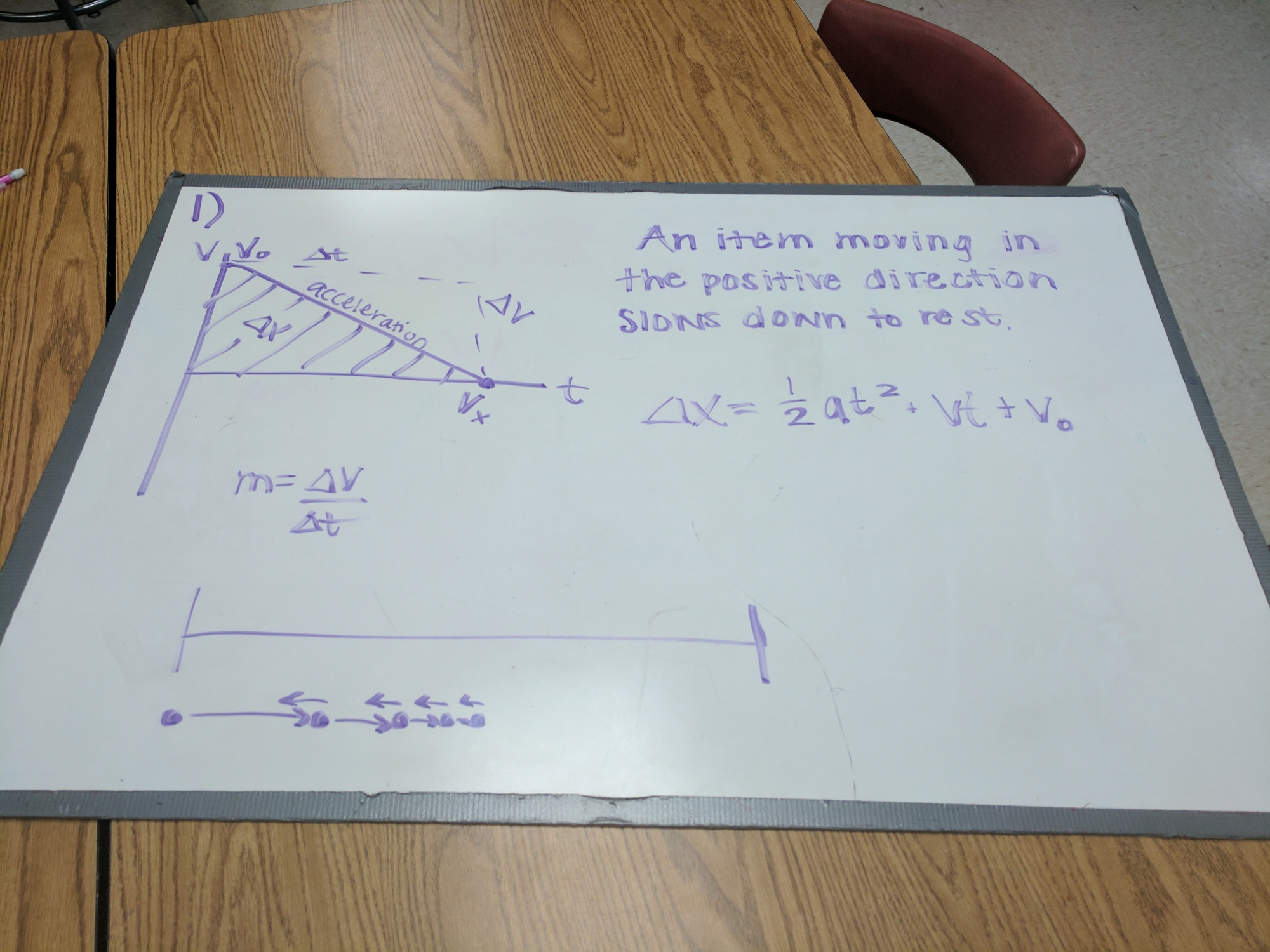
We are starting projectile motion, so today I did a refresher on velocity vs. time graphs. I gave students a few graphs and asked them to annotate the graphs and translate to some other representations. A few of my students got to talking about how their written descriptions of the motion today compare to what they did when we first started constant acceleration, even pointing to particular words and phrases they’ve changed, and the specific change in understanding driving that.

At the end of the hour, I’d planned to go over a few problems on the board to limit how much time this took. When I asked for requests, my students asked if they could whiteboard their solutions instead, so I happily had them do a gallery walk. Have I mentioned lately that my students are awesome?

Physical Science: Marshmallow Debrief

We discussed yesterday’s Marshmallow Challenge. Students recognized many of the growth mindset themes, like the value in learning from failed attempts or the fact that multiple approaches are valuable. We also discussed some things that effective groups do. I want to revisit this discussion later in the tri for students to reflect on how well their group is working.

Day 46: Mistakes Game & Reflecting Telescopes

AP Physics: Mistakes Game

We played Kelly O’Shea’s Mistakes Game using some problems with a central net force. Its great to see my students getting more skilled at discussing physics, which means I’m doing very little to keep the conversation moving. We had some particularly good discussions about a problem about the forces on a roller coaster car as it goes over a hill and about the forces on a yo-yo as it swings in a vertical circle.

img_2482

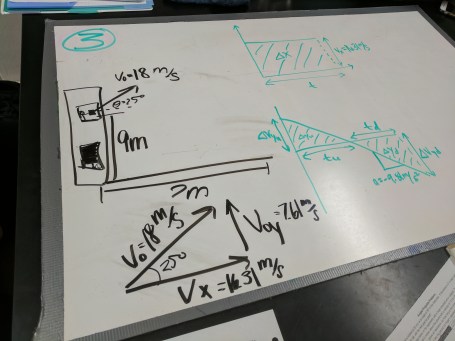
A whiteboard for the roller coaster problem

Earth Science: Reflecting Telescopes

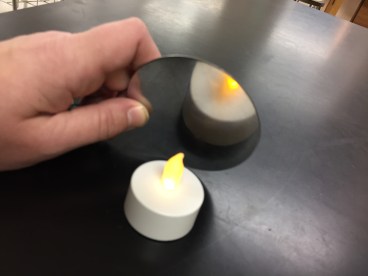
Students played with curved mirrors to get some ideas about how mirrors are used in telescopes. I also got out some electric candles and tasked students with projecting the candle on a sheet of paper. They struggled with that step, but it was great to see their reactions when they got a nice, sharp image of the candle “flame”.

img_2484