Day 107: Experimental Design, Conservation of Momentum, & Particle Diagrams

I had a sub for half the day today.

AP Physics: Experimental Design

Students worked on an experimental design problem off the 2017 AP Physics 1 exam, then did their choice of problems from a packet involving multiple models.

Physics: Conservation of Momentum

Students started working on some problems using conservation of momentum. In the hour I was here for, students were much more confident than I’ve seen them on new problem types all year, which was exciting. When I talked to groups, a lot of them were using connections to energy conservation to think through the problems.

Chemistry Essentials: Particle Diagrams

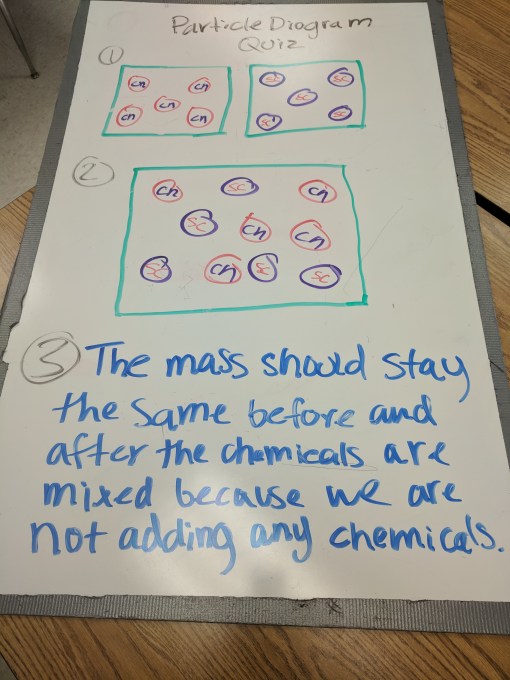
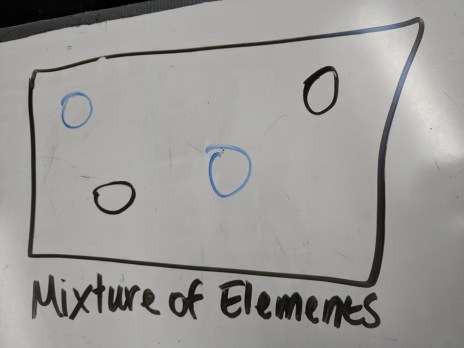
Students reviewed sketching particle diagrams. A lot of students have struggled with these this year and tend to loose track of what a particle diagram is intended to represent, so I want to make sure they get one more shot before the final

Day 105: Multiple Models, Collisions, & Density Review

AP Physics: Multiple Models

With finals next week, students started working on some problems that require them to use multiple models simultaneously. We also spent some time talking through strategies for these kinds of problems; my students are a little more resistant than usual to sketching diagrams, so I made sure to emphasize the value of that step.

Physics: Collisions

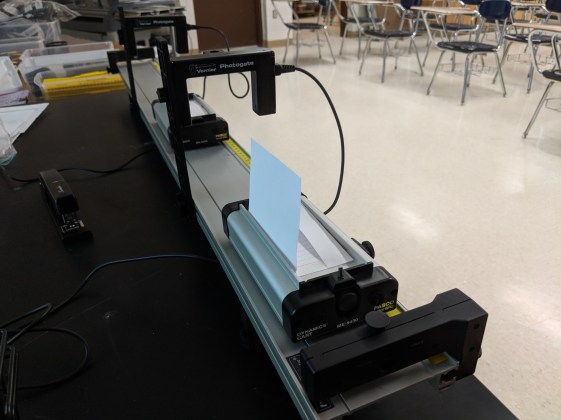
Students started working on a lab with colliding carts to get at conservation of momentum. The lab is going more slowly than I’d hoped, which has me nervous about whether students will be ready to assess on this topic by the end of the week.

collisions.jpg

Chemistry Essentials: Density Review

I have a little more time for review than normal in this class, so I decided to use some potential labs I skipped over this tri. Today, to review density, I had several unknown liquids students had to identify by making a mass vs. volume graph. I had them write their own procedure, which I haven’t done in a while, and students needed a lot more pre-lab discussion to be ready for that.

I’m also starting to struggle more to keep students on task during the lab and to keep them from having side conversations during whole-class instruction. I’ve seen it before with this course; I think a lot of students see it as settled whether they will pass or fail the course once final review begins and get off track as a result.

Day 55: Design a Practical & Review

AP Physics: Design a Practical

Groups set up the lab practicals they’d planned yesterday, then got a chance to try the lab practicals other groups had come up with. It was a lot of fun seeing how much pride students took in watching their peers complete a practical they’d designed. A lot of students said they enjoyed this approach to review, and I liked the thinking it took to design a good practical.

Physics: Review

Students finished up the review assignment they got yesterday, then were able to check answers against my key. Its not my favorite way to review, but it is familiar and comfortable for my students, which I think helped them feel more confident going into the final exam.

Chemistry Essentials: Review

I also went pretty traditional in this class today, giving them some questions to review atomic models and formula writing, especially since we haven’t had a stand-alone quiz on this topic.

Day 55: Design a Practical, Review, & Quiz Jigsaw

AP Physics: Design a Practical

I decided to try something new for my review this year and tasked each group with picking at least one model from this tri, and designing a lab practical. Today, they worked on coming up with an idea and trying it out in the lab. I’m having a lot of fun seeing what students are coming up with; I need to make sure I get photos of all of them tomorrow. The main challenge was I did a lot of running around between classrooms to find lab equipment for students, so next time I’ll try to do a better job of having most of the equipment we’ve used in the room already.

Physics: Review

Students worked on some review worksheets from the Modeling Instruction curriculum. As students worked, there were several I talked to who are feeling very overwhelmed right now, so we talked a little about the worst case scenario as a sort of pep talk. I will probably take a few minutes tomorrow to do that with the whole class.

Chemistry Essentials: Quiz Jigsaw

Groups presented the whiteboards they worked on yesterday. Most students no longer had their old quizzes, which made it tough for them to take full advantage of this; next time, I might give them a full set of blank quizzes as a review packet. I asked groups to pick what they thought were the hardest problems off their quiz to whiteboard, and most groups picked problems that the majority of students got wrong on their original quiz, which was great!

chem jig.jpg

Day 54: Model Summaries & Quiz Jigsaw

Final exams are this week, so all three of my classes are doing some review the next few days.

AP Physics: Model Summaries

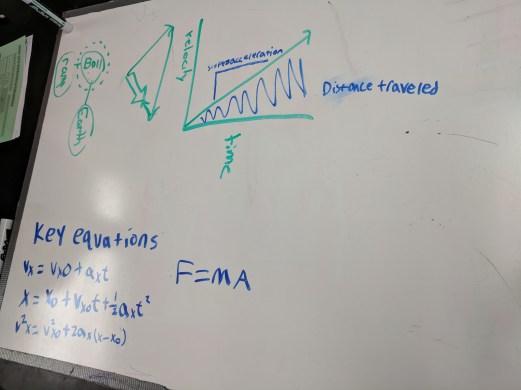
I gave each group one of the four models we’ve covered this trimester, and asked them to whiteboard examples of the key representations for their model, including diagrams, graphs (with notations about what has physical meaning), and equations. Once whiteboards were ready, we took a few minutes to do a gallery walk. A really cool surprise was just about every group included some force representations, regardless of which model they were whiteboarding.
ap capm summary.jpg

CAPM summary

Physics: Model Summaries

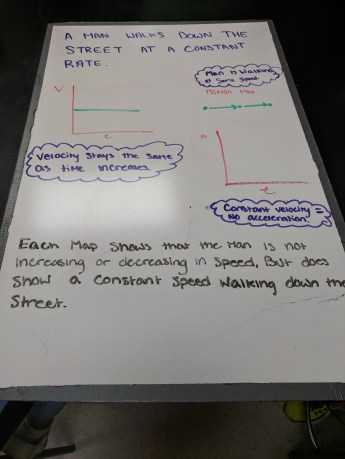
My physics classes also worked on model summaries, but I used a different structure. First, rather than giving each group a different model, I had the whole class whiteboard the same model, then we did a gallery walk before moving on. Second, to make things a little more concrete, I asked each group to come up with a scenario where the model applied, then to sketch representations and give some written descriptions. I think a lot of students didn’t see as much value in this as I’d hoped; I have a lot of students who have been trying to memorize the diagrams, rather than using them as meaning-making tools, and spending time thinking about the relationships between the diagrams doesn’t contribute to that approach. With a new tri starting next week and most of my students either switching hour or switching teacher, I’ve got a good opportunity to think about how I can re-calibrate my classroom culture towards more meaning-making.
cvpm summary.jpg

CVPM summary

Chemistry Essentials: Quiz Jigsaw

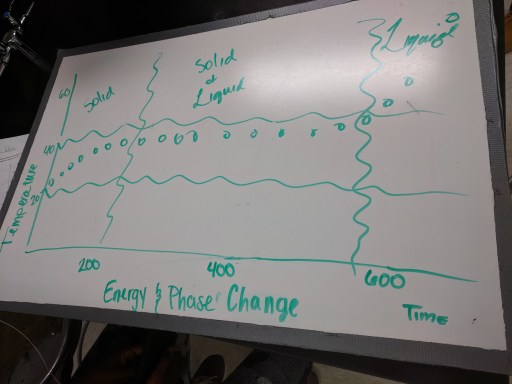
I gave each group an old quiz and asked them to work through it. Once groups started to finish, I asked them to pick the hardest problem or problems and prep a whiteboard with their solutions. The big challenge is I had a lot of students checking out today, which is pretty typical for what I see during finals week with this course; for most of my students, whether or not they pass is more important than their letter grade, and are aware that a final that is 10% of their grade will have little impact on whether they pass. I need to spend some time thinking about final exams that students are more likely to find more intrinsically meaningful.
chem quiz wb

A problem that almost everyone got wrong on the quiz
Day 53: Multiple Choice, Quiz, & Polyatomic Ions

AP Physics: Multiple Choice

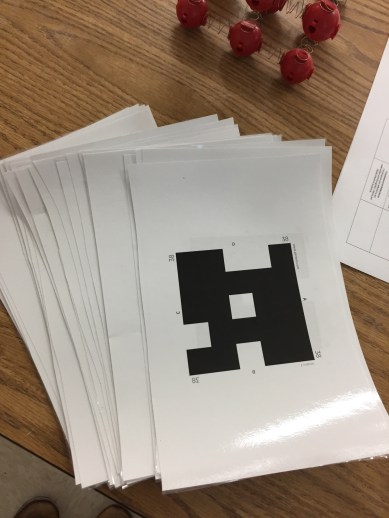
Students took their last quiz for the trimester, then we spent the rest of the hour using Plickers to practice multiple choice questions. Final exams are next week, so the multiple choice also served as a way to start reviewing for the exam. I continued my usual routine of having students answer individually, then talk to a classmate before answering again and both classes had some good conversations about the problems.

img_2398

Physics: Quiz

Students took their last quiz of the trimester over balanced force. A lot of students have been struggling to identify the direction of forces, and that is showing up on the quiz. When working on problems or labs, students were pretty successful when they went back to the language of the interaction stations we’d done, but the students who are struggling usually need prompting to think in those terms. I do some fairly general reflection in the course, but I’m thinking about how I can improve that next tri to help students recognize useful ways of thinking.

Chemistry Essentials: Polyatomic Ions

Students worked on writing formulas based on names that include polyatomic ions. Today, I added having students sketch particle diagrams for each compound, which helped them focus on the meaning of the various numbers. Yesterday’s activity with the Lewis dot beans also helped students think through today’s problems. Next tri, I think that will be my starting point for bonding.

Day 44: Practical, Spring Force, & Vocab Review

AP Physics: CAPM Practical

Students figured out where to start a buggy so that a marble rolling down a ramp would land in it. Some groups had some trouble translating their strategies for yesterday’s problems to this lab practical, which has been pretty common this year. However, once students got going, there was a lot of success!

Physics: Spring Force

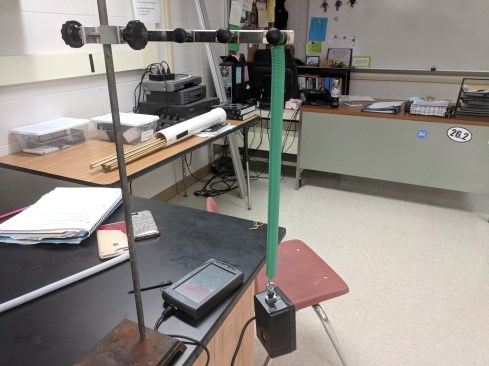
Students worked through the spring force lab I’d previously done with my AP Physics classes. We used force sensors to stretch the spring instead of spring scales or hanging masses so that students could pick one of their springs to also stretch horizontally. From what I saw in notebooks, results are coming out pretty nicely.

spring.jpg

Chemistry Essentials: Vocab Review

This unit has had more vocabulary and factual knowledge than many of the others, so we took some time to review key terms and reinforce connections between the different ideas.

chem vocab.jpg

Day 138: Free Response & Review

AP Physics: Free Response

I made today an optional in-class retake day. Since some students wanted the full hour to do multiple learning targets, I decided to skip doing some multiple choice on Plickers and gave students some free response problems from the 2015 AP exam. On Monday, we’ll take a look at the scoring guides.

Earth Science: Review

Students generated some questions for each learning target on whiteboards, then traded with other groups to try and answer the questions they came up with. I’ve been doing this a lot in my Earth Science classes, and its fun to see the improvement this year, even with students I only have for one tri. A lot of teachers in my building are working getting students to ask high-level questions as part of using AVID instructional strategies, and its neat to see that paying off a bit.

IMG_20170421_083753


Day 112: Model Summaries & Peer Review

AP Physics: Model Summaries

Students made model summaries for the rotation version of key models so far. Students seemed to find it useful to remind themselves what tools are available to think about these models. Afterwards, students worked on some goal-less problems to reinforce the importance of starting a problem with what models apply. Students were really pleased when they realized some of the problems worked equally well with energy or with a combination of constant acceleration and forces.

rot force.jpg

Physical Science: Peer Review

I had groups pair off to share their presentations and give some feedback. My strong groups made good use of the time and I heard a lot of nice feedback, but my other groups could have used more structure. Next time, I think I will provide students with hard copies of the rubrics to fill out to give them a little more accountability and focus their feedback.

Day 111: Model Summaries & Presentation Work

AP Physics: Model Summaries

Today and Monday are dedicated to review for final exams. One of the problems on yesterday’s assessment is from last year’s AP Physics exam, so I gave students a copy of the scoring guide for that problem and some time to see how they measured up against the College Board criteria. Students responded positively and said it helped them understand what the graders are looking for.

Afterward, I assigned each group one of the four major models we’ve covered so far (constant acceleration, forces, momentum transfer, and energy transfer), then had them whiteboard a summary of that model. Once groups finished, we did a gallery walk so students could have a chance to review other models. Students said this helped remind them of tools they’d forgotten about. I think on Monday, I’ll come up with some problems for them to practice picking appropriate tools.

model-summary