Day 56: Toilet Paper Drops & Review

AP Physics: Toilet Paper Drops

Students wrapped up yesterday’s lab practical and got  chance to try dropping their toilet paper rolls. Groups were very successful. Especially in my second hour, I was really pleased that, without any prompting, the students in groups that finished early split up to look for other groups that could use some help.


Earth Science: Review

I had students review for Friday’s final by generating some possible test questions for each unit on a whiteboard, then trading boards with another group. When I put up the title of the first unit, there was a moment of panic as students tried to remember what it was even about, but they pretty quickly turned to their notebooks to remind themselves of the major concepts and look for ideas of questions to ask, which is exactly was I was hoping for.

img_20161130_083834

Day 55: Toilet Paper Drop & Galaxy Sorting

AP Physics: Toilet Paper

Students started a lab practical I got from Frank Noschese’s blog. Students were given a height they will drop one toilet paper roll from and are tasked with figuring out where to drop an unrolling toilet paper roll so it hits the ground at the same time. I’m trying to emphasize the ways that students are using forces and constant acceleration in the practical to make sure this is doubling as a review for the final exam.

tp

Earth Science: Galaxy Sorting

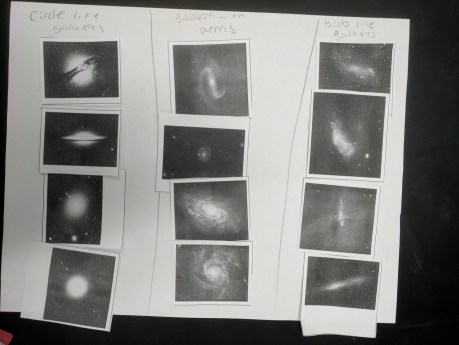
Students were given pictures of a dozen galaxies and tasked with putting them into categories and naming each category. Most groups came up with something pretty close to the three official categories. I can’t decide if I’m happy about that. On the upside, my students are very comfortable with the vocabulary. On the downside, the fact that so many groups got similar results tells me there was limited thinking required.

galaxy-sort

Day 54: Rotational Inertia & Big Bang

AP Physics: Rotational Inertia

We finally collected data and prepped whiteboards for the rotational inertia lab we’ve been working on. Tomorrow, we’ll spend part of the hour on a short whiteboard meeting to figure out what rotational inertia is proportional to. Students did a nice job of working through all the calculations they had to do to get from something they could measure to the rotational inertia, and it was a good review for the final exam later this week.


Earth Science: Big Bang

We discussed the lab from last Wednesday, where students made a graph to find Hubble’s Law. In the discussion, we focused on this result as evidence for the expansion of the universe. Afterwards, I ended up lecturing on the Big Bang Theory and some of the other evidence supporting it. I’m rushing a little bit as I try to cram material in at the end of the tri. Today was a reminder that over the summer, I want to spend some time with the curriculum, comparing it to the required state standards and the district-approved learning targets to get a better idea of what I can cut and where I can add build in more time for scientific practices.

Day 51: CER & HR Diagrams

AP Physics: CER

Students practiced using the CER format to explain their answers on some TIPERs questions related to centripetal force and torque. Students are overall getting better at answering these kinds of questions, but many of them get stuck putting their process into words when they were able to use a formula to guide their answer. We only discussed one problem as a class, so I’m thinking about using a peer review process to go over some of the others.

IMG_20161121_121032.jpg

Earth Science: HR Diagrams

Students worked on plotting temperature vs. absolute magnitude on a logarithmic grid to produce an H-R diagram. The plotting was much more time-consuming than I expected, partly because it was challenging for students to make sense of the logarithmic scale. I don’t think the time spent graphing did much to support understanding the science, so next year I want to give students a completed H-R diagram, then we can spend time making meaning, rather than making the graph.

Day 50: Extending Torque & Light Intensity

AP Physics: Extending Torque

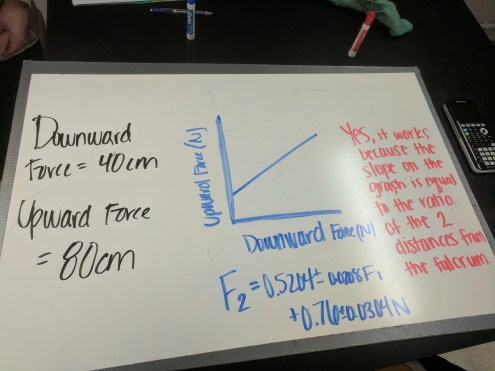
We had a board meeting to discuss yesterday’s lab with second class levers. On the lab, I simply asked whether the model we’d developed so far for a balanced lever also worked for this new type. Since the question is a bit ambiguous, groups that got similar results disagreed on whether the answer should be yes or no, which lead to some great discussion on what are the key elements of the model. I was also pleased with the way students talked about uncertainty to decide whether or not they could ignore the intercept. Over all, I’m really excited about how discussions with this group are going. I feel like I’m getting to take more of a backseat and listen to students talk to each other, rather than relying on me to guide the conversation.

wb-2

Earth Science: Light Intensity

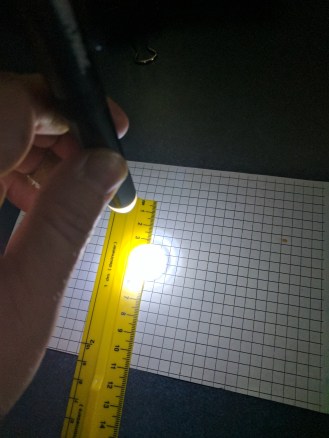
Students graphed the diameter of a light beam vs. the distance from a light source, making some qualitative observations about brightness along the way. We used the results as the basis of a discussion about why an astronomer would want a big telescope to observe very distant objects. I also did some having students observe the pen light itself from different distances to get across the idea that, even though the light beam spreads out, the light source doesn’t look any bigger.

img_20161118_102045

Day 49: Extending Torque & Sun Layers

AP Physics: More Torque

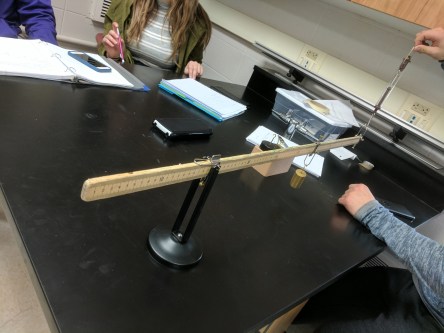
After formalizing the results of yesterday’s lab, I showed students a second class lever and asked them to decide whether the model we have for torque applies to these new levers and prepare a CER on a whiteboard. Most students went back to the first lever lab, where we looked for a relationship between the two forces and got beautiful results, including an intercept that’s too big to ignore. I was pleased at how many groups immediately decided to measure how much force it took to balance the lever with no additional weight on it and by how many had good conversations in their lab groups about what must be causing the intercept.

lever

Earth Science: Layers of the Sun

Students used the textbook to complete a jigsaw on the layers of the Sun. The textbook has a line about “bright hydrogen lines”, so we had some good discussion as a class about how to interpret that statement and connecting back to the spectroscope lab we did a few days ago.

Day 46: Mistakes Game & Reflecting Telescopes

AP Physics: Mistakes Game

We played Kelly O’Shea’s Mistakes Game using some problems with a central net force. Its great to see my students getting more skilled at discussing physics, which means I’m doing very little to keep the conversation moving. We had some particularly good discussions about a problem about the forces on a roller coaster car as it goes over a hill and about the forces on a yo-yo as it swings in a vertical circle.

img_2482

A whiteboard for the roller coaster problem

Earth Science: Reflecting Telescopes

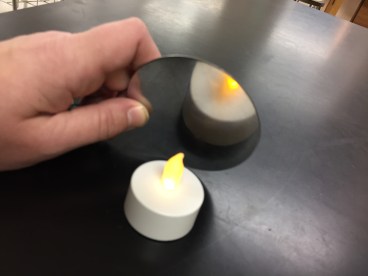
Students played with curved mirrors to get some ideas about how mirrors are used in telescopes. I also got out some electric candles and tasked students with projecting the candle on a sheet of paper. They struggled with that step, but it was great to see their reactions when they got a nice, sharp image of the candle “flame”.

img_2484

Day 44: Central Forces & Orbit Wrap-Up

AP Physics: Central Forces

Students whiteboarded their results from Monday’s activity. In the computer lab, there was a lot of debate about what forces were acting on the weight, so I had students include an FBD for the weight on their whiteboards, which lead to some fantastic discussion in my second hour. Students had strong opinions on whether or not there should be a force to balance the tension and were quick to offer an argument one way or another. Even better, a number of students who are usually quiet during whole-class discussions put ideas and arguments out there. Along the way, students connected this back to the bowling ball lab, where one of their tasks was to get the bowling ball to travel in a circle using a rubber mallet. This was the first time I really felt like I got to just sit and listen while my students figured out something important together, and it was fantastic. As the class came to a consensus, one student captured his take with the “mind blown” gesture and sound effect.img_2473

Earth Science: Orbit Wrap-Up

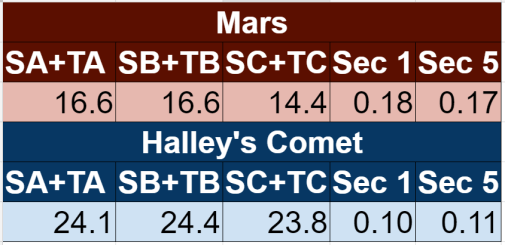
Students took a few minutes for students to finish their measurements for the look at the orbit of Halley’s Comet, and we discussed the results. Interestingly, when we looked at the total distance to the focal points, the class averages for Halley’s Comet was better than the class averages for Mars. When I played with the data on my prep, I saw that one group got dramatically different results from the rest of the class. Tomorrow, I’d like to take some time to look at that with my students to get at the idea of outliers and how to handle them in science.

comet-results

Day 43: Assessment Reflection & Movie

I was chaperoning a field trip today, so no photos and lessons that were easy to leave for a sub.

AP Physics: Assessment Reflection

Students took a test combining forces and constant acceleration today. On tests and quizzes, I’ve been asking students to rate themselves on each learning target and write a short reflection, so I took a few minutes to read over the reflections after the field trip. I like getting a sense of where my students feel confident and where they are struggling before I grade the whole test. It was also fun to see what students wrote. I’ve been trying to improve how explicit I am about what is included in a given model, so I was really pleased to see several students tell me that they started each problem by identifying what models apply, then thinking of the “toolbox” that goes with that model. I also was really excited to see a student who has been struggling write that, moving forward, he wants to shift from trying to understand what they answer is to trying to understand why its the answer.

Earth Science: Movie

The earth science curriculum calls for another movie this unit (I think I’ve shown more movies in Earth Science this year than I’ve shown in physics the last several years combined), and I went with it since that’s an easy thing for a sub. I’ve been using the existing worksheets to go with the movies, which have very factual questions in the order they appear in the movie. The next time I show a video, I might try getting the students to do a little more thinking by adapting some reading response techniques like four square notes or a 3-2-1 response.

Day 42: Mass & Comet Orbits

AP Physics: Mass

Students finished the lab practical we started on Thursday where they used a modified Atwood’s machine to find an unknown mass. Today, once they had an answer, we checked their result using a spring scale. One of my goals this year is to work on hearing from every student, so I tried posting three questions about the lab (one for each group member). Then, before groups could check their result, I would roll dice to decide which group member had to answer each question. Since there are three students in each group, I was able to hear from every student. Groups did a really nice job of making sure all three group members could answer all three questions, which is exactly what I hoped would happen.

img_2469

Earth Science: Comet Orbits

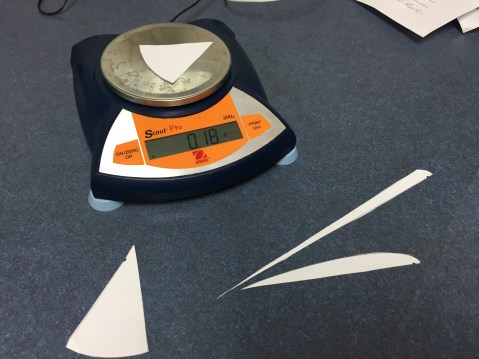
Students finished up yesterday’s lab contrasting Mars’ orbit with Halley’s Comet’s orbit. A lot of groups were surprised when they realized that the patterns from Kepler’s Laws worked equally well for both orbits, especially when they used mass as a proxy to compare the areas of two sections that represent equal times. Next time, I might see if I can get my hands on some card stock or other heavier paper to make it a little more convincing that the small differences are negligible. I also will probably re-work my Kepler’s Law introduction to include Halley’s Comet right off the bat, rather than waiting until we introduce comets.

img_2468