Day 149: Project & Earthquake Engineering

AP Physics: Project

I took a few minutes today to clarify what I’m looking for in the project, and that seemed to help some students shape their next steps. A lot of students would like to use video analysis, so I booked a few days in the computer lab next week. We have some iPads with Vernier Video Physics loaded, so I may see if I can have a few of those in the classroom in the meantime.

Earth Science: Earthquake Engineering

Students tested their towers to see how they held up in an earthquake. Most groups had a pretty wide base, with a narrow tower on top since I made the main criteria height. I’d love to find a good way to measure the acceleration at the top of the tower; I think in a longer project, this could provide students with more opportunities to connect their design to their science knowledge, especially if they were encouraged to try some exotic solutions, like tuned mass damping.

tower.jpg

Day 148: Projects & Earthquake Engineering

AP Physics: Projects

Students continued to work on their final projects. There was a range of how well students were using the time; I suspect part of the problem is they aren’t clear on what I’m looking for in the final product, so I need to spend some time clarifying that Monday and reviewing my expectations. I’m pretty excited about the projects students are working on so far; one student is digging into a certain move in his favorite video game using video analysis and got stuck figuring out how to deal with the camera panning during the move. He ended up tracking a background point, then using a calculated column to find the character’s position relative to that point, which produced a beautiful parabola.

Earth Science: Earthquake Engineering

Students designed towers intended to stay upright during an earthquake. We ran out of time to test the towers, so that will wait until Monday.  Students are just using straws, but I’d like to think about how to encourage students to think about stability at the highest levels. This is also a tough activity for students to really connect to their science knowledge; they are better equipped to justify ideas for shake tests than to justify ideas for a tower design. Even so, students pulled in some interesting ideas from geometry. A few students who were in my class last tri also took some ideas from the Marshmallow Challenge we’d done.

IMG_20170505_085141

Day 140: Types of Mass & Seismometers

AP Physics: Types of Mass
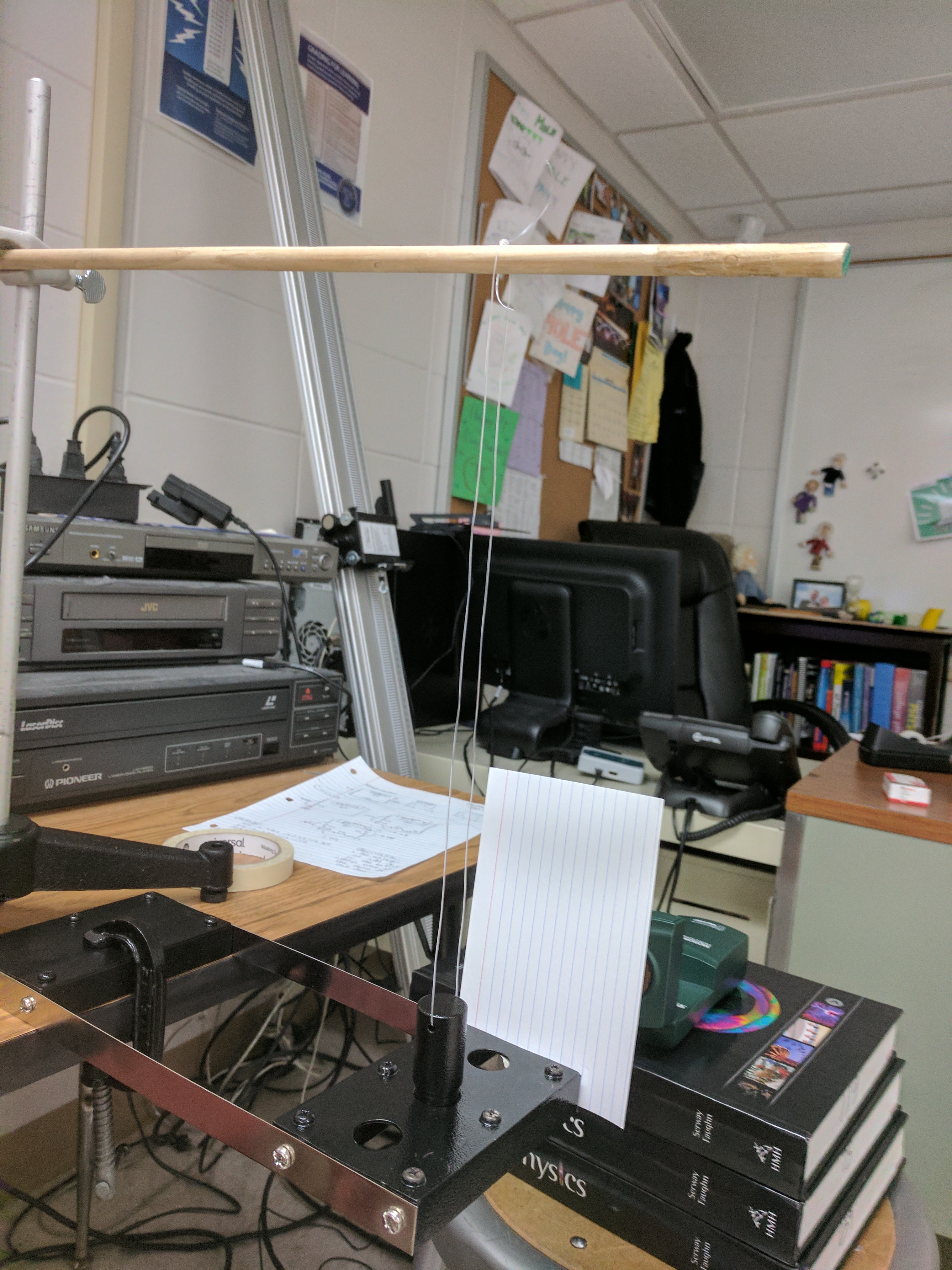
I wanted to revisit gravitational and inertial mass, so I got out the inertial balance and asked which type of mass a spring’s vibration should depend on. Finally, we used the motion detector to find the period with and without a string supporting the added mass and got beautiful results.

Afterward, students worked on some free-response problems in their groups. Tomorrow, they will get limited time with the scoring guides, then present their assigned problem.

Earth Science: Seismometers
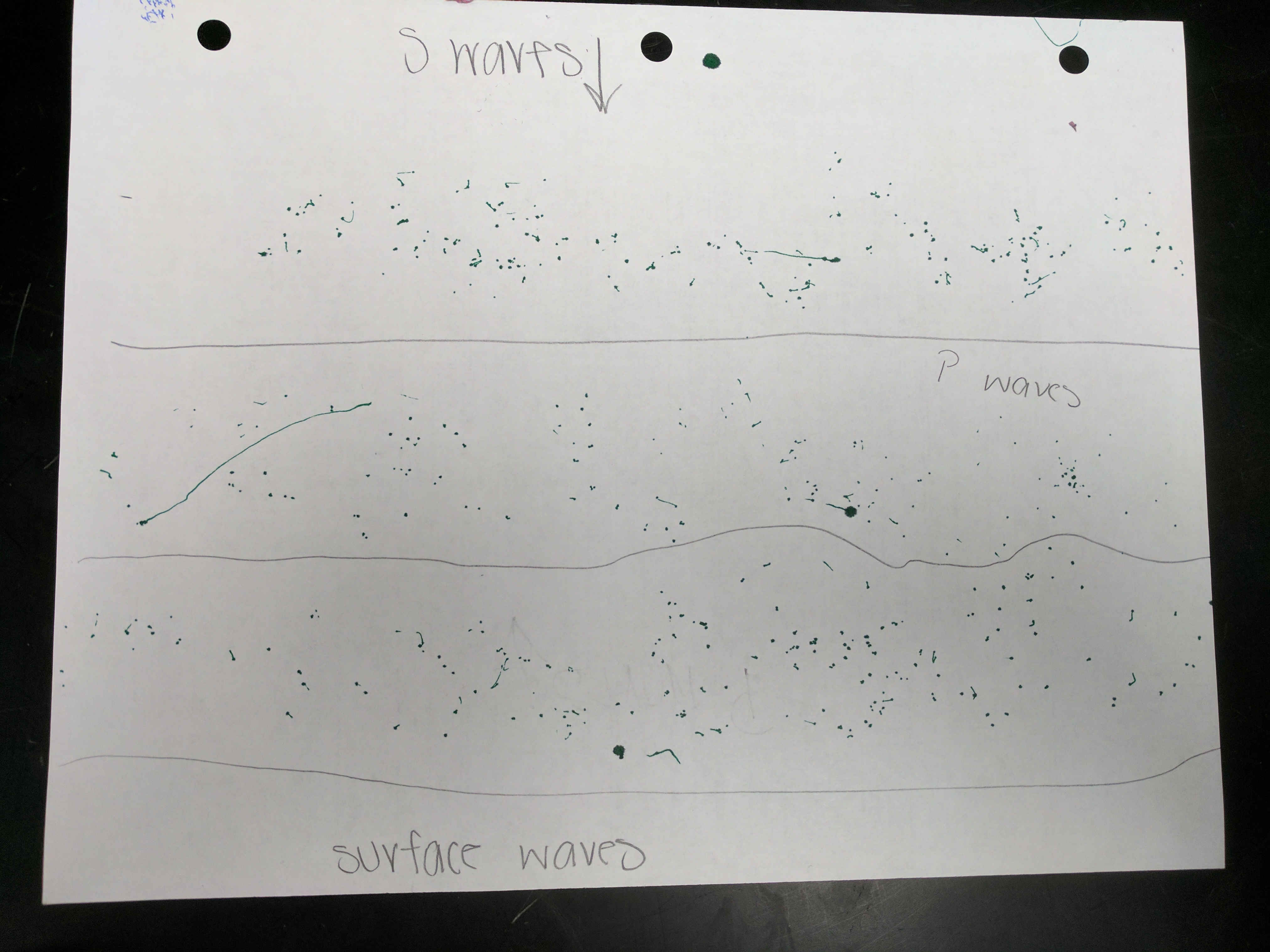
Students built a very basic seismometer, then experimented with recording different types of earthquake waves. The results varied a lot, but it did lead to some good discussion on the limitations of the earliest seismometers.


Day 138: Free Response & Review

AP Physics: Free Response

I made today an optional in-class retake day. Since some students wanted the full hour to do multiple learning targets, I decided to skip doing some multiple choice on Plickers and gave students some free response problems from the 2015 AP exam. On Monday, we’ll take a look at the scoring guides.

Earth Science: Review

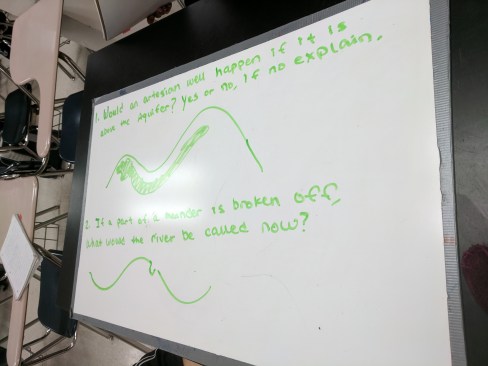
Students generated some questions for each learning target on whiteboards, then traded with other groups to try and answer the questions they came up with. I’ve been doing this a lot in my Earth Science classes, and its fun to see the improvement this year, even with students I only have for one tri. A lot of teachers in my building are working getting students to ask high-level questions as part of using AVID instructional strategies, and its neat to see that paying off a bit.

IMG_20170421_083753


Day 134: Board Meeting & Artesian Wells

AP Physics: Board Meeting

Students whiteboarded the results of yesterday’s lab. Several students had already seen λ=c/f in AP Chemistry, and I was pleased to hear them discussing how their results fit with that formula.

wave wb

Earth Science: Artesian Wells

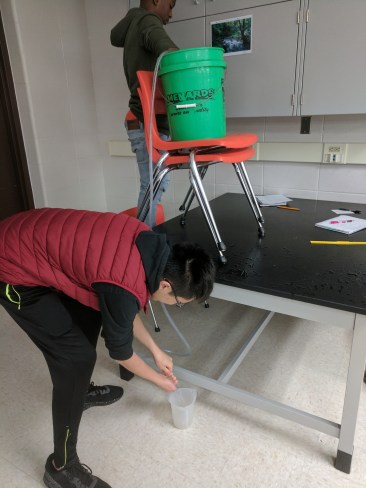
Students simulated an artesian well to find how the change in elevation affects the flow rate. I wish I’d spent more time on the pre-lab discussion to help set up what students should measure and why. I really liked the connections to energy it was possible to make; a few of the students I had last tri sketched bar charts and were able to generate some very nice explanations for why the big elevation change produced a high flow rate.

well

Day 131: Pendulums & Springs & Dam Removal

AP Physics: Pendulums & Springs

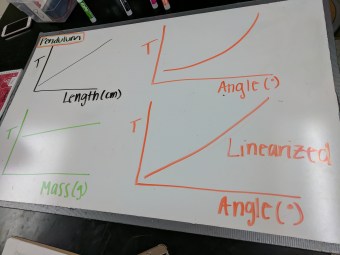
Students wrapped up their labs on what affects the period of  springs and pendulums, then whiteboarded the results. I could tell I was rushing the lab more than I have in the past and I ended up taking over a lot of the post-lab discussion and got a bit hand-wavy. As I rush through the last few topics, I haven’t been doing as much with uncertainty, and this is a lab where it would have really helped. I also skipped having students predict the period of a 5 m long pendulum, which made it much tougher to settle on which relationship works best for the length of a pendulum. Going into waves, I need to think about how I will balance the need to keep moving with giving students time to truly engage with the content.

pendwb

Earth Science: Dam Removal

Students continued work on their dam removal project. Today, they looked at a gradual release, which we modeled by removing one lay of foam at a time. I was very pleased at some of the detailed observations students made and how engaged they were in trying to think about why their observations happened. I’d love to re-work this unit to give students a better grasp of sediment transport in rivers before looking at dams specifically to give them more tools for thinking about the project.

dam

Day 130: Plickers & Dam Removal

AP Physics: Plickers & Quiz

We continued our routine of Plickers to practice some multiple choice questions, followed by a quiz on this week’s new material. I’m continuing to have students pick an answer individually, then discuss and vote again. There were a couple where students struggled to identify useful representations and, once I gave a nudge, they quickly got to the correct answer. I’m thinking about working in a step where students identify applicable models before they pick an answer to help with that.

plicker

Earth Science: Dam Removal

Students used stream tables and a foam model of part of the Salmon River to get some background knowledge for their engineering project. They conducted some observational experiments on sediment transport and deposition, first in a natural, unblocked river, next in a river with a dam, and finally when the dam is removed with a “blow-and-go” approach, where the entire dam structure is removed at once.

dam.jpg

Day 127: Oscillating Particle Model & Problem Scoping

AP Physics: Oscillating Particle Model

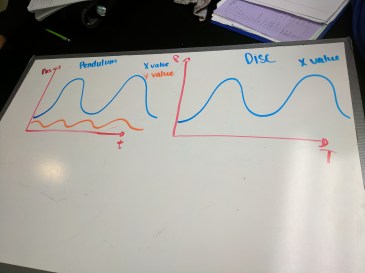
Students whiteboarded their video analysis results for the trio of objects in simple harmonic motion. I haven’t done a lot of circular motion in the past, so when we discussed the spinning disk, I was intrigued by how many students were convinced the angle in the video was responsible for the changing velocity. On a whim, I had students sketch the disk from directly above, then had them sketch velocity vectors, including components, at a few points around the disk, which nicely convinced students that they would see similar graphs for the horizontal motion no matter what the viewing angle.

shm trio

Earth Science: Problem Scoping

This unit includes an engineering project to plan removing a dam from a river. I gave students a memo from their imaginary client and had them do some problem scoping. One of the questions I ask is what background knowledge they will need, which can nicely set up a unit, but students did not identify anything about rivers or erosion as useful knowledge on this project. The memo mentions sediment transport as a major challenge in removing the dam, but I don’t think students saw that as something that would require background knowledge to understand. Even when I handed out the unit’s learning targets, students did not name the target about describing river behavior as one that will be useful. I need to think about how I will address that during the unit.

Day 124: Mystery Boxes & Metamorphic Rocks

AP Physics: Mystery Boxes

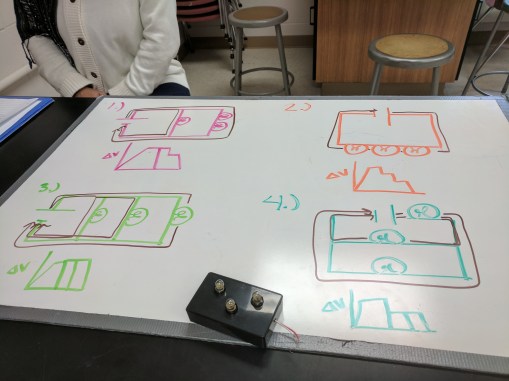
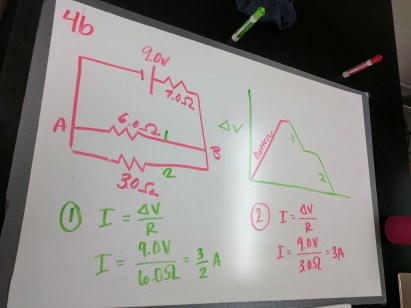
Today, students worked through an activity I got from The Physics Teacher. Groups were given a black box with three light bulbs and had to figure out how the bulbs were wired without opening the boxes. I front-loaded some thinking by having students sketch the four possible circuits and do some KVL diagrams and arrows to show currents, which students were then very successful at applying to interpret the behavior of their boxes. The main issue I ran into is many students students initially wanted to treat equivalent circuits with slightly different arrangements as different circuits. For example, groups often drew one parallel circuit with one bulb on the first branch and two on the second, then a second parallel circuit with two bulbs on the first branch and one on the second. The KVL diagrams provided a nice tool for showing why those circuits are equivalent.

mystery

Thanks, Lotze, for drilling holes in all the boxes!

Earth Science: Metamorphic Rocks

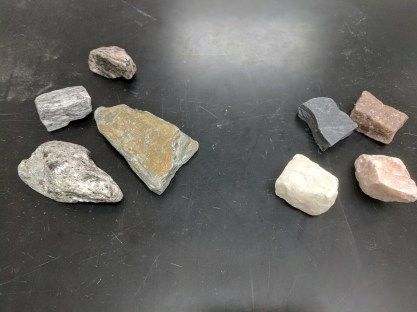
Students identified metamorphic rocks today. Similar to the igneous rock lab earlier this week, I started by having students sort the rocks based on visible properties. Most groups went with whether the rocks were layered, which lead nicely into foliation. A few groups when with sheen, which is the other major property used to identify rocks on this key. Students struggled to tell the difference between marble and quartzite using the key. After the lab, I talked a little about hardness and the acid test, but it would be nice to give students some tools they can use during the lab to differentiate those two.

met rocks

Day 123: Mistakes Game & Sedimentary Rocks

AP Physics: Mistakes Game

Students played the Mistakes Game with some electric circuit problems. I noticed students who drew arrows to represent the possible current paths tended to be much more successful, so in my 4th hour I explicitly made that part of the instructions. I also took a few minutes in that hour to give students a series and a parallel circuit to have students rank the resistances to solidify that idea. I think I will start with that in 2nd hour tomorrow.

wb

Earth Science: Sedimentary Rocks

Student worked on identifying sedimentary rocks using a key. There were some good discussions in lab groups about the fuzzy boundaries between some of the rock types. I struggled a bit with what thinking students could do to go beyond just using the identification key. I think I’m going to run into the same issue tomorrow with the metamorphic rock lab.

sed rocks