Day 23: Board Meeting, Annotating Graphs, & Gas Laws

Today was students’ last day before a 3-day weekend and our homecoming pepfest, so classes were short and students were more energetic than usual.

AP Physics: Board Meeting

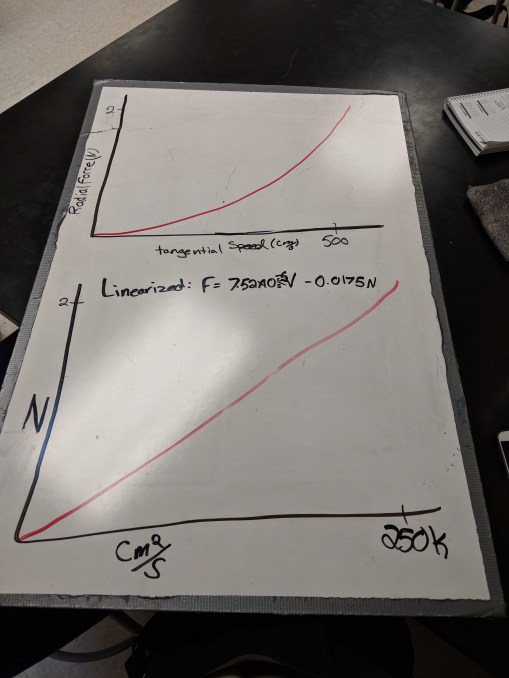
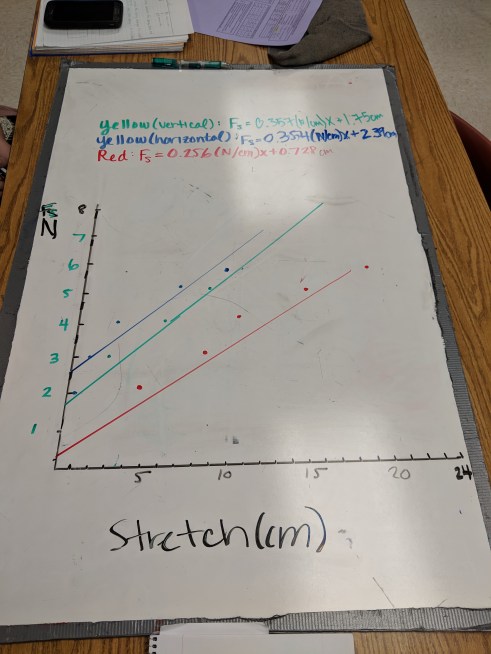
We had a board meeting for the spring force lab. Students initiated some good discussion about the intercepts in both sections, but I had to do a little coaxing to get them thinking about the values of the slopes. One of the challenges was a lot of groups hadn’t distinguished between mass and force of gravity, which tells me I should have done a little more pre-lab discussion, especially since that distinction was just introduced earlier this week.
spring wb.jpg
Physics: Annotating Graphs

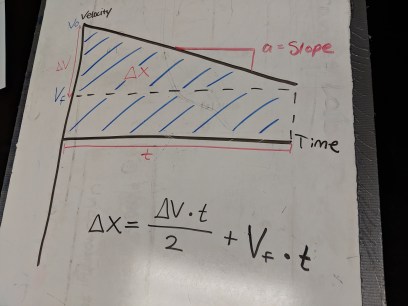
Students whiteboarded yesterday’s problems for a short gallery walk before trying some calculations. I think this is the first year where I didn’t have any students opt to use the formula for the area of a trapezoid on any of their graphs; it just felt more natural to most of my students to split the graph into a triangle and rectangle (which is what I usually do). When students started working with numbers, I had a lot of students independently start talking about specific times and velocities as coordinate pairs, which I haven’t seen students do before and was pretty great.
annot wb.jpg

Chemistry Essentials: Gas Laws

Students sketched their graphs from the past few days for a simplified board meeting. One of the things I really appreciate about this group is I have some students who are really willing to speak up when they are confused about something; one of my students was struggling to see how the graphs fit with the qualitative relationships we found earlier this week and didn’t hesitate to say so, which lead to some valuable discussion about how to read a graph.

gas laws wb.jpg

Day 4: FCI, Board Meeting, & Mass and Change

AP Physics: FCI

Students took the FCI pre-test. When I asked what they thought of it, several students said it was fun, which bodes really well for the rest of the year.

Physics: Board Meeting

Students whiteboarded the dowel lab we’ve been working on for a board meeting. Time got tight, especially the last period of the day, partly because I was wiped out and didn’t keep as on top of my students as I needed to at this point in the year. In the lab template I’m using, students have a space to do a gallery walk with their lab group and start jotting down some observations, which seemed to help with the discussion during the actual board meeting.

dowel lab board

Chemistry Essentials: Mass and Change

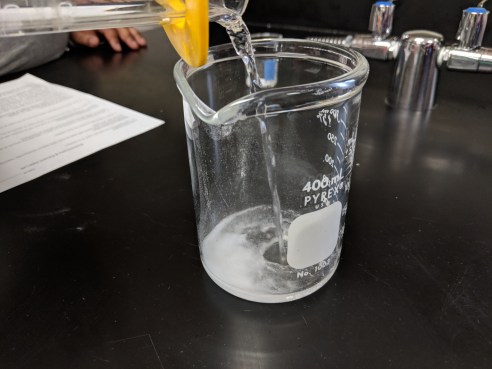
We continued the mass and change sequence today with water melting into ice and a chemical reaction that forms a precipitate. Students consistently resist setting their ice aside to melt while they work on other parts of the lab, so I need to think about how to make things like that feel comfortable.

mass and change

Day 3: Board Meeting, Lab Template, & Burning Steel Wool

AP Physics: Board Meeting

We did the first real board meeting using yesterday’s results from the buggy lab. Once again, I borrowed Casey Rutherford’s Observations, Claims, & Evidence structure. Some of the chemistry teachers have been integrating techniques from Modeling Instruction, and I got to reap rewards in a really good first board meeting. There was some discussion about whether some intercepts were small enough to call zero, which, along with a whiteboad where students plotted multiple trials, lead really nicely into an introduction to uncertainty. Next year, I think that would go even smoother if I push all groups to truly make time the independent variable and complete multiple trials.

Physics: Lab Template

For the second round of the dowel lab, I had students follow the lab template we’ll be using this year. I also changed the guiding question to “What is the relationship between the mass and volume of these dowels?” since that more naturally motivates measuring multiple dowels and is closer to the kind of guiding questions we’ll have on future labs.

dowels.jpg

Chemistry Essentials: Burning Steel Wool

We wrapped up yesterday’s lab by making a post-it histogram of the results students got yesterday, then had some discussion on the significance of those results. Afterward, we continued the mass and change sequence from Modeling Instruction by measuring changes in mass as steel wool burned.

steel wool.jpg

Day 1: Buggies, Broken Circles, & Mystery Tubes

AP Physics 1: Buggies

I took a page from Frank Noschese and embraced the idea that “Any lab worth doing is worth doing twice.” I gave groups the very vague directive to collect data on the buggy’s motion, then represent it on a whiteboard and turned them loose. My students seemed very comfortable with the ambiguity and dove right in, which was fantastic. I had a good mix of data tables and graphs on whiteboards, along with a lot of variations on graphs, which led to some good conversation on what would make it easier for us to compare results. Tomorrow, we’ll re-do the lab with a focus on being able to compare results. I talked more than I’d like today, but that’s pretty typical of when I do a new discussion.

buggy

Physics: Broken Circles

To start building class culture and learning how to collaborate, I started today with Frank Noschese’s subversive lab groups. Once they were in groups, students did the broken circles activity from Designing Groupwork: Strategies for the Heterogeneous ClassroomEach student got an envelope with pieces of a circle inside. As a group, they had to assemble four complete circles without talking. Afterward, we had some discussion about what skills groups needed to complete the task.

broken circles

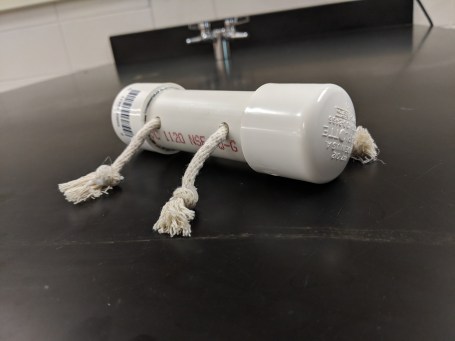
Chemistry Essentials: Mystery Tubes

Today was also about class culture in chemistry. This class also started with subversive lab grouping, but  I stepped in more than I did in physics. There were more students in this class who seemed nervous about approaching their peers and it was tougher for them to identify other possible solutions when a group got too big. Afterward, we got out the mystery tubes. I could tell I didn’t make the goal as clear as I sometimes do; while there were a lot of groups who were very engaged and had great conversations, others had trouble getting started.

mystery tube

Day 147: Test Day, Board Meeting, & Reaction Types

Today was a strange day; a lot of students were impacted by some unexpected news last night.

AP Physics: Test Day

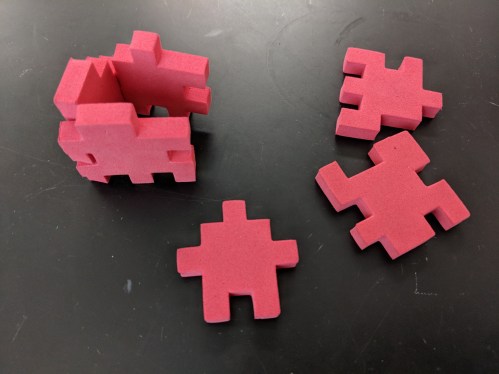
Today was the AP Physics 1 exam. However, we were able to give students the option of taking the make-up exam later this month and the majority of my students took this option. In my morning section, I’d planned to make today a game day for students to relax and have some fun before the exam, and decided to stick with that in both sections. Most students opted for some puzzles the calc teacher loaned me.

puzzle.jpg

Physics: Board Meeting

Students whiteboarded their results for yesterday’s speed of sound lab. The data came out very nice in both classes. Afterward, we had time for students to get the snakey springs out to start exploring wave superpositions. Even though I didn’t mention it in the prompts, one group got curious and tried to figure out whether the pulses reflect or pass through each other.

sound wb.jpg

Chemistry Essentials: Reaction Types

Classroom management gets tricky during labs with this class, so I decided to push back the lab I’d planned for today. Instead, I moved up a worksheet for students to practice identifying reaction types from chemical equations. One student was excited to show me an alternative representation she came up with for balancing chemical equations; its always exciting to not only have students coming up with their own ways of thinking about problems, but proud enough of their work to want to show it off.

bal shortcut.jpg

Day 133: Board Meeting, Pendulum Practical, & Percent Yield

AP Physics: Board Meeting

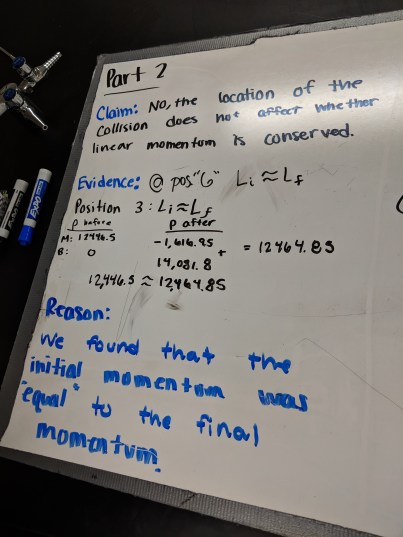
Students whiteboarded their results from yesterday’s Pivot Interactives activity. Students spent a lot of their time yesterday on whether the location of the collision affects whether linear momentum was conserved, but had a lot of interesting approaches and good discussion about that question. For the portions of the activity specific to angular momentum, I ended up much more teacher-directed than I like since I will be out tomorrow and am feeling the time crunch of the looming AP exam.

Maker:S,Date:2017-10-21,Ver:6,Lens:Kan03,Act:Lar02,E-Y

Physics: Pendulum Practical

Students finished yesterday’s practical, then were tasked with finding the period of a pendulum without using a ruler or meterstick. Not surprisingly, most students declared the pendulum practical was much easier than the spring one.

Maker:S,Date:2017-10-21,Ver:6,Lens:Kan03,Act:Lar02,E-Y

Chemistry Essentials: Percent Yield

Students predicted how much carbon dioxide should be produced in a reaction between baking soda and hydrochloric acid, then found the percent yield by measuring how much mass was “lost” during their reaction. I like that this lab circles back to conservation of mass to measure the mass of gas produced, but a lot of students had trouble connecting the lab to the stoichiometry problems we’ve done, so I need to think about how the layout and wording of the lab may be making those connections more difficult.

chem yield lab.jpg

Day 125: Board Meetings & Molar Mass

AP Physics: Lever Board Meeting

We had the board meeting to discuss the results of the lever lab. A few groups were quick to notice the slope slope on the force graph was the ratio of the distances to the pivot, while the slope on the distance graph was the ratio of the masses they used, which lead nicely into a definition of torque.

lever wb.jpg

Physics: Pendulum Board Meeting

In my first hour, the board meeting was pretty rough with a lot of very long silences. I forgot this was the first board meeting of the trimester and about half of my students had the other physics teacher last tri, so I should have taken more time to set up the board meeting. My other hour is a little more talkative to begin with, but I also spent more time prepping for them discussion and things went much better.

Chemistry Essentials: Molar Mass

Students applied molar mass to some real-world problems, such as finding how many moles of chalk it took to write their name. Students are approaching the calculations for number of moles very algorithmically without much sense of why they divide the numbers they do. I need to think about how to make the why more apparent; I’ve discussed some analogies, such as bank tellers counting pennies by weight, but I wonder if it would be helpful to actually carry an analogy out in the lab.

chalk.jpg

Day 118: Board Meeting, Projectile Problems, & Balancing

AP Physics: Board Meeting

We had our board meeting for yesterday’s lab on centripetal force. I approached it as three mini board meetings since students had done experiments for how three different variables affect the force. The units on slope ended up being a very powerful way for students to see the connections between their three graphs. It was especially exciting when we got to the force vs. mass graph and students saw the connections to Newton’s 2nd Law. One class noticed the slope on the force vs. 1/radius graph has units of Joules, but I’m not sure of the significance of that yet.

force vs t.jpg

Physics: Projectiles

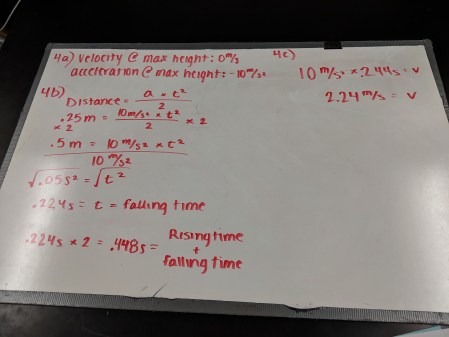
Students whiteboarded yesterday’s problems for a gallery walk. They are consistently viewing free-fall as just a special case of models we’ve already covered, which made the problems pretty easy.  Afterward, students started working problems for horizontal projectiles.

projectile prob.jpg

Chemistry Essentials: Balancing Reactions

After some discussion about the labs from the past few days, students worked on some problems balancing chemical equations. The students who started by sketching a particle diagram were generally very successful at seeing how to balance. A few students got tripped up determining when individual letters in a formula represent individual atoms, especially when the formula included a polyatomic ion, but were getting the hang of it after a couple problems.

balancing prob 1.jpg

Day 98: Kirchoff’s Laws, Board Meeting, & Chemical Formulas

AP Physics: Kirchoff’s Laws

Students started working on a lab for Kirchoff’s Laws. They measured the current and voltage at different points in the circuit to start looking for patterns. I overheard some good discussion about how the results connect to the Ohm’s Law equation we got earlier this week.

kirchoff.jpg

Physics: Board Meeting

Students whiteboarded their results for the impulse lab, but the slopes of their graphs were way off from what I expected. A lot of groups admitted that once they got their hands on the equipment, they ignored that we were interested in the change in velocity, rather than just the maximum or the minimum. I need to think about how to adjust pre-lab discussions in this course to keep students focused on the key ideas. We were able to get some qualitative ideas about impulse in place from the results, but I decided to have students collect data again tomorrow to get a quantitative understanding.

impulse board.jpg

Chemistry Essentials: Chemical Formulas

Students started writing chemical formulas given the name of the compound and the charges. I got out some beans for students to use as manipulative versions of Lewis dot structures, which helped a lot of students get beyond “flop and drop” when figuring out subscripts. Some students did get thrown by switching between electron diagrams and particle diagrams, so I need to work on keeping the types and purposes of diagrams distinct.

beans.jpg

Day 97: Board Meeting, Impulse, & Valence Electrons

AP Physics: Board Meeting

Today, we had two board meetings. First, we discussed the results of last week’s electric potential difference lab, followed by yesterday’s work on Ohm’s Law. The potential difference discussion went well, but the Ohm’s Law lab was trickier. This is the first lab I did as pretty open inquiry where students were working with three different variables, and a lot of groups struggled to relate all three. Next year, I may go back to having students do two separate experiments. There were also several groups who used the battery’s internal resistance and I think a little more pre-lab discussion could have avoided that.


epd board.jpg

Physics: Impulse

Students tied a cart to a force sensor with an elastic string and collected data for a relationship between the area of the force vs. time graph and the cart’s change in velocity. A lot of students had some trouble with the idea that they were graphing features of the LabQuest graphs, but were able to make sense of what was going on with some support.

impulse lab.jpg

Chemistry Essentials: Valence Electrons

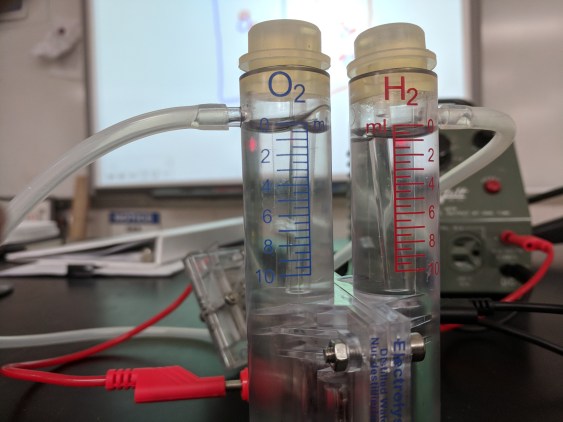
Students sketch Bohr models for selected elements to start identifying patterns in the number of valence electrons. Students seemed pretty successful at making sense of why certain elements have certain charges. I also got out the electrolysis machine to give an example of how we know the ratio of elements in a compound.

IMG_20171102_144642