Day 26: Problems, Bowling Balls, & Assessment

AP Physics 1: Problems

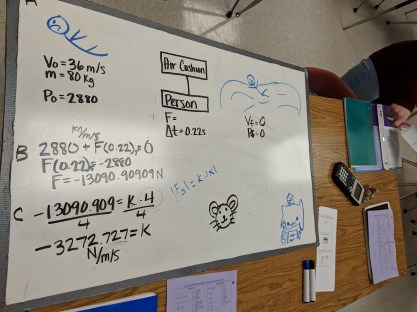
Students worked on a mix of problems on impulse and on using formulas for types of forces. During the second part of class, students whiteboarded problems for a gallery walk.
ap wb

Physics: Bowling Balls

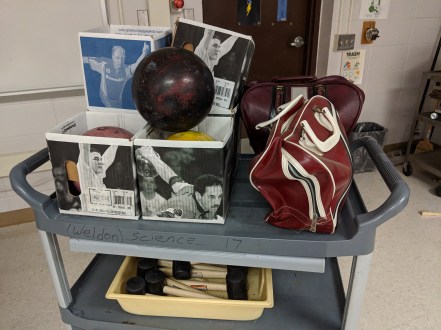
Today was bowling ball day! Students worked through Frank Noschese’s bowling ball and mallet activity.  After getting a class rule so far for taps and bowling ball motion, a few students commented it reminded them a lot of Newton’s 1st Law from 9th grade physical science. Imagine that!
bowling balls.jpg

Chemistry Essentials: Assessment

Students took their gas laws quiz today. Last year, I was pretty good about planning some kind of activity for after the assessment. About half my students take the assessments in a pull-out setting and many of them need more time than the students who stay in the classroom, so I did a lot of nature of science-type activities with students in the classroom while pull out students finished their assessments. I’ve been dropping the ball on that and need to get back into that routine. The students who stayed in the classroom weren’t getting into trouble when they finished, but I’d prefer to have something worthwhile for them to do.

Day 25: Friction, Groupwork Reflection, & Pressure

AP Physics 1: Friction

Students whiteboarded the friction lab from yesterday.  There was some good discussion and I can tell students are getting more comfortable talking about graphs. Its been a couple of years since I last did this lab, and the results are as messy as I remember, but students already seem to have a clearer idea of what the coefficient of friction is telling them, so I think it was worth the time.

friction lab.jpg

Physics: Groupwork Reflection

Today was a quiz day and the routine has become to spend the first part of the hour on an assessment doing some groupwork reflection. I spent some time on discussions about what skills students had used working on certain tasks to reinforce the value of multiple abilities. I have one class that seems to be buying in to valuing multiple abilities more than the other, but I think progress is happening on that front.

Chemistry Essentials: Pressure

To wrap up gas laws, I did a few demos. Before each one, I had students whiteboard a CER with their prediction. My favorite is a demo where I put a pipe between a large and a small balloon with each balloon clamped shut. Students have to predict what will happen when I remove the clamps. The version I first saw calls for putting a very small amount of air in the little balloon, so it isn’t stretching much, which forces air into the big balloon when you remove the clamps. I prefer inflating the small one enough that the rubber has stretched and, when the clamps are removed, the air just stays put in both.

pressure demo

Day 24: Friction, Mistakes Whiteboarding, & Gas Law Problems

AP Physics: Friction

Students worked on collecting data for variables that affect the force of friction. I have some friction blocks with a fuzzy side and a plain wood side, and asked students to make a graph of friction force vs. mass for each side, then prepare a CER for whether surface area and speed matter. A few groups opted to add a graph of friction force vs. mass for the narrow side of the block to answer whether surface area matters, and got beautiful results where the slope matched for both sides covered in the same material.

friction.jpg

Physics: Mistakes Whiteboarding

We did mistakes whiteboarding with Thursday’s problems. I dropped the ball on taking pictures, but there were some fantastic mistakes, especially on problems where neither the final nor the initial velocity is zero. I’m also seeing some great things emerge in the way my students approach discussion; in my 1st hour, there is one student who tends to be one of the most vocal, but both he and the rest of the class were very conscious of finding opportunities for other students to speak up.

Chemistry Essentials: Gas Law Problems

Students worked on some problems doing calculations with the gas laws. Since a lot of my students have very weak algebra skills, we are doing these problems proportionally. While my students worked, my co-teacher and I conferenced with each student about their grade and their progress so far.

Day 23: Board Meeting, Annotating Graphs, & Gas Laws

Today was students’ last day before a 3-day weekend and our homecoming pepfest, so classes were short and students were more energetic than usual.

AP Physics: Board Meeting

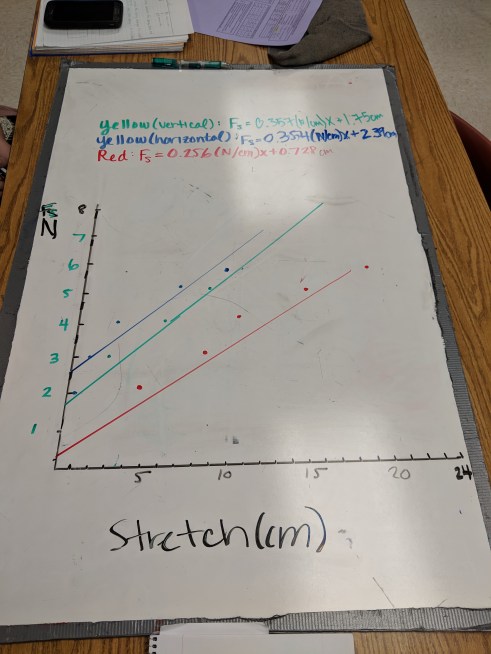
We had a board meeting for the spring force lab. Students initiated some good discussion about the intercepts in both sections, but I had to do a little coaxing to get them thinking about the values of the slopes. One of the challenges was a lot of groups hadn’t distinguished between mass and force of gravity, which tells me I should have done a little more pre-lab discussion, especially since that distinction was just introduced earlier this week.

spring wb.jpg
Physics: Annotating Graphs

Students whiteboarded yesterday’s problems for a short gallery walk before trying some calculations. I think this is the first year where I didn’t have any students opt to use the formula for the area of a trapezoid on any of their graphs; it just felt more natural to most of my students to split the graph into a triangle and rectangle (which is what I usually do). When students started working with numbers, I had a lot of students independently start talking about specific times and velocities as coordinate pairs, which I haven’t seen students do before and was pretty great.

annot wb.jpg

Chemistry Essentials: Gas Laws

Students sketched their graphs from the past few days for a simplified board meeting. One of the things I really appreciate about this group is I have some students who are really willing to speak up when they are confused about something; one of my students was struggling to see how the graphs fit with the qualitative relationships we found earlier this week and didn’t hesitate to say so, which lead to some valuable discussion about how to read a graph.

gas laws wb.jpg

Day 22: Spring Force, Annotating Graphs, & Pressure vs. Volume

AP Physics 1: Spring Force

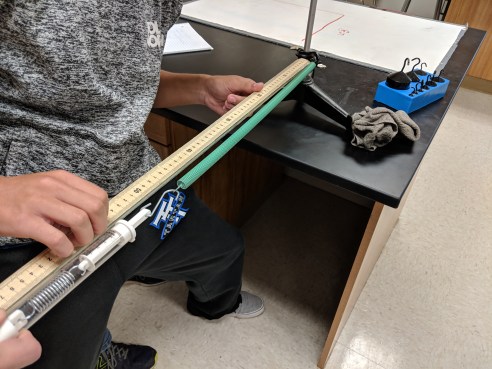
Students collected data for a relationship between the force on a spring and how much it stretches. I have them collect data for at least two different springs hanging vertically, then pick a spring where they also collect data by pulling it horizontally. I love the moment when groups call me over because something is “wrong” with their graphs because the line for when the spring is vertical matches the line for when the spring is horizontal.

spring lab.jpg

Physics: Annotating Graphs

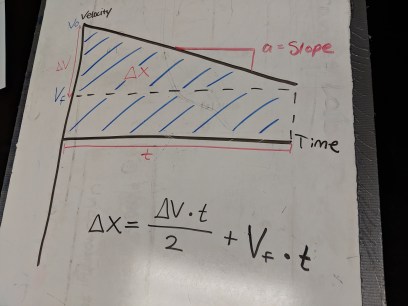
As a stepping stone to graphical solutions for constant acceleration, students worked on annotating velocity vs. time graphs and building equations from the slope and intercept. Last year, this was really tough, so I changed some of the language I used to try and connect the annotations to the visible features of the graph a little more clearly, and it seemed to click for a lot of students.

graphical soln.jpg

Chemistry Essentials: Pressure & Volume

I am being compensated by Pivot Interactives for participating in a pilot of their chemistry materials.

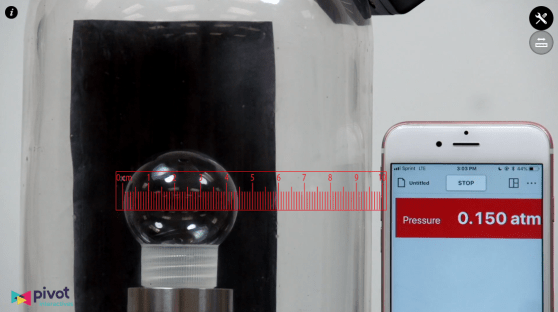
Students used another Pivot Interactives activity. This one used a bubble in a vacuum chamber to allow students to find a relationship between pressure and volume. In a previous lab on volume, finding the volume of a cylinder was a big hurdle for a lot of my students, so it was really nice for them to be able to use the tools in Pivot to do that number crunching without getting hung up on the math.

pivot pressure vol.PNG

Day 21: Board Meeting, Quiz, & Quantitative Gas Laws

AP Physics 1: Board Meeting

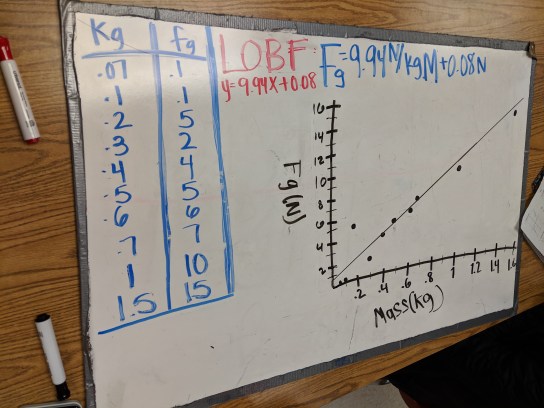
Students finished up their whiteboards for yesterday’s lab and we had our board meeting. Both classes got really nice results and had good discussions. I’m thinking about moving balanced forces to right after constant velocity next year since it gives some really good opportunities for students to be successful on experimental design.

fg whiteboard.jpg

Physics: Quiz

Today was our quiz on representations for constant acceleration. The quiz was pretty short, but I’ve been giving a few minutes before each quiz for students to do a reflection on their collaboration over the past few days. I also spent a few minutes talking with my students about today’s Nobel Prize announcement, and my students had a lot of questions about both this year’s prize and the Nobel Prize in general.

Chemistry Essentials: Quantitative Gas Laws

I am being compensated by Pivot Interactives for participating in a pilot of their chemistry materials.

Students used Pivot Interactives to collect data for a relationship between pressure and temperature. There were some minor issues with the computers, but once students got logged in they were pretty successful. We only have one gas pressure sensor in the school, so this particular activity makes it possible to do a quantitative lab we otherwise wouldn’t be able to and is more firmly rooted in reality than a simulation. The activity included some questions I really like the temperature when the pressure is zero; I overestimated how well my students understand the intercept of a graph, so I’ll need to make sure I allow time to discuss those questions tomorrow.

pivot pressure temp.PNG

Day 20: Force of Gravity, Graph Stacks, & Gas Laws

AP Physics 1: Force of Gravity

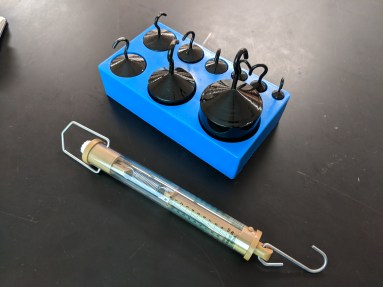
Students collected data to find a relationship between the force of gravity on an object and its mass. Not surprisingly, data is coming out pretty nicely. This is also giving students a chance to have some good conversations about uncertainty since their cognitive load on the rest of the lab is a little lighter.

gravity lab

Physics: Graph Stacks

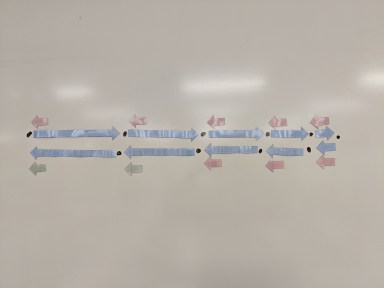
Students whiteboarded some problems from the Modeling Instruction curriculum sketching kinematic graph stacks for a cart on a ramp, a few of which we tested using a ramp with a motion encoder cart. I also got out Brian Frank’s magnetic vectors for the first time, which made it much easier to discuss the motion maps. For the problems we couldn’t test, I had students whiteboard a problem, then get with a group that did the same problem to come to a consensus, which lead to some great conversations between groups that disagreed.

motion map (2).jpg

Chemistry Essentials: Gas Laws

I got out some sealed syringes to do a qualitative exploration of ideal gas laws. Students made some great observations, and developed a nice, kinesthetic understanding of what pressure is.

gas laws.jpg

Day 17: Free Body Diagrams, Whiteboard Prep, & Describing Substances

AP Physics 1: Free Body Diagrams

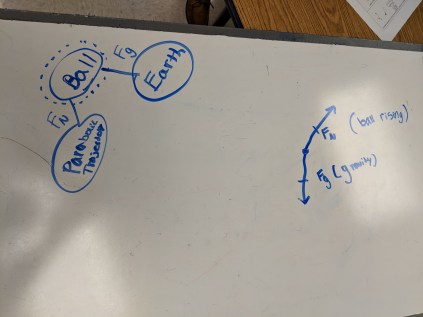
Students started working on some free body diagrams by diving straight into some mistakes whiteboarding. There was a lot of great conversation about the problems where an object was moving with a constant velocity as students did the expected wrestling with how an object is moving forward without a force in that direction. One of my classes also had some surprisingly good conversation about systems with a problem about an object at rest.

ap mistake (1).jpg

Physics: Whiteboard Prep

Students worked on their graphs and prepped whiteboards to discuss the ramp lab. With this being their first experience linearizing and their first time using Desmos, it took some time to get the boards ready. I think next year I’d like to introduce Desmos with the buggy lab so there is a little less new material going on in the ramp lab.

Chemistry Essentials: Describing Substances

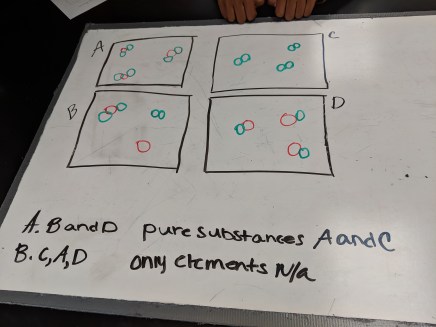
Students did a worksheet to practice with yesterday’s vocabulary, then I had them prep whiteboards and do a gallery walk to check their work.

chem paeti le.jpg

Day 8: Bowling Balls, Motion Maps, & Density

AP Physics 1: Bowling Balls

Students worked on a bowling ball and mallet lab based on Frank Noschese’s version. There was some good debate about whether a bowling ball needs to be tapped to roll at a constant speed, so we used the Motion Shot app to make a motion map we could use to check.

Motion_Shot_2017_09_05_12_06_19

Physics: Motion Maps

To introduce motion maps, I drove a fridge rover across my whiteboard and marked the position at regular time intervals. Motion maps also linked nicely back to the buggy lab, since I forced students to use time as the independent variable. Students then worked on problems; in my 1st hour, most of my students chose to work at desks mostly independently, which I think made the problems more challenging for both my students and for me. In my 6th hour, I started by letting students know the problems were designed to be done in groups and talked about the advantages of completing the task in a group. I’m also wondering if it would help if I made more use of a strategy I got from Designing Groupwork: Strategies for Heterogeneous Classrooms where we take time for some explicit class discussions about what skills are needed for a task to emphasize the value of multiple abilities.

motion map.jpg

Chemistry Essentials: Density of Water

Students did a lab to find the density of water, then we had a short board meeting with the results. We kept the board meeting pretty simple and I was very pleased with how it went; my favorite observation is a student who noticed that different groups had data points at different masses, but every group still got the same slope.

Day 153: Levitating Globe, Pinhole Viewers, & Hollow Pennies

AP Physics: Levitating Globe

The approach I’ve fallen into in order to give students time for their final projects while embedding some review for the students who will be taking the AP Physics 1 exam on the make-up date. Today, I got out a globe that floats in a magnetic stand and asked students to predict what should happen to the reading on a balance when the globe is removed, an idea I got from Kelly O’Shea. One group did a thought experiment where the magnet was replaced with a spring supporting the globe to reason their answer and had a great conversation.
Maker:S,Date:2017-10-21,Ver:6,Lens:Kan03,Act:Lar02,E-Y

Physics: Pinhole Viewers

We discussed some of the results of yesterday’s lab, focusing on how a ray diagram can explain the observations students made. Students are pretty quickly getting then hang of making sense of these diagrams.

pinhole rd.jpg

Chemistry Essentials: Hollow Pennies

Students did a conceptual lab practical on activity series today. I gave students an activity series for metals, then asked them to predict whether copper or zinc is more likely to react with hydrochloric acid. Then, I gave each student a penny with a wedge filed into it to test their prediction. I also showed students the hollow remnants of a penny that had been left in 12M hydrochloric acid for a few hours.

hallow penny.jpg