Day 52: UBFPM Practical, CAPM Problems, & Lewis Dot Beans

AP Physics: UBFPM Practical

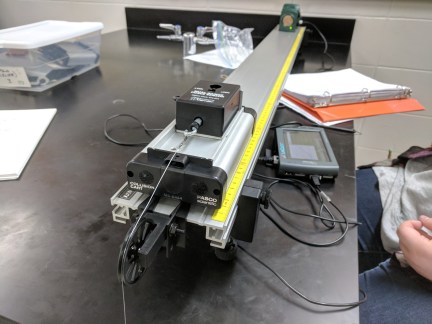
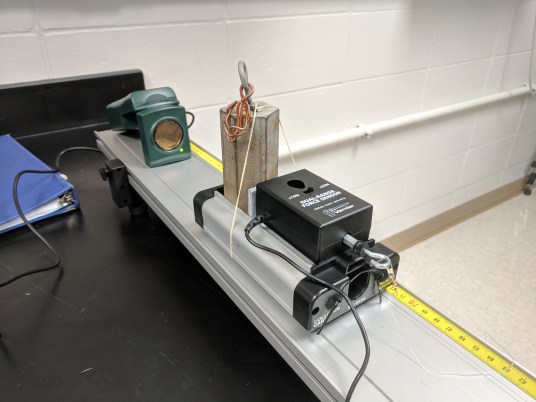
Students were tasked with finding the inertial mass of a lump of metal. While I left it open, students pretty quickly settled in to following the steps from their 2nd Law lab. In one of my classes, a lot of groups initially used the unknown mass to provide the force on their half-Atwoods setup, which has me thinking they were losing track of the significance of the measured quantities; I skipped over having them do an interaction diagram and free-body diagram on the original lab, which I’m betting would have helped.
ubfpm practucal.jpg

Physics: CAPM Problems

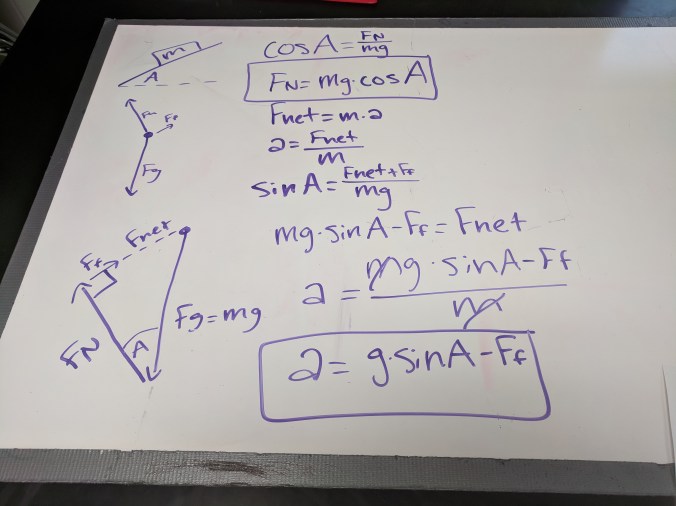
Students used whiteboards to revisit an earlier quiz on CAMP problems. I had them go through piece by piece, rotating who had the marker for each step. That seemed to help students feel a lot more confident on the problems. Tomorrow we’ll see if they can do them independently.

capm prob

Chemistry Essentials: Lewis Dot Beans

Yesterday, when we worked on formula writing, students were losing track of what the various numbers represented. One of the other chemistry teachers suggested I try Lewis dot structures with a manipulative, so today students used beans to check their answers to yesterday’s problems.

lewis dot beans

Day 51: Friction on Ramps, CAPM Card Sort, & Naming Compounds

AP Physics: Is Friction Negligible?

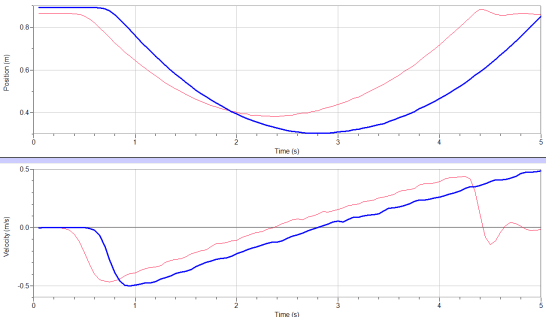
Students sketched free-body diagrams and vector addition diagrams for a cart on a ramp with friction, then were tasked with determining whether friction is negligible using a set of graphs recorded in LoggerPro. There were lots of great conversations connecting the force representations to the motion ones.

friction on ramp grpahs

Physics: CAPM Card Sort
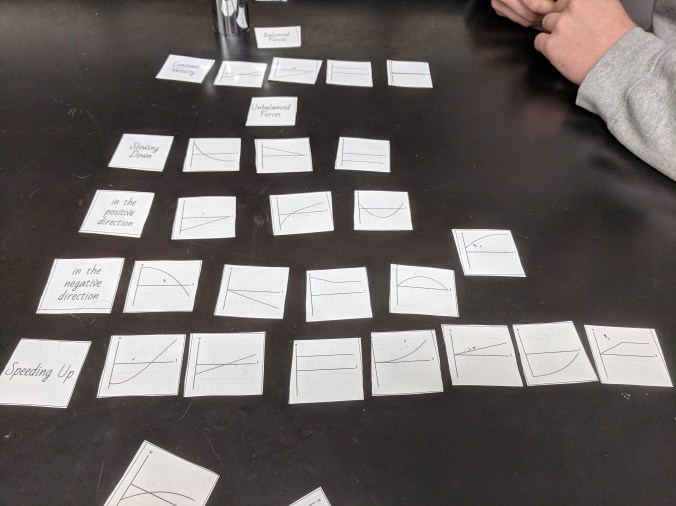
I want to revisit CAPM this week, so we started with Kelly O’Shea’s card sort. A lot of groups needed some nudging to differentiate between constant velocity and constant acceleration on the velocity-time and acceleration-time graphs, but that was no surprise. While students were bothered by the idea that there was no one right answer, they had some great conversations. I think it also helped that I assigned them to random groups, which interrupted some of the usual patterns.

card sort 5.jpg

Chemistry Essentials: Naming Compounds

Students worked on going between formulas and names for compounds. A few groups asked if they could use the cards from Friday to help figure out how many of each atom a compound needs, and I happily got them out. I think a lot of students lost track of what is going on conceptually with the bonding, so I need to think about better ways to reinforce that.

bonding cards.jpg


Day 50: Whiteboarding, Problems, & Bonding

AP Physics: Whiteboarding

Students whiteboarded their problems from the last few days. I tried to keep the focus on the diagrams and initial setup, since there’s where the physics is. With the end of the term looming and students doing pretty well with these, I had them do a gallery walk rather than taking the time for a more involved whole class discussion.

Physics: Problems

Students started using vector addition diagrams to solve problems with balanced forces in 2D. I saw a lot of groups working much more effectively together than a few weeks ago and students were doing a nice job of playing around with strategies to find their way to an answer.

Chemistry Essentials: Bonding

Now that students have some ideas about the structure of an atom and periodic trends, students used cards similar to puzzle pieces (that I forgot to take a picture of) to explore bonding. Students seemed to be getting a lot of ideas in place about which elements are more likely to give up electrons and why the atomic ratios are what they are.

Day 49: Numberless Problems, Vector Addition Diagrams, & Bohr Model

AP Physics: Numberless Problems

Students have been feeling pretty good about the unbalanced force problems so far, so I gave them some problems without any numbers. It took some time to get through the first one, then things went very smoothly, even as the problems got tougher.

Physics: Vector Addition Diagrams

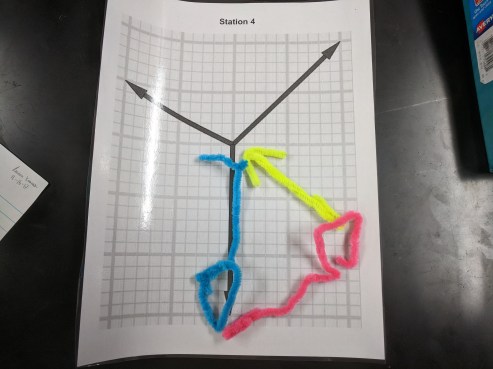
Students did an activity I got from Casey Rutherford using pipe cleaners to translate between free-body diagrams and vector addition diagrams. Students had some good conversations about the difference between balanced forces and equal forces.

vad.jpg

Chemistry Essentials: Bohr Model

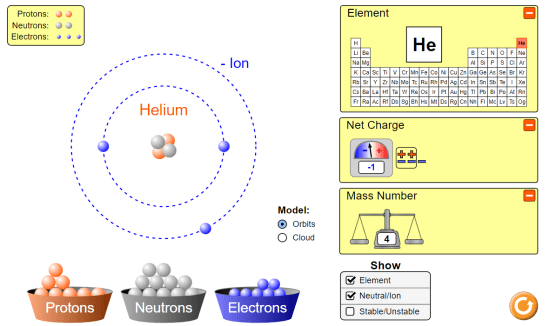
Students finished exploring PhET’s Build an Atom simulation. They were able to recognize all of the patterns I wanted them to and were very successful on the questions I had connecting the simulation to their periodic tables. I was also pleased by how quickly students picked up on the fact that the simulation only gave whole number masses, while their periodic table has lots of decimals.

phet atom

Day 48: Unbalanced Forces, Quantitative Interactions, & Bohr Model

AP Physics: Unbalanced Force Problems

Students started some problems on unbalanced forces. I started by having a group demonstrate their success on last week’s lab practical, then asked students what should happen if we swapped out a lighter marble. Once we tried it, we used vector addition diagrams to find the acceleration of each marble and show the mass doesn’t matter.

Physics: Quantitative Interactions

I borrowed an idea from Kelly O’Shea (I think she’s planning a blog post) and, instead of doing balanced force problems on a worksheet or out of the textbook, I gave students 5 different stations to work through. Several groups went back to their force of gravity lab to figure out the first station, which was great for reinforcing that the labs and problems are connected. The downside is I used a mass today that many used on their lab, so they were able to just read off their data table.

Chemistry Essentials: Bohr Model

Students used PhET’s Build an Atom simulation to play with the Bohr model. The activity took a little longer than I thought, so no one was able to finish, but students were having some good questions about the changes as they added pieces to their atoms and how that fit with patterns on the periodic table. At the end of the hour, I got out the gas tubes and diffraction gratings so students could see some of the evidence for the Bohr Model. They had a lot of questions we didn’t have time to answer, but I’m hoping that will make for a good way to start class tomorrow. I’ve been trying to put something engaging and thought-provoking at the end of the hour to combat students trying to line up at the door or slip out of the classroom in a positive way, and its had the side effect of making it easier to start class the next day since students show up with questions they are excited about answering.

gas tube

Day 47: Board Meeting, Whiteboarding, & Atomic Models

AP Physics: Board Meeting

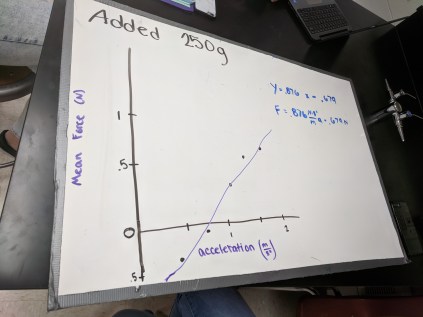
Students whiteboarded their results from yesterday’s lab. I forgot to remind my 2nd hour to zero their force sensors yesterday, which made for a good opportunity to talk about what the intercept means. They were initially bothered by the units on the slope of their graph, but the units of N/(m/s2) became really valuable when we made a “for every” statement about the slope; interestingly, a lot of students phrased their “for every” statement in terms of how the acceleration changes for every 1 N of force, even though that required inverting their slope. I thought about having students plot acceleration on the vertical axis, especially since the College Board’s formula sheet gives a = F/m, but I think the mass pops out more nicely when force is on the vertical. I may still flip the axes next year since acceleration on the vertical would fit better with how they talk about the graph.

fma lab.jpg

Physics: Whiteboarding

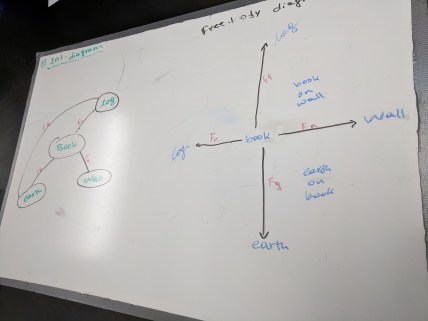
Students whiteboarded their answers to last Friday’s problems. We spent a long time on a problem about using a log to hold a book against the wall, and there was a lot of great discussion about what that force should be and why, as well as whether there should be any horizontal forces. I think a lot of students don’t see that discussion as productive, but I heard a lot of great physics talk.

log prob.jpg

Chemistry Essentials: Atomic Models

Students shared the information on the atomic models they looked at yesterday. They were surprised by the gap between Democritus and Dalton and were also very interested in the personal stories. I tend to skip past those, since most of the people the state standards call for are white guys, but its probably worth having some reminders in my class that science is done by people who live in a particular place at a particular time. Maybe next time, I’ll do a little more background research to try to come up with some other names, especially women and people of color.

Day 46: 2nd Law Lab, Board Meeting, & Atomic Models

AP Physics: 2nd Law Lab

Students started collecting data for a relationship between force and acceleration. A few students took out their formula sheet to get a preview of what the equation should be; it was interesting to listen to their conversation on what they expected the graph to look like and whether their data was consistent with the equation they expect to need.

f a

Physics: Board Meeting

Students whiteboarded their results for the spring lab. They are getting better at “translating” lines of best fit into physics by selecting meaningful variables and putting units on slope and intercept. It was also clear in the discussion that students are gradually making more connections between the graphs and the reality of the lab. When discussing the intercepts, there was a great moment where a student speculated whether gravity could be contributing to the intercept, which lead nicely into comparing the vertical and horizontal springs.

spring graph

Chemistry Essentials: Atomic Models

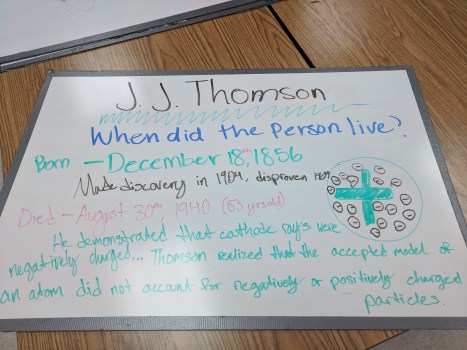
Students worked on a jigsaw for the history of atomic models. This was a nice opportunity to talk about what we mean by a model in science since we are looking at how models of the atom evolved over time. I asked groups to name some of the evidence used to support each atomic model, and students had a lot of trouble with that. I think part of the issue is a lot of students are still shaky on what makes something evidence and part of it is there’s a lot of background knowledge required to make sense of the evidence used in many of the atomic models.

thompson.jpg

Day 44: Practical, Spring Force, & Vocab Review

AP Physics: CAPM Practical

Students figured out where to start a buggy so that a marble rolling down a ramp would land in it. Some groups had some trouble translating their strategies for yesterday’s problems to this lab practical, which has been pretty common this year. However, once students got going, there was a lot of success!

Physics: Spring Force

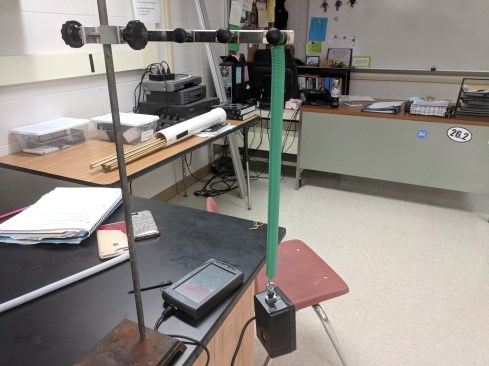
Students worked through the spring force lab I’d previously done with my AP Physics classes. We used force sensors to stretch the spring instead of spring scales or hanging masses so that students could pick one of their springs to also stretch horizontally. From what I saw in notebooks, results are coming out pretty nicely.

spring.jpg

Chemistry Essentials: Vocab Review

This unit has had more vocabulary and factual knowledge than many of the others, so we took some time to review key terms and reinforce connections between the different ideas.

chem vocab.jpg

Day 43: v-t Graphs, Board Meeting, & Chemical Change

AP Physics: v-t Graphs

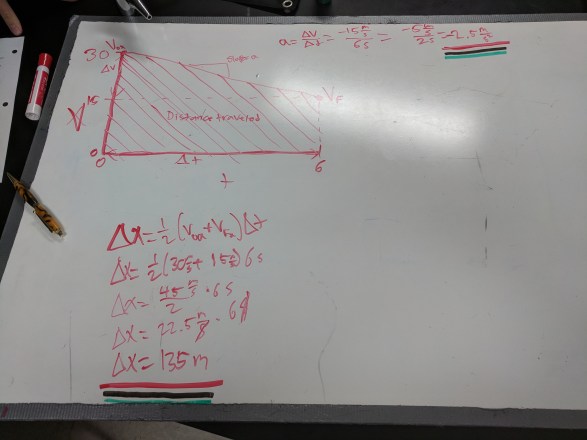
Students took their first stab at solving problems for objects with a constant acceleration using velocity vs. time graphs. Groups were consistently getting the problems down pretty quickly, so we did a gallery walk of solutions for these problems rather than a full whiteboarding session. My students with some calculus knowledge are getting genuinely excited about the connections between physics and calc, which is a lot of fun. I also had some students think week talking about how momentum vs. time graphs fit with what we’re doing now, which has me really excited to start the Newton’s 2nd Law lab next week.

graph soln.jpg

Physics: Board Meeting

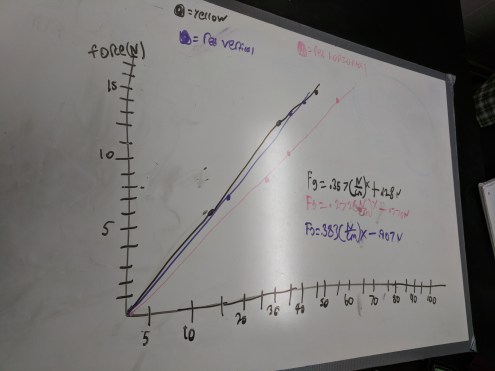
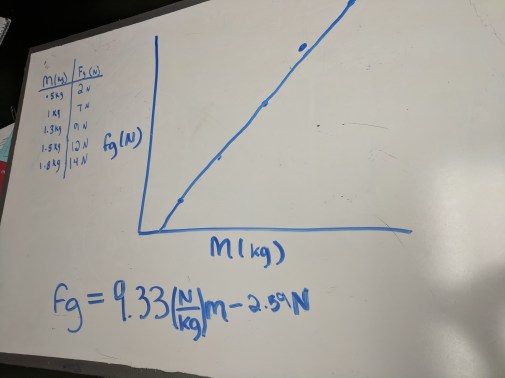
Students whiteboarded the results of the force of gravity lab. The results were pretty good and I had some students speaking up who are usually quiet during whole-class discussions. I’m also seeing students get more confident finding the line of best fit and translating y=mx+b into “physics”.

fg lab.jpg

Chemistry Essentials: Chemical Change

Students did a lab observing several chemical reactions to recognize signs of chemical change. One of the reactions produced a precipitate, and it was interesting that a lot of students were not convinced the precipitate was a solid since it was a fairly fine powder.

chem change.jpg

Day 42: Mistakes, Force of Gravity, & Periodic Trends

AP Physics: Mistakes

Since my students are pretty confident on motion graphs, we went straight to mistakes whiteboarding with some stacks of motion graphs. Students were pretty successful at coming up with interesting mistakes. In addition, during the presentations there was a lot of joking around and students were very willing to own unintentional mistakes, which was great to see.

mistake

Physics: Force of Gravity

Students collected data for a relationship between mass and the force of gravity. One of my classes was able to get their graphs and linear regressions done, and were more successful than I expected at “translating” their line of best fit into physics by adding units to the slope and intercept and replacing x and y with appropriate variables.

gravity lab

Chemistry Essentials: Periodic Trends

Today, I handed out periodic tables and students worked on marking them up based on some of the patterns and trends we’ve been talking about the past few days. Yesterday, several students noticed that the sodium card said it reacts strongly with water. Since many also recognized sodium is in table salt, they weren’t entirely convinced it would react with water, so I got out the pure sodium today to drop a piece into some water. I got a small flame during class, which really blew their minds.