Day 66: Missing Energy, Goal-Less Problems, & Mass vs. Volume

AP Physics: Missing Energy

Students started working on an activity to determine whether a bouncy ball mostly dissipates energy due to air resistance or due to the impact with a table (I’ll have an article on this activity in the January issue of The Science Teacher). Today, students worked on sketching LOL diagrams and velocity vs. time graphs for each explanation, which lead to some good conversations about the connections between energy and motion. Each group also recorded a video of a bouncy ball that they’ll analyze in LoggerPro tomorrow.

Physics: Goal-Less Problems

Students worked on some goal-less problems for Newton’s 2nd Law in two dimensions. I was very explicit with my students that I use them to make it okay to start a problem without knowing where you are going. We also spent some time discussing key steps students should take (like deciding whether the forces are balanced or unbalanced, drawing and annotating diagrams, etc) which helped a lot of students see where to start.

Chemistry Essentials: Mass vs. Volume

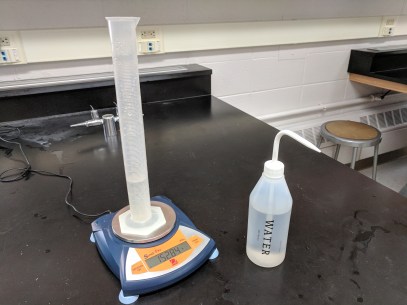
Students worked on finding a relationship between the volume of water and its mass. I had students design their own procedure for the lab and I think they could have used more pre-lab discussion; I usually keep the pre-lab pretty short in favor of doing a lot of coaching lab groups, but the class is bigger than usual this year and I was spread pretty thin, which in turn fed some classroom management issues. I’ll need to keep that in mind for future labs.mass vol.jpg
Day 65: Multiple Choice, Elevator Wrap-Up, & Mystery Tubes

AP Physics: Multiple Choice

Today was a quiz day. This tri, I’m making quizzes the last thing we do for the day to build in a natural time limit. Before the quiz, we used Plickers to go over some multiple choice questions that were tricky on the final exam. I had one class where scores on the final came up, and that seemed to put a damper on some of the conversations. I’ll have some conversation with them on Monday to reinforce that we are after everyone’s success.

plicker

Physics: Elevator Wrap-Up

I gave students some time to do a summary table from Casey Rutherford’s elevator situations. Afterward, they took their quiz on Newton’s 2nd Law.

Chemistry Essentials: Mystery Tubes

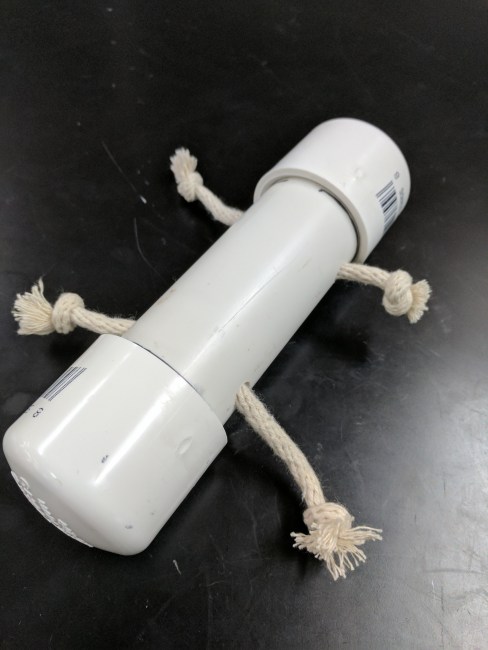
Today was a quiz day. About half of my students take their assessments elsewhere due to IEPs or 504s and most of them need the whole hour, but the students who stay in the room usually only need about half the period, so I’ve been doing nature of science activities once all the students in the room are done. Today, I pulled out the mystery tubes. Compared to last trimester, my current students were less interested and quicker to look for answers online. I think if I’m going to do it early in the trimester, I need to spend a little more time than I did today introducing it and brainstorming strategies.

mystery tube

Day 64: LOL Diagrams, Elevators, & Volume

AP Physics: LOL Diagrams

We did the mistakes game again today (which my AP students now think of as standard whiteboarding in physics) for some problems with conservation of energy calculations. To avoid getting bogged down in the algebra, where most of my students are pretty strong, I had them put their mistake in the LOL diagram or writing the conservation of energy equation. Most groups worked on an accurate solution before they made their mistake, and one group did a nice job of setting up an equation for a problem where 10% of a baseball’s energy is dissipated before it reaches the peak of its path.

lol neat approach.jpg

Physics: Elevators

Students whiteboarded their work on Casey Rutherford’s elevator situations worksheet. A lot of students struggled conceptually with the direction of the net force, but seemed to resolve that by the end of the hour. I’m trying to lower the social risk of whiteboarding to get more engagement, so I gave each problem to two different groups, then had them meet and come to a consensus on a solution. Afterward, students did a gallery walk of all the whiteboards. We also discussed a video I made of a balance on an elevator to reinforce the worksheet.


Chemistry Essentials: Volume

Students filled geometric solids with water to find a relationship between the volume and the amount of water they could hold. I need to put some thought into how I introduce the lab; in particular, I don’t think my students have much concept of why this relationship is worth looking at. I know I can make use of that as we move into density, but I’m not sure how to frame the lab so they see a purpose in it up front.

solids.jpg

Day 63: Conservation Problems, Board Meeting, & Reaction in a Bag

AP Physics: Conservation Problems

Students started working on solving problems with conservation of energy. There was a fantastic moment when I overheard a student say “I don’t understand number 3 yet; I need to draw my LOL diagram.”

Physics: Board Meeting

Students discussed the results of the 2nd Law lab from earlier this week. I put more pauses into the whole-group discussion than usual for students to talk with their lab groups about some question and was very conscious of asking for claims the group, rather than the individual, had come up with and made explicit those claims were rough drafts. This seemed to ease some of the fears about speaking up.

Chemistry Essentials: Reaction in a Bag

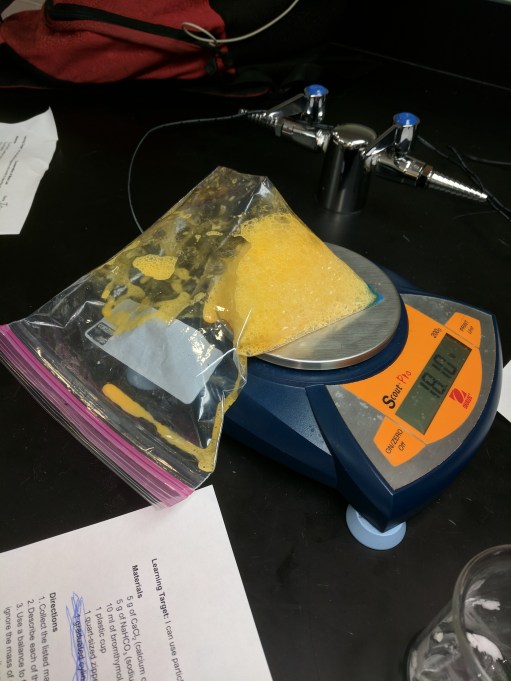
Students reacted calcium chloride, sodium bicarbonate, and bromthymol blue in a Ziploc bag. to see another example of conservation of mass in a reaction that forms a gas. Next time, I might combine this lab with the Alka Seltzer one to make a more involved exploration of whether gas has mass. Aside from this feeling more like a true chemistry lab than the Alka Seltzer one (students definitely connect goggles with “real” chemistry), that may give the opportunity to go into questions such as which was the better method of capturing the gas or whether all or some gasses have mass.

gas

Day 63: Bar Charts, Board Prep, & Particle Diagrams

AP Physics: Bar Charts

Students whiteboarded yesterday’s problems for the mistakes game. In both my classes, students were generally excited to do the mistakes game and I contributed almost nothing to the discussion, which was fantastic. Afterward, we took a few minutes to use some thermal camera images to see examples of energy dissipated by friction, including a photo I took of my car after driving it.

Physics: Board Prep

I’d planned to have the board meeting today, but we ended up just prepping whiteboards today since enough groups had issues with their data that I think it would have been tough to have a good discussion. I tended to let poor data slide last tri, since it was easy enough to recover during the board meeting, but I think a lot of groups are counting on being “that” group during the discussion. I think having those groups re-do their data collection today helped set the expectation that they shouldn’t plan on being “that” group.

n2l wb.jpg

Chemistry Essentials: Particle Diagrams

Students worked on a worksheet to practice drawing particle diagrams. The students who’ve been engaged in the labs so far were able to breeze through the worksheet and had some good discussions along the way. I’ve got more students than last tri, whoever, who checked out during those activities and had a lot of trouble with the worksheet as a result. I need to think about how I will interrupt the vicious cycle that is starting for those students.

chem particle.jpg

Day 62: Systems, Newton’s 2nd Law, & Does Gas Have Mass

AP Physics: Systems

Students worked on a Modeling Instruction worksheet that emphasizes how changing the system changes the LOL diagram. A lot of students very naturally connected this to the SOS diagrams we’d done earlier in the year and how changing your system can affect whether there is any impulse.

Physics: Newton’s 2nd Law

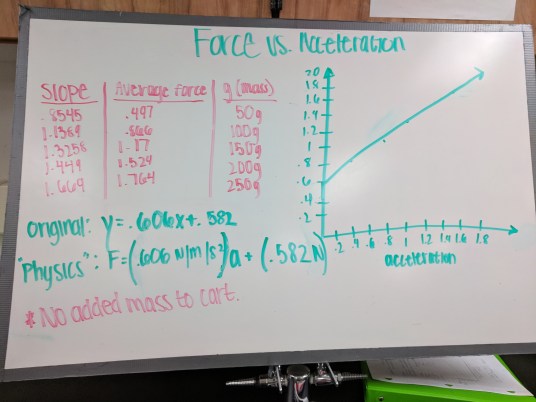
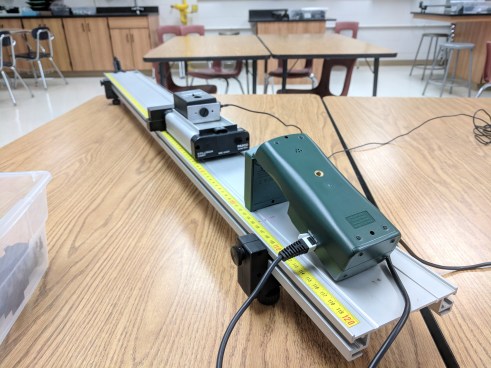
Students used a half-Atwoods machine to collect data for how the force on a cart affects its acceleration. I ended up wishing I’d spent a little more time on the pre-lab; a lot of groups lost track of what they were measuring and how that connected to the purpose of the lab. Since I’m seeing low engagement during whole-class discussions, I’m thinking about how I could have students do some of the pre-discussion in their lab groups, instead.

n2l.jpg

Chemistry Essentials: Does Gas Have Mass

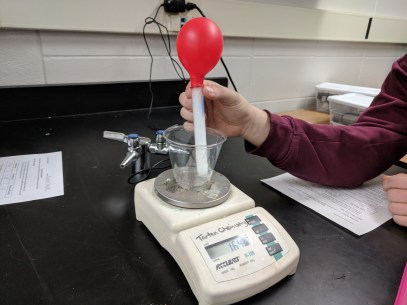
Students measured the mass with a reaction of water and Alka Seltzer to decide whether gas has a mass. They did the reaction once in an open test tube and once with a balloon on top. While the balloon clearly leaked, there was significantly less loss of mass with it in place. I didn’t ask for particle diagrams on the lab handout, but I think that would have helped students think through what they expected and why.

balloon.jpg

Day 61: Bar Charts, Mistakes Game, & Burning

AP Physics: Bar Charts

We discussed the results of yesterday’s lab in order to define kinetic energy, then I showed them the derivation for elastic potential energy. Since we’d already defined change in potential energy as the area of a force vs. displacement graph, I think I could have put that derivation on students. Afterward, I introduced students to LOL diagrams and set them to work sketching bar charts.

Physics: Mistakes Game

I love Kelly O’Shea’s mistakes game, but I’ve been having trouble getting my physics students comfortable talking as a whole class, so I decided to try lowering the stakes. I had them prep whiteboards as usual, but then they presented to another group, rather than the whole class. There were a lot of great conversations between groups and students were much more comfortable speaking up. Afterward, I gave students time to do a gallery walk of the post-discussion boards.

mistake wb.jpg

Chemistry Essentials: Burning

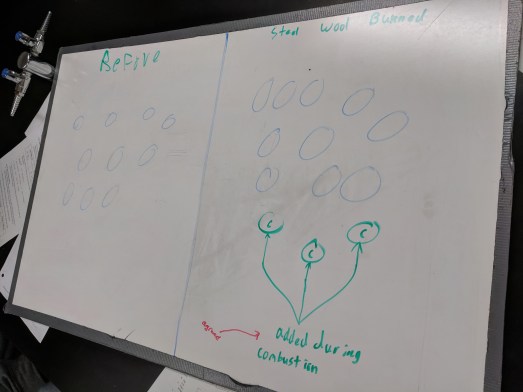
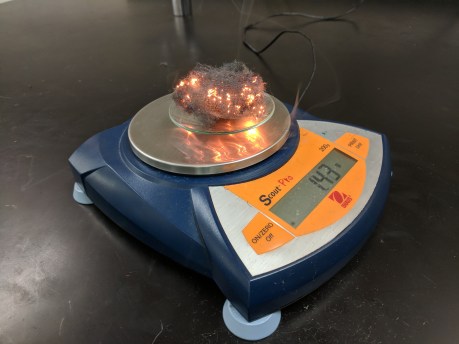
Students burned steel wool on a balance to observe the change in mass. Afterward, we used Post-It notes to make histograms of the change in mass from both yesterday’s labs and the burning. Last trimester, I skipped the class histograms, but I think the helped this group to meaningfully interpret their results. I also got excited when a student brought up conservation of mass before I did, which I don’t manage as often as I’d like in this course.

burn.jpg

Day 60: Kinetic Energy, 3rd Law, & Melting Mass

AP Physics: Kinetic Energy

To introduce kinetic energy, I had students work through a Pivot Interactives activity to find a relationship between the starting height of a puck and its velocity at the bottom of a ramp. I ran out of time to have a pre-lab discussion yesterday, so tried to have one in the computer lab today. I had more students then usual struggling with what to measure or what to graph, and I think that was because a lot of them started the activity rather than fully engaging in the discussion. Once they got rolling however, students warmed up to the interface pretty quickly.

pivot ke.PNG

Physics: 3rd Law

We collided carts with force sensors to check the predictions students made yesterday. I spent more time than usual talking about why I asked them to make predictions I know are likely to be wrong since confidence has been such an issue for students this year.


\

Chem Essentials: Melting Mass

Students continued the Modeling Instruction mass and change labs. Today, they melted ice and mixed sodium carbonate with calcium nitrate; a lot of students really liked that reaction and were observing close enough to notice the precipitate causing the cloudiness. I added a mini-exploration of the zero button on the balance, which I was pretty happy with. A lot of the students in the course struggle with mathematical reasoning, and taking a few minutes to play with the zero button and the readings on the balance seemed to help make its purpose more concrete.

mass change.jpg

Day 59: Energy, 3rd Law, & CER

AP Physics: Intro to Energy

Students measured the average force and the displacement required to give a cart the same change in height on several different ramps. They sketched the force vs. displacement graphs, which I used to introduce gravitational potential energy and work.

peg lab.jpg

Physics: 3rd Law

We ran out of time to hit Newton’s 3rd Law during last tri’s unit on balanced forces, so today we dove in. I showed students a pair of carts, then asked them to draw interaction diagrams and free body diagrams for various collisions, as well as to predict which cart will experience a larger force. One group gave me a hard time about how deadpan I was when they asked if their prediction was right, so we talked a little about Clever Hans the Math Horse.

3rd law.jpg

Chemistry Essentials: CER

As part of the follow-up on yesterday’s lab, I introduced students to the CER framework. I had students identify the claim and evidence in a car commercial, then come up with some potential reasoning for the evidence before they started a CER on whether the mass of steel wool should change.


Day 53: Multiple Choice, Quiz, & Polyatomic Ions

AP Physics: Multiple Choice

Students took their last quiz for the trimester, then we spent the rest of the hour using Plickers to practice multiple choice questions. Final exams are next week, so the multiple choice also served as a way to start reviewing for the exam. I continued my usual routine of having students answer individually, then talk to a classmate before answering again and both classes had some good conversations about the problems.

img_2398

Physics: Quiz

Students took their last quiz of the trimester over balanced force. A lot of students have been struggling to identify the direction of forces, and that is showing up on the quiz. When working on problems or labs, students were pretty successful when they went back to the language of the interaction stations we’d done, but the students who are struggling usually need prompting to think in those terms. I do some fairly general reflection in the course, but I’m thinking about how I can improve that next tri to help students recognize useful ways of thinking.

Chemistry Essentials: Polyatomic Ions

Students worked on writing formulas based on names that include polyatomic ions. Today, I added having students sketch particle diagrams for each compound, which helped them focus on the meaning of the various numbers. Yesterday’s activity with the Lewis dot beans also helped students think through today’s problems. Next tri, I think that will be my starting point for bonding.