Day 151: Inertial Balance, Shadows, & Activity Series

AP Physics: Inertial Balance

Since about 60% of my students are taking the AP Physics 1 exam on the make-up date, I’m adding in some review activities along with working on the final project. Today, I set up the inertial balance and asked students to make a few predictions about the motion, as well as what should happen when the mass is supported vertically. At the end of the hour, we used a motion detector to check students’ predictions.

For the final project, students’ proposal was due at the start of the school day today, and a few students told me they were hesitant about moving forward before seeing my feedback. Next time around, a Friday afternoon deadline may be better since then I can get feedback before their next class period.

Maker:S,Date:2017-10-21,Ver:6,Lens:Kan03,Act:Lar02,E-Y

Physics: Shadows

The other physics teacher and I decided to wrap up the year with some basic optics. Today, students made shadows and sketched ray diagrams to explain what they saw. A lot of students commented that the ray diagrams were a really useful tool to think about what was going on, which was nice to hear, since we’ve had to really work on buy-in on a lot of other diagrams this year.
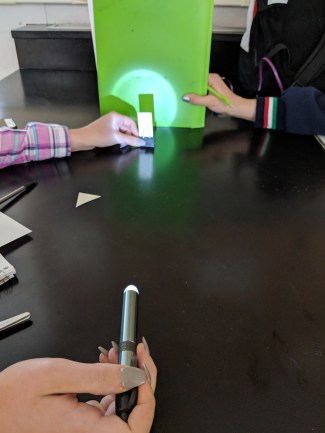
shadows.jpg

Chemistry Essentials: Activity Series

Students did a simple lab to develop an activity series for several pure metals. Most of the solutions were 0.1 M, which wasn’t strong enough to get a very visible reaction in the time we had. Next time, I need to make sure I allow time to mix stronger solutions.

activity series.jpg

Day 149: Final Project, Problems, & Whiteboarding

AP Physics: Final Project

Students continued refining their proposals for the final project. Lots of students have ideas I’m really excited to see. A few students are working on ideas where it may be interesting to look at dissipated energy, so we got out the infrared camera to play a little. It turns out some glasses block a lot of IR.

ir selfie

Physics: Problems

Students worked on some sound wave problems. Things seem to be clicking for most students.

Chemistry Essentials: Whiteboarding

We spent some time talking about the observations students made during yesterday’s lab and drawing explicit connections to the equation for the chemical reaction. My students don’t have a great sense for what certain chemicals look like, so it ended up being more teacher directed than I’d like. Students also weren’t sure when a chemical will show up as a gas, since I’ve dropped the subscript g in order to simplify the equations we’re looking at, but I’m not sure that is a useful simplification.

After the discussion (or, more accurately, lecture with student responses), student whiteboarded some limiting reactant problems. The students who were engaged made some good progress.

Maker:S,Date:2017-10-21,Ver:6,Lens:Kan03,Act:Lar02,E-Y

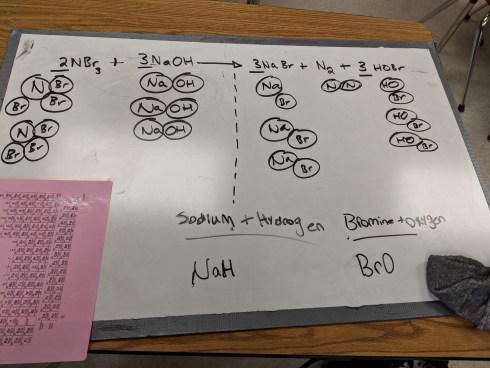
This student asked me if I could write the symbols for sodium hydride and bromine oxide

Day 148: Final Project, Superposition, & Reaction Types Lab

Today, I was missing  a lot of students from AP Physics and Physics for the AP Lit exam, so I kept those classes pretty low-key.

AP Physics: Final Project

The next few weeks are going to be tricky. About 1/3 of my students took the AP Physics 1 exam yesterday, and the rest won’t be taking it until May 24. I decided to go ahead and start the final project I’d planned, based on ideas from Casey Rutherford and Kelly O’Shea. Students are tasked with picking a scenario and using physics they’ve learned this year to describe what is going on. I pointed students to Rhett Allain’s Dot Physics for inspiration and most students spent today starting to think through potential topics.

Physics: Superposition

Students worked on a worksheet from Paul Hewitt’s Conceptual Physics sketching superpositions of triangular wave pulses. This year, students had a much easier time with the worksheet than I usually see; I think yesterday’s time playing with superposition on snakey springs made a big difference.

wave sup.jpg

Chemistry Essentials: Reaction Types Lab

Students worked through a lab to see each of the reaction types we’ve been working on in action. Students were clearly enjoyed the lab, and it was one of the most on-task days I’ve had with this group. Students made some great observations, but had trouble interpreting what those observations mean. Tomorrow, I want to spend some time making connections between observations and the equation for the reaction. I’ve also been thinking a lot this year about the purpose labs serve in a chemistry course, especially one as conceptual as this, and I think emphasizing the ways our paper and pencil representations explain what students see would be a way to add a lot of value to those labs.

single replace.jpg

Copper in silver nitrate solution

Day 164: Presentations & Mystery Block

AP Physics: Presentations

Students continued presenting their work. In one class, the number of presentations I scheduled per day is spot in. In the other, presentations are flying by and won’t need the full period tomorrow. I need to give some thought to what that class will do after finishing presentations.

Earth Science: Mystery Block

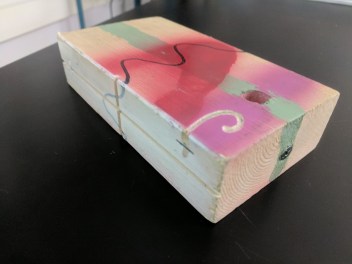
To revisit relative ages, students had to determine the steps in making a mystery block. There were a couple of particular elements that provoked some great conversation. In particular, one side had white paint and some grooves. The color made it very tough to tell if there was any paint in the grooves, so students had to use other features on that side to decide whether the paint or the grooves came first. Next time, I’d like to use this at the start of the unit as a model-building lab; I’m pretty sure this is a concrete enough context that students can reason out most of the principles for relative dating.

block.jpg

Day 163: Presentations & Paleozoic Minnesota

AP Physics: Presentations

Students started presenting their projects today. A full class period of student presentations can be deadly, but I wanted students to have an opportunity to share their work with their peers and couldn’t come up with a good alternative. Students ended up very engaged; over the last few weeks, they’ve heard bits and pieces about each other’s projects and seemed to enjoy seeing how everything came together. In one class in particular, students had some great questions after each presentation that showed they were really thinking about what they heard.

Earth Science: Cenozoic Minnesota

We started class by whiteboarding what students came up with for Minnesota’s Paleozoic era. There was some really nice discussion linking to earlier topics about why there are very few Precambrian fossils in Minnesota. Afterward, we continued the pattern with Minnesota’s Cenozoic rocks and landforms.

paleo

Day 161: Skip Day & Precambrian Minnesota

AP Physics: Skip Day

The Friday before Memorial Day is traditionally senior skip day at Tartan, so my classes were very small. The students who were here worked on their projects. One student was surprised that the fits on his raw data and linearized data had the same coefficient and intercept, which is a good reminder that I need to keep having students verbalize what their slope means, not just what physical quantity it represents, especially when dealing with linearized graphs. Since all but two of my students were either in calculus this year or took it last year, they were able to say a lot of the right words, but I still need to make sure they have a clear understanding of what is behind the words.

Earth Science: Ancient Minnesota

I gave students some information about precambrian rocks in Minnesota, then had them use what they’ve learned this trimester to make some inferences about that era. I had students point to a specific piece of evidence to support each statement they made, but I think this activity would have been better served by having them do a CER for each inference, instead.

inferences.jpg

Day 160: Peer Review & Geologic Time

AP Physics: Peer Review

I put students in random groups and had them share their project so far, then evaluate each other with a rubric. In addition to the feedback, students found it really helpful just to practice talking out loud about their project. A lot of them also got excited hearing about what some classmates they don’t normally interact with are working on and are looking forward to the presentations next week.

Earth Science: Geologic Time

Students made timelines to compare  the relative amounts of time in a 14 year old’s live to the amount of time in the major geologic periods and eras, which seemed to help them wrap their heads around the relative lengths of time much more than the big numbers would. I used a worksheet that already had specific events in the life of a 14 year old they should include, but next time I think I will either stick to just having a set number of years or work on making the events more open-ended since many of them are very cultural.

timeline.jpg

Day 159: Frisbee Golf & Radioactive Decay

AP Physics: Frisbee Golf

Today was the last true work day on the final project. One student is analyzing a specific throw frisbee golf had come up with attaching an LED to a point on the edge of his disk to make it easier to find the angular velocity after a throw since a sticker wasn’t quite visible enough in the video.

A lot of students are getting excited for presentations next week. Several students are really proud of what they’ve done so far and are looking forward to sharing it with their peers. One student was really disappointed when he realized he’s going to miss one day of presentations; I suspect he’ll insist the students he misses tell him about their projects some other time.

Earth Science: Radioactive Decay

When I collected notebooks yesterday, one of the items I looked at was a reflection that included a question about what students need from me to end the term the way they would like. Several students wrote they aren’t always sure what the big idea behind a lab is or how it connects to other labs, which isn’t surprising since I feel like I’ve been struggling with that in earth science. This is a good reminder of how important it is to have a coherent, purposeful curriculum.

Today, we shifted from looking at the relative ages of rocks to finding the absolute age with radioactive dating. Students did a lab flipping “coins” to model radioactive decay. I also collected a class average and spent a lot of the post-lab discussion looking at how results from individual groups compared to the class average. I also expanded the time we spent on connecting the lab to actual radioactive decay in response to the student comments.

coin flip


Day 158: Trampoline & Superposition

AP Physics: Trampoline

Students continued to work on their projects. One student wanted to study trampoline physics, but was having some trouble figuring out how to get reliable jumps. She ended up building a mini “trampoline” by stretching some lycra over a bucket to get something easier to control and collect data from.

Technology access is more of an issue than I anticipated. I have some students who would like to use video analysis on their project, but had fallen behind and were not ready to take advantage of the time last week we were able to spend in the computer lab. Next year, I want to spend more time having students do some backwards planning on their project. I had them submit a proposal to me, and I might have them include a timeline.

Earth Science: Superposition

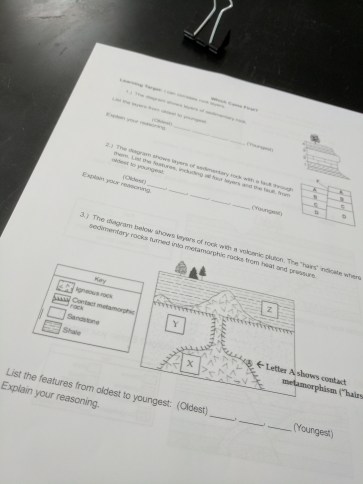
Students got some cross sections and had to rank the age of various features. Students were very successful at figuring out not just the rules of thumb for determining relative age, but making sense of why those rules are true.

superposition

Day 156: Base Sliding & Synthesis Day

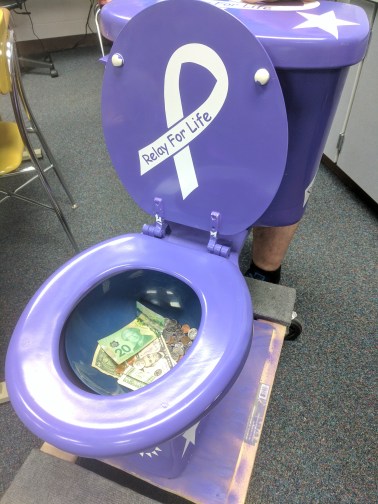
Today is Tartan’s Relay for Life and one of my classes got visited by the infamous purple toilet. Note the Canadian bill donated by one of my students.

toilet

AP Physics: Base Sliding

Students are wrapping up data collection and analysis for their final projects. I’ve got two students looking at the physics of sliding into a base to try and answer whether feet first or head first is better. They’re in different hours, so I’m not too worried about the repetition, but they are also looking at some different perspectives. One is looking at angular momentum as the player moves from running to sliding while the other is focusing on the actual slide. Its actually a little too bad they are in separate hours since it could be fun to have them compare notes.

Earth Science: Synthesis Day

I feel like this unit has been pretty disjointed and students are not making connections between volcanoes, mountains, folds, faults, and plate tectonics. I had them work through some conceptual questions today to explicitly draw connections between those ideas, which illuminated some specific areas I need to revise in this unit. For example, one of the questions asked students to determine whether mountains or volcanoes are more likely to have folds, and it came out that a lot of students don’t have a mental model for how a fold forms.