Day 118: Board Meeting, Projectile Problems, & Balancing

AP Physics: Board Meeting

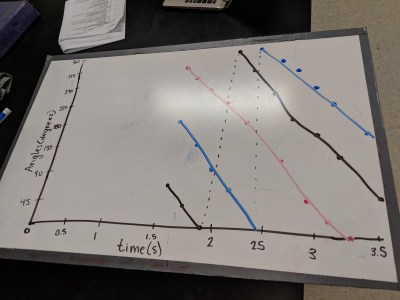
We had our board meeting for yesterday’s lab on centripetal force. I approached it as three mini board meetings since students had done experiments for how three different variables affect the force. The units on slope ended up being a very powerful way for students to see the connections between their three graphs. It was especially exciting when we got to the force vs. mass graph and students saw the connections to Newton’s 2nd Law. One class noticed the slope on the force vs. 1/radius graph has units of Joules, but I’m not sure of the significance of that yet.
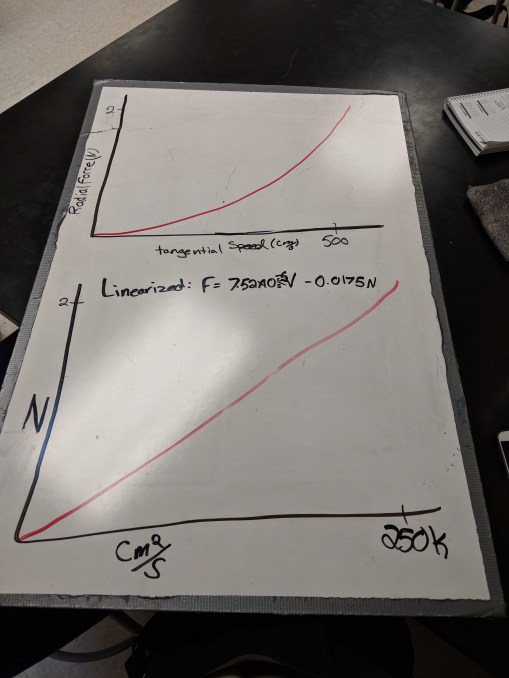
force vs t.jpg

Physics: Projectiles

Students whiteboarded yesterday’s problems for a gallery walk. They are consistently viewing free-fall as just a special case of models we’ve already covered, which made the problems pretty easy.  Afterward, students started working problems for horizontal projectiles.
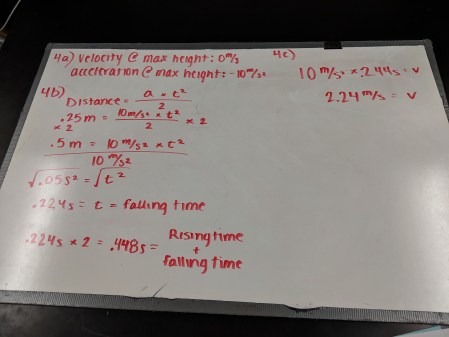
projectile prob.jpg

Chemistry Essentials: Balancing Reactions

After some discussion about the labs from the past few days, students worked on some problems balancing chemical equations. The students who started by sketching a particle diagram were generally very successful at seeing how to balance. A few students got tripped up determining when individual letters in a formula represent individual atoms, especially when the formula included a polyatomic ion, but were getting the hang of it after a couple problems.

balancing prob 1.jpg

Day 116: Multiple Choice, Reaction Time, & Conservation of Mass

AP Physics: Multiple Choice

Students took a quiz on rotational kinematics and we fired up Plickers to discuss some multiple choice problems a lot of students got wrong on the final. There were a lot of great conversations and students generally felt very comfortable pointing out errors in their own thinking. There were a few problems that most students got right on their first try today, which was interesting. I asked my students about it, and they said they were feeling pretty mentally fried during their final, especially since it was on the second day of exams, which makes sense.

img_2398

Physics: Reaction Time

Students dropped rulers to calculate their reaction times. Students were pretty successful at designing an experiment and sketching a velocity vs. time graph for the ruler, but annotating and setting up equations was much more challenging than I’d hoped.  Doing the math with v-t graphs just isn’t sticking for a lot of students this year. I think the problem is a lot of them are not attaching meaning to the variables or numbers, which makes the annotations on the graphs and the formulas we use something to memorize. I need to keep working on supporting my students in using the graphs and other diagrams as tools for meaning-making.

ruler.jpg

Chemistry Essentials: Conservation of Mass

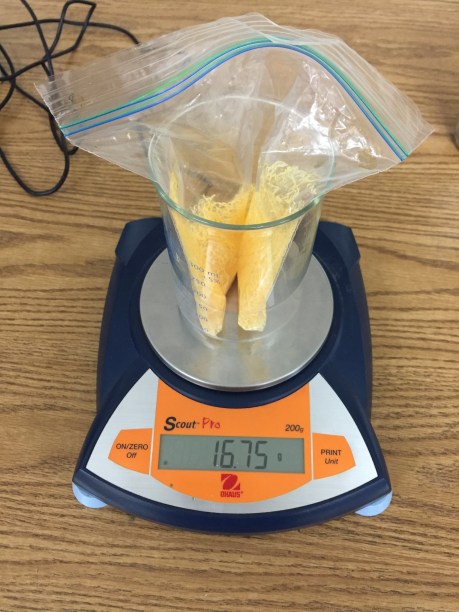
Students did a chemical reaction in a plastic bag to see the conservation of mass and practice translating between different representations of chemical reactions. Time got a little tight because I was not able to have a balance at every table; next time, I would be better off delaying the lab if another class needs the balances on the same day. Students still got a kick out of the chemical reaction.

IMG_1737

Day 115: Mistakes Whiteboarding

AP Physics: Rotation Whiteboarding

Students did mistakes whiteboarding with yesterday’s problems on rotational kinematics. Several of the mistakes lead to some great conversations about what information angular motion graphs do and do not convey.

rot wb.jpg

Physics: Projectile Whiteboarding

These classes also did mistakes whiteboarding with yesterday’s problems on velocity vs. time graphs for projectiles. There were a lot of good mistakes, but a lot of long silences. I need to keep working on making sure my classroom is a comfortable place for intellectual risks.

projectile wb.jpg

Chemistry Essentials: Representing Reactions

I finished out a day of mistakes whiteboarding with some problems going between equations, statements, and particle diagrams for chemical reactions. The main challenge was keeping the class in a single conversation since so many students had questions about the whiteboards, which is a great problem to have. Students also started consciously seeking out new voices when they realized one student was finding most of the mistakes, which was also great.

chem mistake.jpg

Day 114: Rotation Problems, v-t Graphs, & Representing Reactions

Today’s walkout happened to fall during homeroom, so it didn’t have much impact on my classes. A group of senior students organized a short march around the school, and I was very proud watching students march past the windows of my classroom.

All three of my classes were doing problems on a worksheet, so I failed to get good pictures of their work.

AP Physics: Rotation Problems

Students worked through some problems on angular motion with an emphasis on angle vs. time and angular velocity vs. time graphs. The problems went very smoothly; I can most likely count on not needing the whole period to whiteboard the problems tomorrow.

Physics: v-t Graphs

Students worked on some conceptual problems sketching and interpreting velocity vs. time graphs for projectiles. Students are feeling very confident about projectile motion, which is good to see. There are also a lot of great conversations where groups are self-correcting their answers, which is exactly what I’m after.

Chemistry Essentials: Representing Reactions

I introduced students to the notation for chemical reactions and had them practice translating between equations, statements, and particle diagrams. Some students are struggling to keep track of all the details, which is what I expect when they first see the equations.

Day 113: Board Meeting, Projectiles, & Formula Writing Review

AP Physics: Board Meeting

Students whiteboarded the results of yesterday’s lab. Students were very successful making key connections to linear motion. I didn’t specify when students should set time equal to zero or how they should handle it when a dot passed zero radians, so there was some variation in the graphs, but students were able to make sense of those differences.

Maker:S,Date:2017-10-21,Ver:6,Lens:Kan03,Act:Lar02,E-Y

Physics: Projectiles

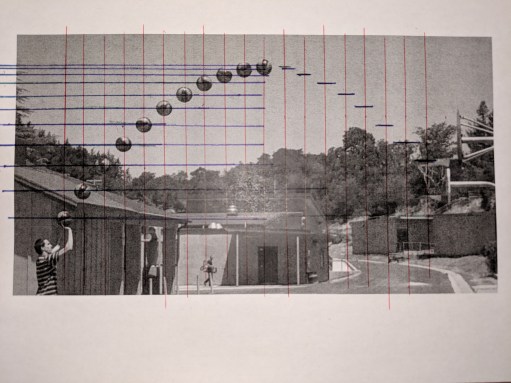
Today, I used an activity Kelly O’Shea came up with based on a post from Dan Meyer. I gave students printouts of an image showing half the path of a basketball, then had them draw lines to see the horizontal and vertical motion of the ball. Students were once again very successful at making the connections I was after.

Maker:S,Date:2017-10-21,Ver:6,Lens:Kan03,Act:Lar02,E-Y

Chemistry Essentials: Formula Writing Review

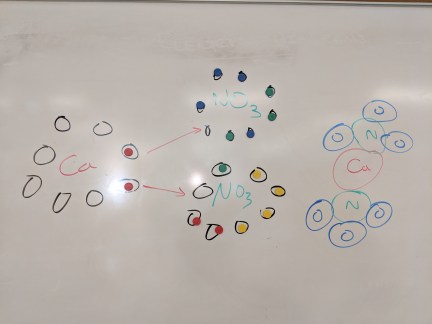
To prep students for translating between representations of chemical reactions, we reviewed writing chemical formulas based on the name. I reviewed electron diagrams, but did not require students to sketch them. However, most students chose to sketch them as a way of thinking through the formulas, which was great.

electron diagram.jpg

Day 112: Rotation, Free-Fall, & Skew Dice

Today was the first day of a new trimester.

AP Physics: Rotation

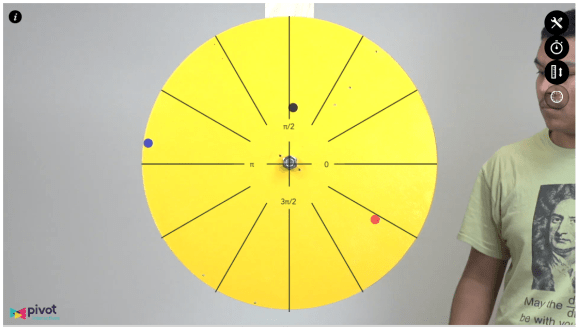
Students used Pivot Interactives to make angular position vs. time graphs for several points on a disk with a constant angular velocity and a point on an accelerating disk. Back in September, my students who took calculus last year were able to make a lot of connections when we did graphs for linear motion. One of the great things about returning to circular motion now is my students currently taking calculus now have enough background knowledge that they were able to make some very similar connections today.

pivot.PNG

Physics: Free-Fall

To kick off projectile motion, students worked through a worksheet I got from Michael Lerner where they were asked to describe the motion of a falling orange using a variety of tools from earlier in the year. This seemed to help some student synthesize and connect a lot of ideas from earlier in the year.

Chemistry Essentials: Skew Dice

A lot of my students haven’t had chemistry since first trimester, so I wanted to reestablish some class norms. I used Frank Noschese’s subversive grouping to get students into group, then had them whiteboard a CER to answer whether skew dice are fair. Time got a little tight, so a lot of groups collected less data than I normally would push for, but in the follow-up discussion, that gave us the opportunity to talk about the value of getting as much data as possible.

Day 111: Tri 2 Reflections

AP Physics

I’ve gotten a lot more late work than usual this year, and the problem is especially pronounced when it comes to lab portfolios for AP Physics. My students tell me the portfolio entries are fairly quick and easy to write, so I’m planning to survey them this spring about why they are putting those off. My guess is students simply don’t see the value in the lab portfolio aside from the points. We spend time discussing each lab after it is complete, so the lab portfolio does not add much meaning making. I wonder if a better approach may be to ask students to write a reflection on how their thinking changed over the course of the lab or on their growth when it comes to science practices. I want to take some time this summer to work on what a reflective lab portfolio might look like.

Physics

I’ve continued to struggle this year with getting students to make the leap to meaning-making; students are especially struggling to connect different representations of a scenario or articulate what those representations mean. One of the results has been that students rarely use those representations if they aren’t explicitly asked. We’ll be starting projectile motion next week, and I think it will be worthwhile to really take our time getting to the math in order to spend more time than usual working with the velocity vs. time graphs and other representations.

Chemistry Essentials

This year is the first time I taught the 1st trimester of Chemistry Essentials, and I had the opportunity to teach it both tri 1 and tri 2. This summer, I want to spend some time working on the storyline for this course. I used a lot of elements from the Modeling Instruction chemistry curriculum, but I modified a lot in order to meet the Minnesota science standards assigned to this trimester of the course and to adapt to the needs of my students. Especially since chemistry is not my strong suit, the result feels like an awkward Frankenstein. I think with some work, I can get to something that feels more cohesive and has a better flow.

Day 110: Final Exams

Today is day 1 of final exams.

AP Physics

Students took  the multiple choice portion of an AP practice exam. I left the rotation and circular motion questions in, even though we haven’t touched those topics yet, since students have a 1 in 4 chance of getting them right and it will give me some information on their existing ideas. I made sure to communicate this to students in advance, including that I will adjust my grading accordingly, which helped students approach those questions calmly.

Physics

About half of the period was spent on an individual exam that was pretty traditional and the other half was a lab practical that students completed in small groups. Due to limits on equipment and space, about half the class was doing each portion at a time, which made for a noisy testing environment than usual. If we take this approach again, I might see if another teacher could accommodate my students working on the individual portion. I also think the individual and lab practical portions of the final represent two very different purposes; I think that is a reflection of my counterpart and I both being stretched a little thin this year and not having many opportunities to talk about why we’re doing things a certain way.

Maker:S,Date:2017-10-21,Ver:6,Lens:Kan03,Act:Lar02,E-Y

Chemistry Essentials

Students took a pretty traditional final exam. No matter how long I make the test, it consistently takes students about an hour to finish; I think a lot of students simply reach a point where they can’t focus anymore, especially since this tends to be their last final (honestly, I usually have trouble concentrating by this point during finals). I decided to plan for an hour-long final and used the first 30 min of the block to whiteboard portions of the final review. I think that helped some students build confidence and it felt like a relief for many of them to have some collaborative time.

Day 109: Free Response & Review

Yesterday was a snow day and tomorrow is the start of final exams, so today was a little tricky.

AP Physics: Free Response

With the AP exam looming, I gave students most of a practice exam as their final. Today, they took the free response portion. I took out a few problems to make sure there was no rotation and to get it reasonable for a 55 minute class period.

Physics: Final Review

Students worked on a final review that asked them to apply several different models to the same scenario. A few groups opted to work on whiteboards, instead of on paper, which was just fine with me. A lot of students went back to drawing their free-body diagrams without sketching in context, like the surface of a hill or ramp, which lead to some mistakes, but most students were able to get on track once they added in that surface.

Chemistry Essentials: Final Review

Students worked on a pretty traditional final review. The particle diagrams finally seem to be clicking for a lot of my students, which is great to see. I am seeing some students check out since it is fairly set whether they will pass or fail; if I teach this course next year, I need to spend some time this summer thinking about how to make final exams meaningful to my students.

Day 108: Experimental Design, Collisions, & Particle Diagrams

AP Physics: Experimental Design

Yesterday, students worked on an experimental design problem from the 2017 AP exam. Today, they exchanged work and used the scoring guide to assign points and give each other feedback. A lot of students were pretty nervous about giving their work to someone else; I think the simple act of recording points on a very tough problem raised the stakes more than I expected. Students still said they found the activity useful, so that may help ease the discomfort if we trade papers again.

Physics: Collisions

Students whiteboarded some of yesterday’s problems before taking a quiz on conservation of momentum. I had some students who actually consider conservation of momentum easier than impulse on a single object; one student told me its just like energy, but they don’t have to think about the different types.

mom wb.jpg

Chemistry Essentials: Whiteboarding

Students have been struggling with what particle diagrams are intended to show, so we started by brainstorming a list of characteristics of a good particle diagram and having some discussion about why they are useful. Afterward, we whiteboarded yesterday’s problems and did a gallery walk. This seemed to help reinforce the purpose of a particle diagram for a lot of students.