Day 51: Problems, 3rd Law, & Covalent Bonds

AP Physics 1: Problems

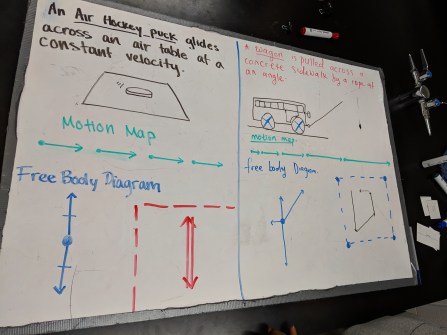
Students worked some problems on balanced forces, with an emphasis on Newton’s 3rd Law. We also started talking a little bit about the final exam, which will be a modified practice AP exam.

Physics: 3rd Law

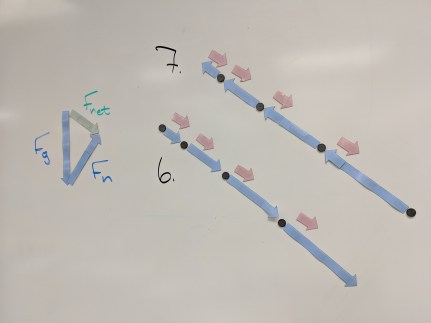
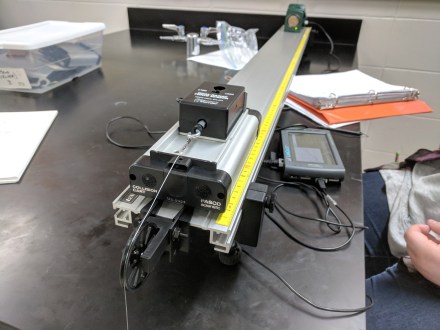
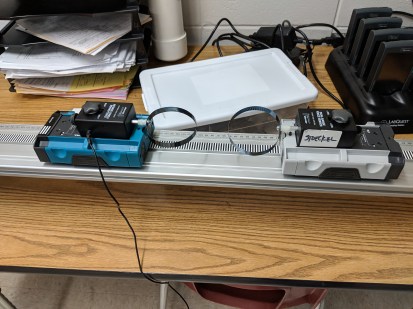
Students predicted how the forces would compare during a series of collisions, then we tested teach collision out using a a pair of force sensors with hoop springs attached. Partway through the testing, a few students made the connection to Newton’s 3rd Law, which was fun to see.
n3l

Chemistry Essentials: Covalent Bonds

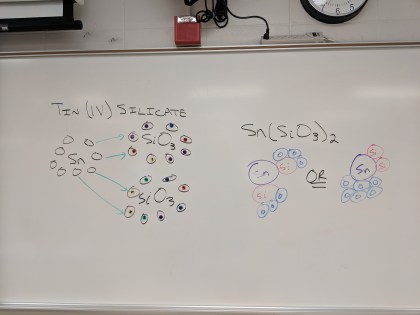
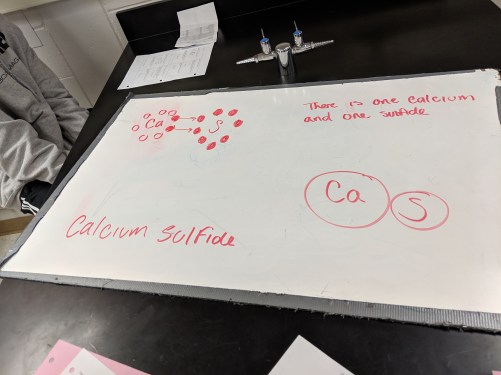
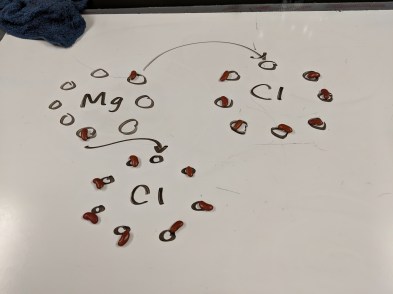
I introduced students to covalent bonding today. We aren’t going into much depth on figuring out the formulas, but we did take some time today to sketch electron diagrams (simplified Lewis dot structures) to get at what is going on during a covalent bond.

11.19 Covalent Bonding Example.jpg

Day 50: 3rd Law, Elevator, & 2 Truths

AP Physics 1: 3rd Law

We took some time for students to generate a rule based on the collisions we observed yesterday. A few students connected the results to Newton’s 3rd Law and we were able to connect the results to the system schema, showing there was a single interaction between the carts.


Physics: Elevator

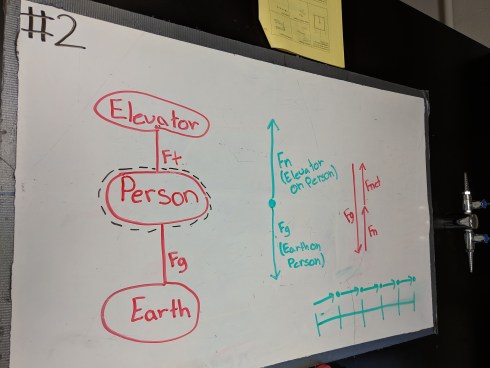
We finished discussing a video of a balance during an elevator ride to figure out which way the elevator was moving. At first, a few students thought I might have ridden the elevator down, then up to get the two different accelerations, but the class was very successful at working through why a single ride needs two different accelerations.


Chemistry Essentials: 2 Truths & a Lie

To continue practicing formula writing and naming, we played “Two Truths & a Lie”. Each group prepped a whiteboard with two correct names and formulas, and one name and formula with an error. This class struggles with whole-class discussion, but this has produced some good small-group discussion. One student came up to me during class to say she really likes the formula writing since it’s allowing her to talk more like a chemist and understand what the formulas mean, which was cool to hear.

2 truths.jpg

Day 49: Newton’s 3rd Law, Whiteboarding, & Polyatomic Ions

AP Physics 1: Newton’s 3rd Law

Students predicted the relative forces on two carts in various collisions, then we tested them using a pair of carts with force sensors. I really like using hoop springs for this since it gives a very clear visual in addition to the force vs. time graphs.


Physics: Whiteboarding

Students whiteboarded the problems they worked on yesterday for a gallery walk. We set up the packet to re-use the problems we had that just deal with representations.

phys force prob.jpg

After discussing the problems, I showed students a video I’d recorded on our elevator and asked them to write a CER for whether I took the elevator up or down.


Chemistry Essentials: Polyatomic Ions

We added polyatomic ions to the formula writing we’ve been doing. Students seem to be getting the hang of how to figure out the formula. Some students have figured out the “flop and drop” strategy, and others are opting to draw the simplified Lewis dot structures we’ve been using when they get stuck.

11.15 Polyatomic Ion Example.jpg

Day 48: Mistakes Whiteboarding, Problems, & Mistakes Worksheet

AP Physics 1: Mistakes Whiteboarding

We did mistakes whiteboarding for yesterday’s problems. I had students focus on the diagrams and the set-up for their whiteboards, rather than worrying about getting all the way to a correct answer during the discussion. I overheard a lot of students who wanted to get the answer on their whiteboards comment they couldn’t do the problem without a correct diagram, which tells me they are seeing how to use the diagrams.

Physics: Problems

Students worked on some calculations with unbalanced forces. I’m really liking the pairing of motion maps with vector addition diagrams; this has been a light bulb moment for me of why motion maps are useful.

vad mm.jpg

Chemistry Essentials: Mistakes Worksheet

Students worked on some written problems where they had to determine whether a given formula was reasonable. I intentionally included some metals with multiple possible charges, so they would have to consider each possibility before ruling out the formula. After students had worked, they whiteboarded the problems for a gallery walk.

chem wb

Day 47: Card Sort, Mistakes Whiteboarding, & Formula Writing

AP Physics 1: Card Sort

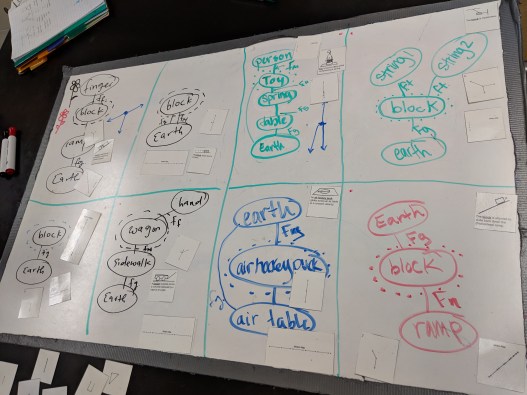
Students whiteboarded two of the items from yesterday’s card sort that they found trickiest. Not surprisingly, the item with an air hockey puck that glides at a constant speed was a very popular choice. I didn’t tell students anything about what the vector addition diagrams represent and there was a great moment during one section’s discussion where a student said the new diagram really reminded him of vector addition in math.

card sort wb.jpg

Physics: Mistakes Whiteboarding

We did some mistakes whiteboarding with representations of objects with unbalanced forces. There was a lot of good discussion. I regretted not pushing students to draw acceleration arrows on motion maps, because this is a time when it would have really paid off.

On a side note, there were several problems about a passenger on an elevator. While the problem did not include any gendered language, about half the students who whiteboarded that problem changed passenger to “guy” or “man” while the other half stuck with something gender-neutral.

mistakes wb.jpg

Chemistry Essentials: Formula Writing

We did a gallery walk of yesterday’s formula writing problems. Most students seem to be making sense of what the charges on their ion sheet represent and figuring out how to write the formulas. At the end of the hour, we spent some time going over the different representations we have and what the purpose of each is.

Day 46: Card Sort, Board Meeting & Formula Writing

AP Physics 1: Card Sort

Students worked on Kelly O’Shea’s balanced forces card sort. Since they haven’t seen vector addition diagrams yet, I tried holding those back until they’d sorted everything else, which worked really nicely. I was also much stricter than I was in my regular physics that students needed to sketch the interaction diagrams, and that seemed to really help students think through each scenario.

card sort.jpg

Physics: Board Meeting

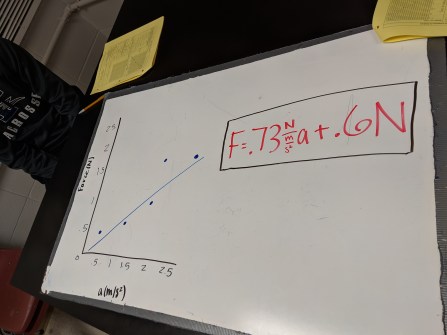
Students whiteboarded their results from Thursday’s lab on Newton’s 2nd Law. My 1st hour got pretty nice results, including slopes that came out very close to the masses of their carts, but my 6th hour had much messier data. I ended up telling students to focus on a few specific whiteboards when we were talking about some key points, which seemed to work out fine.

n2l wb.jpg

Chemistry Essentials: Formula Writing

We started working on writing chemical formulas. I had students sketch simplified Lewis dot structures on whiteboards, then use beans as manipulatives to figure out the correct chemical formula. The students who took the time to sketch and use the diagrams were very successful at thinking through the formulas I threw their way.

bonding beans.jpg

Day 45: Quiz, Force Representations, & Bonding Intro

I had a sub today, so no pictures. I’ll find out Monday how things went.

AP Physics 1: Quiz

Today’s quiz was maybe closer to test length. I included the notorious bumpy ramp problem (which I really love); my students are still uncomfortable with problems that don’t reflect something they’ve already seen, so I think this will be a great one to have some discussion on how students approached it.

Physics: Force Representations

Students worked on some problems extending the representations we’ve been using for forces to unbalanced forces. I’m hoping this will be a relatively small leap. It occurred to me this worksheet could have been a nice card sort, but I didn’t think of that far enough in advance to get copies run and cut, plus I’d prefer to be in the classroom myself the first time my students complete a new card sort.

Chemistry Essentials: Introduction to Bonding

Students worked on a worksheet designed to bridge what they know about the Bohr Model to bonding. Students also took a quiz and, since students had a really tough time working on something new after last week’s quiz, the para, my co-teacher, and I all agreed to try putting the quiz at the end of the hour this time.

Day 44: Whiteboarding, 2nd Law, & Whiteboarding

AP Physics 1: Whiteboarding

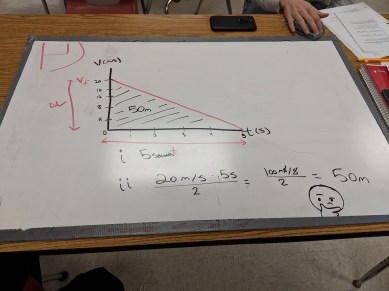
Students whiteboarded some constant acceleration problems for a gallery walk. These problems are coming very easily to most of my students, which is great to see.

ap wb

Physics: Second Law Lab

Students collected data for a paradigm lab on Newton’s 2nd Law. Some students were a little thrown off by recording values from a graph in a data table, then making a new graph from the data table, but that’s fairly common.

f a

Chemistry Essentials: Bohr Model Whiteboarding

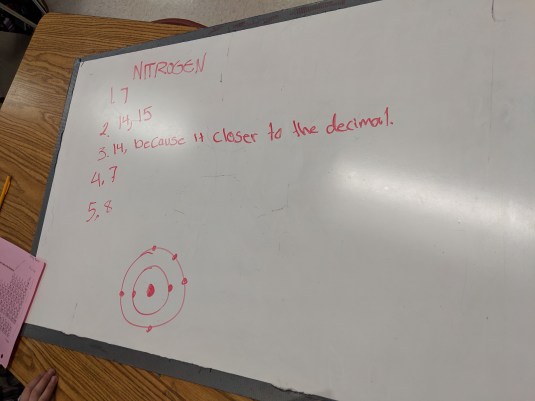
We whiteboarded and discussed some key information from the periodic table and Bohr model for several different elements. Students lit up at the end when I had them leave off the name and the number of protons, then have another group try to figure out which element they’d answered the rest of the questions for.

bohr wb

Day 43: Whiteboarding, Assessment, & Isotopes

AP Physics 1: Whiteboarding

Students whiteboarded yesterday’s problems for a gallery walk.They are definitely taking to velocity vs. time graphs very quickly.

ap wb.jpg

Physics: Assessment

Students took their assessment on balanced force problems today. We’ve been using weekly packets, and including a groupwork reflection at the end of each packet. We’ve been consistently using the same three questions, but switched to a rubric from Colleen Nyeggen for a change of pace. Several students were very vocal that they liked that the switch pushed them to think a little differently about their participation this week.

Chemistry Essentials: Isotopes

This course usually includes the fairly classic penny isotope lab where students figure out the ratio of pre-1982 pennies to post-1982 pennies in a sealed container, but the math always felt like a black box in this course, so I came up with an alternative. Today, I tried having each group find the average mass of a random sample of pennies, then comparing that average to the mass of each type of penny. Groups really consistently saw that their average was closer to the typical mass of the type of penny they had more of, which lead nicely into identifying the most common isotope of elements on the periodic table. The key moment seemed to be when I had students whiteboard their average mass and which type of penny they had more of.

pennies.jpg

Day 42: Problems, Practical, & Bohr Model

AP Physics 1: Problems

Students took the plunge to solving problems for objects with a constant acceleration. There was a great moment in one class where a group was struggling with a problem, and a student said “I’m gonna be [calculus teacher]!” He then proceeded to walk the graph while describing his motion to the rest of the group, which was just what they needed to figure out the problem. Thanks, Ms. Hyers!

Physics: Practical

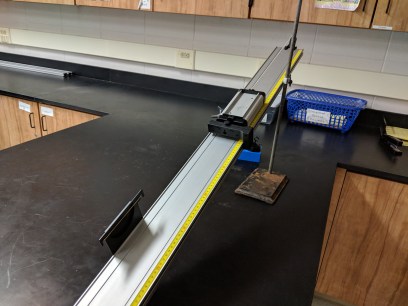
Students did a lab practical where they needed to calculate how much mass to hang off a string in order to balance the forces on a cart on a ramp. Students tested their calculations using mass sets that went down to 10 g, which got them close enough to be satisfying.

practical

Chemistry Essentials: Bohr Model

Students whiteboarded yesterday’s problems connecting the Bohr model of the atom to the periodic table. I remembered today that I want to re-work the problems I have to make the periodic trend in valence electrons pop out. The students who were checked in were feeling very confident by the end of the hour today. The trouble is I’m seeing more and more students check out; I’m wondering if another round of one-on-one conferences might help some students get more engaged by making it clear that they can still improve their grade.

bohr models