Day 153: Charlie Brown & Volcanic Landforms

AP Physics: Charlie Brown

Students continued work on their projects. One student did some video analysis of a clip of Charlie Brown kicking a football to explain why he falls down after Lucy pulls it away.

Earth Science: Volcanic Landforms

I did some notes on volcanic landforms, but tried to break it up a bit by explicitly having students annotate their notes at a few points during class. I also tried a “give one, get one” at the end since many of my students have been skipping writing questions based on their notes, but I don’t think students saw the value in that activity. Partly, since I’ve managed to cut down on the notes, I haven’t spent much time laying the foundation for Cornell notes, and students haven’t had much practice in my class writing questions based on notes.

Day 152: Project & Mountain-Building

AP Physics: Project

Students continued work on their projects. Both of my classes are wrapping up the theory and planning portions of the project, and the different personalities of those classes is incredibly apparent. In my 2nd hour, there was a lot of noise and chaos as students worked through their ideas out load as they typed or wrote. In my 4th hour, you could hear a pin drop as students worked out their ideas independently.

Earth Science: Mountain-Building

Today was one of those days in my earth science class. I’d put together an activity on mountain-building and volcano formation in PhET’s Plate Tectonics simulation that I was pretty excited about. When my students fired up the laptops, only thee out of 35 were able to get the simulation running. Plan B was to demo the activity on the SMARTBoard, but the teacher computer failed to load the simulation with a different error. With half the period gone, I resorted to notes. Our tech guy got the issue fixed, so now I have to decide whether I want to try again, or hold on to the activity for the next time I teach earth science.

Day 151: Space Yo-Yos & Volcano Types

AP Physics: Space Yo-Yos

Students continued work on their projects. I showed students Rhett Allain’s recent post on fidget spinner physics as a really strong example of what I’d like. Yesterday was also the last AP exam that a large percentage of seniors at my school take, and the combined result is a lot of students seemed much more focused on their projects today. In one hour, a student was talking through the physics behind some yo-yo tricks, and started trying to figure out which tricks should work in space and why. Turns out, there is video evidence for some of the tricks he said don’t require gravity!


Earth Science: Volcano Types

Today, I introduced students to the three main types of volcanoes. First, they predicted whether wet sand, ooblek, or a pile of scoria could make a taller volcano to get them thinking about the physical properties that lead to the shapes of the different types of volcanoes.

wb

Day 150: Project & Fault Blocks

AP Physics: Project

Most of my students were gone for the AP Calculus test today. The students who were here continued work on their projects. While I’ve got a lot of students who are legitimately excited about this project, I also have some who see it as post-AP test filler, so I need to keep revisiting what I’m looking for and why it is worthwhile to complete a project like this. One of my students has never been all that confident on rotation, so he decided to dig deeply into the behavior of the flippers in a pinball machine so that he could improve his understanding of rotation, which is awesome.

Earth Science: Fault Blocks

This unit includes a learning target about types of faults. Students built paper fault blocks to explore different fault types. I liked giving them a manipulative, but it was tricky for them to make sense of how the pieces related before they were assembled. Next time, I might number the layers on each side of each piece before I run copies to make that a little clearer.

I also have to brag about a comment from a student when I was handing back the most recent quiz. She said, as she wrote her answers, she “felt like a scientist”, which is especially exciting with what I’ve read about the importance of science identity in retaining women and students of color in STEM. I need to keep giving students opportunities to feel like a scientist!

fault blocks.jpg

Day 149: Project & Earthquake Engineering

AP Physics: Project

I took a few minutes today to clarify what I’m looking for in the project, and that seemed to help some students shape their next steps. A lot of students would like to use video analysis, so I booked a few days in the computer lab next week. We have some iPads with Vernier Video Physics loaded, so I may see if I can have a few of those in the classroom in the meantime.

Earth Science: Earthquake Engineering

Students tested their towers to see how they held up in an earthquake. Most groups had a pretty wide base, with a narrow tower on top since I made the main criteria height. I’d love to find a good way to measure the acceleration at the top of the tower; I think in a longer project, this could provide students with more opportunities to connect their design to their science knowledge, especially if they were encouraged to try some exotic solutions, like tuned mass damping.

tower.jpg

Day 148: Projects & Earthquake Engineering

AP Physics: Projects

Students continued to work on their final projects. There was a range of how well students were using the time; I suspect part of the problem is they aren’t clear on what I’m looking for in the final product, so I need to spend some time clarifying that Monday and reviewing my expectations. I’m pretty excited about the projects students are working on so far; one student is digging into a certain move in his favorite video game using video analysis and got stuck figuring out how to deal with the camera panning during the move. He ended up tracking a background point, then using a calculated column to find the character’s position relative to that point, which produced a beautiful parabola.

Earth Science: Earthquake Engineering

Students designed towers intended to stay upright during an earthquake. We ran out of time to test the towers, so that will wait until Monday.  Students are just using straws, but I’d like to think about how to encourage students to think about stability at the highest levels. This is also a tough activity for students to really connect to their science knowledge; they are better equipped to justify ideas for shake tests than to justify ideas for a tower design. Even so, students pulled in some interesting ideas from geometry. A few students who were in my class last tri also took some ideas from the Marshmallow Challenge we’d done.

IMG_20170505_085141

Day 147: Project Work & Plate Tectonics

AP Physics: Project Work

Students continued working on their final projects for physics. I had a fun conversation with a student who plays baseball and is planning to analyze hitting a baseball. I’m extremely ignorant about sports, so wanted to make sure there would be enough meat for him to dig into and, as he talked about everything that goes into an effective swing, it quickly became clear he will need to pick some aspects of the swing to focus on.

Earth Science: Plate Tectonics

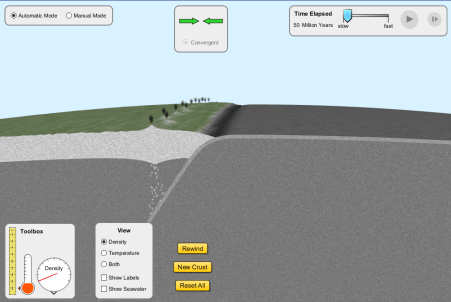
Students played with PhET’s plate tectonics simulation to reinforce what is going on at plate boundaries. I think if I fleshed out what students are doing in the simulation, I could significantly reduce (or get rid of completely) the notes I did yesterday.

sim

Day 146: Project Intro & Convection Currents

AP Physics: Project Intro

For the rest of the trimester, my students will be working on a project I borrowed from Casey Rutherford. They will pick something they are interested in, explain it using physics from the course, then do some kind of data collection and modeling. A lot of students seem really excited about the project. I’m embedding checkpoints about once a week so I can make sure students stay on track. Today, with most of my students taking the AP Literature exam, I gave them time to start playing with ideas for a topic.

balancrd.jpg

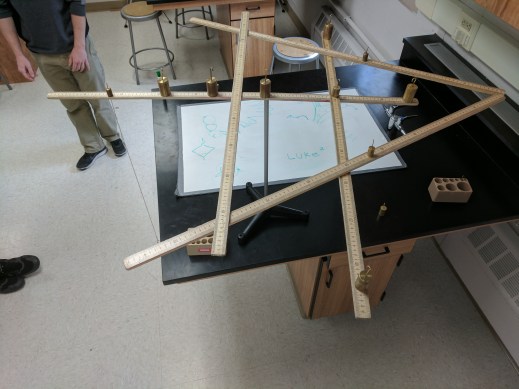
A few students played with balanced torques today

Earth Science: Convection Currents

I’ve been working on replacing the notes in Earth Science with more hands-on activities, but I caved and gave the slides on how convection currents drive plate tectonics today. I really like the way this brought together a lot of ideas from labs we’ve been doing recently, but I found myself wishing that students had some exposure to mountain-building and volcanoes, which are the next unit.

Day 145: AP Test Day & Pangea

AP Physics: AP Test Day!

As I write this, my students are sitting in the AP Physics 1 exam! I only saw one of my classes before the test, and I told them they could do whatever will help them feel good going into this afternoon’s test, with one of the options being to simply relax for a period. The class asked me to go over one of their last quizzes and to review a few concepts. After that, a few students worked independently to go over a practice test they took. Meanwhile, I taught a group of students how to play Quiddler and had a blast while getting royally trounced by all of them.

quiddler

Earth Science: Pangea

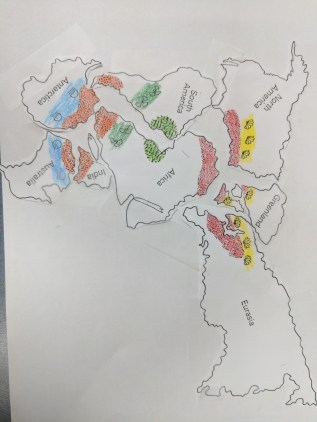
Students got continents with indicators for what kinds of rocks and fossils are present. They used that information, along with the shapes, to construct Pangea, which should lead nicely to the idea of moving plates. I didn’t get to see yet how it went; the AP Chem teacher offered to trade classes with me since she has a lot of my physics students and they were begging for one more chance to ask me questions.

pangea

Day 144: Review & Seafloor Spreading

AP Physics: Review

A little over half of my students were at the AP Chemistry test today, so I left it open for students in class to do what they needed to feel ready for tomorrow’s exam. I had one group of students go back over old quizzes to focus on mistakes they’d made, while some other students asked for a free-response question on circuits.

Earth Science: Seafloor Spreading

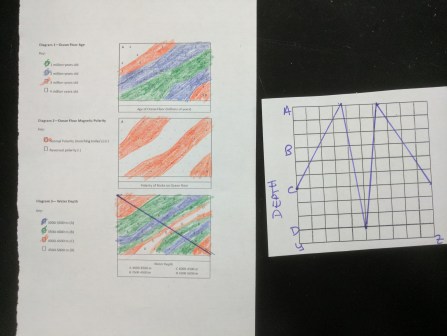
Students looked at maps of a couple of different data on the mid-Atlantic ridge. Next time, I might try to get them pre-colored maps of the data to allow for more time on the analysis and interpretation. This did combine nicely with Friday’s look at earthquake depth to justify subduction on the coast of South America. I lead students through the connection due to lack of time, but it would be interesting to give students more room to connect this data to Friday’s earthquake data.

spreading.jpg