Day 163: Presentations & Paleozoic Minnesota

AP Physics: Presentations

Students started presenting their projects today. A full class period of student presentations can be deadly, but I wanted students to have an opportunity to share their work with their peers and couldn’t come up with a good alternative. Students ended up very engaged; over the last few weeks, they’ve heard bits and pieces about each other’s projects and seemed to enjoy seeing how everything came together. In one class in particular, students had some great questions after each presentation that showed they were really thinking about what they heard.

Earth Science: Cenozoic Minnesota

We started class by whiteboarding what students came up with for Minnesota’s Paleozoic era. There was some really nice discussion linking to earlier topics about why there are very few Precambrian fossils in Minnesota. Afterward, we continued the pattern with Minnesota’s Cenozoic rocks and landforms.

paleo

Day 162: CTSR & Ancient Minnesota

AP Physics: CTSR

Students took the CTSR today so that I can have some data to help decide whether to use that or the FCI next year, though I’m leaning towards the FCI since the responses on individual questions is much more meaningful. In the past I gave the CTSR because I was in a PLC with a chemistry teacher, so we wanted an assessment we could both use, and it lead to great conversations about how to build reasoning skills across grade levels. I think if all of the science classes gave the CTSR each spring, especially if we developed some common language using materials like Sayer & Addy’s Curriculum Analysis Taxonomy and the NGSS Science Practices, there is the potential for some really interesting department-wide vertical alignment.

Earth Science: Ancient Minnesota

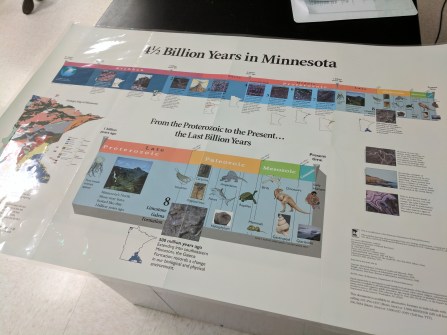
Students examined a poster of Minnesota’s geologic history to reinforce the relative lengths of time and see how the geology has changed over time. Afterwards, I gave students some information about Minnesota’s Paleozoic geology so they could complete an activity similar to Friday’s look at Precambrian Minnesota.

timeline.jpg

Day 161: Skip Day & Precambrian Minnesota

AP Physics: Skip Day

The Friday before Memorial Day is traditionally senior skip day at Tartan, so my classes were very small. The students who were here worked on their projects. One student was surprised that the fits on his raw data and linearized data had the same coefficient and intercept, which is a good reminder that I need to keep having students verbalize what their slope means, not just what physical quantity it represents, especially when dealing with linearized graphs. Since all but two of my students were either in calculus this year or took it last year, they were able to say a lot of the right words, but I still need to make sure they have a clear understanding of what is behind the words.

Earth Science: Ancient Minnesota

I gave students some information about precambrian rocks in Minnesota, then had them use what they’ve learned this trimester to make some inferences about that era. I had students point to a specific piece of evidence to support each statement they made, but I think this activity would have been better served by having them do a CER for each inference, instead.

inferences.jpg

Day 160: Peer Review & Geologic Time

AP Physics: Peer Review

I put students in random groups and had them share their project so far, then evaluate each other with a rubric. In addition to the feedback, students found it really helpful just to practice talking out loud about their project. A lot of them also got excited hearing about what some classmates they don’t normally interact with are working on and are looking forward to the presentations next week.

Earth Science: Geologic Time

Students made timelines to compare  the relative amounts of time in a 14 year old’s live to the amount of time in the major geologic periods and eras, which seemed to help them wrap their heads around the relative lengths of time much more than the big numbers would. I used a worksheet that already had specific events in the life of a 14 year old they should include, but next time I think I will either stick to just having a set number of years or work on making the events more open-ended since many of them are very cultural.

timeline.jpg

Day 159: Frisbee Golf & Radioactive Decay

AP Physics: Frisbee Golf

Today was the last true work day on the final project. One student is analyzing a specific throw frisbee golf had come up with attaching an LED to a point on the edge of his disk to make it easier to find the angular velocity after a throw since a sticker wasn’t quite visible enough in the video.

A lot of students are getting excited for presentations next week. Several students are really proud of what they’ve done so far and are looking forward to sharing it with their peers. One student was really disappointed when he realized he’s going to miss one day of presentations; I suspect he’ll insist the students he misses tell him about their projects some other time.

Earth Science: Radioactive Decay

When I collected notebooks yesterday, one of the items I looked at was a reflection that included a question about what students need from me to end the term the way they would like. Several students wrote they aren’t always sure what the big idea behind a lab is or how it connects to other labs, which isn’t surprising since I feel like I’ve been struggling with that in earth science. This is a good reminder of how important it is to have a coherent, purposeful curriculum.

Today, we shifted from looking at the relative ages of rocks to finding the absolute age with radioactive dating. Students did a lab flipping “coins” to model radioactive decay. I also collected a class average and spent a lot of the post-lab discussion looking at how results from individual groups compared to the class average. I also expanded the time we spent on connecting the lab to actual radioactive decay in response to the student comments.

coin flip


Day 158: Trampoline & Superposition

AP Physics: Trampoline

Students continued to work on their projects. One student wanted to study trampoline physics, but was having some trouble figuring out how to get reliable jumps. She ended up building a mini “trampoline” by stretching some lycra over a bucket to get something easier to control and collect data from.

Technology access is more of an issue than I anticipated. I have some students who would like to use video analysis on their project, but had fallen behind and were not ready to take advantage of the time last week we were able to spend in the computer lab. Next year, I want to spend more time having students do some backwards planning on their project. I had them submit a proposal to me, and I might have them include a timeline.

Earth Science: Superposition

Students got some cross sections and had to rank the age of various features. Students were very successful at figuring out not just the rules of thumb for determining relative age, but making sense of why those rules are true.

superposition

Day 157: FCI & Review

AP Physics: FCI

Students took the FCI today. I didn’t get my act together to give anything as a pre-test this year, but I want to start doing a pre- and post-test again next year and am trying to decide whether I’d rather use the FCI or the CTSR. To help decide, I’m going to see if one test correlates better to my students’ scores on the AP Physics 1 exam.

Earth Science: Review

I had students whiteboard their answers from Friday’s review for discussion. On a question about what causes different types of volcanoes, I realized students were having trouble separating characteristics of the different types from what causes the different types, so we spent some time discussing that. Next time I teach this course, I need to think about how to shift this unit (and several others) to help students more clearly separate cause and effect.

wb (5).jpg

Day 156: Base Sliding & Synthesis Day

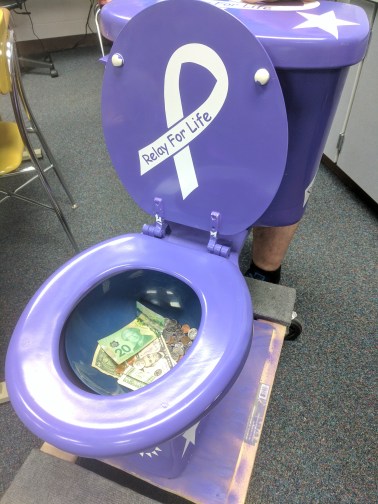
Today is Tartan’s Relay for Life and one of my classes got visited by the infamous purple toilet. Note the Canadian bill donated by one of my students.

toilet

AP Physics: Base Sliding

Students are wrapping up data collection and analysis for their final projects. I’ve got two students looking at the physics of sliding into a base to try and answer whether feet first or head first is better. They’re in different hours, so I’m not too worried about the repetition, but they are also looking at some different perspectives. One is looking at angular momentum as the player moves from running to sliding while the other is focusing on the actual slide. Its actually a little too bad they are in separate hours since it could be fun to have them compare notes.

Earth Science: Synthesis Day

I feel like this unit has been pretty disjointed and students are not making connections between volcanoes, mountains, folds, faults, and plate tectonics. I had them work through some conceptual questions today to explicitly draw connections between those ideas, which illuminated some specific areas I need to revise in this unit. For example, one of the questions asked students to determine whether mountains or volcanoes are more likely to have folds, and it came out that a lot of students don’t have a mental model for how a fold forms.

Day 155: Hockey Pucks & Vocab

AP Physics: Hockey Pucks

Students continued to work on their projects today. One of my students is analyzing momentum transfer between a hockey puck and a stick and found a surprising result. He expected the puck to have a fairly constant acceleration while in contact with the stick, but his data shows a big jump in the puck’s acceleration when the blade of the stick starts to flex. The next challenge is to try and figure out why!

Earth Science: Vocab

This class had a sub today, so no photos. There’s been a lot of vocabulary this unit, so I had student work on a short activity to put the vocab into student-friendly language and do some synthesis with the terms. I’ll find out tomorrow how things went.

Day 154: Colliding Bouncy Balls & Isostacy

AP Physics: Colliding Bouncy Balls

Students continued to work on their final projects. One student worked on colliding pairs of bouncy balls together at different speeds to see how bouncing changes against an elastic surface instead of a hard one.

Earth Science: Isostacy

We didn’t actually use the word isostacy today, but students floated blocks of different kinds of wood in a bucket of water and measured the ratio of the block above the water to below the water. I’d love to plan ahead better and get a better mix of blocks with several with the same density, but different volumes. I was able to get around that by having them stack two identical blocks to see the ratio stays the same.

isostacy