Day 117: Ohm’s Law & Earth’s Layers

I almost forgot about my blog post today!

AP Physics: Ohm’s Law

We got out the power supplies and resistors to see if the formula students found for Ohm’s Law in the sim yesterday also works in the real world. Students were getting good results and I overheard a lot of good talk about uncertainty.

Earth Science: Earth’s Layers

Students worked on a scale drawing of the interior of the earth. I like students comparing the thickness of the layers and getting a sense of scale by adding some features like Mount Everest or an ocean trench. The questions are fairly superficial, so I need to think about what kind of deeper thinking I want them to do tomorrow. I do like the way the Mystery Tubes lead into this, since we don’t have any direct observations of Earth’s interior.

Day 116: Circuit Sim & Mystery Tube

AP Physics: Circuit Sim

Students used the PhET Circiut Construction Kit to start exploring circuits. Students had some great conversations around a few questions about the blue dots I took from the PUM curriculum. I was surprised to hear some students say the blue dots must get used up since batteries die over time, but students were able to test that idea by removing their battery. This lead a few students to connect back to momentum, thinking of the battery as a source of impulse, which I thought was an interesting connection.

circuit

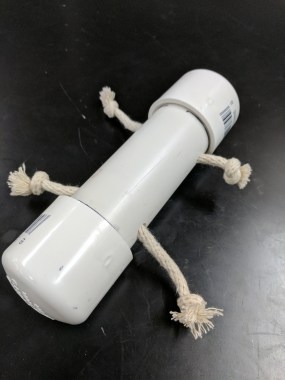
Earth Science: Mystery Tubes

With the start of a new trimester, students got shuffled again. A little over 75% of my 9th graders haven’t had me yet this year, so I will need to make sure I am paying attention to classroom culture and helping students understand what I want from them.

To get students practicing observations and inferences, I had them play with the mystery tubes. In their notebooks, I asked students to explicitly connect each inference to at least one of their observations with an arrow. Several groups were surprised when I told them their sketch of the inside of the tube was a useful inference, so I know I’ll need to do some work with this group explicitly valuing non-verbal representations. Tomorrow, I’ll take some time to connect this activity to the scientific process and how I want to approach this course.

mystery tube.jpg

Day 115: Tri 2 Reflections

We are on day 2 of final exams, so I am taking the opportunity to reflect on this trimester while my students test.

AP Physics

I use standards-based grading in this course, but both trimesters so far I’ve had very few retakes. When I talk to students, I hear a lot of focus on the percentage their score translates to and many students are very demoralized by that. I think next year I need to spend more time on how the quiz scores fit with the gradebook. I may also switch to giving students a rating with words (mastery, partial mastery, not yet) or colors, rather than a number, to get more focus on what the rating means. I also want to take some time next week for an anonymous poll on what kept students from reassessing.

During the registration period for AP exams, I got word that a lot of students were hesitant to sign up because they didn’t think they’ll be ready for it in May. I’ve got a lot of evidence that students are in decent shape, but I need to make sure I am sharing that information with students. A lot of AP teachers in my building make it much more explicit that I did so far this year when students are working problems from past exams (like the AP chem teacher who does Free-Response Fridays), so I think many came to my class with that expectation. It should be a pretty easy shift to get better about naming it when we do problems off past exams.

Physical Science

My biggest issue this trimester was ignoring culture-setting. I’ve gotten much better at this in my senior classes, but I’ve been spoiled by the last few years when I only had 9th graders at the beginning of the year, which means I get to set their expectations for high school science. Since many of my students started the year with a different teacher, they needed more support to adjust to my expectations. Starting third trimester, I need to keep that in mind and make sure I am taking steps from day 1 to help students understand what I want and how to be successful in my classroom.

Day 114: Final & Project Presentations

Today and tomorrow we are on a special schedule for final exams.

AP Physics: Final Exam

Students are taking a practice AP exam for their final. Since we have 90 min class periods during finals, they did a modified free response section yesterday on our last day with a regular schedule. Tomorrow, during their final exam period, they will take the multiple choice. I already know they are going to struggle on a few specific questions because we have not done much thinking in terms of the center of mass of a system, so, when we review, I’m planning to re-do a couple of topics focusing on those kinds of problems.

Physical Science: Project Presentations

I cut down the written final to fit in a single class period, then had students present their designs to the class during the extended period. Afterwards, students did some reflecting on the project, focusing on how they functioned in a group. A lot of the reflection would be more meaningful if students weren’t going to be completely reshuffled the next regular day of classes, but they were pretty engaged nonetheless. Students said they much preferred this over doing the written final today since it was lower stress and gave them a break from sitting in silence all day.

Day 113: Free Response & Written Final

Final exams don’t officially start until tomorrow, but both my classes got an early start today.

AP Physics: Free Response

I’m using a practice exam from the College Board as my final this tri. Students worked on the free response section, minus one problem on waves and one on circuits since we haven’t done those topics yet. I was relieved by how many students said the free response wasn’t that bad. While they worked, I was mulling over a multiple choice problem about the change in speed of a projectile and played around with the problem in Desmos.

Speed time graph

Physical Science: Written Final

I decided to use the final exam period for students to present their engineering projects, so today they took a written final. Just like first trimester, I’d like to shift to something more deeply rooted in the scientific practices.I really like the two-stage lab exams I’ve done in physics, but that is different enough from the multiple choice other 9th grade teachers do that I would need to talk some other teachers into it. I need to come up with some ideas for easy grading and for managing a lab exam with up to 42 9th graders in the room. I might pitch a lab-based final to the other 9th grade teachers and see if they’d be up for some summer curriculum writing to work on those issues and design some good labs.

Day 112: Model Summaries & Peer Review

AP Physics: Model Summaries

Students made model summaries for the rotation version of key models so far. Students seemed to find it useful to remind themselves what tools are available to think about these models. Afterwards, students worked on some goal-less problems to reinforce the importance of starting a problem with what models apply. Students were really pleased when they realized some of the problems worked equally well with energy or with a combination of constant acceleration and forces.

rot force.jpg

Physical Science: Peer Review

I had groups pair off to share their presentations and give some feedback. My strong groups made good use of the time and I heard a lot of nice feedback, but my other groups could have used more structure. Next time, I think I will provide students with hard copies of the rubrics to fill out to give them a little more accountability and focus their feedback.

Day 111: Model Summaries & Presentation Work

AP Physics: Model Summaries

Today and Monday are dedicated to review for final exams. One of the problems on yesterday’s assessment is from last year’s AP Physics exam, so I gave students a copy of the scoring guide for that problem and some time to see how they measured up against the College Board criteria. Students responded positively and said it helped them understand what the graders are looking for.

Afterward, I assigned each group one of the four major models we’ve covered so far (constant acceleration, forces, momentum transfer, and energy transfer), then had them whiteboard a summary of that model. Once groups finished, we did a gallery walk so students could have a chance to review other models. Students said this helped remind them of tools they’d forgotten about. I think on Monday, I’ll come up with some problems for them to practice picking appropriate tools.

model-summary

Day 110: Fun Test & Presentations

AP Physics: Assessment

Students took their energy assessment. For the first time, I had multiple students tell me the test was fun, which was especially good to hear since I included a free-response problem from the 2016 AP exam. My PLC has been focused on experimental design this year, and I’m enjoying seeing that payoff in my students not only doing well with that skill, but feeling confident enough that they can enjoy applying it.

Physical Science: Presentations

Students worked on presentations to make the case for their cargo carrier design. I gave students a template a colleague made last year to help students make sure they are connecting the science to their design, but, after watching them work, it feels like too much scaffolding. I made much better use of a graphic organizer for evidence-based reasoning than in the past and did more to embed that skill throughout the course, and I think framing the presentation as evidence-based reasoning on a bigger scale may have been enough. I need to think about what that might look like next year.

Day 109: Collision Types & Testing Round 2

AP Physics: Collision Types

Students worked some problems using elastic vs. inelastic collisions. They are feeling very confident about energy, which is great to see, and several students are thinking about how they could use energy to work problems we’d done earlier in the year, which is fantastic.

As a side note, registration for our AP exams ends tomorrow, and I’ve offered doughnuts to the first class to get 100% registered. Its been surprisingly effective and I’ve currently got the highest registration rate. I need to remember to give the same challenge next year.

Physical Science: Testing Round 2

Students tested their second design. There was a nice variety of tests, including one group that had a tray of ice at the bottom of their ramp to simulate weather conditions. Most groups tried at least one collision besides the head-on we’d done before. One group asked if they could use bubble wrap to simulate a bumpy road. While the trucks are heavy enough that I don’t think the bubble wrap did much, I like the idea and am thinking about what might have worked better.

Since we only have four ramps, I assigned groups with similar tests to the same stations and directed them to figure out how they would share the equipment. It was more chaotic than the first round of testing, but that’s to be expected. I might scaffold them a little more on making that plan next year.


Day 108: Collision Types & Building Again

AP Physics: Collision Types

We whiteboarded the results of Friday’s Direct Measurement Videos to get to the definitions of elastic and inelastic collisions. A lot of groups tried to answer purely conceptually, in spite of some quantitative questions on the activity. I think these groups were treating each question as separate, rather than thinking about how one answer could help them with the next piece of the activity. I want to make better use of lab notebooks (most likely starting next year) as a reflective tool, which I think might help students see more connections between problems.

ap-wb

Physical Science: Building Again

Students worked on their second round of building. I upped the cost of paper cups, which were the most popular material on the first go around, which lead to a little more variety in egg holders. I also did another round of visiting each group and asking them to explain their design choices using Newton’s Laws, and I can tell students are getting more confident with this skill.

eps-cx