Day 128: SHM Energy & Floods

My classes had a sub while I chaperoned a field trip today, so no photos.

AP Physics: SHM Energy

Students worked on some problems on the role of energy in simple harmonic motion. While there aren’t any circular motion problems today, I’ve been liking the connections we’ve made to circular motion and I’m spending the bus ride thinking about if and how I want to connect today’s work to circular motion.

Earth Science: Floods

Students watched a video and answered some questions on flooding.

Day 127: Oscillating Particle Model & Problem Scoping

AP Physics: Oscillating Particle Model

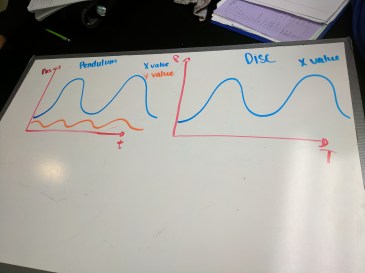
Students whiteboarded their video analysis results for the trio of objects in simple harmonic motion. I haven’t done a lot of circular motion in the past, so when we discussed the spinning disk, I was intrigued by how many students were convinced the angle in the video was responsible for the changing velocity. On a whim, I had students sketch the disk from directly above, then had them sketch velocity vectors, including components, at a few points around the disk, which nicely convinced students that they would see similar graphs for the horizontal motion no matter what the viewing angle.

shm trio

Earth Science: Problem Scoping

This unit includes an engineering project to plan removing a dam from a river. I gave students a memo from their imaginary client and had them do some problem scoping. One of the questions I ask is what background knowledge they will need, which can nicely set up a unit, but students did not identify anything about rivers or erosion as useful knowledge on this project. The memo mentions sediment transport as a major challenge in removing the dam, but I don’t think students saw that as something that would require background knowledge to understand. Even when I handed out the unit’s learning targets, students did not name the target about describing river behavior as one that will be useful. I need to think about how I will address that during the unit.

Day 126: SHM Trio & Water

AP Physics: SHM Trio

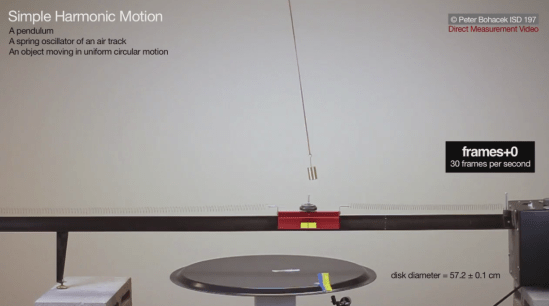
Students downloaded a Direct Measurement Video of three objects in simple harmonic motion and did some video analysis. There was lots of great discussion about why the pendulum’s y-position vs. time graph showed a different period than the x-position vs. time graph. I also really liked the conversations students had about whether the net force on each object is constant. My favorite moment was when a student called me over for help, and the person sitting next to her said “You need to think about it first!” The second student then started asking questions to help the first student figure out the answer she needed. Yay, students!

SHM Trio

Earth Science: Where is Earth’s Water?

Students filled beakers with their prediction for how Earth’s water is distributed, then got the actual distribution and compared. I liked how doing their own prediction first made it much more dramatic when they got the actual results, and saw just how little of Earth’s water is in a form we can really use.

water.jpg

Day 125: Mistakes Game & Molar Mass

Physics: Mistakes Game

Students whiteboarded yesterday’s problems including at least one mistake. Its been a little while since I last had students do this, and a lot of students were excited to do it again.

IMG_1771

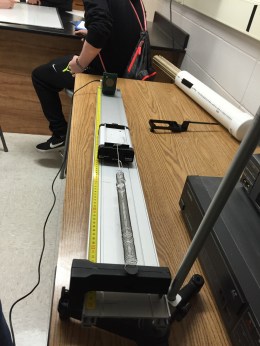
Since everything we’ve done so far has been vertical springs, I sent up a ramp with a cart attatched to a spring so we could look at position vs. time graphs compare the period at different angles as a way to see how “changing gravity” affects the spring’s period. In spite of having the equation, a lot of students expected gravity to matter because they thought there had to be a force to de-compress, not recognizing that the spring could exert that force since we’ve mostly looked at stretching springs.

IMG_1770

Chemistry: Molar Mass Introduction

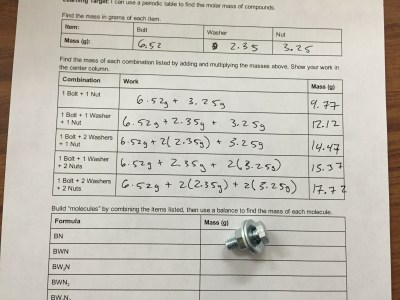
Students got the mass of individual nuts, bolts, and washers, then predicted the masses of various combinations. Compared to last trimester, I took some extra time debriefing after the lab and tried to be very explicit that the hardware was being used to represent individual atoms, since we can’t observe individual atoms directly.

IMG_1768

Day 123: Board Meeting & Balancing Equations

Physics: Period of a Spring Board Meeting

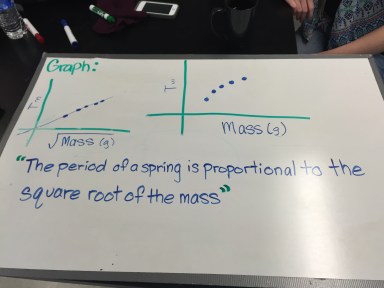
Students whiteboarded their results to yesterday’s lab. Once we get situated, I usually give students a minute or two to talk with their lab group. I watched one group use this time to furiously tap at a tablet, then edit their board to reflect a square root, rather than linear, relationship between period and mass. During the discussion, I asked them to explain the change they made and they shared that, prior to seeing they other whiteboards, they stopped after trying a linear fit because it had a really nice correlation coefficient. When they saw other groups got an intercept much closer to zero using a square root fit, they quickly tried the same fit on their data, and saw they got a better correlation and an intercept of nearly zero. We’re talking a lot in my building about how to use technology in the classroom, and this moment exemplifies how I want students to use technology. This group had to decide whether their linear fit or their classmate’s square root fit was more convincing, and Desmos made it possible to quickly and easily test the competing ideas and get the evidence they needed to be convinced.

IMG_1765

Chemistry: Balancing Equations

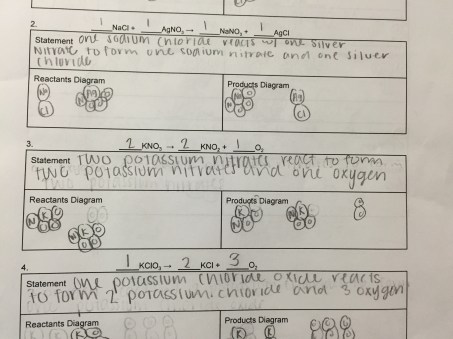
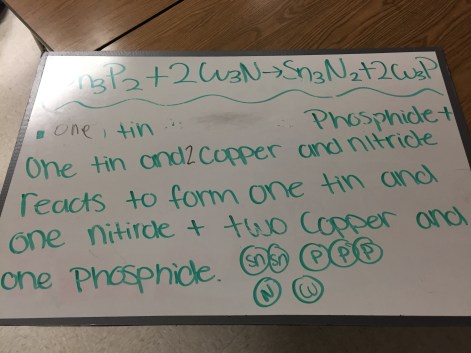
Students combined the multiple representations we worked on before break with what they figured out in yesterday’s sim to practice balancing chemical equations. I remain very impressed with how easy the reaction diagrams make this process for students.

IMG_1764

Day 122: Springs & Balancing Equations

Physics: Period of a Spring

Students designed experiments to determine the variables that impact the period of a spring. I was very pleased with how many students pulled up their notes and results from the pendulum lab, in spite of the fact that it was on the other side of a week-long break, to help with experimental design and make sense of their results. For next year, I want to look at getting some additional springs. A lot of groups wanted to find a way to test the impact of the spring constant, and I only have options with relatively extreme spring constants, which made it tricky to get meaningful data.

IMG_1761

Chemistry: Balancing Chemical Equations

Students used PhET’s Balancing Chemical Equations sim as an introduction to what it balancing means. Last tri, I had a lot of groups skip straight to the game and play using trial and error, missing out on most of the sense-making. This tri, I took a few minutes to talk with students about why I structured the activity the way I did and students took the sim’s introduction and the questions I’d written much more seriously. Next time around, I want to add some questions to get students to focus a bit more on the significance of the subscripts vs. the coefficients.

IMG_1760

Day 121: Pendulums & Quiz

Today was the last day of classes before spring break.

Physics: Pendulums

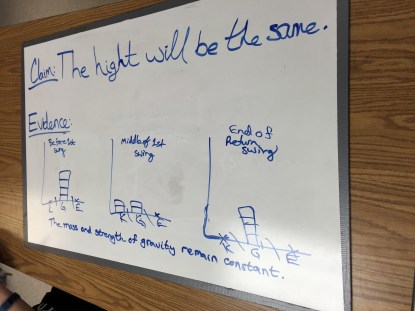
Before their quiz, I had students make predictions about a few different pendulums. First, they predicted how the maximum height on the return swing should compare to the starting height, then they made some predictions about a pendulum that uses a magnet to pick up a steel sphere at its lowest point, and finally we used a hover disc on a tilted table as a pendulum and students made predictions about what happens when the table’s angle changes.

IMG_1747

Chemistry: Quiz

Students took their first assessment of the course on representing reactions.

Day 120: Pendulum Motion Graphs & Mistakes Game

Physics: Pendulum Motion Graphs

Students whiteboarded their answers to yesterday’s worksheet. They did a nice job of using energy bar charts and free body diagrams to make predictions about what the position vs. time, velocity vs. time, and acceleration vs. time graphs should look like. We put a pendulum in front of a motion detector to get a look at the actual graphs and used both the formula and the graphs to determine the period of the pendulum.

Chemistry: Mistakes Game

Students whiteboarded their solutions to yesterday’s problem, including at least one intentional mistake. I ended up splitting each problem between groups, so one group did the statement, one did a diagram of the reactants, and one did a diagram of the products. I wish I’d had each group do a whole problem, then just limited how many present, since multiple representations gives room for richer mistakes.

IMG_1740

A partially corrected whiteboard

Day 119: Pendulum Problems & Representing Reactions

Physics: Pendulum Problems

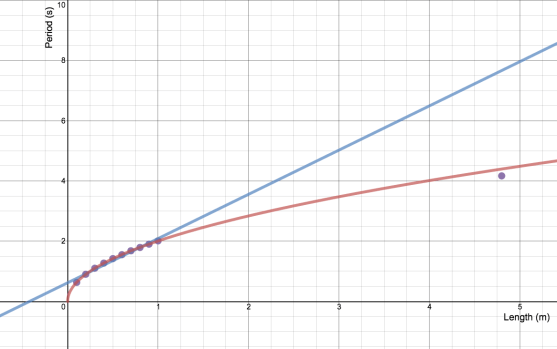
We had a brief discussion about the results of the pendulum lab, especially why a linear fit for the data my students collected usually looked pretty good, but did a very poor job of predicting the period of a large pendulum. I need to do a much better job of having my students talk about their intercepts, including whether or not an intercept of zero makes sense. Most of the groups who tried a square root function to fit their data gave it a shot because they didn’t like the intercept on the linear fit.

Afterward, students worked on a pendulum worksheet I put together where they drew energy bar graphs and free body diagrams for the pendulum at key points in its motion, then sketched position vs. time, velocity vs. time, and acceleration vs. time graphs for the pendulum.
pendulum graph

Chemistry: Representing Reactions

Students practiced translating between statements, chemical equations, and reaction diagrams. A lot of students needed some support to work through what a coefficient means vs. a subscript, but they did get there.
Day 118: Giant Pendulum & Conservation of Mass

Physics: Big Pendulum

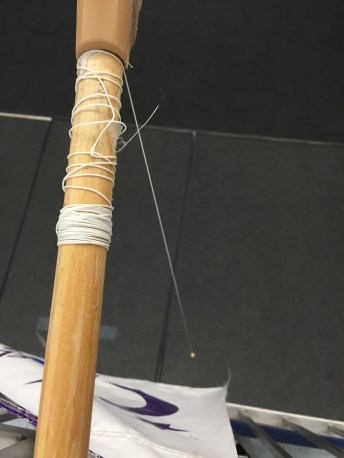
Before discussing the results of yesterday’s pendulum lab, we went to the main entrance of the school where we could hang a string from the second floor down to the first to make a 5 m long pendulum. Students used their mathematical models to predict what the period should be. Most groups used a linear fit for their data, and ended up predicting a period that was too big as a result. The really long pendulum provided a reason to refine their models by collecting more data and trying some linearization.

IMG_1736

Chemistry: Conservation of Mass

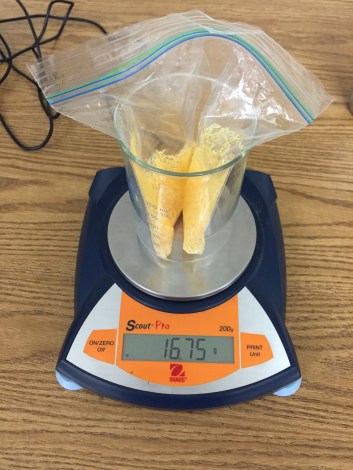
Students reacted calcium chloride, baking soda, and bromthymol blue in a Ziploc bag, making sure to take the mass of everything at various stages. This tri, I gave each group a beaker to place their bag in when using the balance, rather than having them set the bag directly on the balance pan, and the results were much better; students were able to use their results to articulate the law of conservation of mass very nicely.

IMG_1737