Day 128: Wave Superposition & Molar Mass in Reactions

I’m out today, so I’ll find out tomorrow how things actually went.

Physics: Wave Superposition

Students used a Direct Measurement Video to start exploring wave superposition. Since I’m not there to listen in on their conversations, I’m having them submit answers to some questions in Google Classroom so I can look over what my students are thinking before class on Wednesday.
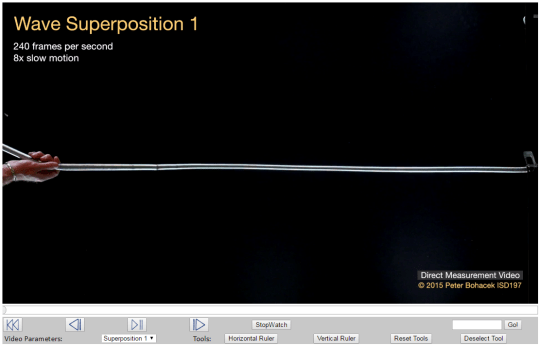
Wave DMV

Chemistry: Molar Mass in Reactions

Students went back to the nuts, bolts, and washers to introduce the idea of stoichiometry. I made up a “reaction” using those three elements and provided a total mass available for one of the reactants. Students used the hardware as manipulatives to determine how much of the other reactants would be needed along with how much of the product would be produced. When I did this last tri, students tended to ignore the manipulatives, so I reworked some of the questions to try and emphasize how the physical nuts, bolts, and washers can be used to check an answer.

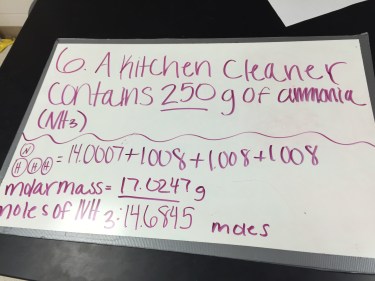
IMG_1599

Day 127: Wave Equation & Molar Mass

Physics: Wave Equation

Students used snakey springs data for a relationship between wavelength and frequency and made graphs. I’d hoped to share the graphs today, but there just wasn’t enough time. They spent a lot longer than last year’s students figuring out how to measure the wavelength. Last year, the weather was nice enough to do the lab outside, and a lot of groups found ways to use their spring’s shadow to mark key points on the ground. Today, we had snow, so were stuck doing the lab inside. Students were quick to recognize, based on the units, that the slope of their linearized graph was the speed of the wave.

Chemistry: Molar Mass Practice

Students worked on some practice molar mass problems, then whiteboarded solutions for a gallery walk. A lot of students initially struggled going from a measured mass to a number of moles, but when I asked students to think back to the lab they did a few days ago and tell me how they would figure out how many bolts I had if all they knew was the mass, things clicked pretty quickly.

IMG_1782

Day 126: Snakey Springs & Molar Mass

Physics: Snakey Spring Waves

Students used the snakey springs to start exploring properties of mechanical waves. Today, they found ways to affect the speed of the wave and made observations about what happens when a pulse reaches the end of the spring.

IMG_1776.JPG

Chemistry: Molar Mass

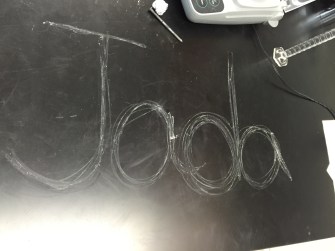
Today molar mass got a little more abstract as students calculated the molar mass for actual chemical formulas and answered questions like how many moles of chalk it takes to write their names on a lab table. A lot of students sketched diagrams of the formulas to help figure out what they had to add or multiply to get the molar mass and most felt pretty confident by the end of the hour.

IMG_1774

Day 125: Mistakes Game & Molar Mass

Physics: Mistakes Game

Students whiteboarded yesterday’s problems including at least one mistake. Its been a little while since I last had students do this, and a lot of students were excited to do it again.

IMG_1771

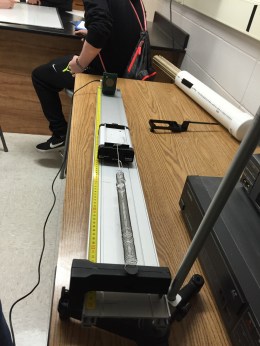
Since everything we’ve done so far has been vertical springs, I sent up a ramp with a cart attatched to a spring so we could look at position vs. time graphs compare the period at different angles as a way to see how “changing gravity” affects the spring’s period. In spite of having the equation, a lot of students expected gravity to matter because they thought there had to be a force to de-compress, not recognizing that the spring could exert that force since we’ve mostly looked at stretching springs.

IMG_1770

Chemistry: Molar Mass Introduction

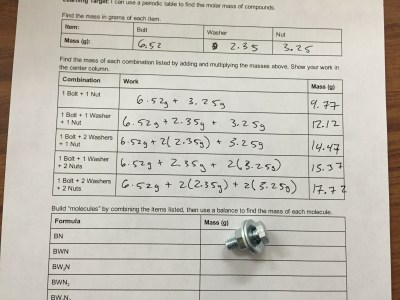
Students got the mass of individual nuts, bolts, and washers, then predicted the masses of various combinations. Compared to last trimester, I took some extra time debriefing after the lab and tried to be very explicit that the hardware was being used to represent individual atoms, since we can’t observe individual atoms directly.

IMG_1768

Day 124: Spring Problems & Mistakes Game

Physics: Spring Problems

Students worked through a Modeling Instruction worksheet using forces and energy to analyze the motion of a spring. The worksheet has students define h = 0 in a way that gives a negative gravitational potential energy at one extreme of the spring’s oscillation, and my students struggled with what a negative potential means. Both for cases like this and for negative electric potential differences, I need to adjust my energy unit to include some scenarios with negative energies.

Chemistry: Mistakes Game

Students whiteboarded yesterday’s problems balancing chemical equations, including intentional mistakes to help spur discussion. A lot of students were gone yesterday for a blood drive, and this seemed to help them get caught up. Tomorrow, they’ll be taking a quiz on balancing, so I took some time during class to do a practice problem under quiz-like conditions. Last tri, the chemistry students who did poorly in the class tended to have trouble self-assessing and would equate having an answer with understanding the problem, even when the answer was just copied from a classmate. I have some students who look like they could go down the same path this tri and, after the practice quiz, they were interested in how to improve their understanding before tomorrow’s quiz. While this is a step in the right direction, my real challenge is to help these students self-assess much earlier in hopes of helping them shift their habits in my class.

Day 123: Board Meeting & Balancing Equations

Physics: Period of a Spring Board Meeting

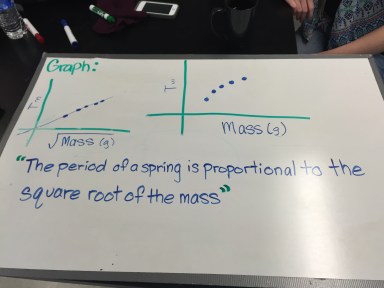
Students whiteboarded their results to yesterday’s lab. Once we get situated, I usually give students a minute or two to talk with their lab group. I watched one group use this time to furiously tap at a tablet, then edit their board to reflect a square root, rather than linear, relationship between period and mass. During the discussion, I asked them to explain the change they made and they shared that, prior to seeing they other whiteboards, they stopped after trying a linear fit because it had a really nice correlation coefficient. When they saw other groups got an intercept much closer to zero using a square root fit, they quickly tried the same fit on their data, and saw they got a better correlation and an intercept of nearly zero. We’re talking a lot in my building about how to use technology in the classroom, and this moment exemplifies how I want students to use technology. This group had to decide whether their linear fit or their classmate’s square root fit was more convincing, and Desmos made it possible to quickly and easily test the competing ideas and get the evidence they needed to be convinced.

IMG_1765

Chemistry: Balancing Equations

Students combined the multiple representations we worked on before break with what they figured out in yesterday’s sim to practice balancing chemical equations. I remain very impressed with how easy the reaction diagrams make this process for students.

IMG_1764

Day 122: Springs & Balancing Equations

Physics: Period of a Spring

Students designed experiments to determine the variables that impact the period of a spring. I was very pleased with how many students pulled up their notes and results from the pendulum lab, in spite of the fact that it was on the other side of a week-long break, to help with experimental design and make sense of their results. For next year, I want to look at getting some additional springs. A lot of groups wanted to find a way to test the impact of the spring constant, and I only have options with relatively extreme spring constants, which made it tricky to get meaningful data.

IMG_1761

Chemistry: Balancing Chemical Equations

Students used PhET’s Balancing Chemical Equations sim as an introduction to what it balancing means. Last tri, I had a lot of groups skip straight to the game and play using trial and error, missing out on most of the sense-making. This tri, I took a few minutes to talk with students about why I structured the activity the way I did and students took the sim’s introduction and the questions I’d written much more seriously. Next time around, I want to add some questions to get students to focus a bit more on the significance of the subscripts vs. the coefficients.

IMG_1760

Day 121: Pendulums & Quiz

Today was the last day of classes before spring break.

Physics: Pendulums

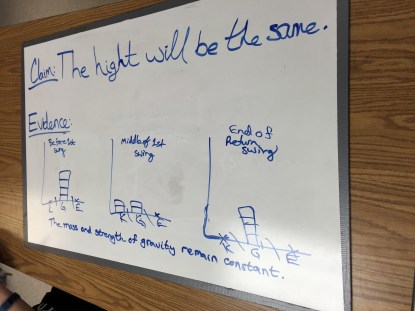
Before their quiz, I had students make predictions about a few different pendulums. First, they predicted how the maximum height on the return swing should compare to the starting height, then they made some predictions about a pendulum that uses a magnet to pick up a steel sphere at its lowest point, and finally we used a hover disc on a tilted table as a pendulum and students made predictions about what happens when the table’s angle changes.

IMG_1747

Chemistry: Quiz

Students took their first assessment of the course on representing reactions.

Day 120: Pendulum Motion Graphs & Mistakes Game

Physics: Pendulum Motion Graphs

Students whiteboarded their answers to yesterday’s worksheet. They did a nice job of using energy bar charts and free body diagrams to make predictions about what the position vs. time, velocity vs. time, and acceleration vs. time graphs should look like. We put a pendulum in front of a motion detector to get a look at the actual graphs and used both the formula and the graphs to determine the period of the pendulum.

Chemistry: Mistakes Game

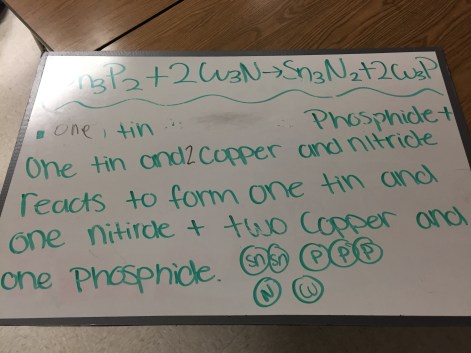
Students whiteboarded their solutions to yesterday’s problem, including at least one intentional mistake. I ended up splitting each problem between groups, so one group did the statement, one did a diagram of the reactants, and one did a diagram of the products. I wish I’d had each group do a whole problem, then just limited how many present, since multiple representations gives room for richer mistakes.

IMG_1740

A partially corrected whiteboard

Day 119: Pendulum Problems & Representing Reactions

Physics: Pendulum Problems

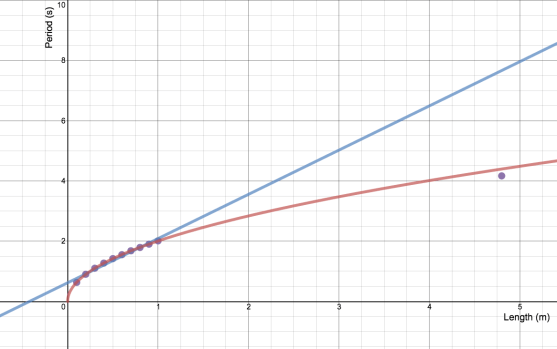
We had a brief discussion about the results of the pendulum lab, especially why a linear fit for the data my students collected usually looked pretty good, but did a very poor job of predicting the period of a large pendulum. I need to do a much better job of having my students talk about their intercepts, including whether or not an intercept of zero makes sense. Most of the groups who tried a square root function to fit their data gave it a shot because they didn’t like the intercept on the linear fit.

Afterward, students worked on a pendulum worksheet I put together where they drew energy bar graphs and free body diagrams for the pendulum at key points in its motion, then sketched position vs. time, velocity vs. time, and acceleration vs. time graphs for the pendulum.

pendulum graph

Chemistry: Representing Reactions

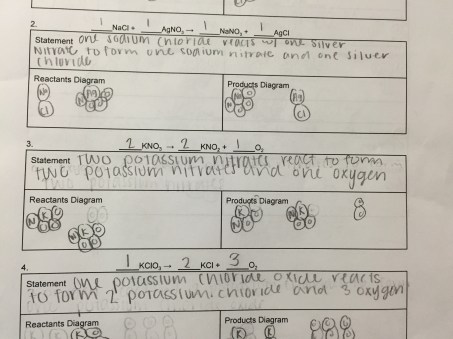
Students practiced translating between statements, chemical equations, and reaction diagrams. A lot of students needed some support to work through what a coefficient means vs. a subscript, but they did get there.