Day 48: Unbalanced Forces, Quantitative Interactions, & Bohr Model

AP Physics: Unbalanced Force Problems

Students started some problems on unbalanced forces. I started by having a group demonstrate their success on last week’s lab practical, then asked students what should happen if we swapped out a lighter marble. Once we tried it, we used vector addition diagrams to find the acceleration of each marble and show the mass doesn’t matter.

Physics: Quantitative Interactions

I borrowed an idea from Kelly O’Shea (I think she’s planning a blog post) and, instead of doing balanced force problems on a worksheet or out of the textbook, I gave students 5 different stations to work through. Several groups went back to their force of gravity lab to figure out the first station, which was great for reinforcing that the labs and problems are connected. The downside is I used a mass today that many used on their lab, so they were able to just read off their data table.

Chemistry Essentials: Bohr Model

Students used PhET’s Build an Atom simulation to play with the Bohr model. The activity took a little longer than I thought, so no one was able to finish, but students were having some good questions about the changes as they added pieces to their atoms and how that fit with patterns on the periodic table. At the end of the hour, I got out the gas tubes and diffraction gratings so students could see some of the evidence for the Bohr Model. They had a lot of questions we didn’t have time to answer, but I’m hoping that will make for a good way to start class tomorrow. I’ve been trying to put something engaging and thought-provoking at the end of the hour to combat students trying to line up at the door or slip out of the classroom in a positive way, and its had the side effect of making it easier to start class the next day since students show up with questions they are excited about answering.

gas tube

Day 24: Center of Mass, Ramps, & Gas Laws

AP Physics: Center of Mass

Students started a video analysis activity by Taylor Kaar, Linda Pollack, Michael Lerner, and Robert Engles that recently appeared in The Physics Teacher. I gave students a video of two linked hover disks and had students first track one of the disks, then track the center of mass for the system. In their article, the authors say their students resist tracking the disks, wanting to jump straight to the center of mass. My students, however, were very happy to track the motion of the disks, which made for a really satisfying payoff when they saw how much simpler the motion of the center of mass is.

Physics: Ramps

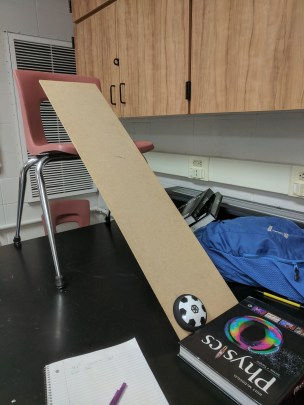
I’ve found a lot of groups are recording pretty incomplete data during labs. I think since groups don’t make much use of their individual results, some of these students aren’t seeing the value in recording that information. To give them a little more purpose, today we had some discussion to identify changes that could affect the motion of a hover disk on a ramp, then tasked them with collecting data to write a CER to answer how the change affects the motion. This will hit some points I wanted to get anyway, while also giving each group their own task using their data.

ramp hover

Chemistry Essentials: Gas Laws

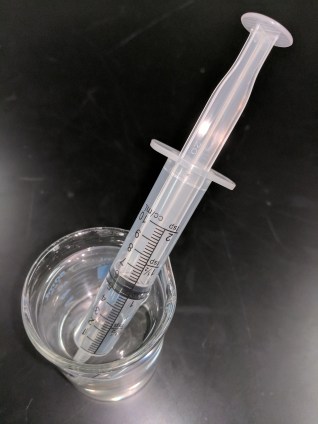
Students made qualitative observations using sealed syringes in water baths. The ice machine in the school is broken, so the cold water tests didn’t work out very well, but we got some great results with hot water. A few groups had some trouble distinguishing between a change in pressure and a change in volume, so I wish we’d spent some time discussing how we could tell when the pressure in the syringe went up prior to the lab. However, by the end of the hour, groups were able to come up with qualitative descriptions of the ideal gas laws.

syribge.jpg

Day 22: 3rd Law, Video Physics, & Thermal Expansion

AP Physics: 3rd Law

Students predicted which cart would experience a larger force for several different collisions, then we got out the force sensors and hoop springs to find out. In one of my classes, the computer was acting up, so we relied on the hoop springs and slow motion video. Fortunately, students found the video very convincing and even described watching the hoop springs compress as satisfying.

collision lab f-t graph

Physics: Video Physics

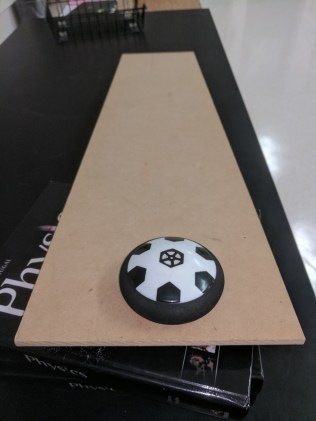
We started constant acceleration today. Students used photogates with a cart on a ramp during the first unit, so I decided to have students analyze hover disks on a ramp using Video Physics.  I’m hoping that some of the features, like seeing the points in the video, will help students connect the representations we’re using to their physical meaning.

hover

Chemistry Essentials: Thermal Expansion

I did a few demos of thermal expansion, and had students complete particle diagrams of each one. Students seem to be getting the big ideas, and I’m seeing students naturally improving how they represent key elements of their particle diagrams as time goes on. One student called me on falling into pretty teacher-centered habits during the whiteboard discussions; I have a tendency to talk to much the first time I teach a lesson, and this is my first time through Chemistry Essentials A, so that’s happening a lot. I need to spend a little more time during my lesson planning making sure I clarify the goal of each discussion and planning out some open-ended questions so I can give students more of the reigns.

chem wb

Day 152: Project & Mountain-Building

AP Physics: Project

Students continued work on their projects. Both of my classes are wrapping up the theory and planning portions of the project, and the different personalities of those classes is incredibly apparent. In my 2nd hour, there was a lot of noise and chaos as students worked through their ideas out load as they typed or wrote. In my 4th hour, you could hear a pin drop as students worked out their ideas independently.

Earth Science: Mountain-Building

Today was one of those days in my earth science class. I’d put together an activity on mountain-building and volcano formation in PhET’s Plate Tectonics simulation that I was pretty excited about. When my students fired up the laptops, only thee out of 35 were able to get the simulation running. Plan B was to demo the activity on the SMARTBoard, but the teacher computer failed to load the simulation with a different error. With half the period gone, I resorted to notes. Our tech guy got the issue fixed, so now I have to decide whether I want to try again, or hold on to the activity for the next time I teach earth science.

Day 147: Project Work & Plate Tectonics

AP Physics: Project Work

Students continued working on their final projects for physics. I had a fun conversation with a student who plays baseball and is planning to analyze hitting a baseball. I’m extremely ignorant about sports, so wanted to make sure there would be enough meat for him to dig into and, as he talked about everything that goes into an effective swing, it quickly became clear he will need to pick some aspects of the swing to focus on.

Earth Science: Plate Tectonics

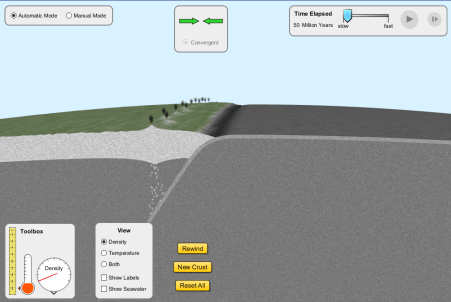
Students played with PhET’s plate tectonics simulation to reinforce what is going on at plate boundaries. I think if I fleshed out what students are doing in the simulation, I could significantly reduce (or get rid of completely) the notes I did yesterday.

sim

Day 132: Problems & Glaciers

AP Physics: Problems

Students worked on some oscillating particle problems. Students had some really good discussion about a cart on an angled ramp oscillating on a spring; a lot of groups really dug into what should happen when the angle of the ramp changes. At the end of the hour, we tested their predictions. I wasn’t paying much attention to when I started data collection, but still got a set of graphs my 2nd hour considered applause-worthy.


Earth Science: Glaciers

I gave students a brief overview of some glacial features, then had them use some sand in the stream tables to make a recreational area with a variety of glacial features. Students liked the activity, but they did not connect the vocabulary to how the features form or how they are related. I think I’d prefer to do this at the end of a glacier unit, where students would have the background to tie the features they are using together. At this point in the unit, I’d rather focus on how these features form to give some basis for naming them.

glacier

Day 127: Oscillating Particle Model & Problem Scoping

AP Physics: Oscillating Particle Model

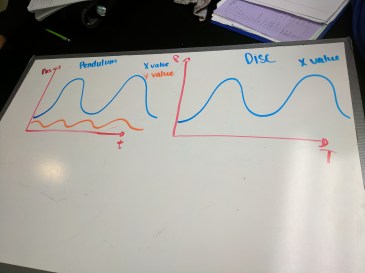
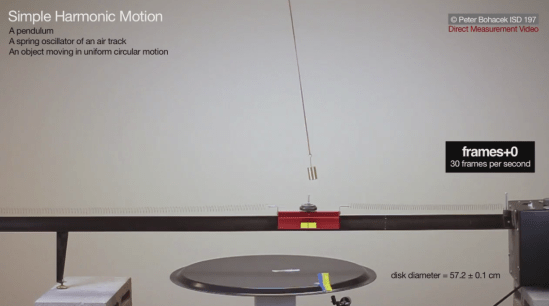
Students whiteboarded their video analysis results for the trio of objects in simple harmonic motion. I haven’t done a lot of circular motion in the past, so when we discussed the spinning disk, I was intrigued by how many students were convinced the angle in the video was responsible for the changing velocity. On a whim, I had students sketch the disk from directly above, then had them sketch velocity vectors, including components, at a few points around the disk, which nicely convinced students that they would see similar graphs for the horizontal motion no matter what the viewing angle.

shm trio

Earth Science: Problem Scoping

This unit includes an engineering project to plan removing a dam from a river. I gave students a memo from their imaginary client and had them do some problem scoping. One of the questions I ask is what background knowledge they will need, which can nicely set up a unit, but students did not identify anything about rivers or erosion as useful knowledge on this project. The memo mentions sediment transport as a major challenge in removing the dam, but I don’t think students saw that as something that would require background knowledge to understand. Even when I handed out the unit’s learning targets, students did not name the target about describing river behavior as one that will be useful. I need to think about how I will address that during the unit.

Day 126: SHM Trio & Water

AP Physics: SHM Trio

Students downloaded a Direct Measurement Video of three objects in simple harmonic motion and did some video analysis. There was lots of great discussion about why the pendulum’s y-position vs. time graph showed a different period than the x-position vs. time graph. I also really liked the conversations students had about whether the net force on each object is constant. My favorite moment was when a student called me over for help, and the person sitting next to her said “You need to think about it first!” The second student then started asking questions to help the first student figure out the answer she needed. Yay, students!

SHM Trio

Earth Science: Where is Earth’s Water?

Students filled beakers with their prediction for how Earth’s water is distributed, then got the actual distribution and compared. I liked how doing their own prediction first made it much more dramatic when they got the actual results, and saw just how little of Earth’s water is in a form we can really use.

water.jpg

Day 119: Whiteboarding & Mineral Intro

AP Physics: Whiteboarding

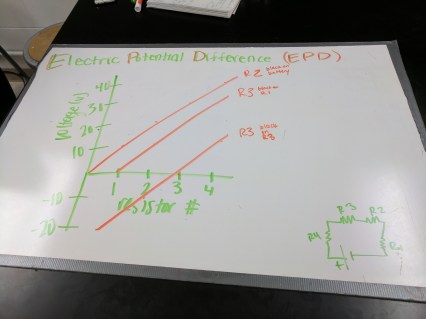
Students whiteboarded their results for the Ohm’s Law lab and an electric potential difference activity I had them try in yesterday’s sim. Students plotted voltage vs. resistor with the multimeter’s ground probe in several different positions to see the change is always the same. The analogy between gravitational potential and electric potential doesn’t seem as clear for my students as in the past, so next year I might go back to having students map electric potential.epd

Earth Science: Mineral Stereograms

I did a few notes on what caused the early Earth to melt and form layers. Afterward, students spent some time with books of stereograms of rocks, minerals, and gemstones. I wrote some questions to get students thinking about the key characteristics of each category and it was fun to listen to some of the things students were noticing.

stereo

Day 118: Circuit Sim Again & Earth’s Layers

AP Physics: Circuit Sim Again

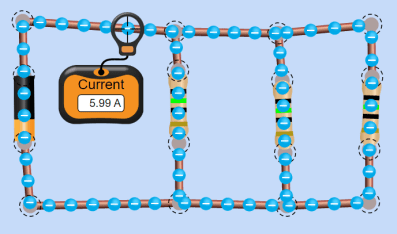
Students used PhET’s circuit construction kit to explore Kirchoff’s Laws in series and parallel circuits. I also tried to mimic an extension of an electric field mapping lab by having students place the ground probe of the voltmeter at different points in the circuit, then move the measuring probe around the circuit. I liked that this got students noticing that the total change in voltage is always the same and it got them thinking about what a negative voltage means. On the Kirchoff’s Laws portion of the activity, I saw a lot more variation in how students thought about the patterns than in the past, which was a lot of fun. I was especially impressed when one student pretty much derived the equivalent resistance for a parallel circuit.

parallel.PNG

Earth Science: Earth’s Layers

Today, we built on the scale diagrams students made yesterday, adding some information on the properties of each layer. I tried to get some deeper thinking by asking questions like how two layers could have similar composition, but different densities, and it was a little tougher than I expected. I think if I’d primed students with some questions about pressure, that task may have been easier. It bothered me to just state give students information about the interior of the Earth, so I spent a few minutes talking about seismic tomography with my students. Next time I teach the course, I’d love to come up with a lesson to give students an analogous experience.