Day 74: Mistakes Whiteboarding, Pie Charts, & Particle Diagrams

AP Physics 1: Mistakes Whiteboarding

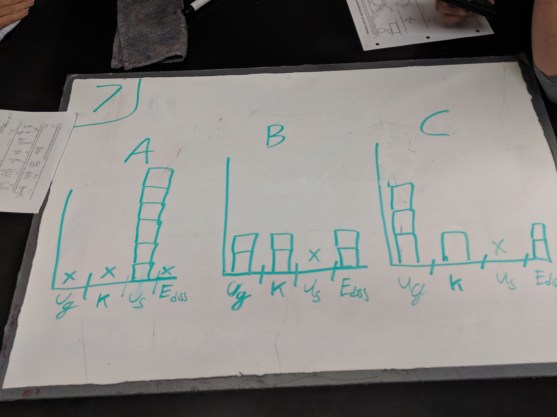
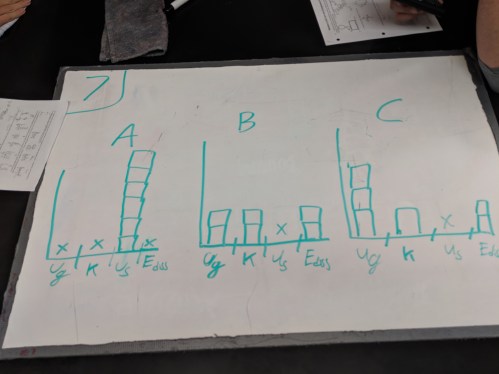
Students did mistakes whiteboarding with yesterday’s problems. Energy is clicking nicely for a lot of students, which is great to see. One challenge I’m running into is I’ve got some students who have been struggling to connect variables to physical quantities, and are having trouble making sense of all the different quantities that show up in energy problems. I need to give some thought to how to help these students work on doing more sense making, as well as how I might prevent a similar situation next year.

Physics: Pie Charts

Students worked on some problems sketching energy pie charts. They were pretty successful at identifying the main types of mechanical energy, but placing dissipated energy in the pie charts got tricky. I think my students have a good sense for what the mechanical energy forms are, but not a clear sense of what dissipated energy is. I need to think about how I can help them clarify that idea.

Chemistry Essentials: Particle Diagrams

A lot of my students have been struggling to use particle diagrams in their thinking, so we spent some time today sketching particle diagrams to use the qualitative gas laws we have so far to make predictions about a variety of situations. We also spent some time in whole-class discussion using PhET’s gas properties simulation to define pressure and temperature in terms of particle behavior, which seemed to help.

phet gas

Day 73: Problems, Work, & Gas Laws

Today was our first day back from break.

AP Physics 1: Problems

Students worked on some conservation of energy problems. I had to do some prodding to remind students to start with an LOL diagram, but they got into the swing of things fairly quickly.

Physics: Work

Students sketched force vs. distance graphs for raising a cart to the same height using different ramps in order to introduce the idea of work. Results were a little messier than usual, but I think I didn’t introduce the lab as clearly as usual and my students weren’t as focused as usual thanks to it being the first day back from break. But, we were still able to get the ideas we needed.

fd board.jpg

Chemistry Essentials: Gas Laws

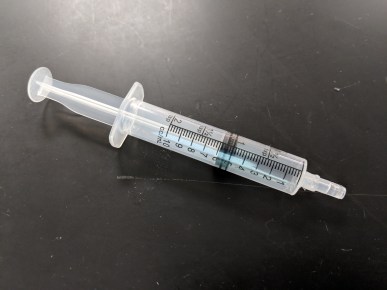
Students made some observations with capped syringes to get a conceptual understanding of gas laws. After a hot glue fail last tri, I glued the caps on with super glue, and the lab worked very nicely. It was really tough for a lot of students to connect their observations to particle diagrams, so I think it would have been worth spending a little more time before the lab revisiting what particle diagrams show.

gas laws

Day 72: Tests

Today was our last day of class before winter break. In all three of my classes, we wrapped up a topic by taking an assessment.

AP Physics 1: Energy Bar Charts & Unbalanced Forces

I’ve been giving students at least two in-class opportunities on every learning target this year, so this assessment covered energy bar charts and revisited unbalanced forces. Almost everyone improved on unbalanced forces, which is exactly what I want to see!

Physics: Conservation of Momentum

Students took their conservation of momentum test. Students have been saying the bar charts make the math very intuitive, and it definitely shows on the work I’ve graded so far. This is definitely the easiest time I’ve seen students have with momentum.

Chemistry Essentials: Density

This assessment was more hit or miss than my other classes. I had some students who did great, but a few were surprised to see some representations, like particle diagrams and a mass vs. volume graph, that were significant components of our daily work. I’m thinking about doing some individual conferences with students after break to try to get a better understanding of what’s behind that.

Day 70: Systems and Bar Charts, Conservation of Momentum Problems, & Pivot Interactives

AP Physics 1: Systems and Bar Charts

Students worked on whiteboarding some problems switching between different systems for energy bar charts. Students were doing a nice job of switching smoothly between different systems.

ap bar chart

Physics: Conservation of Momentum Problems

Students worked on calculations with conservation of momentum. This is the first year I’ve really used momentum bar charts, and its also the first time I’ve had students call conservation of momentum easy. The best part was I overheard a lot of students talking about whether their answer was reasonable based on their bar charts. When one of my AP sections came in, I still had some bar charts on the whiteboard and my AP students asked why I didn’t teach them momentum bar charts since it made the problem seem much easier. I’m sold and will be bringing bar charts into AP next year.

Chemistry Essentials: Pivot Interactives Density

I am as part of Pivot Interactive’s Chemistry Fellows program.

Students worked on an activity in Pivot Interactives to identify materials based on their density. I ended up giving students a handout to record their work, rather than having them answer in Pivot’s interface, since something about writing on paper seems to feel more comfortable for a lot of my students. I was really excited about how many students on their own tried to decide between multiple materials with similar densities by paying attention to what they could see about the material. It was also nice to be able to easily split up the class to look at different liquids so we can have some conversation tomorrow about who should have similar answers and who should have different answers, and why.

pivot density.PNG

Day 69: Mistakes Whiteboarding & Card Sort

AP Physics 1: Energy Bar Chart Mistakes Whiteboarding

Students did mistakes whiteboarding with energy bar charts. There was some good discussion about what differences matter in energy bar charts at this point and what differences, like the exact number of boxes, are irrelevant.

ap bar chart.jpg

Physics: Momentum Card Sort

Students worked on a momentum transfer model card sort I got from Kelly O’Shea. I was (pleasantly) surprised by how easy it was for students to work out which equation went with each problem. The force-time graphs in the card sort were tough; part of the trick is those graphs are more similar across different problems than some of the other graphs and we haven’t made enough use of force-time graphs in other contexts for students to focus on the subtle details that distinguished the different graphs here.

card sort.jpg

Chemistry Essentials: Density Mistakes Whiteboarding

This class also did mistakes whiteboarding, but on a worksheet using different representations for density. There was some great discussion and some signs this group is starting to build an identity as a class, which is great.

Day 67: Board Meeting, Representations Jeopardy, & Density of a Solid

AP Physics 1: Board Meeting

Students whiteboarded their results for the elastic potential energy lab we’d done earlier this week.

Physics: Representations Jeopardy

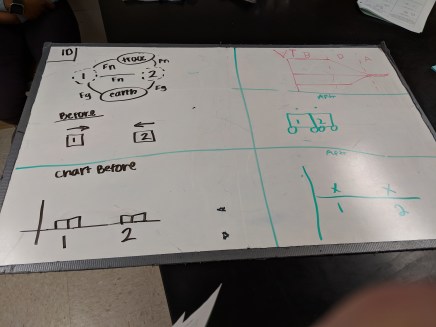
In both my sections, we started with mistakes whiteboarding for yesterday’s problems. My 6th hour is about 1/3 the size of my other section, so they got through the mistakes whiteboarding very quickly. I tried what I called Representations Jeopardy: each group came up with a scenario, and whiteobarded a set of representations, minus the sketches and any labels that would identify what the objects involved are. Then, groups traded whiteboards and had to come up with a scenario that matched the whiteboard they received. Students said they really liked that they had to think differently in order to work backwards from the diagrams.

phys mistake

From mistakes whiteboarding

Chemistry Essentials: Density of a Solid

Students worked on finding the density of some metal dowels. I realized belatedly this is the first lab we’ve done where they didn’t need a container when measuring the mass, so it was actually a tricky leap for them to not tare something out on the balance.

volume

Day 66: Board Meeting, Momentum Representations, & Density

AP Physics 1: Kinetic Energy Board Meeting

I am being compensated by Pivot Interactives as part of their Chemistry Fellows program.

Students whiteboarded their results from this week’s Pivot Interactives activity with a puck on a ramp to get to a definition for kinetic energy. I definitely wish I’d done energy bar charts prior to this lab, but conservation of energy is emphasized enough across our science curriculum that it wasn’t too big of a leap for students to recognize the energy transformation happening. Students were really pleased when they realized their slope worked out to equal 1/(2g), which is exactly what the formulas predict.

ke lab.jpg

Physics: Momentum Representations

Students worked on representing momentum transfer using sketches, bar charts, and velocity vs. time graphs. The use of velocity vs. time graphs was influenced by Brian Frank’s work on momentum representations, and I really like the way it connects momentum to tools we’ve used earlier in the year. I’ve got one section with 30 students and one section with 8, and I’m quickly figuring out I need to be conscious about hanging back in my small class to encourage them to talk to each other about the problems before they talk to me.

Chemistry Essentials: Density

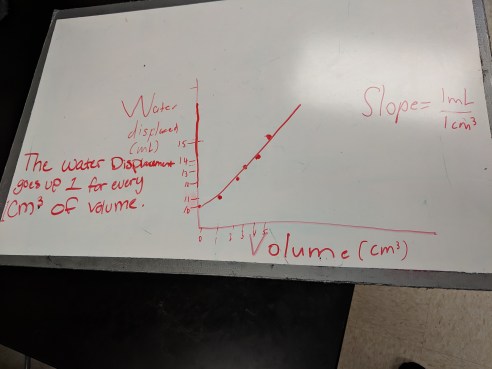
Students worked on finding a relationship between the mass and volume of water. Today really stretched my students since I had them design their own experiment and we started a board meeting on the lab, but students rose to the challenge. I’ve been having them use fill int he blank “for every” statements to talk about their slope, and that has been a big help for students to get a conceptual understanding of what their slope means. Yesterday, we had to pause the board meeting to define what the intercept of a graph is, so I got really excited when students not only brought up that groups had intercepts of either 0 g or 10 g, but came up with the idea that the intercept came down to whether groups hit tare after putting their graduated cylinder on the balance.

Day 65: Spring Energy & Board Meetings

AP Physics 1: Spring Energy

I am being compensated by Pivot Interactives as part of their Chemistry Fellows program.

Students collected data for a relationship between a spring’s stretch and the final velocity of an attached cart using a lab in Pivot Interactives. While I took more time than yesterday on a pre-lab discussion, I think students were still a little confused since we haven’t talked much about energy types yet. I think it would have helped if we’d done the board meeting for yesterday’s lab prior to this activity. I’m also thinking about doing bar charts before these equations next time around.

pivot epe.PNG

Physics: Explosions Board Meeting

Students whiteboarded their results from yesterday’s lab to introduce conservation of momentum. This was a tricky discussion for a lot of my students since we were dealing with four variables simultaneously, but students did well with it. It was a nice reminder of the progress my students have made so far this year.

explosion board.jpg

Chemistry Essentials: Volume Board Meeting

Students whiteboarded their results from yesterday’s lab. I really hit “for every” statements about the slope hard, and that seemed to help students attach some conceptual meaning to the slope. There were a few groups who graphed the actual water level, rather than the water displaced, which gave a great opportunity to talk about what the intercept tells us in this lab. I think next time, I’ll make sure a couple of groups do that.

group 3.jpg

Day 64: Kinetic Energy, Exploding Carts, & Volume

AP Physics 1: Kinetic Energy

I am being compensated by Pivot Interactives as part of their Chemistry Fellows program.

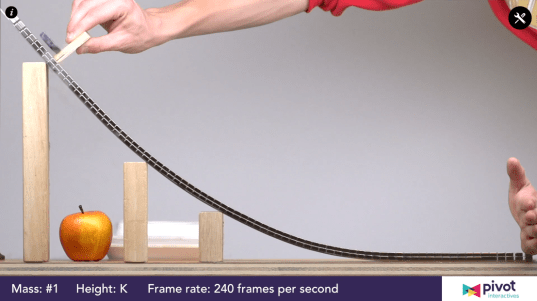
Students used Pivot Interactives to collect data for a relationship between an object’s starting height and its velocity at the bottom of a ramp to work toward a relationship for kinetic energy. Because the activity included directions for how to make each measurement, I got complacent and rushed through the pre-lab discussion, which meant some students were lost on the goal of the activity. I think I would have been better off taking a little more time, and pointing out connections between the directions in the activity and the measurements we discussed.

pivot ke.PNG

Physics: Exploding Carts

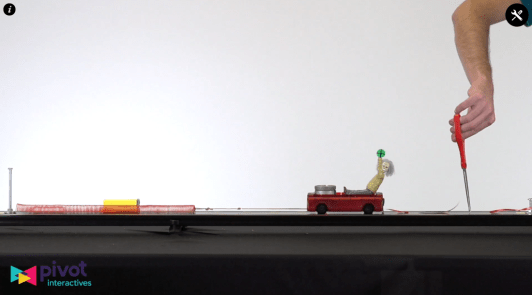
To start working toward momentum conservation, students launched pairs of carts off each other and plotted the ratio of the masses and the ratio of the velocities. Rather than measuring the velocity, we worked out that since the carts have a pretty constant velocity after the explosion, if they hit the end stops simultaneously, the ratio of the distances is the same as the ratio of the velocities. I like that this forces students to start making some predictions about how they need to adjust the distance, rather than waiting until the end to come up with a model.

explosion.jpg

Chemistry Essentials: Volume

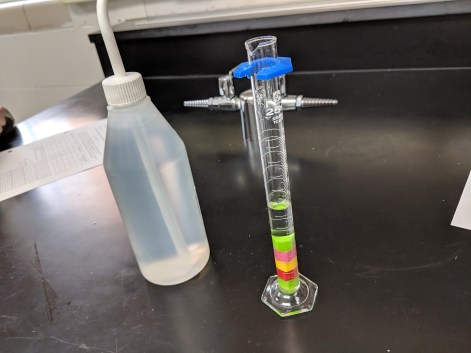
The Modeling Instruction chemistry curriculum has a lab I really like to show that 1 cm3 = 1 mL, but I’ve struggled to make it work for my students. Both when I’ve used empty geometric solids and a selection of cylinders, doing the math to calculate the volume in cubic centimeters has been a huge hurdle. Today, I tried the lab using plastic cubes that are 1 cm on each side and it finally went smoothly. Students were actually paying attention to the relationship, rather then getting lost in the math to calculate the solid volume.

volume.jpg

Day 63: Work, Quiz, & Histogram Interpretation

AP Physics 1: Work

To introduce work, I had students pull a cart up a ramp to a consistent height, but changing the angle. They then sketched force vs. distance graphs and saw the area was pretty consistent.

f-d graphs.jpg

Physics: Quiz

We wrapped up Friday’s mistakes whiteboarding, then moved into a quiz on impulse. I’m finding students are loosing track of the different variables we have, which is making it tough to use the equations accurately. I think we might take some time soon to do a “glossary” of all the variables we’ve gotten so far this year to see if having a reference like that helps.

Chemistry Essentials: Histogram Interpretation

To wrap up Friday’s labs on mass and change, I projected some histograms of the class results. The discussion ended up being a lot of me asking a question, followed by one student responding, which is not what I like to go for. I need to spend some time thinking about better prompts I can use on these graphs to get more student-to-student discussion going.

histogram.PNG