Day 87: Projectile Practical, Energy Problems, & Board Meeting

AP Physics 1: Projectile Practical

Students finished predicting where a marble rolled off a lab table will hit the floor. Once students have a success, I gave them a lighter marble and asked them to predict where it will land without taking any new measurements.

IMG_1393

Physics: Energy Problems

Students worked on calculations using conservation of energy. This was a tougher leap than I expected given how easily students got the hang of setting up conservation of momentum problems from bar charts. I think a card sort similar to the one we did for momentum would have been a good stepping stone.

Chemistry Essentials: Board Meeting

Students had a board meeting with their results from yesterday’s lauric acid lab. I had students collect data for the acid both melting and freezing, which made for a good visual of how similar those processes are. Students also made some good connections to last week’s activity in Pivot Interactives. I think starting with the cleaner data helped students to see the patterns in their data and there was some great conversation about why everyone had the same temperatures on their flat sections today while different groups got different temperatures on their graphs last week.

lauric board.jpg

Day 86: Projectile Practical, Bouncy Ball CER, & Lauric Acid Phase Change

AP Physics 1: Projectile Practical

Students started working on predicting where a marble rolled off the edge of a table will hit the floor. As a wrinkle, I left it open how to set up a ramp to launch a marble and how to measure the horizontal velocity, then had students write a procedure. Groups exchanged procedures with the goal that they should get the same velocity as the group who wrote the original procedure. My goal is for students to get some low-stakes feedback on this kind of writing.

Physics: Bouncy Ball CER

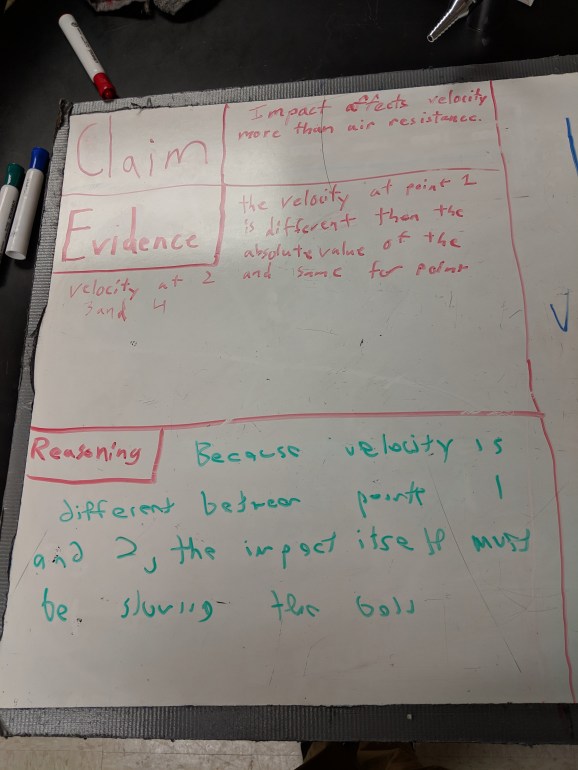
Students finished up with the bouncy ball lab we’ve been working on and whiteboarded CER statements for what is dissipating the bouncy ball’s energy. There was good consensus that the impact has a much bigger effect than air resistance. We used a worksheet to scaffold the pre-work for this activity, so there wasn’t as much variety as when I leave it wide open, but I think students were more successful than they would have been without it.

bouncy cer.jpg

Chemistry Essentials: Lauric Acid Phase Change

Students collected data for phase changes of lauric acid. A few groups weren’t stirring, which made their data messier, but the patterns are pretty clear overall, even on the data table.

lauric acid.jpg

Day 85: Whiteboarding, Video Analysis, & Board Meeting

AP Physics 1: Whiteboarding

Students whiteboarding yesterday’s problems. I focused on a consensus-building approach, where all groups whiteboarded the same problem, then we used the discussion to come to an agreement on what the answer should be, and why. Both my sections have a pretty good sense of class community, which made students pretty comfortable sharing work they weren’t sure about yet and building off each others’ ideas.

Physics: Video Analysis

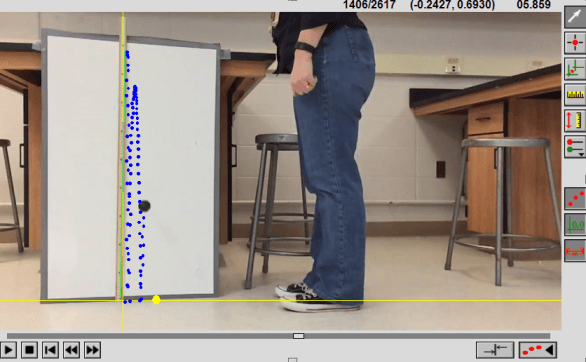
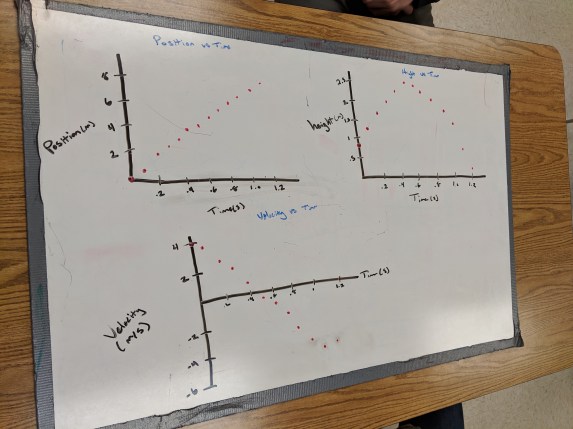
We finally got out the computers to do some video analysis of a bouncy ball to figure out what interaction is dissipating the energy. I’ve never had much luck walking the whole class through the software, so I have a video analysis guide with lots of animated screenshots that I put on the class website. Students were able to get some nice graphs of the bouncy ball’s motion and connect them to our work from the past few days.

bouncy ball va.PNG

Chemistry Essentials: Board Meeting

Students whiteboarded their results from yesterday’s lab in Pivot Interactives. During the board meeting, students continued to share observations faster than I could write them down, which is a great problem to have in this course. It was also very clear to students that the temperature stays fairly constant during the freezing process. I’m hoping having had a board on these results will help students make sense of our lauric acid lab on Tuesday.

pivot phase change.jpg


Day 84: Projectile Calcs, Bouncy Ball Diagrams, & Pivot Interactives Phase Changes

AP Physics 1: Projectile Calcs

Students started working on some projectile motion calculations. We also took a few minutes to discuss a new clip from Mythbusters Jr. where an archer attempts to replicate Odysseus’ shot through a series of rings. Students head read the Odyssey in English and were excited to link what they’d read to some physics and Mythbusters and there was some good conceptual discussion about the trick.

Physics: Bouncy Ball Diagrams

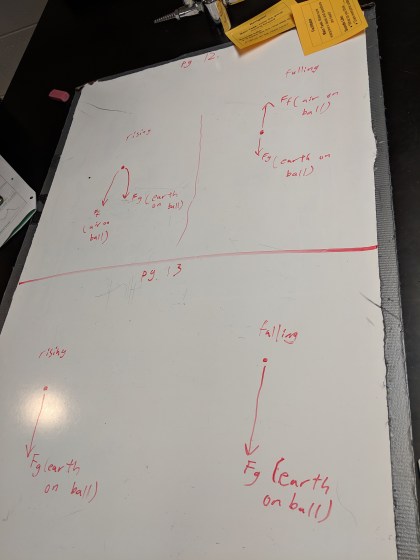
We spent some more time whiteboarding diagrams in our efforts to figure out what interaction dissipates a bouncy ball’s energy. It was clear students were a little rusty on free-body diagrams and velocity vs. time graphs, but they were able to make sense of  what the diagrams should look like and there was some good discussion along the way.

bouncy fbd.jpg

Chemistry Essentials: Pivot Interactives Phase Change

I am a part of the Pivot Interactive’s Chemistry Fellows program.

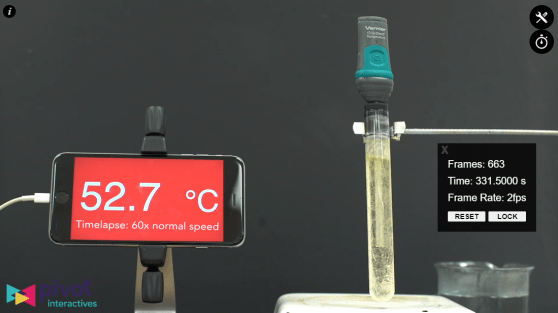
I usually introduce phase changes with a lab using lauric acid, but have found that while students notice their temperature doesn’t change during the lab, many of the students I see in Chemistry Essentials struggle enough with reading graphs that the small errors and uncertainty in their data makes it tough to pick out the big ideas. This time around, I decided to try starting with a version of the lab in Pivot Interactives. When students weren’t responsible for stirring, the data came out much cleaner. I also found students were much more willing to accept the temperature plateau as something real than I’ve seen in the past. This lead to some great questions about where the heat must be going when the temperature isn’t changing.

Pivot Phase Change.PNG

Day 83: Whiteboarding & Assessment

AP Physics 1: Projectile Whiteboarding

We finally whiteboarded students’ results from Friday’s projectile motion activity using Pivot Interactives. We also made a lot of references to yesterday’s activity and how it fit with what we saw in the graphs. I always love this board meeting since things just click for students and projectile motion suddenly feels simple to them.

projectile.jpg

Physics: Bouncy Ball Whiteboarding

Students started whiteboarding the representations they’d sketched yesterday for a bouncing bouncy ball. We were only able to get through the energy bar charts today, but students started to make some connections that will help make more sense of the placed they struggled yesterday, like the v-t graphs.

bouncy ball.jpg

Chemistry Essentials: Assessment

Students took their density retake and their gas laws quiz. It ended up taking the whole hour since we had shortened periods today. A lot of students told me they felt like they improved on density, which was the goal.

Day 82: Projectile Motion Maps, Bouncy Ball Energy, & Density Refresher

Today was another sub day.

AP Physics 1: Projectile Motion Maps

Students worked on an activity based on Dan Meyer’s “Will It Hit the Hoop?” where they analyze a strobe photo of a basketball. I used this activity in Physics last year, which helped students make good connections to motion maps. I’m hoping the same will happen for my AP students.

Physics: Bouncy Ball Energy

Students started working on my lab to determine what dissipates a bouncy ball’s energy. I got through the opening discussion in one section yesterday, but recorded a short video introducing the lab for the other. Last year, I put together a scaffolded worksheet for students to sketch an assortment of representations and highlight the differences between the competing explanations.

Chemistry Essentials: Density Refresher

The density assessment students took before break was rough, I think at least partly because it was one of the last class periods on the last day of classes. My co-teacher and I decided tomorrow’s assessment will include another shot at density along with gas laws. Today, my co-teacher went over some extra practice on density that students worked on yesterday.


Day 80: Pivot Projectiles, TIPERs, and States of Matter

The combined forces of a neck sprain and a cold got the best of me, and I ended up at home while my students worked with a sub.

AP Physics 1: Pivot Projectiles

I am as part of Pivot Interactive’s Chemistry Fellows program.

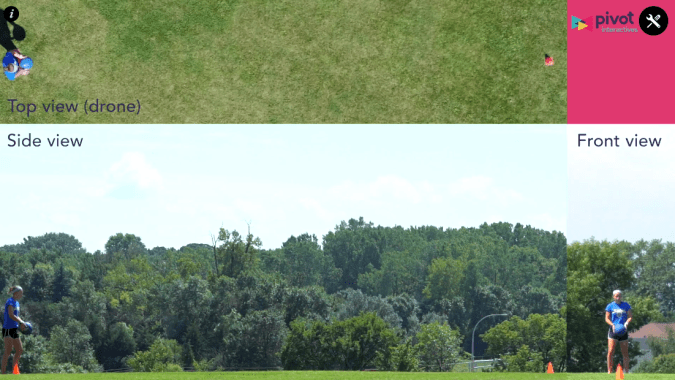
Students collected data in a Pivot Interactives video showing three views of a projectile to generate position vs. time graphs and velocity vs. time graph for the motion in each direction.

pivot projectile.PNG

Physics: TIPERs

Students worked on some problems out of TIPERs using energy bar charts as a reasoning tool.

Chemistry Essentials: States of Matter

Students did a short reading out of the textbook to get an introduction to states of matter. My co-teacher also took advantage of how short the activity is to meet with each student about their grade so far.

Day 79: Projectiles, Graphing, & Gas Law Problems

AP Physics 1: Projectiles

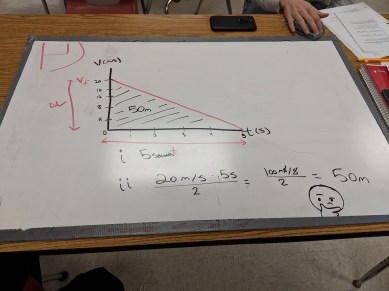
Students worked through some questions I got from Michael Lerner to introduce projectiles by having students represent the motion of a falling object using key tools from each of the models we’ve covered so far this year. This day always makes me really happy I wait until the end of linear mechanics to do projectiles.

Ap projectile.jpg

Physics: Graphing

Students worked on finishing up their data collection and graphing from yesterday’s kinetic energy lab. I was really excited about how many students recognized on their own that they would need to linearize this data; even groups that had data that looked fairly linear, which is common with this lab, realized their intercept would make more sense with a parabola than a straight line, which was awesome. January and February are always a tough time of year, and a clear reminder of how much my students have grown so far this year was just what I needed.

Chemistry Essentials: Gas Law Problems

Students worked on solving problems using the gas laws. First trimester, I switched from using the formulas to having students use proportions to solve the problems, which helped make the math more accessible. This trimester, I added a question where students had to determine whether the unknown quantity should increase or decrease based on their particle diagrams, which made a big difference for students when deciding whether to multiply or divide to get their answer.

Day 45: Quiz, Force Representations, & Bonding Intro

I had a sub today, so no pictures. I’ll find out Monday how things went.

AP Physics 1: Quiz

Today’s quiz was maybe closer to test length. I included the notorious bumpy ramp problem (which I really love); my students are still uncomfortable with problems that don’t reflect something they’ve already seen, so I think this will be a great one to have some discussion on how students approached it.

Physics: Force Representations

Students worked on some problems extending the representations we’ve been using for forces to unbalanced forces. I’m hoping this will be a relatively small leap. It occurred to me this worksheet could have been a nice card sort, but I didn’t think of that far enough in advance to get copies run and cut, plus I’d prefer to be in the classroom myself the first time my students complete a new card sort.

Chemistry Essentials: Introduction to Bonding

Students worked on a worksheet designed to bridge what they know about the Bohr Model to bonding. Students also took a quiz and, since students had a really tough time working on something new after last week’s quiz, the para, my co-teacher, and I all agreed to try putting the quiz at the end of the hour this time.

Day 44: Whiteboarding, 2nd Law, & Whiteboarding

AP Physics 1: Whiteboarding

Students whiteboarded some constant acceleration problems for a gallery walk. These problems are coming very easily to most of my students, which is great to see.

ap wb

Physics: Second Law Lab

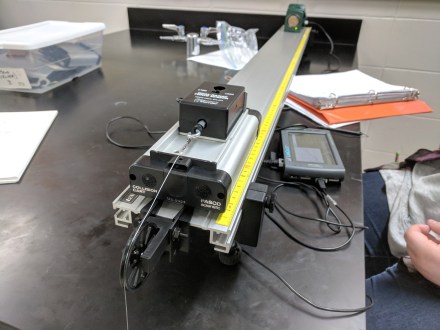
Students collected data for a paradigm lab on Newton’s 2nd Law. Some students were a little thrown off by recording values from a graph in a data table, then making a new graph from the data table, but that’s fairly common.

f a

Chemistry Essentials: Bohr Model Whiteboarding

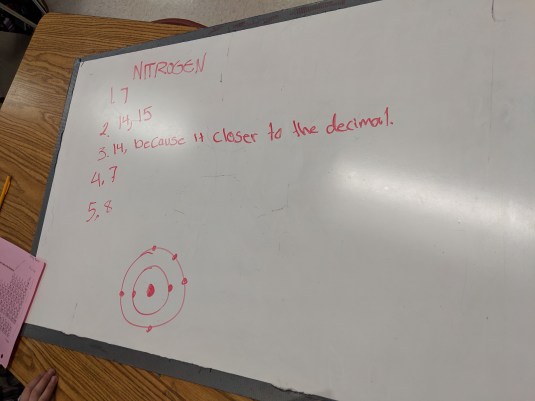
We whiteboarded and discussed some key information from the periodic table and Bohr model for several different elements. Students lit up at the end when I had them leave off the name and the number of protons, then have another group try to figure out which element they’d answered the rest of the questions for.

bohr wb