Day 77: Bouncy Balls, Mistakes Whiteboarding, & Gas Laws

I dropped the ball and didn’t take any pictures today.

AP Physics 1: Bouncy Balls

A large percentage of my students were on a field trip today. I had the students who were here work on the video analysis of a bouncy ball’s motion.

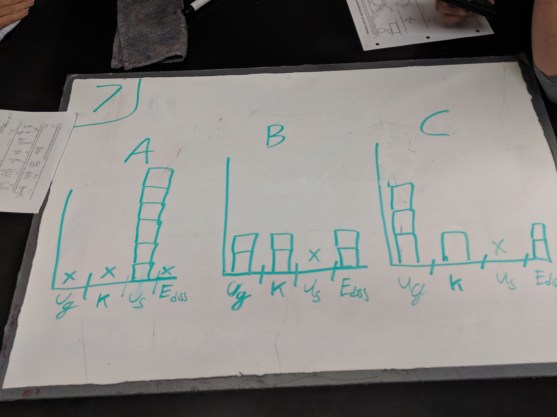
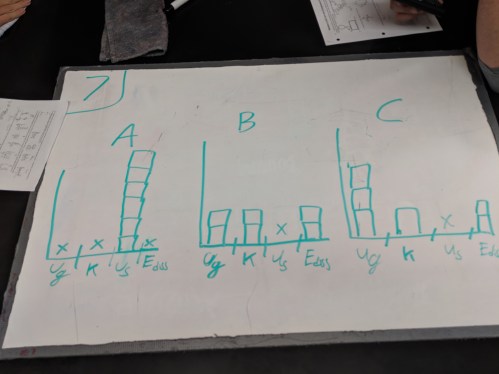
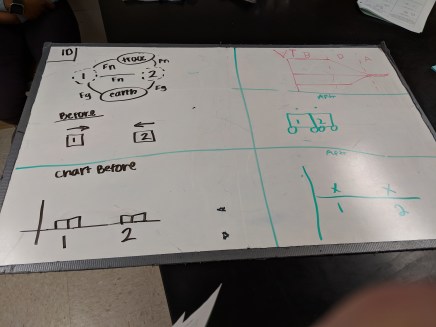
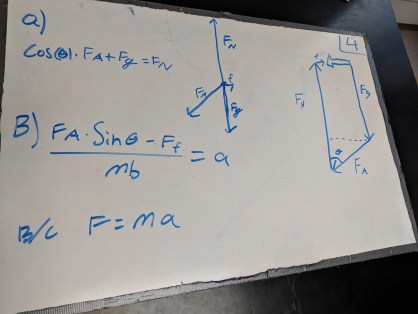
Physics: Mistakes Whiteboarding

Students did mistakes whiteboarding with energy bar charts.

Chemistry Essentials: Gas Laws

I am as part of Pivot Interactive’s Chemistry Fellows program.

Students used Pivot Interactives to collect data for a relationship between pressure and volume for a bubble in a vacuum chamber.

Day 76: Bouncy Balls, Bar Charts, & Quantitative Gas Laws

AP Physics 1: Bouncy Balls

Students started a lab to determine what interaction is dissipating a bouncy ball’s energy (my article on this lab appears in the Jan, 2018 issue of The Science Teacher). Today was all about figuring out what kind of evidence might be useful, so students worked on sketching representations for the bouncy ball’s motion. I could tell I’ve been slipping on spiraling back to earlier concepts; students had a tougher time than I’d hoped sketching the velocity vs. time graph.

Physics: Bar Charts

Before diving in to some problems sketching energy bar charts, we did a quick round of representations jeopardy. Each group came up with a scenario, then sketched a set of energy pie charts and a matching set of energy bar charts to describe that scenario on a whiteobard. Then, they gave their whiteboard to another group who had to come up with a scenario that fit with the representations on the whiteboard they got.

Chemistry Essentials: Quantitative Gas Laws

I am as part of Pivot Interactive’s Chemistry Fellows program.

Students used Pivot Interactives to collect data for a relationship between the temperature of a gas and its pressure. This is a great example of the kind of lab I really like Pivot Interactives for; it makes a nice graph, but we just don’t have the equipment to try this lab. Its not as visually interesting as some of the other labs on Pivot, but it is still clearly an actual lab and not idealized, simulated data. Students made some nice connections to their qualitative observations made using syringes last week.

pivot temp pressure.PNG

Day 75: Free Response, Mistakes Whiteboarding, & Vacuum Chamber

AP Physics 1: Free Response

Students worked on a released free response problem, then used a scoring guide to review their work. The problem calls for sketching an energy vs. position graph, which we haven’t used, but a lot of students immediately started sketching energy bar charts and were able to reason out what the new representation should look like based on their work, which was a lot of fun to see.

Physics: Mistakes Whiteboarding

Students did mistakes whiteboarding with yesterday’s problems using energy pie charts. Yesterday, they were very successful at solving the problems and today their confidence started to match.

Chemistry Essentials: Vacuum Chamber

To practice connecting particle diagrams to observations, students sketched particle diagrams and made predictions for various scenarios related to pressure and gas laws, many in a vacuum chamber, then we tested each out and discussed the predictions.

Day 74: Mistakes Whiteboarding, Pie Charts, & Particle Diagrams

AP Physics 1: Mistakes Whiteboarding

Students did mistakes whiteboarding with yesterday’s problems. Energy is clicking nicely for a lot of students, which is great to see. One challenge I’m running into is I’ve got some students who have been struggling to connect variables to physical quantities, and are having trouble making sense of all the different quantities that show up in energy problems. I need to give some thought to how to help these students work on doing more sense making, as well as how I might prevent a similar situation next year.

Physics: Pie Charts

Students worked on some problems sketching energy pie charts. They were pretty successful at identifying the main types of mechanical energy, but placing dissipated energy in the pie charts got tricky. I think my students have a good sense for what the mechanical energy forms are, but not a clear sense of what dissipated energy is. I need to think about how I can help them clarify that idea.

Chemistry Essentials: Particle Diagrams

A lot of my students have been struggling to use particle diagrams in their thinking, so we spent some time today sketching particle diagrams to use the qualitative gas laws we have so far to make predictions about a variety of situations. We also spent some time in whole-class discussion using PhET’s gas properties simulation to define pressure and temperature in terms of particle behavior, which seemed to help.

phet gas

Day 70: Systems and Bar Charts, Conservation of Momentum Problems, & Pivot Interactives

AP Physics 1: Systems and Bar Charts

Students worked on whiteboarding some problems switching between different systems for energy bar charts. Students were doing a nice job of switching smoothly between different systems.

ap bar chart

Physics: Conservation of Momentum Problems

Students worked on calculations with conservation of momentum. This is the first year I’ve really used momentum bar charts, and its also the first time I’ve had students call conservation of momentum easy. The best part was I overheard a lot of students talking about whether their answer was reasonable based on their bar charts. When one of my AP sections came in, I still had some bar charts on the whiteboard and my AP students asked why I didn’t teach them momentum bar charts since it made the problem seem much easier. I’m sold and will be bringing bar charts into AP next year.

Chemistry Essentials: Pivot Interactives Density

I am as part of Pivot Interactive’s Chemistry Fellows program.

Students worked on an activity in Pivot Interactives to identify materials based on their density. I ended up giving students a handout to record their work, rather than having them answer in Pivot’s interface, since something about writing on paper seems to feel more comfortable for a lot of my students. I was really excited about how many students on their own tried to decide between multiple materials with similar densities by paying attention to what they could see about the material. It was also nice to be able to easily split up the class to look at different liquids so we can have some conversation tomorrow about who should have similar answers and who should have different answers, and why.

pivot density.PNG

Day 69: Mistakes Whiteboarding & Card Sort

AP Physics 1: Energy Bar Chart Mistakes Whiteboarding

Students did mistakes whiteboarding with energy bar charts. There was some good discussion about what differences matter in energy bar charts at this point and what differences, like the exact number of boxes, are irrelevant.

ap bar chart.jpg

Physics: Momentum Card Sort

Students worked on a momentum transfer model card sort I got from Kelly O’Shea. I was (pleasantly) surprised by how easy it was for students to work out which equation went with each problem. The force-time graphs in the card sort were tough; part of the trick is those graphs are more similar across different problems than some of the other graphs and we haven’t made enough use of force-time graphs in other contexts for students to focus on the subtle details that distinguished the different graphs here.

card sort.jpg

Chemistry Essentials: Density Mistakes Whiteboarding

This class also did mistakes whiteboarding, but on a worksheet using different representations for density. There was some great discussion and some signs this group is starting to build an identity as a class, which is great.

Day 68: Energy Bar Charts, Momentum Bar Charts, & Density Problems

AP Physics 1: Energy Bar Charts

I introduced students to LOL diagrams and had them start working on some energy bar charts. Things seemed to go very smoothly. I have one section that is very small this tri, and I need to be conscious of how quick I am to jump in when students are stuck or have a question. In a larger class, I have an easier time leaving more space for students to think and discuss with each other since I hear less of the conversation and feel more pressure to move between groups.

Physics: Momentum Bar Charts

Students did some whiteboarding to wrap up momentum bar charts before taking a quiz. In my larger class, I tried representation jeopardy. This hour didn’t like it as much as my small class; students said they would prefer something that is structured more similar to the types of problems that show up on assessments. I’m not overly surprised, since many of my students are still much more comfortable with answer-getting than meaning-making, but I need to keep thinking about how my moves in the classroom place value on each approach to physics and how I can shift what I’m doing to place more explicit value on meaning-making.

Chemistry Essentials: Density Problems

Students worked on a worksheet connecting particle diagrams to density. I gave less instruction than I typically do, which lead to more student-to-student conversation and more student success than I’ve seen on this worksheet before. I get frustrated and push back when someone says “those kids” can’t handle reform-based science instruction, I’m still susceptible to that line of thinking and sometimes over-scaffold. When I give them space, the students I have in Chemistry Essentials can rise to the occasion just as well as the students I get in other courses.

Day 67: Board Meeting, Representations Jeopardy, & Density of a Solid

AP Physics 1: Board Meeting

Students whiteboarded their results for the elastic potential energy lab we’d done earlier this week.

Physics: Representations Jeopardy

In both my sections, we started with mistakes whiteboarding for yesterday’s problems. My 6th hour is about 1/3 the size of my other section, so they got through the mistakes whiteboarding very quickly. I tried what I called Representations Jeopardy: each group came up with a scenario, and whiteobarded a set of representations, minus the sketches and any labels that would identify what the objects involved are. Then, groups traded whiteboards and had to come up with a scenario that matched the whiteboard they received. Students said they really liked that they had to think differently in order to work backwards from the diagrams.

phys mistake

From mistakes whiteboarding

Chemistry Essentials: Density of a Solid

Students worked on finding the density of some metal dowels. I realized belatedly this is the first lab we’ve done where they didn’t need a container when measuring the mass, so it was actually a tricky leap for them to not tare something out on the balance.

volume

Day 63: Work, Quiz, & Histogram Interpretation

AP Physics 1: Work

To introduce work, I had students pull a cart up a ramp to a consistent height, but changing the angle. They then sketched force vs. distance graphs and saw the area was pretty consistent.

f-d graphs.jpg

Physics: Quiz

We wrapped up Friday’s mistakes whiteboarding, then moved into a quiz on impulse. I’m finding students are loosing track of the different variables we have, which is making it tough to use the equations accurately. I think we might take some time soon to do a “glossary” of all the variables we’ve gotten so far this year to see if having a reference like that helps.

Chemistry Essentials: Histogram Interpretation

To wrap up Friday’s labs on mass and change, I projected some histograms of the class results. The discussion ended up being a lot of me asking a question, followed by one student responding, which is not what I like to go for. I need to spend some time thinking about better prompts I can use on these graphs to get more student-to-student discussion going.

histogram.PNG

Day 61: Mistakes Whiteboarding, Impulse Problems, & Designing Experiments

AP Physics 1: Mistakes Whiteboarding

Students did some mistakes whiteboarding with yesterday’s problems. A few students said they feel like unbalanced forces are easier than balanced, which I made sure to point out is a great indicator of how much they’ve grown in using free-body diagrams and vector addition diagrams.

ap mistake.jpg

Physics: Impulse Problems

Students worked on some problems using yesterday’s results on impulse. Overall, the problems seemed to go well, but I need to think about how to handle whiteboarding. I’ve got one section of 30, where I’ll be able to handle whiteboarding the way I normally would. My other section is only 8 students, and they ended up gathered around a single table having a lot of great discussion about how to do the problems. I’m not sure how much a whiteboarding session will add to their understanding.

Chemistry Essentials: Designing Experiments

We spent some time talking about the graphs I made of yesterday’s lab results, then moved on to starting the next set of mass and change labs. I asked students to plan their own procedure for finding the change in mass for sugar dissolving in water and Alka-seltzer dissolving in water. This turned out to be harder than I expected, so we ended with some whole-class discussion to figure out what steps we needed and why.