Day 88: Ohm’s Law & Limiting Reactants

Physics: Ohm’s Law

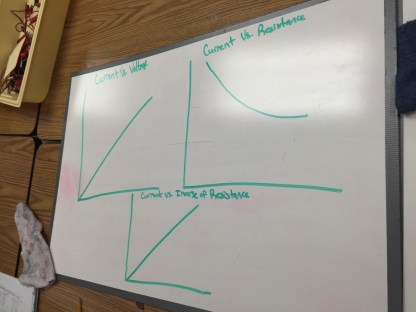
Students wrapped up using the PhET circuit construction kit to develop Ohm’s Law. Students were able to pretty easily reason out the formula based on their graphs. Looking back, I wish I’d had students put their experimental conditions and equations on the boards, as well. I usually try to keep the boards pretty simple since I have some big classes, but I think that information would have added a lot of value to the conversation in this case.
IMG_1610

Chemistry: Limiting Reactant Practice

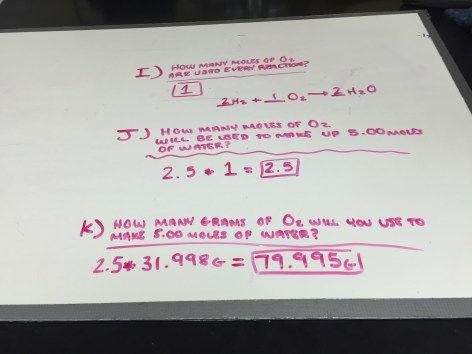
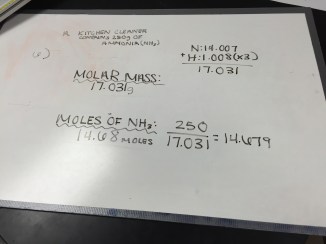
Today, students did some limiting reactant problems where the given and desired information is in grams, rather than moles. I was really pleased at how easily most of them worked through the problems. A lot of my students were struggling to connect ideas between different days earlier in the trimester, so it was great to see how many readily pulled out earlier skills and problem solving strategies to help today. I also saw a big jump in the quality of the questions I’m getting from my students; one student in particular was really focusing on the why when she was talking to me, when in the past she seemed most interested in getting something to write down. I’ve been having a lot of conversations with this class about how learning works and sharing why I do things the way I do, and I’m hoping I can get students to continue with the things I saw today.
Day 87: Ohm’s Law & Limiting Reactants

Physics: Ohm’s Law

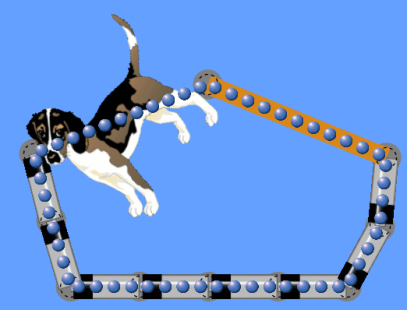
Students used PhET’s circuit construction kit to do a short activity based on the PUM materials to help orient them to the sim, then started looking for a relationship between current and potential difference. I loved it when, during the orientation activity, several groups got curious about the mysterious resistors in the kit, and immediately tried adding them to a circuit to see what they do, without any prompting or intervention on my part. There was also some great discussion and debate in one class about what exactly the blue dots represent. There were also many attempts to electrocute the dog.

dog circuit

Chemistry: Limiting Reactants

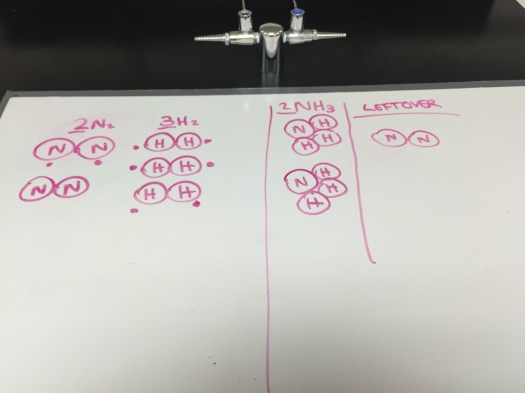
After a short percent yield quiz, we had some class discussion to formalize what students found in yesterday’s PhET sim on limiting reactants. I picked some reactant quantities for one of the reactions in the simulation, then had students get into groups and try to predict what they would produce and what the leftovers would be. Before students went to their groups, we had some conversation about what I was looking for. I tried to emphasize that I wasn’t after right answers; instead, I wanted them to share different approaches so we could decide on some useful ways to think about this kind of problem. There was a nice mix of students who focused on the equation given for the reaction and students who sketched diagrams.

IMG_1609

Day 85: Whiteboarding & Percent Yield

Physics: Whiteboarding

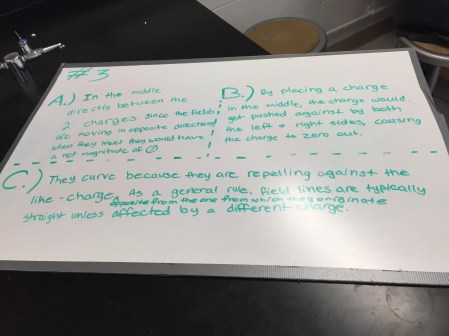
Students whiteboarded their answers to Friday’s questions. There were a few questions where students had some good discussion and connected some questions back to the lab where they’d mapped electric potential. I still need to work on getting students to talk to each other more than they talk to me.

IMG_1606

Chemistry: Percent Yield

Students worked on some problems calculating percent yield. While they can do the calculations pretty easily, the concept seems pretty abstract to them. I need to find a good lab to make percent yield more concrete.

Day 84: Electric Potential & Whiteboarding

Physics: Electric Potential vs. Gravitational Potential

Students worked on a worksheet from the Modeling Instruction curriculum that draws analogies between gravitational potential and electric potential. Several students commented that relating electric potential to something more tangible helped them make sense of what we’ve been doing. I also had a very good conversation with a student about how last trimester, she really liked how connected the mechanics topics were, but doesn’t have the same sense with electricity. This confirms that I need to keep working on my storyline for this trimester, but it was great to hear some of the metacognition the student was doing and I consider it a sign of a good class climate that a student was willing to have that conversation.

Chemistry: More Whiteboarding

Students used whiteboards to work through another stoichiometry problem. A lot of students left with much more confidence than they’d started the day with.

Day 83: Electric Potential Difference & Whiteboarding

Physics: Electric Potential Difference

In the past, I’ve motivated the need for electric potential difference in addition to electric potential purely through analogies to gravitational potential energy. Today, I tried an extension of the Modeling Instruction lab to map electric potential. I had students measure the voltage along a line in their tray of water with the multimeter’s ground attached to the negative lead of the power supply, then repeat with the ground attached to the power supply’s positive lead and the ground held somewhere in the middle. In the discussion, students agreed that the change in voltage is more meaningful than the specific value.

IMG_1604

Chemistry: Whiteboarding Problems

Students struggled with the stoich problems I left them yesterday, so we took some time to go through the first part of one. I tried to be very explicit and specific in bringing up previous labs or activities that used each skill, and that seemed to help students make connections. Students then continued the problem in small groups working on whiteboards. I need to do more whiteboarding problems in this class; the whiteboards really helped students function as a cohesive group, which is really not surprising.

IMG_1603

Day 79: Electric Field Lines & Energy in Reactions

Physics: Electric Field Lines

Students whiteboarded their answers to yesterday’s worksheet. The time we spent on vector addition diagrams with forces paid off as students were very successful adapting those to make sense of electric fields.

IMG_1589

Chemistry: Energy in Reactions

We started with a “mini-lab” to give students some first-hand, tactile experience with endothermic and exothermic reactions. After that, I tried having them sketch bar charts for those reactions, but it was clear I hadn’t done enough to help them understand what energy is, let alone the different types of energy that will appear in a chemical reaction, so the bar charts ended up a confusing abstraction for most students. I need to rethink how I approach reaction types next time to give students a better foundation in energy.

IMG_1588

Day 68: Work & Stoich

Physics: Work

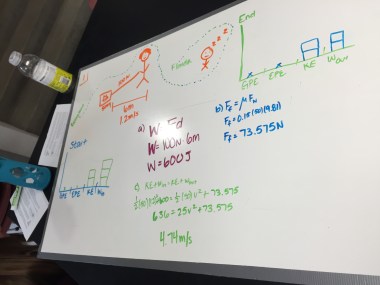
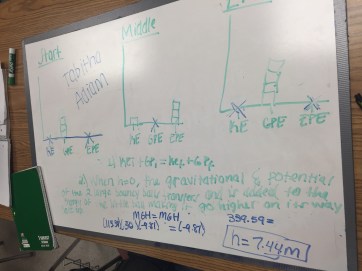
Students did some problems where the energy of the system is changing. The other physics teacher and I skipped having students define their system due to time constraints, but some of the mistakes I’m seeing could be fixed by having students take that step, so I will be going back to the full LOL diagrams next year.

IMG_1539

Chemistry: Stoich

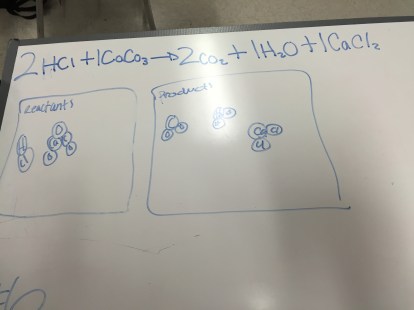
Students did some problems calculating theoretical yield for chemical reactions. When we first started balancing chemical equations, I required students to sketch a diagram of the atoms involved to emphasize that the atoms are just being rearranged. Today, I left it up to students whether they wanted to include the sketch or not, and it drove home for me how important concrete, conceptual tools are when nearly every student still drew the diagrams.

Day 67: Work & Molar Mass

Physics: Work

Students picked a specific height above the lab table and calculated how much energy a dynamics cart would have at that point. Then, they set up ramps at three different angles and sketched force vs. displacement graphs to represent pulling the cart up the ramp to the height above the table they picked earlier. Finally, they calculated the area of the force vs. displacement graphs. This lead nicely to a definition of work as the cart’s change in energy and the area of a force vs. displacement graph.


Chemistry: Molar Mass

Students worked on some word problems using molar mass. While no diagrams made it onto whiteboards, a lot of students sketched molecules the same way they’d done when balancing equations to help determine when they needed to multiply a mass from the periodic table.

IMG_1532

Day 64: Energy Practical & Mistakes Game

Physics: Energy Practical

Students were given an elastic string to hang from the ceiling. Students had to find k for their string, then figure out how high above the ground to hold an action figure attached to the end so that, when they dropped it, the figure would just barely hit the ground. In the past, I’ve used a bucket of water and we go by the sound (“splash, but no thud”). This year, the other physics teacher suggested using a force plate and looking for a small spike in the force vs. time graph. While students like the splashing, the force plate is a lot easier to move around, and makes it possible to capture slow-motion video.

Chemistry: Mistakes Game

To go over Friday’s practice problems for balancing chemical equations, I had them do the mistakes game. Students focused on making their error an inconsistency in their representations of the reaction. I appreciated how willing my students were to try something new; they seemed to especially appreciate the safety inherent in the mistakes game.

IMG_1513

Day 63: Astroblaster & Balancing Equations

Physics: Astroblaster

After a quiz, students made some observations of the Astro Blaster and used conservation of energy to explain what they saw. Students also worked through some conservation of energy questions out of TIPERs.

IMG_1512

Chemistry: Balancing Chemical Equations

Students used what they found in the simulation yesterday to practice balancing chemical equations. I took a page from the Modeling Chemistry curriculum and had students sketch the molecules in the reaction, which turned out to be a really effective tool to make balancing a much more concrete process.