Day 16: Systems, v-t Graphs, & Good Questions

AP Physics: Systems

Students did the mistakes game (pretty much my default mode of whiteboarding if you can’t tell yet) for a free-body diagram worksheet. Both classes had some great discussion about whether there should be an upward force for a projectile while it is in the air and it helped a lot to frame forces as interactions. I ended up wishing I’d taken some time to revisit Newton’s 1st Law from the momentum unit since some students were having trouble with the idea that forces are balanced on an object rising with a constant velocity. I’ll probably spend some time reinforcing that tomorrow.

I also took this opportunity to introduce students to the idea of defining their system. Both sections had debates about different problems where they were trying to decide what was causing an upward force. That lead nicely into discussing how we could define our system to make each possible answer correct.
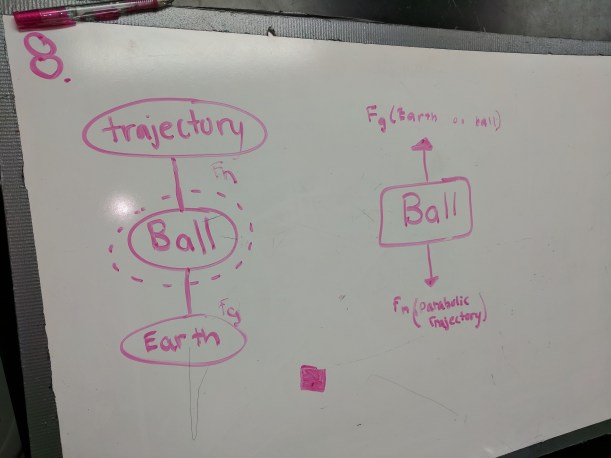
fbd mistake.jpg

Physics: v-t Graphs

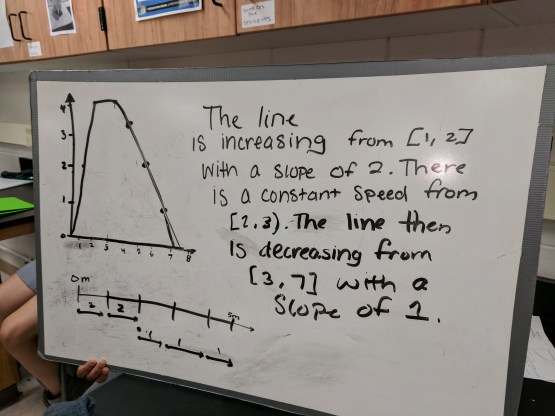
Students worked on sketching velocity vs. time graphs based on motion maps and position vs. time graphs. The calculus class started v-t graphs at the end of last week, so I had some students who not only finished quickly, but were eager to exercise their new knowledge by helping their peers, which was great. I had a lot of students who struggled with the idea that the horizontal axis on the graph represents moving forward in time; I want to try getting out the motion detectors tomorrow so they can watch the graph form in real-time to see if that helps.

Chemistry Essentials: Good Questions

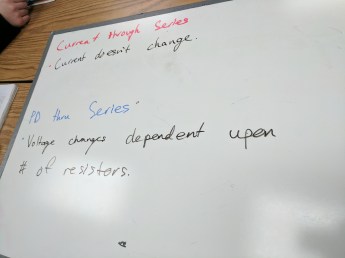
We spent some time working on asking good questions. I prepped a whiteboard with an intentional mistake, and asked students about what they saw. Some were able to use the question stems to immediately get to a good question. When a student had an observation or an idea of where to steer me next, I had them share it and we formed a question as a class. Then, we went back to the remaining student whiteboards and were much more successful and focused than yesterday.

Day 15: Rubber Bands & Mistakes Game

AP Physics: Rubber Bands

Both sections worked on drawing interaction diagrams and free-body diagrams, but one of my sections is about 30 minutes ahead and was able to get the problems mostly done last week. That section had asked about what the graph looks like when a spring is overstretched and Hooke’s Law breaks down, so we got out some rubber bands to try. I told students I hadn’t had a chance to collect my own data, so we’d be finding out together, and they seemed on board with that.

rubber band

Physics: CVPM Mistakes Game

Students played Kelly O’Shea’s mistakes game with Friday’s worksheet on translating between different representations of constant velocity. I really like this worksheet for introducing the mistakes game since its easy to direct students towards meaningful mistakes. I usually talk about some stems for good questions, but this time, I also projected them, which seemed to help. When the discussion lagged, I used Post-It notes to feed questions to students, but another student would usually ask the question I had in mind before I could finish writing, which is a good reminder to give them time.

phys mistake

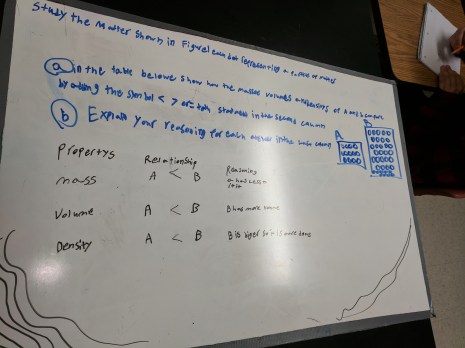
Chemistry Essentials: Density Mistakes Game

This class played the mistakes game with Friday’s density problems. I also used the question stems with them, but they struggled a lot more with asking good questions. I think they need a little more scaffolding; I might put together a whiteboard and have students prep questions in their groups. A lot of students fell back into some of the behaviors I’ve been trying to push back against with the work on norms, and I think some of that was a result of some students feeling confused and frustrated with the discussion.

chem mistake

Day 5: Mistakes Game, Pendulums, & Dissolving

AP Physics: Mistakes Game

On Friday, as students finished the FCI, they picked up some problems translating between momentum vs. time graphs, motion maps, and written descriptions. Today, we went over them using the Mistakes Game.  Students pretty readily embraced this approach, which was great to see. I did notice a lot of students were not clear on whether arrows between the dots on a motion map represent the momentum vector or a “tap”, which I think goes back to how I introduced the bowling ball lab. Asking students about the spacing on the motion map got them to think about whether there should be a tap, which seemed to help.

mistakes

Physics: Pendulums

Students worked on finding a relationship between the length and period of a pendulum. On Friday, we’d measured a single period as a class to motivate the need to measure multiple periods. Today, I verbally reminded students of that discussion, but, once in the lab, a lot of students were unclear about what it meant to measure multiple periods; I think it would have been useful to demo that to help with their language. Most groups were able to get a graph done, and have done a linear fit with a nice big intercept, which will lead nicely into motivating the need for other relationships tomorrow.

pendulum.jpg

Chemistry Essentials: Dissolving

We continued the mass and change sequence from the Modeling Instruction chemistry curriculum. My plan was to get through both sugar and Alka Seltzer dissolving in water, but I wasn’t thinking when I grabbed beakers this morning and ended up with way more mass than the balances could handle. I ended up having my students do a lot of math, which many found overwhelming, especially since they had to add some blanks to the handout I’d made. If I’d been thinking, I would have pulled out some lightweight plastic cups to replace the beakers. Tomorrow, I’ll use those for the Alka Seltzer lab.

Day 123: Mistakes Game & Sedimentary Rocks

AP Physics: Mistakes Game

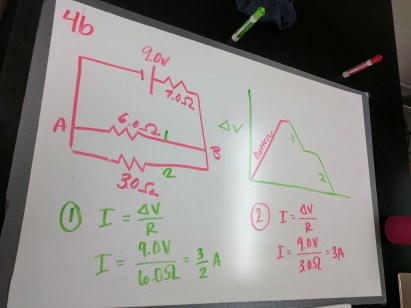
Students played the Mistakes Game with some electric circuit problems. I noticed students who drew arrows to represent the possible current paths tended to be much more successful, so in my 4th hour I explicitly made that part of the instructions. I also took a few minutes in that hour to give students a series and a parallel circuit to have students rank the resistances to solidify that idea. I think I will start with that in 2nd hour tomorrow.

wb

Earth Science: Sedimentary Rocks

Student worked on identifying sedimentary rocks using a key. There were some good discussions in lab groups about the fuzzy boundaries between some of the rock types. I struggled a bit with what thinking students could do to go beyond just using the identification key. I think I’m going to run into the same issue tomorrow with the metamorphic rock lab.

sed rocks

Day 121: Kirchoff’s Laws & Rock Cycle

AP Physics: Kirchoff’s Laws

Students attempted to apply their patterns to some fill-in-the-blank circuits and whiteboarded statements to describe the patterns they’d found using both the simulation and the real-world lab. It definitely felt more challenging than last year, but I think it was because of how I broke things down to get into a computer lab. Next year, I will get laptops or tablets instead so we can stay in the classroom, then do both the simulation and physical lab for series one day, then do both versions of the parallel lab the next day. That should reduce how much information students are trying to keep track of to make this series of labs more manageable.kvl wb.jpg

Earth Science: Rock Cycle

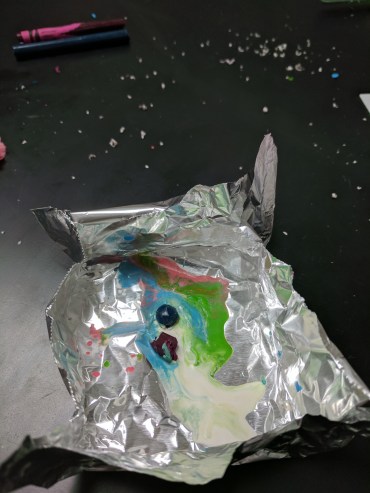
I modified an activity from the middle school Modeling Instruction curriculum using crayons to look at the rock cycle. I had students make some shavings to represent weathering and erosion, then squish the shavings together for a sedimentary rock. Students then melted their sedimentary rock and let it cool to make an igneous one. Next time, I think I’ll have them use higher pressure, maybe from a stack of books, to get metamorphic rocks in there.

crayon

Day 108: Collision Types & Building Again

AP Physics: Collision Types

We whiteboarded the results of Friday’s Direct Measurement Videos to get to the definitions of elastic and inelastic collisions. A lot of groups tried to answer purely conceptually, in spite of some quantitative questions on the activity. I think these groups were treating each question as separate, rather than thinking about how one answer could help them with the next piece of the activity. I want to make better use of lab notebooks (most likely starting next year) as a reflective tool, which I think might help students see more connections between problems.

ap-wb

Physical Science: Building Again

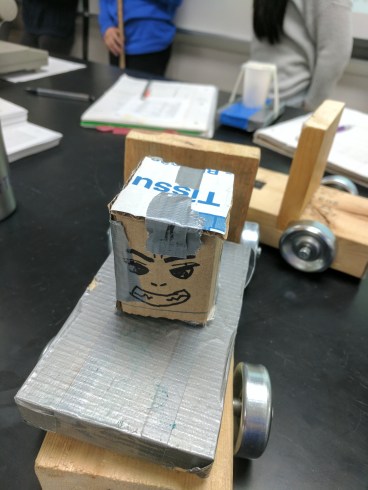
Students worked on their second round of building. I upped the cost of paper cups, which were the most popular material on the first go around, which lead to a little more variety in egg holders. I also did another round of visiting each group and asking them to explain their design choices using Newton’s Laws, and I can tell students are getting more confident with this skill.

eps-cx

Day 106: Energy & Crashes

AP Physics: Energy

Students whiteboarded CER statements for various energy questions, including their answers to where the bouncy ball loses energy and why the tiny bouncy ball from a seismic accelerator flies off. I really liked that different groups tended to take different approaches, which made for some good sharing of ideas once whiteboards were ready and made students very confident in their responses.

bouncy-wb

Physical Science: Crashes

Students attached their cargo carriers to trucks, then sent them down to ramps for head-on collisions. My students usually get pretty animated on this day, which usually includes a lot of bragging about how well they expect their design to do. For some reason, a lot of students in this class were expecting their eggs to break right away, including some students who were filled with confidence yesterday, and the class as a whole was very anxious and nervous. None of the points come from how well the design performs, so it was interesting to see how much tension some students were feeling, anyway.

carrier-1

Day 103: Energy Practical & Explanations

AP Physics: Energy Practical

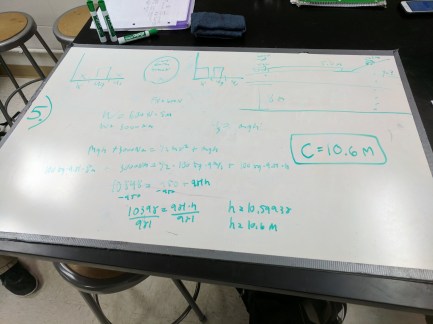
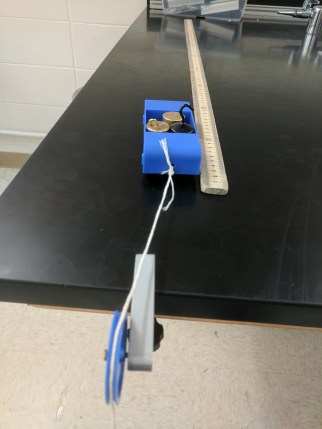
I tried a new lab practical for energy in an effort to integrate rotation and spiral back to some old ideas. Back in December, students measured the launch velocity of a marble, then predicted where it would hit the floor. Today, I had them use conservation of energy, including rotational kinetic energy, to find the launch velocity of their marble, then predict where it would hit the floor. I saw a lot of students pull out their old work, including their lab from December, to help remind themselves how to do the projectile portion of the problem, which is exactly what I hoped they would do. I overheard several students talking about how much they liked looking at an old problem through a new lens, as well as seeing how old ideas fit with the new ones.

practical.jpg

Physical Science: Explanations

Students practiced making predictions and writing explanations using Newton’s Laws. I showed students some videos and clips, including one from Smarter Every Day and an animation of the Mars Pathfinder landing, then had them write an explanation individually, followed by a revised explanation with their whole group. I was struggling more than usual to keep my students focused, but part of the problem might have been the English test next hour and the pep fest this afternoon. I’ve got some demos I’m planning to have students write explanations of as warm-ups, and I probably would have been better off using the demos today, then using the videos as warm-ups.

newton

Day 102: Gallery Walk & 2nd Law

AP Physics: Gallery Walk

I ended up having students do a gallery walk for yesterday’s problems.

wb-2

Physical Science: Newton’s 2nd Law

Students worked on a version of the modified Atwood’s machine lab for Newton’s 2nd Law. While I have students make a graph, we don’t go much deeper than whether each relationship is direct or indirect. I spent more time on the pre-lab discussion today than I have for most labs with this group, and I feel like that paid off with more confidence while they were actually working in the lab.

n2l

Day 98: Mistakes Game & Motion Detector Lab

AP Physics: Mistakes Game

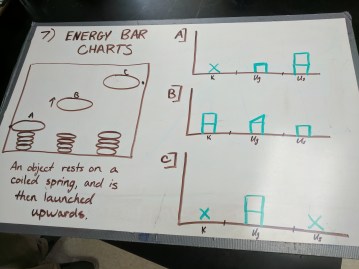
Students played the mistakes game with energy bar charts. My 2nd hour had a sub, so I’m not sure how things went. My meeting got done early, so I made it in time for my 4th hour class. This group is usually quieter during discussions, and they were much more nervous about doing the mistakes game without me since they were not confident they would get the right answers, but I was able to sit back while my students ran the show.

wb.jpg

Physical Science: Motion Detector Lab

Students worked on describing motion based on position vs. time graphs. On Monday, we’ll get out the motion detector to check their descriptions. They had a sub, so I’ll find out then how things went.