Day 139: Free Response, Standing Waves, & Whiteboarding

AP Physics: Free Response

We are starting to review proper for the AP Physics 1 exam. Today, I gave students the 2015 free response and asked each group to sign up for a problem they will become the experts on. There was lots of good discussion about reading carefully and parsing what the question is really asking.

Physics: Standing Waves

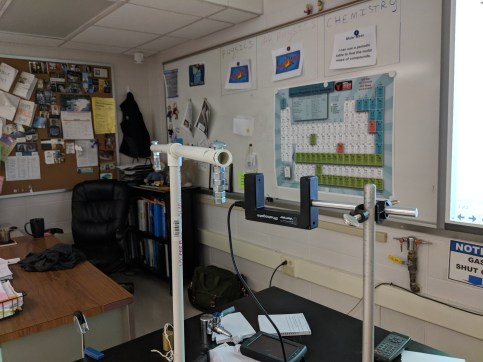
We got out the wave generator and a strobe light to get a few more ideas in place about standing waves. The strobe light helped a lot with talking about the particle motion since it became possible to track the movement of the string.

Maker:S,Date:2017-10-21,Ver:6,Lens:Kan03,Act:Lar02,E-Y

Chemistry Essentials: Whiteboarding

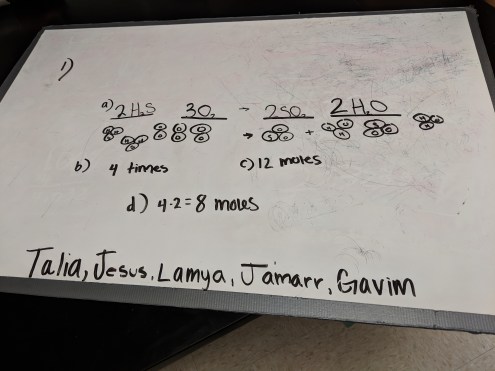
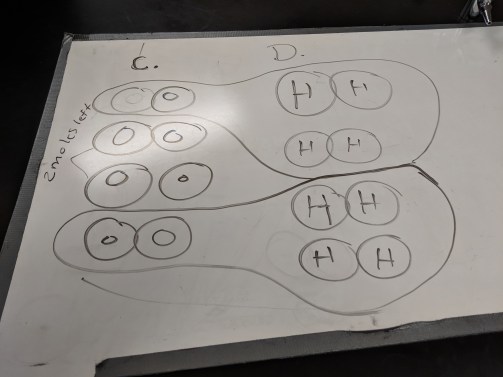
We spent some time whiteboarding yesterday’s problems. We spent a lot of time on the first problem, which had nice whole number mole ratios, so we could look at how the particle diagrams show what math needs to be done.
chem limit.jpg

Day 136: Toilet Paper, Snakey Springs, & Limiting Reactants

AP Physics: Toilet Paper

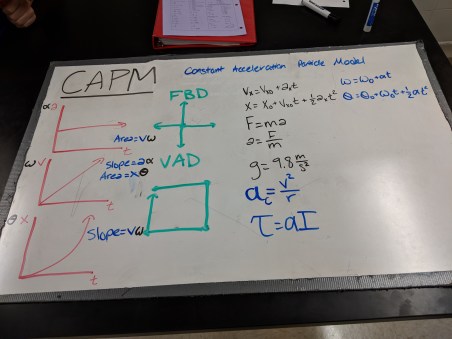
I started by having students whiteboard some model summaries. I started with linear motion, then asked students to add the angular version of each representation. This seemed to help students draw connections between linear and angular motion. Afterward, students started working on a lab practical to predict where to start an unrolling roll of toilet paper so it hits the ground at the same time as a toilet paper roll dropped from a given height.

Maker:S,Date:2017-10-21,Ver:6,Lens:Kan03,Act:Lar02,E-Y

Physics: Snakey Springs

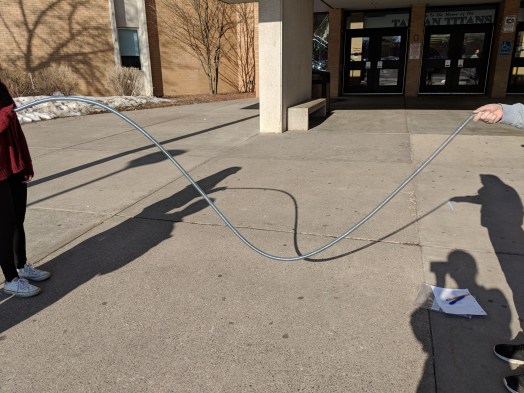
To introduce waves, students played around with snakey springs to look for ways to change the behavior of the waves and get some data for a relationship between wavelength and frequency. Today was one of the first days it was 60 degrees all day and there wasn’t much snow on the ground, so I took the lab outside and a lot of students used sidewalk chalk to help with their measurements. There were also some good observations of the shadows; one group making cycloid waves noticed their shadow looked the same as the shadow for 2D waves.

snakey.jpg

Chemistry Essentials: Limiting Reatants

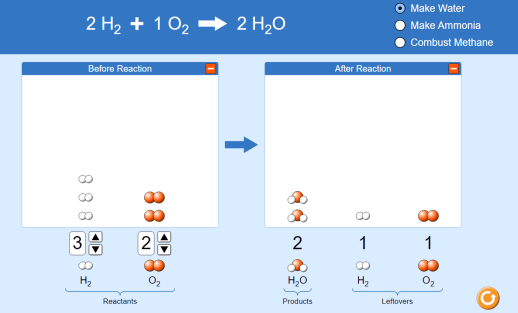
Students used a PhET simulation to start building some ideas about limiting reactants. The class was much rowdier than usual; the class meets the last period of the day, and I think the nice weather was making a lot of them restless. The concrete visualizations did seem to help a lot of students start making sense of limiting reactants.

limiting ract.PNG

Day 135: Whiteboarding

AP Physics: Angular Momentum

Students whiteboarded yesterday’s problems. There was a lot of good discussion; I think rotation is starting to click for a lot of students. I also did a few demos, including one with an RC motorcycle inspired by a Evel Knievel statement prior to a jump over the Snake River Canyon that his biggest fear was accidentally letting go of the gas while in mid-air.


Physics: Oscillating Particle Whiteboarding

Students whiteboarded yesterday’s problems. The connections between the math and the big ideas seem to be clicking for a lot of students. One of the questions we discussed is whether the angle of a ramp should affect the period of a cart oscillating on a spring, so I set up the demonstration.

Chemistry Essentials: Percent Yield 

I kept the whiteboarding pretty short since a quiz on percent yield was also on deck for today and the para working with the class had let me know that students had done very well with the problems. We targeted a couple of trouble spots, like a problem where a lot of students dropped a decimal point yesterday, leading to over 800% yield. I was really pleased that students recognized why that was not a reasonable answer, even if they had trouble finding the error.

Day 130: Rotational Inertia, Springs, & Whiteboarding

AP Physics: Rotational Inertia

Students worked on data collection for the rotational inertia lab we started yesterday. A lot of groups are setting up spreadsheets to streamline the calculations, which is great. However, this lab is time-consuming enough that I want to spend some time this summer looking at alternatives or trying to simplify it.

Maker:S,Date:2017-10-21,Ver:6,Lens:Kan03,Act:Lar02,E-Y

Physics: Springs

Students worked on connecting models from earlier in the year to the motion of springs. A few students struggled to get started with the free-body diagrams, but most were able to work through and make the connections I was after.

On a side note, I talked to one lab group about their pre-calc homework. They had some problems involving free-body diagrams for blocks on a ramp, but were thrown off by some differences in language and notation. I should find a time to connect with the pre-calc teachers to see if there are ways we could do a better job of building on each others’ classes.

Chemistry Essentials: Whiteboarding

Students whiteboarded yesterday’s problems. Since the problems are on the long side, I decided to do a gallery walk today. Stoichiometry seems to be clicking for a lot of students.

Maker:S,Date:2017-10-21,Ver:6,Lens:Kan03,Act:Lar02,E-Y

Day 128: Whiteboarding, Springs, & Stoich

AP Physics: Whiteboarding

Students whiteboarded some torque problems. I can tell the last week or so has been a little disjointed; I had a lot of students trying to use Universal Gravitation to find the force of gravity in the torque problems and some were having trouble with what we meant by the radius. I spent some time talking with those groups how to decide when to use each version of the force of gravity equation, and that helped resolve things.

Physics: Springs

Students wrapped up collecting data for the period of a spring. I overheard a great conversation in a lab group; one student was griping a little about collecting data for the mass since he was convinced it shouldn’t matter based on the pendulum lab. Once they had a few data points, though, there was a moment when he lit up and made a beautiful connection to energy transformations to explain why mass mattered.

Maker:S,Date:2017-10-21,Ver:6,Lens:Kan03,Act:Lar02,E-Y

Chemistry Essentials: Stoich

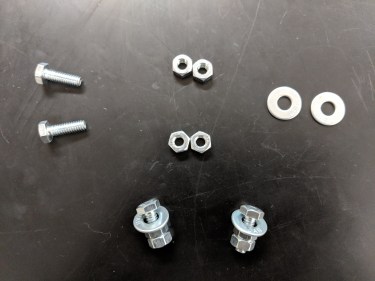
We got the hardware out again to start stoichiometry. Students assembled nuts, bolts, and washers into “molecules” and predicted how many grams of each molecule they should have after a chemical reaction. The manipulatives seemed to help a lot of students wrap their heads around what is going on in a stoichiometry problem, which I’m hoping will translate into success with the paper and pencil problems tomorrow.

stoich.jpg

Day 119: Whiteboarding

AP Physics: Central Force Whiteboarding

Students whiteboarded some problems dealing with a central net force. My students who have taken Astronomy are pretty excited with the connections they are seeing to orbits. I also pulled up a simulation of Newton’s Cannon to talk about a problem that asks why the ISS doesn’t crash into the earth.

Physics: Projectile Motion Mistakes

We did the mistakes game, focusing on the diagrams and initial set-up for problems rather than all of the math. There are a lot of long silences, so I might try giving students some structure for additional pre-discussion with their lab groups next time. Maybe students could do a gallery walk and jot down some potential questions for each whiteboard. There are a lot of groups opting to use “vertical” energy to solve for key values, which is pretty cool.

Maker:S,Date:2017-10-21,Ver:6,Lens:Kan03,Act:Lar02,E-Y

Chemistry Essentials: Balancing Mistakes Game

We did the mistakes game with yesterday’s problems on balancing chemical equations. I’ve got the opposite problem of my physics class, where lots of students have things to say, which leads to too many people talking at once. Most of my contributions end up being to re-focus the discussion or redirect students, rather content-related questions to move things along. I’m okay with this problem, even if I’m not sure how to solve it yet.

2.jpg

Day 118: Board Meeting, Projectile Problems, & Balancing

AP Physics: Board Meeting

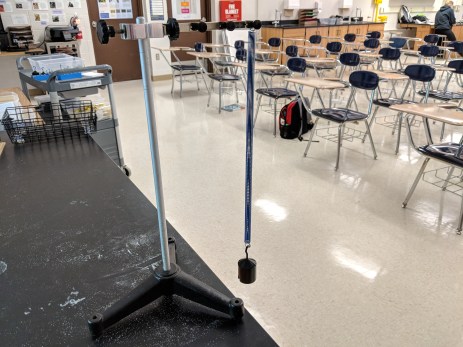
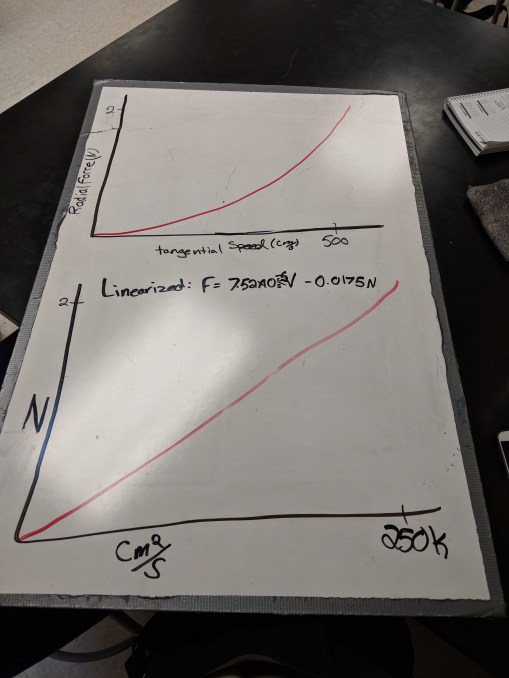
We had our board meeting for yesterday’s lab on centripetal force. I approached it as three mini board meetings since students had done experiments for how three different variables affect the force. The units on slope ended up being a very powerful way for students to see the connections between their three graphs. It was especially exciting when we got to the force vs. mass graph and students saw the connections to Newton’s 2nd Law. One class noticed the slope on the force vs. 1/radius graph has units of Joules, but I’m not sure of the significance of that yet.

force vs t.jpg

Physics: Projectiles

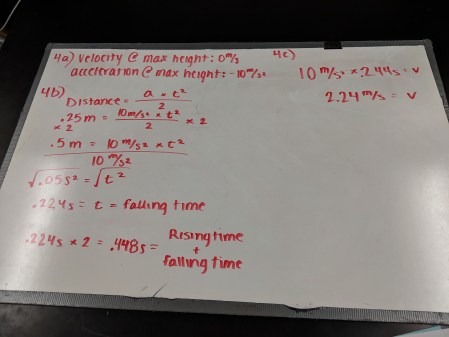
Students whiteboarded yesterday’s problems for a gallery walk. They are consistently viewing free-fall as just a special case of models we’ve already covered, which made the problems pretty easy.  Afterward, students started working problems for horizontal projectiles.

projectile prob.jpg

Chemistry Essentials: Balancing Reactions

After some discussion about the labs from the past few days, students worked on some problems balancing chemical equations. The students who started by sketching a particle diagram were generally very successful at seeing how to balance. A few students got tripped up determining when individual letters in a formula represent individual atoms, especially when the formula included a polyatomic ion, but were getting the hang of it after a couple problems.

balancing prob 1.jpg

Day 106: Model Summaries, Collisions, & Gas Laws Review

AP Physics: Model Summaries

To help review for the final, students whiteboarded model summaries for the mechanics topics we’ve done so far. I just asked for key diagram types, along with relevant annotations, and key equations. For the first time, I saw a lot of groups including pieces of the force models, including free-body diagrams, system schema, and Newton’s 2nd Law, in summaries for other models. I’m excited that students are seeing and valuing the connections between different models.

Physics: Collisions

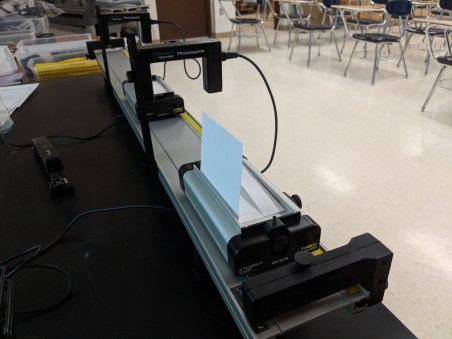
Students continued the cart collisions lab from the Modeling Instruction materials. A lot of groups struggled with interpreting the graphs produced by the photogates, which has been pretty common this year. The classic graph matching lab always seems to help students make sense of what the motion detectors are recording; I’m wondering if it would be worthwhile to have a lab that’s essentially play with photogates next year.

Maker:S,Date:2017-10-21,Ver:6,Lens:Kan03,Act:Lar02,E-Y

Chemistry Essentials: Vacuum Chamber

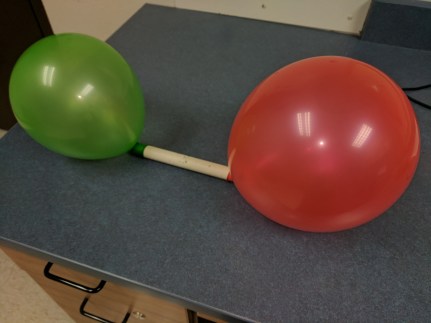
I got out the vacuum chamber and a few other demos, including balloons linked by a pipe, to revisit gas laws and pressure today. Sticking with pretty hands-on review seems to be helping a few students stay engaged as we approach the final exam.
balloons

Day 102: Whiteboarding

AP Physics: Circuits Whiteboarding

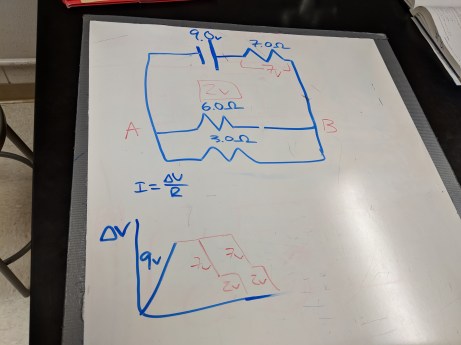
Students whiteboarded yesterday’s problems on circuits. Students are recognizing the value of sketching circuit paths and KVL diagrams more quickly than some of the other diagrams this year. My students say its because the value of the diagrams is very obvious, but I think its a factor that they’ve come around to the value of other diagrams in the class.

circuit wb.jpg

Physics: Impulse Whiteboarding

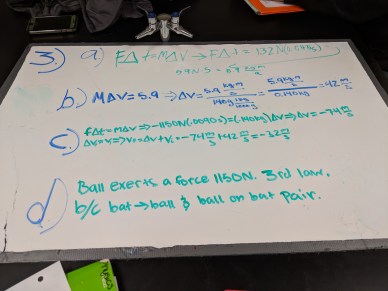
Students whiteboarded yesterday’s problems. A lot of students referred back to last week’s paradigm lab on impulse and Friday’s qualitative problems, which was fantastic. I also had some students who couldn’t remember doing either the lab or problems and struggled quite a bit today as a result; I need to keep working on helping these students see the value in being an active participant in their lab group.

impulse (1).jpg

Chemistry Essentials: Formula Writing Whiteboarding

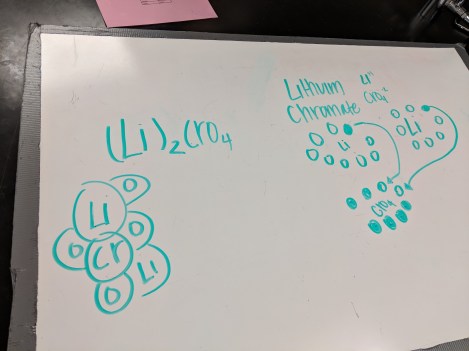
Students whiteboarded yesterday’s problems naming formulas with polyatomic ions. Each day, things are clicking for a few more students. One of the big keys is understanding the relationship between the charge and the electron diagram. At this point, I’m leaving it up to students whether to sketch the electron diagram, but many are choosing to sketch it because they find it helpful.

IMG_20180221_142216.jpg

Day 99: Kirchoff’s Laws, Impulse, & Mistakes Game

AP Physics: Kirchoff’s Laws

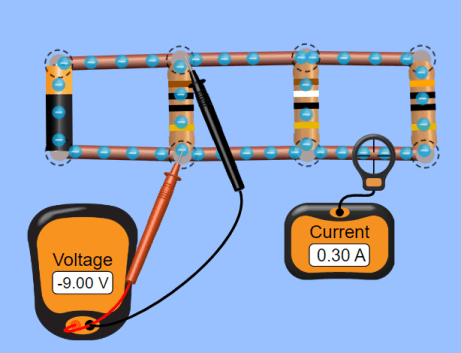
Students used PhET’s circuit construction kit to look for patterns in the current and potential difference in both series and parallel circuits. I usually do the PhET version before the real-world version we started yesterday, but testing season makes it tricky to reserve a computer lab right now. I overheard some students making good connections to their work yesterday and noticing the key things I wanted them to notice.

circuit kit parallel

Physics: Impulse

Students re-did the impulse lab from earlier this week. This time, I spent more time discussing with them why we care about the change in velocity, rather than the velocity at a specific moment. Students were more visibly attentive when I walked through how to get the change in velocity on a LabQuest than they were earlier in the week; I think it helped that they knew we were re-doing the lab because their earlier results came out poorly. I also had groups assign someone to plot their data as it was collected, which had them thinking about whether their results make sense throughout the lab. One section got beautiful results, while the other still had slopes all over the place; I’m not quite sure what happened in the second section.

Maker:S,Date:2017-10-21,Ver:6,Lens:Kan03,Act:Lar02,E-ve

Maker:S,Date:2017-10-21,Ver:6,Lens:Kan03,Act:Lar02,E-ve

Chemistry Essentials: Mistakes Game

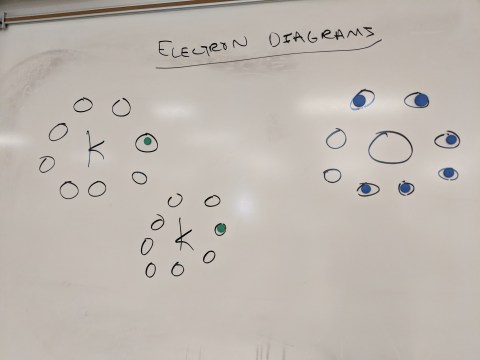
Students whiteboarded yesterday’s problems using the Mistakes Game. The students who are using the electron diagrams as a thinking tool are pretty quickly getting the hang of things.

electron diagra.jpg