Day 87: Ohm’s Law & Limiting Reactants

Physics: Ohm’s Law

Students used PhET’s circuit construction kit to do a short activity based on the PUM materials to help orient them to the sim, then started looking for a relationship between current and potential difference. I loved it when, during the orientation activity, several groups got curious about the mysterious resistors in the kit, and immediately tried adding them to a circuit to see what they do, without any prompting or intervention on my part. There was also some great discussion and debate in one class about what exactly the blue dots represent. There were also many attempts to electrocute the dog.
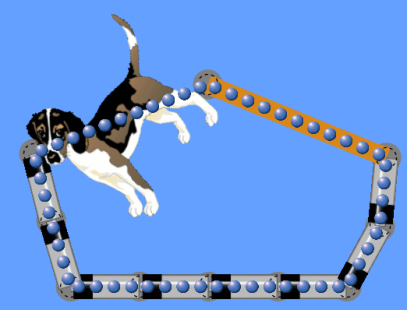
dog circuit

Chemistry: Limiting Reactants

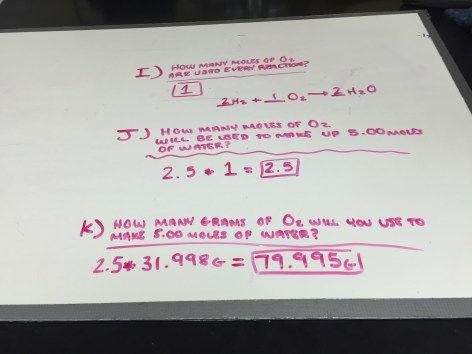
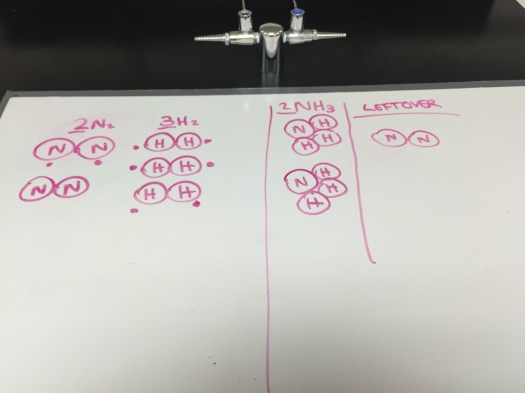
After a short percent yield quiz, we had some class discussion to formalize what students found in yesterday’s PhET sim on limiting reactants. I picked some reactant quantities for one of the reactions in the simulation, then had students get into groups and try to predict what they would produce and what the leftovers would be. Before students went to their groups, we had some conversation about what I was looking for. I tried to emphasize that I wasn’t after right answers; instead, I wanted them to share different approaches so we could decide on some useful ways to think about this kind of problem. There was a nice mix of students who focused on the equation given for the reaction and students who sketched diagrams.
IMG_1609

Day 85: Whiteboarding & Percent Yield

Physics: Whiteboarding

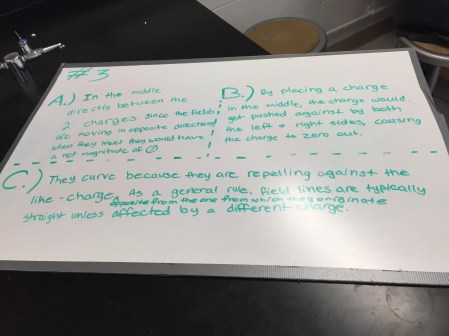
Students whiteboarded their answers to Friday’s questions. There were a few questions where students had some good discussion and connected some questions back to the lab where they’d mapped electric potential. I still need to work on getting students to talk to each other more than they talk to me.

IMG_1606

Chemistry: Percent Yield

Students worked on some problems calculating percent yield. While they can do the calculations pretty easily, the concept seems pretty abstract to them. I need to find a good lab to make percent yield more concrete.

Day 84: Electric Potential & Whiteboarding

Physics: Electric Potential vs. Gravitational Potential

Students worked on a worksheet from the Modeling Instruction curriculum that draws analogies between gravitational potential and electric potential. Several students commented that relating electric potential to something more tangible helped them make sense of what we’ve been doing. I also had a very good conversation with a student about how last trimester, she really liked how connected the mechanics topics were, but doesn’t have the same sense with electricity. This confirms that I need to keep working on my storyline for this trimester, but it was great to hear some of the metacognition the student was doing and I consider it a sign of a good class climate that a student was willing to have that conversation.

Chemistry: More Whiteboarding

Students used whiteboards to work through another stoichiometry problem. A lot of students left with much more confidence than they’d started the day with.

Day 83: Electric Potential Difference & Whiteboarding

Physics: Electric Potential Difference

In the past, I’ve motivated the need for electric potential difference in addition to electric potential purely through analogies to gravitational potential energy. Today, I tried an extension of the Modeling Instruction lab to map electric potential. I had students measure the voltage along a line in their tray of water with the multimeter’s ground attached to the negative lead of the power supply, then repeat with the ground attached to the power supply’s positive lead and the ground held somewhere in the middle. In the discussion, students agreed that the change in voltage is more meaningful than the specific value.

IMG_1604

Chemistry: Whiteboarding Problems

Students struggled with the stoich problems I left them yesterday, so we took some time to go through the first part of one. I tried to be very explicit and specific in bringing up previous labs or activities that used each skill, and that seemed to help students make connections. Students then continued the problem in small groups working on whiteboards. I need to do more whiteboarding problems in this class; the whiteboards really helped students function as a cohesive group, which is really not surprising.

IMG_1603

Day 80: Projectile Launchers & Return to Stoich

Physics: Projectile Launchers

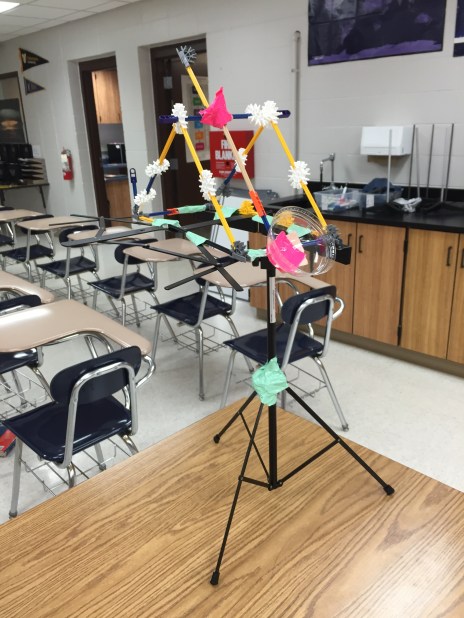
Students tested the final versions of their projectile launchers today. I picked random target distances in three different ranges, and groups had to pick one target to try and hit. I really enjoyed seeing the creativity in the materials students used. On group built a basic launcher out of K’Nex and decided to take a slushie break as they tried to come up with something to hold the ping pong ball, only to realize the lids from their slushies were the perfect size and shape. They also decided an adjustable height would make it easier to hit the target and came up with attaching the launcher to a music stand.

While students applied a lot of good data analysis to the project, the connections to energy and projectile motion weren’t as strong as I’d like, which I think has a lot to do with the way I broke up the project. I tried to squeeze energy into the two weeks between the start of tri 2 and winter break, and the project ended up bleeding into electrostatics. Next year, I may try starting the project with projectile motion, then working the redesign into the energy unit. There will be some administrative challenges, since the project will be split across two terms and a lot of students switch class periods, but I think it will pay off with students seeing a stronger connection to the physics content.

IMG_1595

Music stand, K’Nex, and a slushie lid

Chemistry: Return to Stoich

The next unit covers percent yield and limiting reagents, but scores were low enough on the assessment I gave before winter break that I want to revisit stoichiometry before we try any percent yield problems. Today, students started a lab to predict masses for an imaginary reaction using nuts, bolts, and washers in place of actual atoms. I wanted to give them something they could manipulate and measure very directly to get some conceptual understanding of stoich before we try any more problems. I wrote the lab with the intention of helping students work piece by piece through the process and questions frequently rely on information from a previous answer. A few groups, I think in an effort to be collaborative, tried to divide and conquer, and the students working on the later portions of the lab found they were stuck. Before we finish the lab next week, I’m planning to have a conversation with them about the shortfalls of the divide and conquer strategy and to come up with some more effective collaboration strategies.

IMG_1599

Day 79: Electric Field Lines & Energy in Reactions

Physics: Electric Field Lines

Students whiteboarded their answers to yesterday’s worksheet. The time we spent on vector addition diagrams with forces paid off as students were very successful adapting those to make sense of electric fields.

IMG_1589

Chemistry: Energy in Reactions

We started with a “mini-lab” to give students some first-hand, tactile experience with endothermic and exothermic reactions. After that, I tried having them sketch bar charts for those reactions, but it was clear I hadn’t done enough to help them understand what energy is, let alone the different types of energy that will appear in a chemical reaction, so the bar charts ended up a confusing abstraction for most students. I need to rethink how I approach reaction types next time to give students a better foundation in energy.

IMG_1588

Day 77: Board Meeting & Activity Series

Physics: Electric Fields Board Meeting

Students whiteboarded their graphs from yesterday’s electric fields simulation. I was really pleased with how quick students were to bring up Coulomb’s Law as a way to check if their relationships made sense. There was also some good discussion about why linearization is useful, where several groups shared their initial attempt to linearize using a purely inverse (rather than inverse-square) relationship between field strength and distance.

IMG_1583

Chemistry: Activity Series

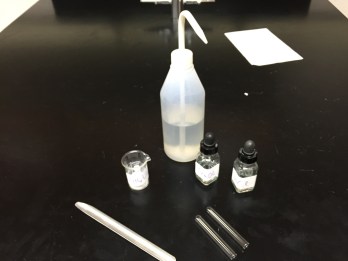
Students dropped four different metals into four different solutions to see how many times each metal reacted. They were able to rank the metals in a crude activity series, then we looked at how that activity series could explain which solutions each metal reacted with.

IMG_1586


Day 74: Board Meeting & Observations

Physics: Coulomb’s Law Board Meeting

Students whiteboarded the results of yesterday’s lab and we had a board meeting. I had students graph force vs. distance, then both an inverse and inverse-square test plot so we could compare the correlation coefficients. While both classes were able to get to the inverse-square relationship, I struggled to get students to take the lead in the discussion. I think part of the problem is, while we’ve whiteboarded lots of problems and conceptual questions, the last board meeting where we focused on graphs produced in a lab was early November. I need to either do more whiteboarding labs during projectile motion and energy, or I need to bring in more of the scaffolding I do early in the year to help students refresh their skills.

IMG_1574

Chemistry: Observations of Reaction Types

Students finished up the lab from yesterday, then we spent some time trying to connect their inferences to their observations in the lab. In the discussion, I realized I need to make explicit to my students what is a good observation and how that contrasts with an inference or claim. For example, the textbook lists gas formation as a sign of a chemical reaction, so nearly every student listed gas formation as an observation at least once, but struggled to explain what they saw that suggested a gas was formed. I can’t forgot how important it is to explicitly address the basics in a class like this.

IMG_1572

Day 72: Van de Graaff & Finish Review

Physics: Van de Graaff

We started by discussing the results of yesterday’s lab. It ended up much more teacher-centered than I would have liked; I had a few different concepts I wanted students to take away from the lab, and I wasn’t quite sure how to have students summarize their results on a whiteboard or how to guide the discussion to get students to those concepts. It also didn’t help that about half of my students were on a field trip and the empty room made students more self-conscious about speaking up. After discussing the lab, we played with the Van de Graaff generator. Students did a nice job of using what they’d gotten from the lab to make predictions and construct explanations of what we saw with the generator.

IMG_1564

Chemistry: Finish Review

No one managed to finish yesterday’s assignment, so we spent some time discussing together the parts students had finished, then I gave them time to finish the rest. I’d hoped to start a lab today, but many students needed the whole hour to work.

Day 71: Electrostatics Intro & Review

Physics: Electrostatics

This year, I decided to try the electrostatics labs from Eugenia Etkina’s PUM curriculum. The effects were pretty visible and just about every student, including the ones concurrently enrolled in AP Chemistry where they just finished Coulomb’s Law, made some observation they found surprising.

IMG_1563

Chemistry: Review

In preparation for tomorrow’s lab, I had students balance the equations for the reactions they’ll be doing, as well as categorize each reaction into the five types that were introduced right before break.