Day 125: Mistakes Game & Molar Mass

Physics: Mistakes Game

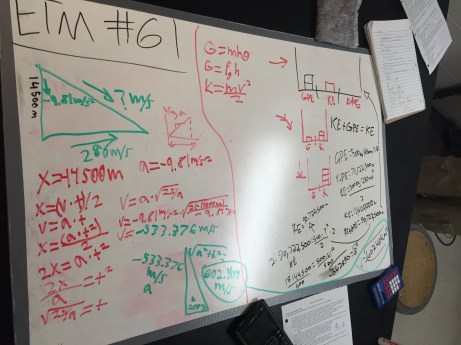
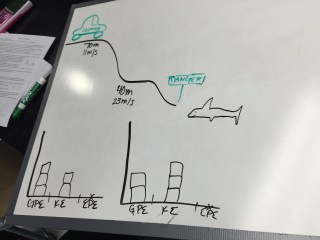
Students whiteboarded yesterday’s problems including at least one mistake. Its been a little while since I last had students do this, and a lot of students were excited to do it again.

IMG_1771

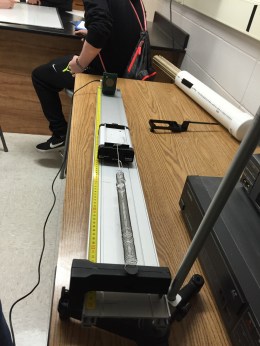
Since everything we’ve done so far has been vertical springs, I sent up a ramp with a cart attatched to a spring so we could look at position vs. time graphs compare the period at different angles as a way to see how “changing gravity” affects the spring’s period. In spite of having the equation, a lot of students expected gravity to matter because they thought there had to be a force to de-compress, not recognizing that the spring could exert that force since we’ve mostly looked at stretching springs.
IMG_1770

Chemistry: Molar Mass Introduction

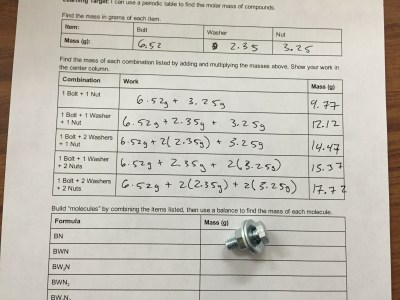
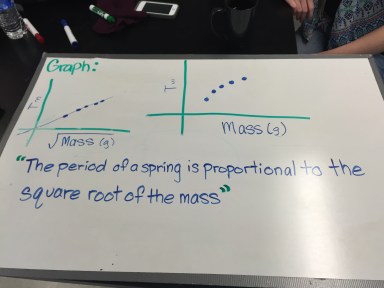
Students got the mass of individual nuts, bolts, and washers, then predicted the masses of various combinations. Compared to last trimester, I took some extra time debriefing after the lab and tried to be very explicit that the hardware was being used to represent individual atoms, since we can’t observe individual atoms directly.
IMG_1768

Day 124: Spring Problems & Mistakes Game

Physics: Spring Problems

Students worked through a Modeling Instruction worksheet using forces and energy to analyze the motion of a spring. The worksheet has students define h = 0 in a way that gives a negative gravitational potential energy at one extreme of the spring’s oscillation, and my students struggled with what a negative potential means. Both for cases like this and for negative electric potential differences, I need to adjust my energy unit to include some scenarios with negative energies.

Chemistry: Mistakes Game

Students whiteboarded yesterday’s problems balancing chemical equations, including intentional mistakes to help spur discussion. A lot of students were gone yesterday for a blood drive, and this seemed to help them get caught up. Tomorrow, they’ll be taking a quiz on balancing, so I took some time during class to do a practice problem under quiz-like conditions. Last tri, the chemistry students who did poorly in the class tended to have trouble self-assessing and would equate having an answer with understanding the problem, even when the answer was just copied from a classmate. I have some students who look like they could go down the same path this tri and, after the practice quiz, they were interested in how to improve their understanding before tomorrow’s quiz. While this is a step in the right direction, my real challenge is to help these students self-assess much earlier in hopes of helping them shift their habits in my class.

Day 123: Board Meeting & Balancing Equations

Physics: Period of a Spring Board Meeting

Students whiteboarded their results to yesterday’s lab. Once we get situated, I usually give students a minute or two to talk with their lab group. I watched one group use this time to furiously tap at a tablet, then edit their board to reflect a square root, rather than linear, relationship between period and mass. During the discussion, I asked them to explain the change they made and they shared that, prior to seeing they other whiteboards, they stopped after trying a linear fit because it had a really nice correlation coefficient. When they saw other groups got an intercept much closer to zero using a square root fit, they quickly tried the same fit on their data, and saw they got a better correlation and an intercept of nearly zero. We’re talking a lot in my building about how to use technology in the classroom, and this moment exemplifies how I want students to use technology. This group had to decide whether their linear fit or their classmate’s square root fit was more convincing, and Desmos made it possible to quickly and easily test the competing ideas and get the evidence they needed to be convinced.

IMG_1765

Chemistry: Balancing Equations

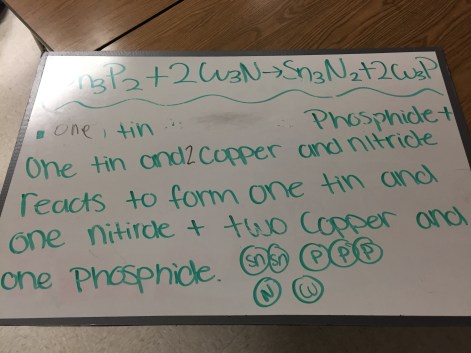
Students combined the multiple representations we worked on before break with what they figured out in yesterday’s sim to practice balancing chemical equations. I remain very impressed with how easy the reaction diagrams make this process for students.

IMG_1764

Day 121: Pendulums & Quiz

Today was the last day of classes before spring break.

Physics: Pendulums

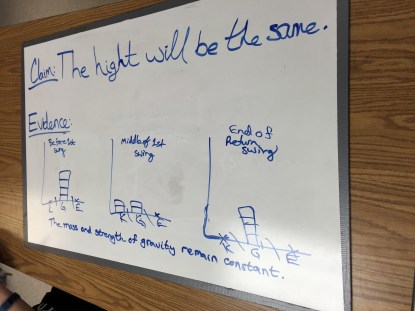
Before their quiz, I had students make predictions about a few different pendulums. First, they predicted how the maximum height on the return swing should compare to the starting height, then they made some predictions about a pendulum that uses a magnet to pick up a steel sphere at its lowest point, and finally we used a hover disc on a tilted table as a pendulum and students made predictions about what happens when the table’s angle changes.

IMG_1747

Chemistry: Quiz

Students took their first assessment of the course on representing reactions.

Day 120: Pendulum Motion Graphs & Mistakes Game

Physics: Pendulum Motion Graphs

Students whiteboarded their answers to yesterday’s worksheet. They did a nice job of using energy bar charts and free body diagrams to make predictions about what the position vs. time, velocity vs. time, and acceleration vs. time graphs should look like. We put a pendulum in front of a motion detector to get a look at the actual graphs and used both the formula and the graphs to determine the period of the pendulum.

Chemistry: Mistakes Game

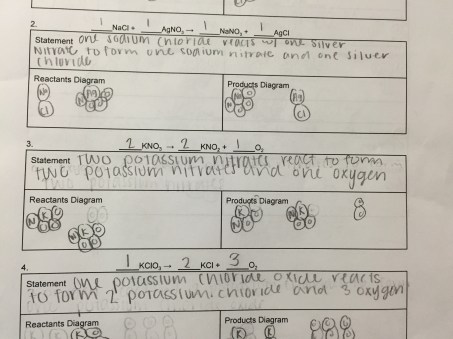
Students whiteboarded their solutions to yesterday’s problem, including at least one intentional mistake. I ended up splitting each problem between groups, so one group did the statement, one did a diagram of the reactants, and one did a diagram of the products. I wish I’d had each group do a whole problem, then just limited how many present, since multiple representations gives room for richer mistakes.

IMG_1740

A partially corrected whiteboard

Day 115: Final Exams

Physics: Collaborative Exam

Since physics is both very lab-based and very collaborative, we decided the final should be as well. We planned lab practicals based on the models from this trimester. Students are getting a test to complete individually that has descriptions of each lab practical, but no numbers. Students will have about an hour to set up equations and plan what they will need to do in the lab. For the last half hour, students will be placed into groups where they will actually complete each of the lab practicals.

IMG_1733

Chemistry: Final Exam

I went with a fairly traditional written exam, though there was enough time that I could have done a two stage collaborative exam. I might try that next trimester, though I’ll need to think about how I will make sure students make effective use of the collaborative time. I also need to rethink how I approach the review assignment. I allowed students to use their review on the final, and several students answered some questions by just copying over their answer from the review, even when the test question was looking at a different reaction or element. Many of my students read below grade level, so I’m wondering if that was a factor in students who missed the ways the test was different from the review.

Day 114: Gallery Walk

Tomorrow is the start of final exams, so both classes today went over their final review assignments. I decided to go with a gallery walk, with each group preparing a whiteboard for a different problem. Then, one member of each group stayed put to answer questions while the others moved around the room to check out the other whiteboards. Especially in my largest class, I really like that the gallery walk gets more students involved in the conversation. A few students decided to play the “reverse mistakes game” during the gallery walk by pretending to hold a misconception as they asked questions at a whiteboard.

IMG_1730

This group asked if they could try their problem with both constant acceleration and energy transfer.


Day 113: More Final Review

Students in both courses continued to work on their final review assignments. After a three-day weekend, both classes were much less focused than they were on Thursday. In chemistry, I talked to them a bit about the strategies I saw during class, and how they could improve on them. The students who were working pretty well on Thursday seemed receptive and tried to refine their approach. There were some groups that had great conversations about the problems on the review. In physics, I saw a lot less collaboration than on Thursday and a lot more off-task behavior in general. A lot of students talked about feeling fried from studying and working on final papers or projects over the weekend, and I saw more students working on other homework than usual. I think a lot of students are just feeling fried by the end of the tri. Tomorrow, I’ll switch to something more structured, especially since it will be time to go over the reviews.

Day 112: Final Review

We’re down to three class periods before finals (possibly two, if the basketball team makes the state tournament). In both of my courses, we started the final review. While both reviews were pretty similar, it was interesting to contrast how my two classes approached it. In physics, students were quick to grab whiteboards to collaborate on and pull out old quizzes and other work to jog their memory. I also saw a lot of students jumping around in the assignment, looking for the problems and questions they found most challenging to use those as a starting point. In chemistry, we talked about strategies to prioritize what to work on, but most students took a very linear approach and only a few pulled out work from earlier in the term. I saw much more variation in how students approached working together. Two students in particular did a really nice job of bouncing ideas off each other and challenging the other one’s thinking, but other groups “worked together” by agreeing to divide up who would do what portions of the review. No one opted to use a whiteboard for brainstorming and collaborating; when I asked some students about it, they saw it as extra work since they would have to transfer their work onto their paper.IMG_1713

Contrasting these classes really reinforced for me how important it is to work with students in this chemistry course on how to be a student. In physics, I have some of the top students in the school and they come to me expecting that they need to understand the daily work to do well on assessments and knowing that having the right answer down is very different from understanding how to answer the question. Many of my chemistry students don’t see that connection between assessments and what happens day-to-day, so don’t value the daily work as much. I need to keep working on making the value of daily work explicit to my students. There are a few who’ve bought into the idea that what they do today influences how their test will go, and they tell me chemistry is one of their highest grades. My challenge for next tri is to get more students to that point.


Day 111: TIPERs & Half-Life

Physics: TIPERs

Students worked through some questions related to magnetic forces from TIPERs. I overheard a lot of good discussions, and students shifting their ideas as they went.

IMG_1711

Chemistry: Half Life

We spent some time going over the results of yesterday’s lab, then students worked on some half-life problems. Based on conversations with my students, many were struggling to connect the definition of half-life to the process for solving problems. I need to rework the lab discussion for next time to try and help students really get what half-life means.