Day 40: Mass & Craters

AP Physics: Mass

Students worked on a lab practical to find the mass of an unknown object using a modified Atwood’s machine. My plan is to use spring scales to verify the mass the determined, then use this to introduce the difference between inertial mass and gravitational mass, but time got tight and most groups need a little longer to finish their calculations.

img_2456

Earth Science: Craters

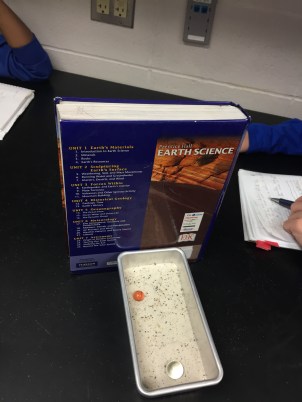
During yesterday’s lab, it quickly became clear that my students did not have much sense of how craters are formed. Today, I got out some trays of sand and an assortment of marbles and we explored how mass and impact speed affect the crater size. I was really excited when the groups who finished early started asking new questions, like how the depth of the sand or angle of impact changes the crater, and coming up with experiments to answer those questions. This is why I love freshmen! We also dropped a shot put into a bigger tray of sand and got some slow-motion video just because its cool.
img_2452

Day 39: Assumptions & Moon Landscapes

AP Physics: Assumptions
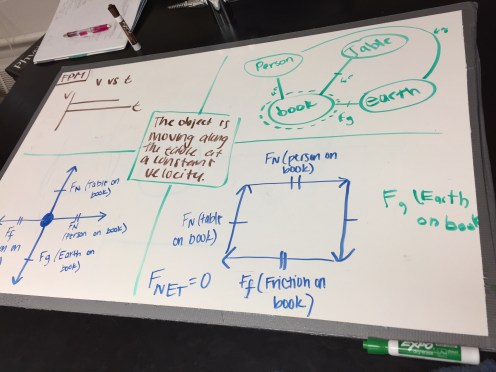
Some of my students are losing track of the tools they have for problems involving forces, so we started by whiteboarding as many different representations for a simple force problem as we could and then making a list of what we have in our forces toolkit. From there, students worked on some TIPERs problems. I had students answer each problem using a CER, but turned it into a CAER by asking them to state and justify key assumptions before diving into the evidence. We had some good conversation about what makes something an assumption rather than evidence or a claim. We will definitely need to revisit this as the year goes on, but I liked hearing my students start by articulating what they had to just agree is true before digging into the rest of the problem.

img_2451

Earth Science: Moon Landscapes

Students looked at a topographic map of an area of the Moon. They made some good observations and inferences about the craters formed, but students have had limited exposure to topographic maps so far and, as a result, had trouble connecting the map to what the would physically see. Next time, I think I’ll start by having them look at an actual image of the Moon, then transition to a topographic map of the same area.

Day 38: Pushing Blocks & Kepler’s 2nd Law

AP Physics: Pushing Blocks

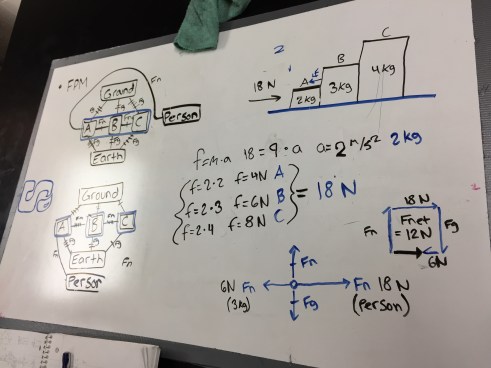
Students worked on a problem I’ve come to really like where three blocks of different masses are being pushed along by a certain force. Based on some of the struggles a few groups were having, I think it would be worthwhile to pause sometime soon to do a model summary. I loved the moment when students figured out how to use the 3rd Law to think about the normal forces between each pair of blocks. The best thing I overheard, though, was a student who said “You need to convince me you’re right! If you can explain your idea and your evidence, then I’ll believe you.”

img_2438

Earth Science: Kepler’s 2nd Law

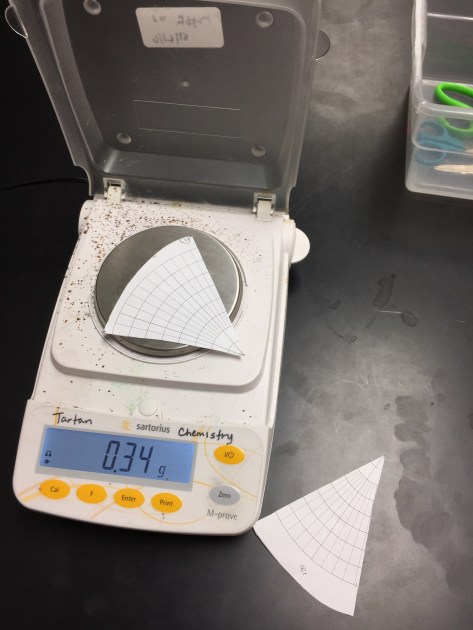
Students plotted the position of Mars along its orbit, then cut out some wedges that represent the same amount of time. We used the mass as a stand-in for area to show that an orbiting object sweeps out the same area in the same amount of time. We got really nice results; the class average for the mass was within 0.01 g for the two wedges. I think students lost track of what they were plotting, however, so I need to think about how I can reinforce what the numbers they are plotting has to do with the actual path of Mars.

img_2436

Day 34: Springs & Review

AP Physics: Spring Force

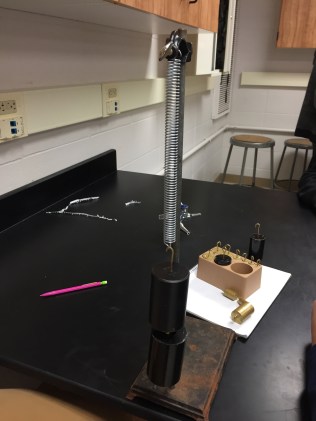
Students looked for a relationship between the force on a spring and the amount it stretches. I rushed the follow-up discussion since I’m going to be out the rest of the week, so I want to make sure to revisit some of the key ideas next week, especially when it comes to interpreting the graphs.

img_2423

Earth Science: Review

I used the same review activity from earlier units where students work with their lab group to write some questions for each learning target, then pass their questions on to another group. Overall, I could tell my students were struggling more to come up with questions than in some of the earlier units. I think a lot of that stems from my own struggles interpreting the learning targets and connecting them to the established lessons. If I’m not clear on what the learning targets mean or how everything connects, my students definitely won’t be.

img_2420

Day 31: Quiz & Human Impacts

AP Physics: Quiz

I missed my AP Physics classes today to chaperone a field trip. they took a quiz on system schema and free-body diagrams, then worked on some 2nd Law problems. It was around this time last year that it finally clicked for me what system schema are for, so this is the first group of students I’ve had that really “get” that representation and truly find it useful. Based on their quizzes, we do need to spend some more time on internal vs. external forces, as well as how to pick your system when the problem doesn’t specify.

Earth Science: Human Impacts on Climate

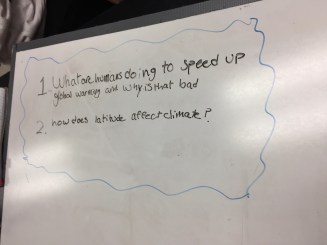
Students used several different representations of emissions to answer some questions about pollution and its effects. The activity gave students a lot of opportunities to practice reading data tables and graphs, but I found my students did pretty superficial interpretation. My students also made pretty limited connections to the earth science content, and I think finding ways to go deeper on the data interpretation will help with the content connections.

Day 29: Board Meeting & Hurricanes

AP Physics: Board Meeting

Students whiteboarded their results from the 2nd Law Lab and we had a board meeting. Students needed a reminder to translate the equation for their lines of best fit into “physics terms”, but they are getting more skilled at that. I was also pleased with how quickly students picked up on things like which groups had similar slopes, which made it easy to build some ideas like why the slopes would change.

img_2389

Earth Science: Hurricane Tracking

Students used some data from 1992’s Hurricane Andrew to plot its path and answer a few questions. They did a nice job connecting what they’ve learned about heat and wind so far to find some patterns in the hurricane’s path and wind speed, but the plotting took a long time. I’m debating whether I want to try and streamline the plotting next year so students can spend more time on the interpretation. It would be very easy to give them a completed map of the hurricane’s path, but I would need to revise or eliminate some of the questions where students paused their plotting to make predictions. Another option would be to put the map into Desmos as an image, then have students type in the coordinates. With the manual plotting, I overheard some conversations where students were connecting coordinates on the map to coordinates on a graph, which is a great connection for them to make and I can’t decide whether Desmos would help or hurt that connection. I also need to identify the key take-aways from this lab to help decide where I want students to spend their time.

Day 28: Modified Atwood’s & Project Wrap-Up

AP Physics: Modified Atwood’s Machine

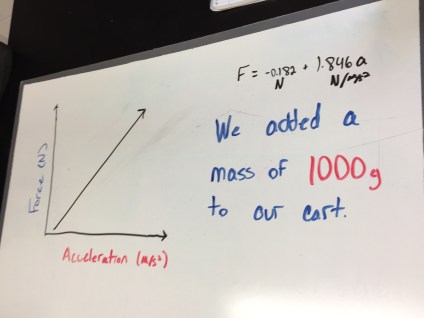
Students used a modified Atwood’s machine to collect data for a relationship between force and acceleration. We spent some time unpacking that statement since I’ve found it really isn’t obvious to students what that means; last year, a lot of students really struggled to go from that statement to recognizing they needed to change the force and measure acceleration,

img_2383

Earth Science: Wind Turbine Wrap-Up

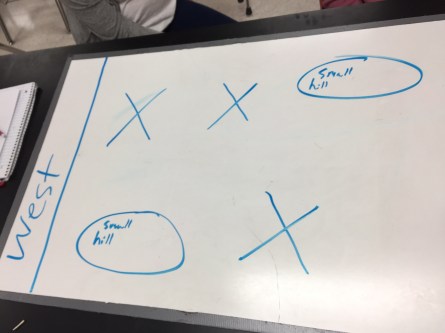
To conclude the wind turbine project, I gave students some information about an imaginary small farm and tasked them with selecting locations for three wind turbines and preparing a report for our “client” to justify their choice. Unfortunately, with the wind turbines and fans we have, it isn’t practical to set up both the topography and a trio of wind turbines for students to test their plans. Next year, I might try setting up a single, larger test area using a couple of our box fans so that we can have a big enough model for students to actually test their plan.

img_2358


Day 27: Elevators & Turbine Interference

AP Physics: Elevators

I showed students a video I made riding the elevator with a balance and asked them to determine whether the elevator was going up or going down and support their answer with free-body diagrams. I was pleased with how many groups started their conversation with “What’s our system?” I could tell from the conversations that a lot of students are still not entirely solid on the idea that an acceleration can be in the opposite direction of the motion, but thinking about the bowling ball lab from a few days ago seems to be helping. Next year, I want to do a better job of using the change in velocity arrows that show up in Etkina to help solidify the direction of acceleration.


Earth Science: Turbine Interference

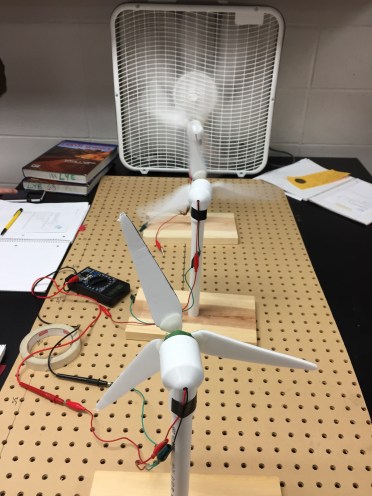
In the next step towards designing a wind farm, students experimented with several turbines, comparing the amperage produced with different arrangements. This lab got my students asking some great questions that had me wishing that the trimester on physics came first rather than second this year. A lot wanted to know why the last turbine in a line wasn’t spinning, which is easy to explain with conservation of energy. A few others wanted to know what’s inside the turbine, which fits great with the build-a-motor lab we do in 9th grade physics. When we work on next year’s schedule, I’ll make sure to advocate for physics-earth-earth rather than this year’s earth-physics-earth sequence.

img_2336

Day 26: Defining Systems & Topography

AP Physics: Defining Systems

We played the mistakes game with yesterday’s free-body diagrams. In both my hours, there was some great discussion about a problem with a skydiver attached to a parachute and whether the upward force should be a tension force from the straps of the parachute or a normal force from the air on the parachute, which lead beautifully into the importance of defining your system.

IMG_2328.JPG

Earth Science: Topography & Wind

As the next stage of their project to plan a wind farm, students built a simple “topography” using textbooks and used simple flags to make observations about how that impacted wind speeds. Afterwards, students tried placing a turbine at some of the locations where they’d left flags and measuring the current produced.

img_2324

Day 24: Bowling Balls & Problem Scoping

AP Physics: Bowling Balls

Students did a lab I borrowed from Frank Noschese hitting bowling balls with rubber mallets to look for a relationship between force and acceleration. I really like the conversations that happen when students are working out how to get a bowling ball to move at a constant velocity. When one group was wondering how to check, we ended up pulling out the Motion Shot app to make a motion map. Another group decided they needed to use gentle forward taps to maintain the constant velocity combined with even gentler backwards taps to counteract the forward ones; as they made their taps gentler and gentler, they eventually realized they could do away with them entirely. My 4th hour also got very excited about balancing things on their bowling balls.


Earth Science: Problem Scoping

On Thursday, students only had time to answer the problem scoping questions individually. Today, I had them answer the questions with their lab groups using a different colored pencil to differentiate individual ideas from group ideas. After that, we discussed as a class what kinds of things students will need to know for the engineering design challenge, which lead nicely into introducing and previewing the learning targets for the unit.