Day 21: Lab Practical, More Problems, & States of Matter

AP Physics: Lab Practical

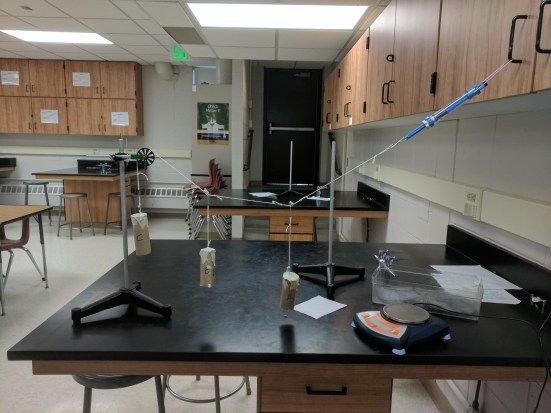
Students worked on a balanced forces lab practical to determine an unknown mass given the tensions supporting it. I just made one set-up, and it was interesting to see that in one class, each group wanted to take their own measurements, while the other class wanted to just have one person take the measurements and record them on the whiteboard. The hour that took measurements as a whole class actually took longer to get everyone the data, but had a lot more conversation about what they needed.

static prac

Physics: More Problems

I’ve got enough students struggling with constant velocity that we took a day to do a Modeling worksheet that I usually skip. Talking to students, there were several groups who thought the area of the velocity vs. time graph only gave displacement in special cases. I’m also seeing a lot of evidence that students are losing track of the physical meaning of the graphs and their connections with the math. For example, when writing an expression based on a graph, a lot of students are using units and variables from the dowel lab, which tells me they know a procedure to turn y=mx+b into “physics”, but don’t have a conceptual understanding of what they are doing. These challenges have been a recurring theme in physics this year; we’re starting constant acceleration tomorrow, and I think I want to revamp the lab a bit to try and prevent some of these issues.

Chemistry Essentials: States of Matter

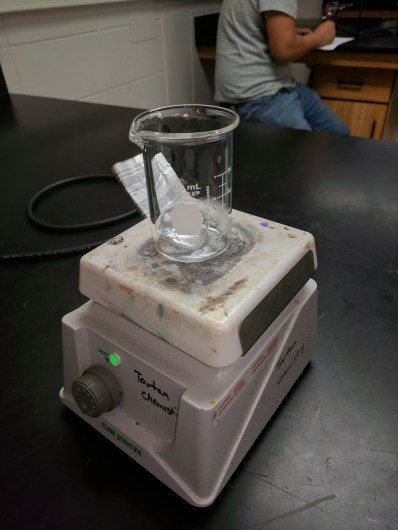
Students melted ice into steam and made observations and drew particle diagrams along the way. This led nicely into the idea that as the temperature increases, the particles are moving more. Students also made some nice connections to yesterdays’ demo with food coloring in water.
boil ice

Day 19: Plickers, Dueling Buggies, & Quiz

AP Physics: Plickers

After a quiz, I introduced students to Plickers. One piece of feedback I got from students last year was that they would have liked to practice multiple choice earlier in the year so, this year, I’m planning to spend part of each Friday on that. I have students read the question silently and vote on an answer, then vote again after talking to their peers. My 4th hour had some great, spirited discussion and was actually disappointed when I told them it was time to put the cards away and head to lunch.

plicker

Physics: Dueling Buggies

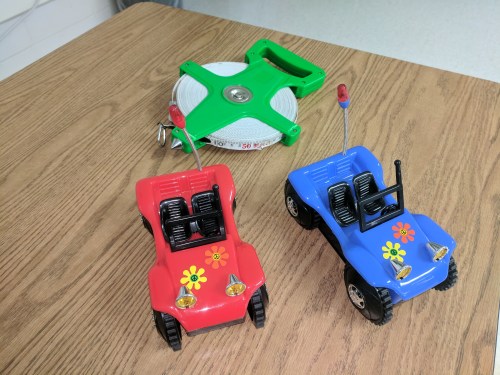
We wrapped up the dueling buggies lab practical. For the rear end collision, most of my groups got a crash position behind where both of the buggies started, so I paused the class to look at what results would make sense. I’m debating whether its worth having that conversation sooner next year, or if it is better to wait until there is a need. This fits with a pattern I’ve noticed this year where more students than usual are struggling to connect their graphs and math to what is physically happening.

I couldn’t get a volunteer to release the second buggy or to film the collisions for me, so here’s a video from a couple years ago.


Chemistry Essentials: Quiz

Students spent most of the hour on their density quiz. While I haven’t graded them yet, there were some stark differences in how students did on the quiz. Several students immediately made a connection to some of the worksheets and labs we’d done and found the quiz extremely easy. Others thought the quiz was completely unfamiliar and really struggled. I need to keep working on helping students to make connections across different days, as well as supporting my students in developing as independent thinkers.


Day 18: Trig It Out, Dueling Buggies, & Density Problems

AP Physics: Force Problems

Students worked on using vector addition diagrams to solve balanced force problems (one of many things I learned from Kelly O’Shea). I really like that while many of my students still ended up using a version of components, they see where the components come from. Once students set up their vector addition diagrams, the slogan for the day was “Trig it out!”, a line from last year’s students.

Physics: Dueling Buggies

Students worked on the Modeling Instruction lab practical to predict where two buggies will collide. I didn’t give quite enough instruction to my 1st hour, but once I suggested they try drawing some representations and play with them, they started making some progress.

One of my goals this year is to help students value ways of being successful in class besides knowing the answer quickly, so as part of the lab practical I gave them a list of skills based on similar lists from Kelly O’Shea and Ilana Horn, then asked them to identify at least one example for each group member where they demonstrated one of those skills. I’m looking forward to reading their responses.

dueling buggy.jpg

Chemistry Essentials: Density Problems

Students worked on some density calculations. Some students really struggled with the algebra, so I’m trying to decide whether that really needs to be in the course. Most are getting to a point where they are successful with the graph, and I think that is more valuable in the long term than using the equation.

I also handed back the first quiz; most students performed about how I expected, but I was surprised at how many students had underestimated how they did and were genuinely excited about their score. Several confirmed with me (multiple times, in one case) that they got to keep their quiz so they could show their parents. I need to work on reinforcing the connections between our day-to-day work and the assessments so that more students will see that kind of success.

Day 10: Force of Gravity, Lab Practical, & Volume

AP Physics: Force of Gravity

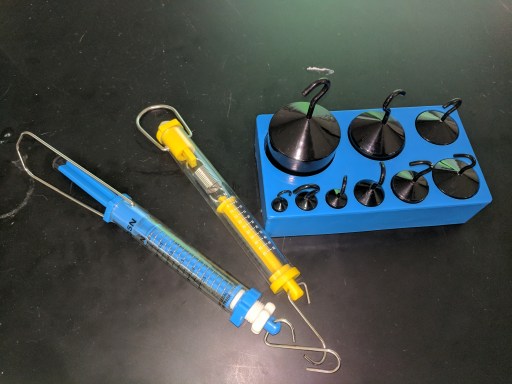
Students collected data to plot the force of gravity on an object vs. its mass. I had different groups use spring scales with two different ranges. Tomorrow, I’ll use the different levels of precision to motivate a discussion of uncertainty. Groups with the 50 N spring scale have already noticed that the smallest hanging masses don’t noticeably change the scale’s reading, which is exactly the kind of observation I was hoping for.

mass.jpg

Physics: Lab Practical

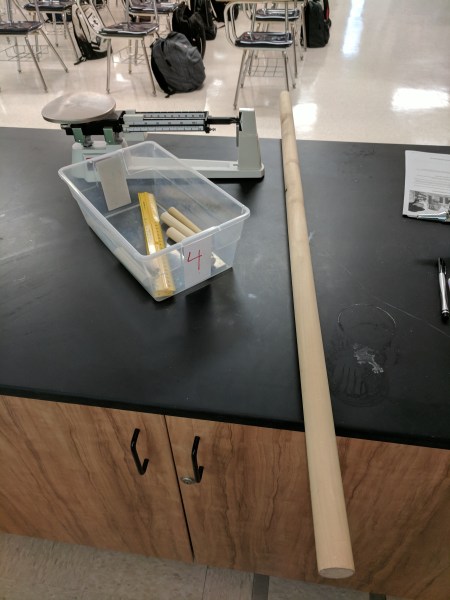
Students revisited the dowel lab, this time as a group assessment. Their results on the original lab weren’t as good as I was hoping, but they are looking much better now that students have had an opportunity to discuss the flaws in their original approach.

dowela.jpg

Chemistry Essentials: Volume

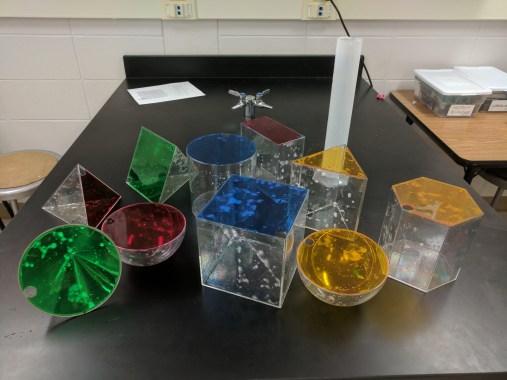
Students found the volume of several different shapes, then measured how much water was needed to fill each one. Some groups got beautiful results, but other groups struggled. I think the groups that struggled had trouble matching up their measurements to the formulas on the cheat sheet I gave them or the Google calculators I showed them. A lot of students also also had trouble measuring the amount of water they put into the shape. The groups that struggled with these measurements were also the groups that were the least focused, but I’m not quite sure which issue is the chicken and which is the egg.

shapes.jpg

Day 124: Mystery Boxes & Metamorphic Rocks

AP Physics: Mystery Boxes

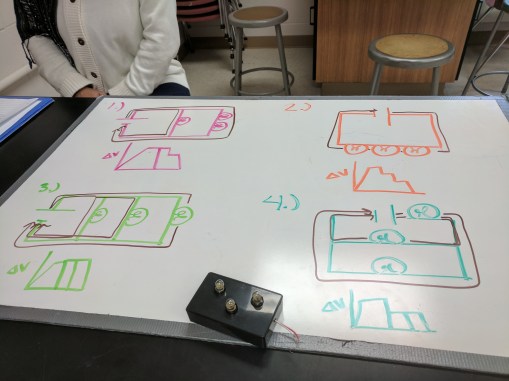
Today, students worked through an activity I got from The Physics Teacher. Groups were given a black box with three light bulbs and had to figure out how the bulbs were wired without opening the boxes. I front-loaded some thinking by having students sketch the four possible circuits and do some KVL diagrams and arrows to show currents, which students were then very successful at applying to interpret the behavior of their boxes. The main issue I ran into is many students students initially wanted to treat equivalent circuits with slightly different arrangements as different circuits. For example, groups often drew one parallel circuit with one bulb on the first branch and two on the second, then a second parallel circuit with two bulbs on the first branch and one on the second. The KVL diagrams provided a nice tool for showing why those circuits are equivalent.

mystery

Thanks, Lotze, for drilling holes in all the boxes!

Earth Science: Metamorphic Rocks

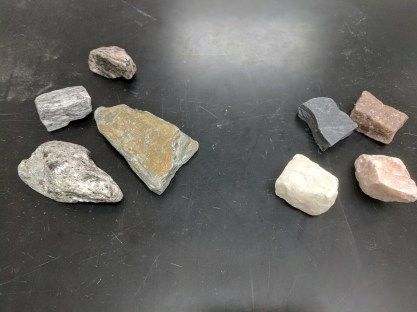
Students identified metamorphic rocks today. Similar to the igneous rock lab earlier this week, I started by having students sort the rocks based on visible properties. Most groups went with whether the rocks were layered, which lead nicely into foliation. A few groups when with sheen, which is the other major property used to identify rocks on this key. Students struggled to tell the difference between marble and quartzite using the key. After the lab, I talked a little about hardness and the acid test, but it would be nice to give students some tools they can use during the lab to differentiate those two.

met rocks

Day 103: Energy Practical & Explanations

AP Physics: Energy Practical

I tried a new lab practical for energy in an effort to integrate rotation and spiral back to some old ideas. Back in December, students measured the launch velocity of a marble, then predicted where it would hit the floor. Today, I had them use conservation of energy, including rotational kinetic energy, to find the launch velocity of their marble, then predict where it would hit the floor. I saw a lot of students pull out their old work, including their lab from December, to help remind themselves how to do the projectile portion of the problem, which is exactly what I hoped they would do. I overheard several students talking about how much they liked looking at an old problem through a new lens, as well as seeing how old ideas fit with the new ones.

practical.jpg

Physical Science: Explanations

Students practiced making predictions and writing explanations using Newton’s Laws. I showed students some videos and clips, including one from Smarter Every Day and an animation of the Mars Pathfinder landing, then had them write an explanation individually, followed by a revised explanation with their whole group. I was struggling more than usual to keep my students focused, but part of the problem might have been the English test next hour and the pep fest this afternoon. I’ve got some demos I’m planning to have students write explanations of as warm-ups, and I probably would have been better off using the demos today, then using the videos as warm-ups.

newton

Day 78: Flying Pig & Quiz

AP Physics: Flying Pig

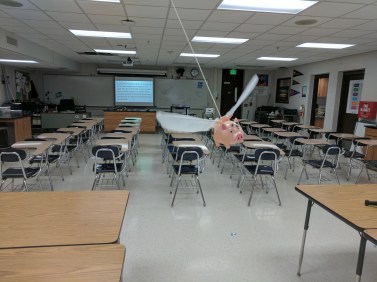
Today, I got out the flying pig for a lab practical. I had students measure the length of the string and the height of the cone, then use what they know about forces and circular motion to predict the time for the pig to make 10 revolutions.

pig

Physical Science: Quiz

Students took a quiz on magnetism. Afterward, we took a few minutes to review vocabulary for talking about waves that students learned during first trimester. It was pretty teacher directed, but I didn’t want to spend much time on terms students should have mastered earlier this year.

Day 74: Balanced Force Practical & Field Lines

AP Physics: Balanced Forces Practical

I tasked students with figuring out the unknown masses in a set up with several strings at different angles. Groups found they had to be very clear about what they defined at their system, which as a nice element of the task. Different groups defined their systems differently and took different approaches to solving their vector addition diagrams, which lead to some fantastic conversations when groups who finished early compared results. I got really happy when I overhead a student slowing down his group down by telling them the process is more important than the answer, and even used the fact that I couldn’t remember the masses I used as evidence.

During prep today, I got a kick out of grading quizzes. I’ve been asking students this year to self-assess and do a short reflection on each quiz, and several students took that into specific problems on this quiz. These students wrote down some really interesting, specific metacognition right alongside their solutions without any extra prompting. It was really interesting to read. I might start having students do some journaling later this tri to explicitly encourage that kind of thinking.

practical-1

Physical Science: Field Lines

To help make sense of magnetic field lines, I had students connect gravitational energy to a topographic map of a hill, then went back to the magnetic field lines we saw yesterday to talk about magnetic energy. I haven’t done any forces with this class yet, but they are fairly solid on energy, so magnetic energy seemed to help ground the material in a way I don’t think forces would have. I also like that the topographic map helped link back to some of the map interpretation students did first tri in Earth Science.

field-lines

Day 70: Hoop Practical & Circuits

AP Physics: Hoop Practical

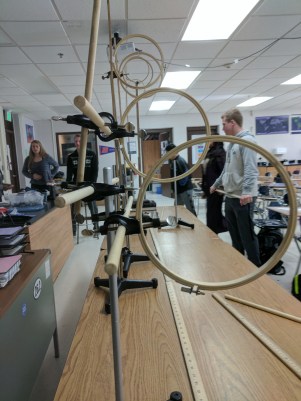
We finished up a lab practical on angled projectiles. Each group had a different distance from the launcher and figured out how high above the ground to place a hoop. In both classes, some groups had to shift their hoop to one side or the other, but eventually managed to get the projectile though all the hoops. I also had some goal-less problems to try and shift students away from needing to be able to picture the full solution to be able to progress. The problems mostly got ignored, because it was more exciting to watch the parabola of hoops come together and it took most of the hour to get all the hoops in place.practical

Physical Science: Series vs. Parallel Circuits

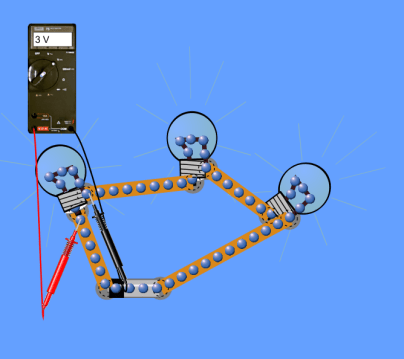
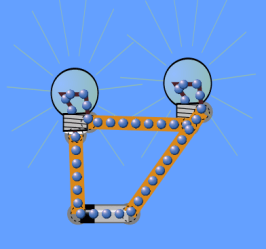
Students used the PhET circuit construction kit again, this time using a lab on series and parallel I modified from Eugenia Etkina’s PUM curriculum. I think students  were getting the big ideas, but its very tough to circulate with a full class in the computer lab, so I feel a little blind. Last year, I was able to do the PhET sims on netbooks in the classroom, so it was easy for me to listen i on student conversations and pull them together at the end of the hour to discuss some big ideas. Next year, I might re-work my calendar to make time for a day in the classroom so my students and I have a chance to make sure they are on track.

circuit

Day 69: Angled Projectile Practical & Ohm’s Law

AP Physics: Angled Projectile Practical

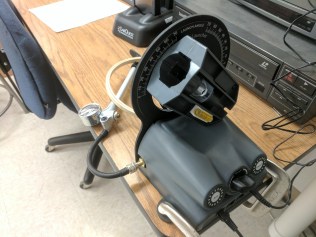
We wrapped up yesterday’s mistakes game, then started a lab practical. Each group got a different distance from the launcher, and needs to determine how high off the ground to place a hoop so that the projectile will travel through it. Tomorrow, we’ll setup the hoops so students can see the results. In both this practical and the problems we’ve been doing, I’ve found some of my strongest students get stuck. They usually know what they’re doing, but don’t see their way to the answer yet. I need to keep reminding my students that they can play with the pieces, even if they don’t know what the full picture will look like yet. I might look for a good goal-less problem to combine with the practical tomorrow to help push them towards thinking about what else they can do, rather than what the answer must be.

launcher

Physical Science: Ohm’s Law

I’ve found I really like having students use PhET’s circuit construction kit before we get out the batteries and bulbs, so today we went to the computer lab to find a relationship between current, voltage, and resistance. I left the directions fairly open so that students would be designing their own experiments. Since I don’t talk much about units in this course, the simulations ammeter felt like a black box to a lot of the students. I was really intrigued by one student who measured current by counting how many blue dots passed a selected point in one minute, which connects really nicely to the definition of current as the flow of electric charge.ohms-law