Day 66: Board Meeting, Momentum Representations, & Density

AP Physics 1: Kinetic Energy Board Meeting

I am being compensated by Pivot Interactives as part of their Chemistry Fellows program.

Students whiteboarded their results from this week’s Pivot Interactives activity with a puck on a ramp to get to a definition for kinetic energy. I definitely wish I’d done energy bar charts prior to this lab, but conservation of energy is emphasized enough across our science curriculum that it wasn’t too big of a leap for students to recognize the energy transformation happening. Students were really pleased when they realized their slope worked out to equal 1/(2g), which is exactly what the formulas predict.

ke lab.jpg

Physics: Momentum Representations

Students worked on representing momentum transfer using sketches, bar charts, and velocity vs. time graphs. The use of velocity vs. time graphs was influenced by Brian Frank’s work on momentum representations, and I really like the way it connects momentum to tools we’ve used earlier in the year. I’ve got one section with 30 students and one section with 8, and I’m quickly figuring out I need to be conscious about hanging back in my small class to encourage them to talk to each other about the problems before they talk to me.

Chemistry Essentials: Density

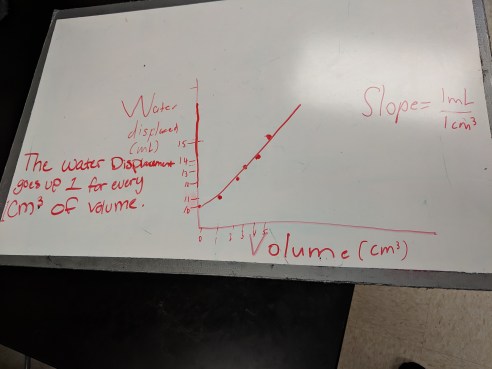
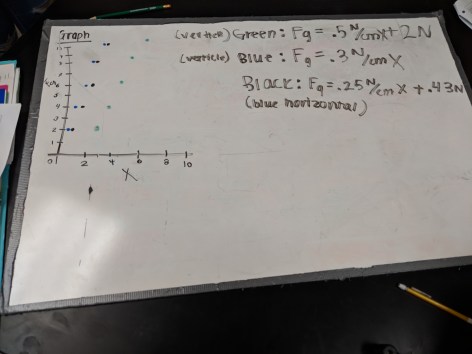
Students worked on finding a relationship between the mass and volume of water. Today really stretched my students since I had them design their own experiment and we started a board meeting on the lab, but students rose to the challenge. I’ve been having them use fill int he blank “for every” statements to talk about their slope, and that has been a big help for students to get a conceptual understanding of what their slope means. Yesterday, we had to pause the board meeting to define what the intercept of a graph is, so I got really excited when students not only brought up that groups had intercepts of either 0 g or 10 g, but came up with the idea that the intercept came down to whether groups hit tare after putting their graduated cylinder on the balance.

Day 65: Spring Energy & Board Meetings

AP Physics 1: Spring Energy

I am being compensated by Pivot Interactives as part of their Chemistry Fellows program.

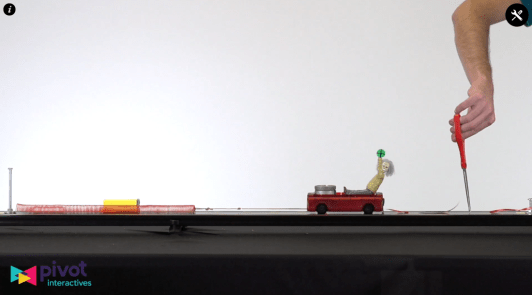
Students collected data for a relationship between a spring’s stretch and the final velocity of an attached cart using a lab in Pivot Interactives. While I took more time than yesterday on a pre-lab discussion, I think students were still a little confused since we haven’t talked much about energy types yet. I think it would have helped if we’d done the board meeting for yesterday’s lab prior to this activity. I’m also thinking about doing bar charts before these equations next time around.

pivot epe.PNG

Physics: Explosions Board Meeting

Students whiteboarded their results from yesterday’s lab to introduce conservation of momentum. This was a tricky discussion for a lot of my students since we were dealing with four variables simultaneously, but students did well with it. It was a nice reminder of the progress my students have made so far this year.

explosion board.jpg

Chemistry Essentials: Volume Board Meeting

Students whiteboarded their results from yesterday’s lab. I really hit “for every” statements about the slope hard, and that seemed to help students attach some conceptual meaning to the slope. There were a few groups who graphed the actual water level, rather than the water displaced, which gave a great opportunity to talk about what the intercept tells us in this lab. I think next time, I’ll make sure a couple of groups do that.

group 3.jpg

Day 60: Problems, Board Meeting, & Conservation of Mass

AP Physics 1: Problems

Students worked some unbalanced force problems. The set I gave them is mostly what I call “alphabet soup problems”, were there are only variables, no numbers. My students still get nervous about those problems, but they did very well with them, nonetheless. They are also starting to feel more comfortable relying on diagrams to set up their math, which is fantastic and lead to some great conversations during the problems today.

Physics: Board Meeting

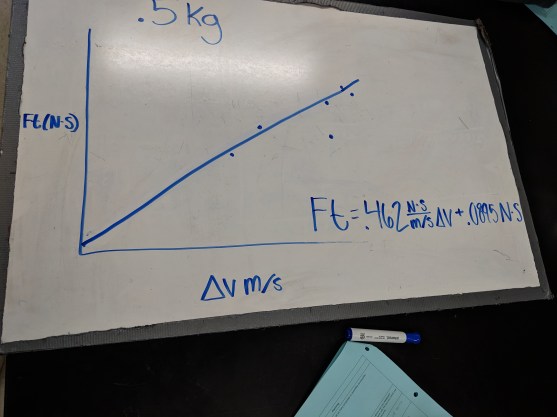
We had our board meeting for yesterday’s impulse lab. The results were the best I’ve seen with this lab to-date, which was great to see. My students this year are more comfortable with the LabQuests than the students I had last year and I spent significantly more time on the pre-lab discussion than I had in the past, and the result was a lot more groups than usual where their slope came convincingly close to the mass of their cart.

impulse board.jpg

Chemistry Essentials: Conservation of Mass

Today students looked at the change in mass in two scenarios, ice melting into water and two liquid solutions getting mixed together. As soon as I started to preview the lab, students started sharing their predictions for what would happen to the mass completely unprompted, so I decided to take a few minutes to let them discuss their predictions. I planned to have students get the initial mass of the ice, then work on mixing solutions together while the ice melted, but it turned out to be challenging for a lot of students to shift between two different experiments. I think it may be better to just use hot plates to help the ice melt so students can do one scenario completely before shifting to the other.

chem lab.jpg

Day 59: Board Meeting, Impulse, & Particle Diagrams

AP Physics 1: Board Meeting

We had a board meeting for yesterday’s lab on Newton’s 2nd Law. Overall, students got very nice results and were very successful at making sense of what they saw.

Physics

n2l board.jpg

This group added some notation to their graph to find the units on their slope

Physics: Impulse

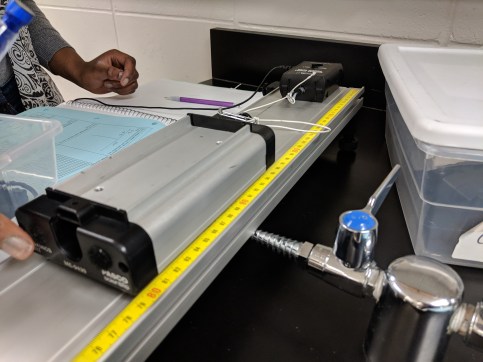
Students used an elastic string to tie a cart to a force sensor in order to find a relationship between the cart’s change in velocity and the area of the force vs. time graph. I’ve tried this lab a few times without great results, so spent a lot more time on the pre-lab than I had in the past and its looking like results will come out fairly nice.

impulse.jpg

Chemistry Essentials: Particle Diagrams

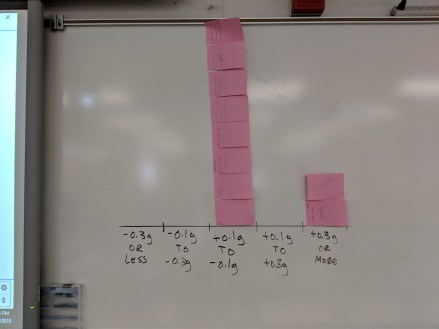
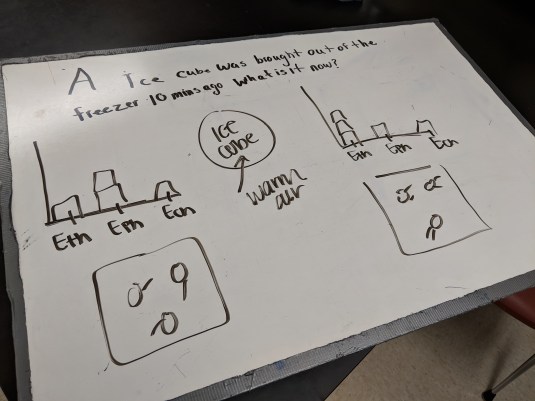
Students looked at the change in mass as they spread out a piece of steel wool and started drawing particle diagrams. My co-teacher and I agreed we want to ramp up the graph interpretation in the course, so we made a histogram of the class results and spent a fair amount of time discussing them. Students had some great observations about the graph.

histo.jpg

Day 46: Card Sort, Board Meeting & Formula Writing

AP Physics 1: Card Sort

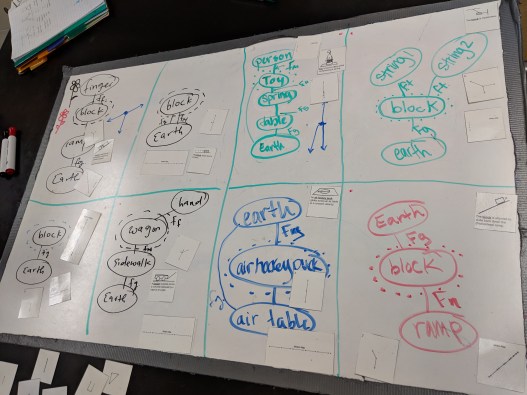
Students worked on Kelly O’Shea’s balanced forces card sort. Since they haven’t seen vector addition diagrams yet, I tried holding those back until they’d sorted everything else, which worked really nicely. I was also much stricter than I was in my regular physics that students needed to sketch the interaction diagrams, and that seemed to really help students think through each scenario.

card sort.jpg

Physics: Board Meeting

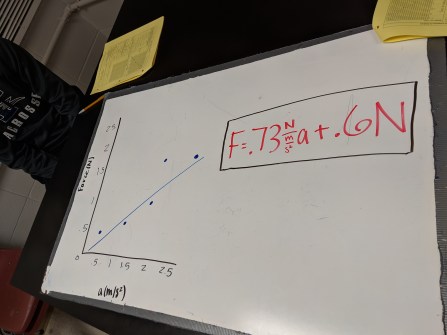
Students whiteboarded their results from Thursday’s lab on Newton’s 2nd Law. My 1st hour got pretty nice results, including slopes that came out very close to the masses of their carts, but my 6th hour had much messier data. I ended up telling students to focus on a few specific whiteboards when we were talking about some key points, which seemed to work out fine.

n2l wb.jpg

Chemistry Essentials: Formula Writing

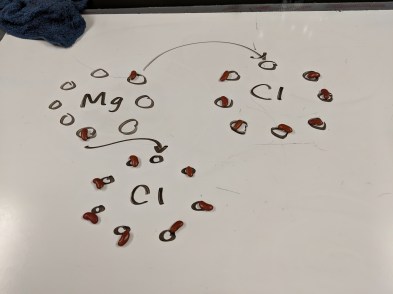
We started working on writing chemical formulas. I had students sketch simplified Lewis dot structures on whiteboards, then use beans as manipulatives to figure out the correct chemical formula. The students who took the time to sketch and use the diagrams were very successful at thinking through the formulas I threw their way.

bonding beans.jpg

Day 35: Assessment, Board Meeting, & Two Truths and a Lie

AP Physics 1: Assessment

After wrapping up yesterday’s whiteboards, students took their quiz on impulse and momentum conservation in collisions. One of the things I love about giving this assessment is a lot of students felt much more confident than on the assessment on impulse of a single object, in spite of it being the same material in a more complex situation. Its a great opportunity for students to see their growth so far.

Physics: Board Meeting

We had the board meeting for the spring force lab. I’ve been hitting “for every” statements about the slope much harder and more consistently this year than in the past, and I’m seeing students with a much stronger conceptual understanding of what their slopes represent, which is fantastic.

spring wb

Chemistry Essentials: Two Truths & a Lie

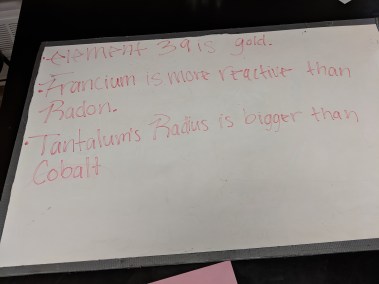
After going over some key periodic trends and how to read a periodic table, I used a variation on a community-building activity that we frequently use in homeroom called “Two Truths and a Lie”. Each group came up with two accurate statements, and one wrong statement. Groups then traded whiteboards and had to correct the wrong statement. A lot of groups had some good discussion and seemed to get more comfortable reading their periodic table, which was the goal.

w truths

Day 33: Problems, Board Meeting, & Assessment

AP Physics 1: Problems

Students worked on some conservation of momentum problems, including Michael Lerner‘s watermelon on wheels, that require them to be flexible about the system they are using. A lot of groups went straight for a whiteboard once the work time started, which lead to some great discussion and collaboration on the problems.

Physics: Board Meeting

We had a board meeting for yesterday’s force of gravity lab. This was actually the first traditional formula students got from a lab this year. During the discussion, I could tell my students are getting much better at making “for every” statements about the slope and describing the meaning of the intercept.

force of gravity wb.jpg

Chemistry Essentials: Assessment

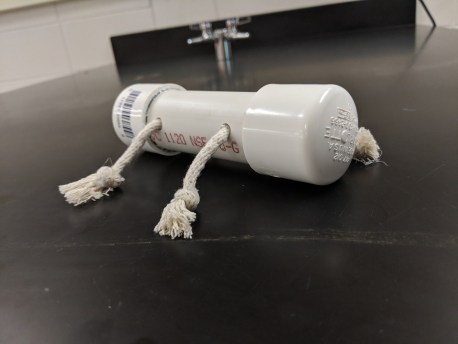
Students took their quiz on phase changes. One problem talked about a generic chemical, rather than something specific, which threw several students off. It was a good reminder to keep problems firmly rooted in real situations. Afterward, we revisited the mystery tubes from the first day of class as preparation to start talking about the periodic table and atomic models.

mystery tube

Day 32: Board Meetings, Gravity, Invented Problems

AP Physics: Board Meetings

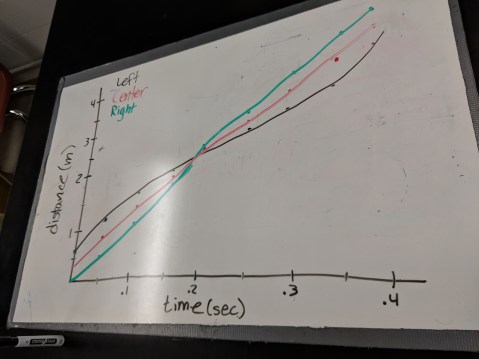
Students whiteboarded their results for the collisions lab and the center of mass video analysis from last week. Between the two labs, I think students started to see why it might be useful to switch between systems when thinking about momentum.

com wb.jpg

Physics: Force of Gravity

Students worked on a lab finding the relationship between mass and the force of gravity. Whiteboards are ready and looking good for a board meeting tomorrow!

gravity lab

Chemistry Essentials: Invented Problems

To review phase changes, I had students write their own problems and exchange whiteboards with another group. There were a few groups that had some good conversation as they were writing their problems and there was some good cross-group conversation when comparing answers after working another group’s problem.

chem wb.jpg

Day 29: Collisions, Card Sort Part 2, & Board Meeting

AP Physics 1: Collisions

Students started working on a lab to compare the momentum before and after a collision between two carts. This was their first time using photogates, so the first data point took some time, but then students were able to get data pretty quickly. One student pointed out I’d posted “spoiler alert” instead of a learning target, so we took a few minutes to talk about why I don’t always want to post a learning target at the beginning of a new lab.

spoilet

Physics: Cart Sort Part 2

We did some whiteboarding Kelly O’Shea’s balanced forces card sort. Students seem to be doing well with what each representation shows. Students are having some trouble with the direction of the normal force, so I took some inspiration from Joe Cossette and did a quick demo where I put a balance on a board, then slowly lifted one end.

Chemistry Essentials: Board Meeting

We whiteboarded the results of last week’s lauric acid phase change lab. Students pretty readily recognized the flat sections of their graphs that occurred during a phase change. I haven’t spent a lot of time setting up the concept of energy in this class, so I think they had some trouble with the idea that the water baths were still changing the energy of the lauric acid when the temperature wasn’t changing, but I think we’ll get there.

lauric

Day 25: Friction, Groupwork Reflection, & Pressure

AP Physics 1: Friction

Students whiteboarded the friction lab from yesterday.  There was some good discussion and I can tell students are getting more comfortable talking about graphs. Its been a couple of years since I last did this lab, and the results are as messy as I remember, but students already seem to have a clearer idea of what the coefficient of friction is telling them, so I think it was worth the time.

friction lab.jpg

Physics: Groupwork Reflection

Today was a quiz day and the routine has become to spend the first part of the hour on an assessment doing some groupwork reflection. I spent some time on discussions about what skills students had used working on certain tasks to reinforce the value of multiple abilities. I have one class that seems to be buying in to valuing multiple abilities more than the other, but I think progress is happening on that front.

Chemistry Essentials: Pressure

To wrap up gas laws, I did a few demos. Before each one, I had students whiteboard a CER with their prediction. My favorite is a demo where I put a pipe between a large and a small balloon with each balloon clamped shut. Students have to predict what will happen when I remove the clamps. The version I first saw calls for putting a very small amount of air in the little balloon, so it isn’t stretching much, which forces air into the big balloon when you remove the clamps. I prefer inflating the small one enough that the rubber has stretched and, when the clamps are removed, the air just stays put in both.

pressure demo