Day 75: Whiteboarding & Electromagnets

AP Physics: Whiteboarding

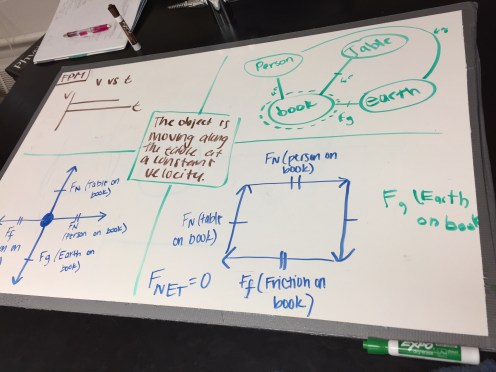
Most of my students were on a field trip today, so classes were pretty small. We whiteboarded some problems from earlier in the week on balanced forces in 2D. While the problems had a lot of calculations, I just had students whiteboard their diagrams and set-up, including some intentional mistakes. Later, I’ll post correct answers to the class website so students can check their calculations.


Physical Science: Electromagnets

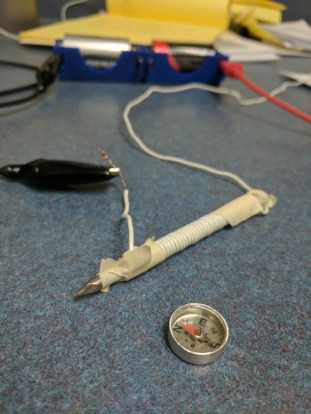
Students built electromagnets, then made some observations about the magnetic field and strength of the magnet.To visualize the field, most groups opted for the compass over the filings, which reinforces my thinking earlier this week that I should start students with the compasses to see the bar magnet’s field.

This week, I’ve been thinking a lot about the fact that I’m really struggling to engage students the way I’d like, especially in post-lab discussions. The last couple of years, I’ve been able to get almost immediate buy-in from my 9th graders, but I think that’s because I only taught them during 1st trimester, when I got to set their expectations for high school science. Most of my students right now had a different teacher 1st tri, so I’m upending their expectations just when they were starting to get comfortable with high school and need to be much more intentional about helping students adjust. On Monday, I want to start with some conversation with the class about my observations and why I do things differently than their other science teachers. I’m also going to start thinking about how I can smooth the transition 3rd trimester, when about 2/3 of the class will be new to me again.
electromagnet

Day 74: Balanced Force Practical & Field Lines

AP Physics: Balanced Forces Practical

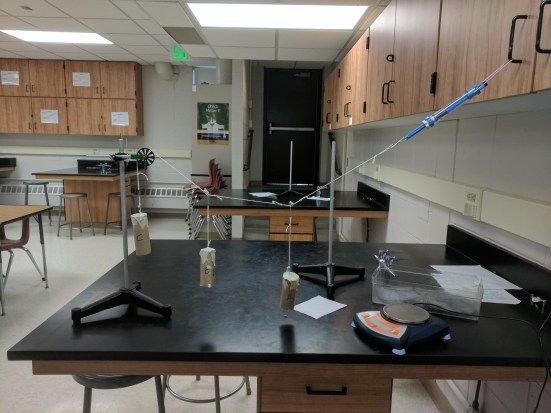
I tasked students with figuring out the unknown masses in a set up with several strings at different angles. Groups found they had to be very clear about what they defined at their system, which as a nice element of the task. Different groups defined their systems differently and took different approaches to solving their vector addition diagrams, which lead to some fantastic conversations when groups who finished early compared results. I got really happy when I overhead a student slowing down his group down by telling them the process is more important than the answer, and even used the fact that I couldn’t remember the masses I used as evidence.

During prep today, I got a kick out of grading quizzes. I’ve been asking students this year to self-assess and do a short reflection on each quiz, and several students took that into specific problems on this quiz. These students wrote down some really interesting, specific metacognition right alongside their solutions without any extra prompting. It was really interesting to read. I might start having students do some journaling later this tri to explicitly encourage that kind of thinking.

practical-1

Physical Science: Field Lines

To help make sense of magnetic field lines, I had students connect gravitational energy to a topographic map of a hill, then went back to the magnetic field lines we saw yesterday to talk about magnetic energy. I haven’t done any forces with this class yet, but they are fairly solid on energy, so magnetic energy seemed to help ground the material in a way I don’t think forces would have. I also like that the topographic map helped link back to some of the map interpretation students did first tri in Earth Science.

field-lines

Day 73: Force Vector Addition & Magnets

AP Physics: Force Vector Addition

Students worked some problems with balanced forces in two dimensions. We also had some discussion about whether you could have a mass hanging from a perfectly horizontal rope and used some hanging masses and string to experiment with some of the ideas. Not surprisingly, they really wanted it to work with a small enough mass in the center and a large enough force on either side, but once they started drawing free-body diagrams, it became very clear that the rope has to flex.

tension.jpg

Physical Science: Magnets

Students played with some bar magnets and steel filings to start building some ideas about magnetic fields. Every year, my 9th graders struggle to see patterns in the filings, even when they are very clear to me. I usually have them start with the filings, then get out a compass to compare the patterns. Next year, I might have them plot the orientations of a compass arrow first, giving them some specific positions around the magnet to check, then get out the filings. That should give them an idea of what to look for in the filings.

magnet

Day 72: Vector Addition & Electric Power

AP Physics: Vector Addition

I shamelessly stole an activity that Casey Rutherford shared on Twitter. I gave students some free-body diagrams drawn to scale, and had them use pipe cleaners to rearrange the vectors and do some graphical vector addition. The activity not only reinforced graphical vector addition, but I was pleased with how it drove home the difference between forces that are balanced and forces that are equal.

vectors

Physical Science: Electric Power

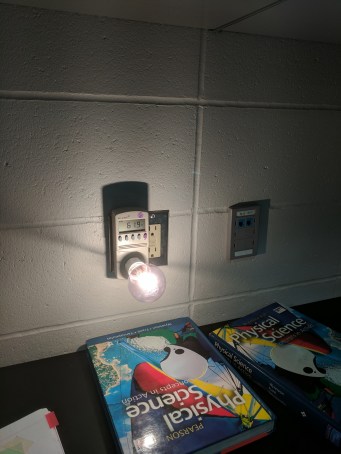
Students plugged different light bulbs into Kill-A-Watt monitors to find the power each one used. To emphasize the connection to energy, I also had students sketch energy bar charts for each light bulb, using light and thermal energy as their energy types. This lead very nicely into a comparison of the efficiency of different light bulb types.

killawatt

Day 46: Mistakes Game & Reflecting Telescopes

AP Physics: Mistakes Game

We played Kelly O’Shea’s Mistakes Game using some problems with a central net force. Its great to see my students getting more skilled at discussing physics, which means I’m doing very little to keep the conversation moving. We had some particularly good discussions about a problem about the forces on a roller coaster car as it goes over a hill and about the forces on a yo-yo as it swings in a vertical circle.

img_2482

A whiteboard for the roller coaster problem

Earth Science: Reflecting Telescopes

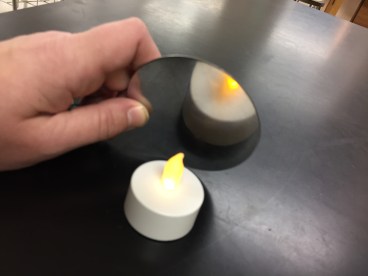
Students played with curved mirrors to get some ideas about how mirrors are used in telescopes. I also got out some electric candles and tasked students with projecting the candle on a sheet of paper. They struggled with that step, but it was great to see their reactions when they got a nice, sharp image of the candle “flame”.

img_2484

Day 45: Central Force Problems & Historical Astronomy

AP Physics: Central Force Problems

Students worked on a few problems related to central net force causing circular motion. I also introduced Newton’s Law of Universal Gravitation as we discussed a problem about orbits. A couple students got really excited when they realized the connection between Universal Gravitation and F= mg; one student decided that called for a dab.

Earth Science: Historical Astronomy

After the quiz on the Moon and planets, I did some short notes on historical astronomy. As part of the effort to incorporate engineering into 9th grade science, the curriculum calls for focusing on the tools astronomers use, but this seems like a great opportunity to incorporate the contributions of diverse groups. Next year, I want to do a better job of balancing the tools with the range of cultures we could talk about. I also want to find ways to make this lesson more active, but need to figure out what I can have students do without making the lesson significantly longer.

Day 42: Mass & Comet Orbits

AP Physics: Mass

Students finished the lab practical we started on Thursday where they used a modified Atwood’s machine to find an unknown mass. Today, once they had an answer, we checked their result using a spring scale. One of my goals this year is to work on hearing from every student, so I tried posting three questions about the lab (one for each group member). Then, before groups could check their result, I would roll dice to decide which group member had to answer each question. Since there are three students in each group, I was able to hear from every student. Groups did a really nice job of making sure all three group members could answer all three questions, which is exactly what I hoped would happen.

img_2469

Earth Science: Comet Orbits

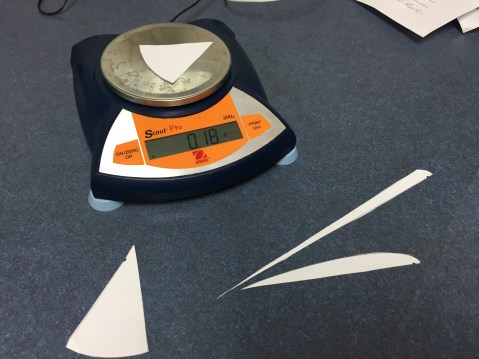
Students finished up yesterday’s lab contrasting Mars’ orbit with Halley’s Comet’s orbit. A lot of groups were surprised when they realized that the patterns from Kepler’s Laws worked equally well for both orbits, especially when they used mass as a proxy to compare the areas of two sections that represent equal times. Next time, I might see if I can get my hands on some card stock or other heavier paper to make it a little more convincing that the small differences are negligible. I also will probably re-work my Kepler’s Law introduction to include Halley’s Comet right off the bat, rather than waiting until we introduce comets.

img_2468

Day 41: Central Force & Comet Orbits

AP Physics: Central Force

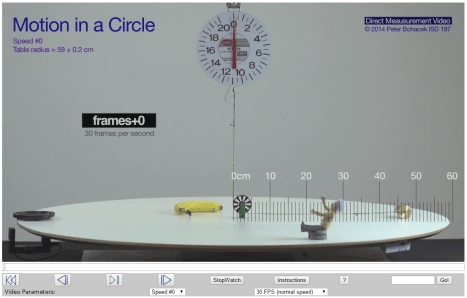
Students used a Direct Measurement Video of a weight on a rotating table to find a relationship between force and tangential velocity. One of the first questions on my activity was to draw a free-body diagram of the weight and determine whether there is any net force. A lot of groups had some great discussion as they tried to rectify the fact that the table rotates with a pretty constant speed with the fact that their free-body diagrams showed a net force on the weight. There were also some groups that asked questions like how the speed of the banana compared to the speed of the weight, bringing them back to a Direct Measurement Video of a rotating disk we’d used earlier in the year.

motin-in-a-circle-dmv

Earth Science: Comet Orbits

A major theme this week is comparing different kinds of solar system objects, so I decided to take an idea Michael Lerner gave me last week and have students compare the orbit of Halley’s Comet to Mars. I used an ellipse drawer to give students the orbit of both objects, then had them start by making some observations. Today, most groups only had time for the qualitative questions about the two orbits.

comet-orbit

Day 40: Mass & Craters

AP Physics: Mass

Students worked on a lab practical to find the mass of an unknown object using a modified Atwood’s machine. My plan is to use spring scales to verify the mass the determined, then use this to introduce the difference between inertial mass and gravitational mass, but time got tight and most groups need a little longer to finish their calculations.

img_2456

Earth Science: Craters

During yesterday’s lab, it quickly became clear that my students did not have much sense of how craters are formed. Today, I got out some trays of sand and an assortment of marbles and we explored how mass and impact speed affect the crater size. I was really excited when the groups who finished early started asking new questions, like how the depth of the sand or angle of impact changes the crater, and coming up with experiments to answer those questions. This is why I love freshmen! We also dropped a shot put into a bigger tray of sand and got some slow-motion video just because its cool.

img_2452

Day 39: Assumptions & Moon Landscapes

AP Physics: Assumptions
Some of my students are losing track of the tools they have for problems involving forces, so we started by whiteboarding as many different representations for a simple force problem as we could and then making a list of what we have in our forces toolkit. From there, students worked on some TIPERs problems. I had students answer each problem using a CER, but turned it into a CAER by asking them to state and justify key assumptions before diving into the evidence. We had some good conversation about what makes something an assumption rather than evidence or a claim. We will definitely need to revisit this as the year goes on, but I liked hearing my students start by articulating what they had to just agree is true before digging into the rest of the problem.

img_2451

Earth Science: Moon Landscapes

Students looked at a topographic map of an area of the Moon. They made some good observations and inferences about the craters formed, but students have had limited exposure to topographic maps so far and, as a result, had trouble connecting the map to what the would physically see. Next time, I think I’ll start by having them look at an actual image of the Moon, then transition to a topographic map of the same area.