Day 17: Vector Addition, Motion Detectors, & Water Displacement

AP Physics: Vector Addition Diagrams

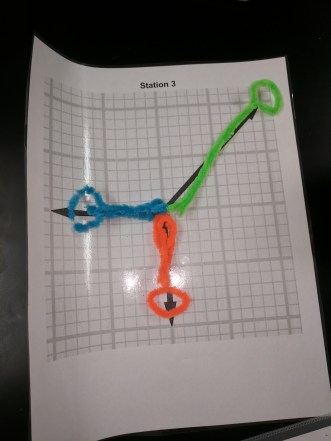
Students worked through an activity from Casey Rutherford to introduce vector addition diagrams. A few groups started thinking about how they could use trig and other math to do calculations with the shapes they made; one group even came up with the idea of components, which was awesome!
vad

Physics: Motion Detectors

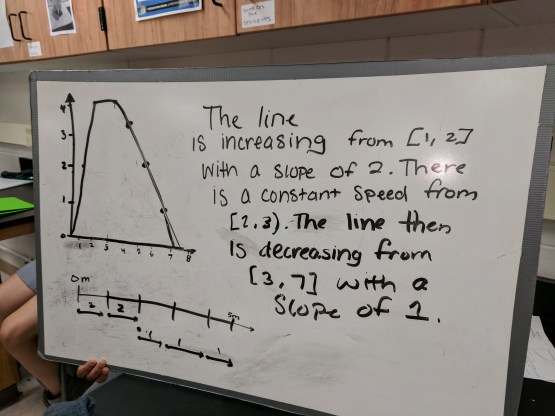
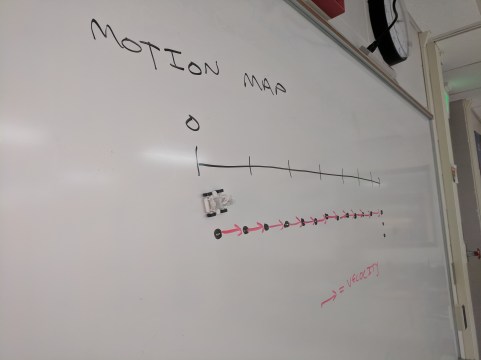
For the first half of class, we did the mistakes game for yesterday’s problems. Based on the mistakes several groups decided to make and the discussion that followed, I realized that a lot of students are drawing their velocity vs. time graphs to look like the motion maps.

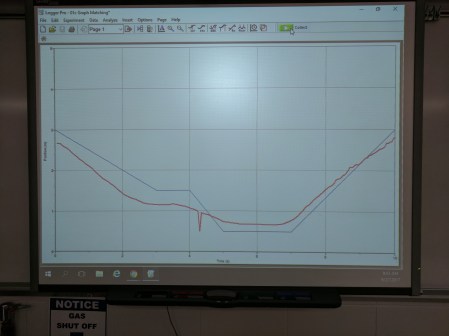
After finishing the problems, we got out the motion detector and focused on what the time axis means. Watching the graph form live seemed to help some of the students who’ve been sketching graphs that look like motion maps.
motion detector

Chemistry Essentials: Water Displacement

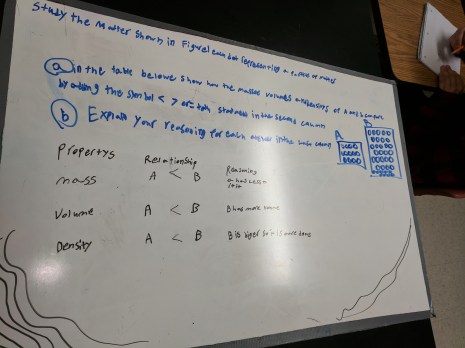
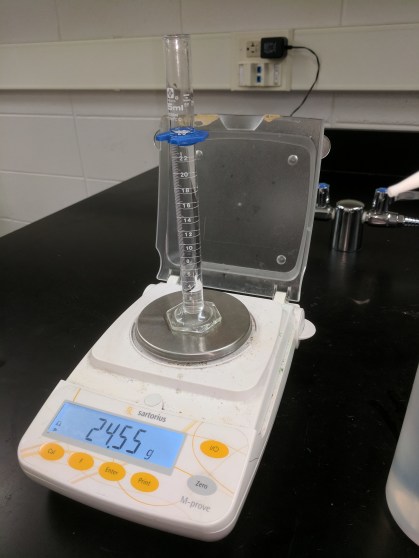
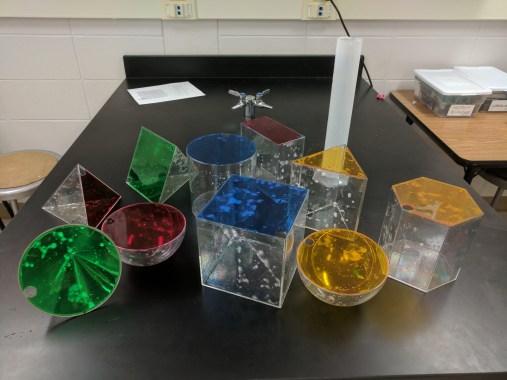
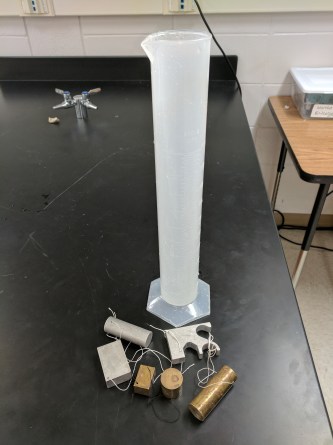
Students used displacement of water to find the volume and density of aluminum and brass blocks. I collected results to put on a class graph, and it was interesting to ask students to predict the shape of the graph. A lot of students expect the graph to have no pattern since the blocks are all different shapes. I may need to have them do some particle diagrams tomorrow to help compare.
density

Day 16: Systems, v-t Graphs, & Good Questions

AP Physics: Systems

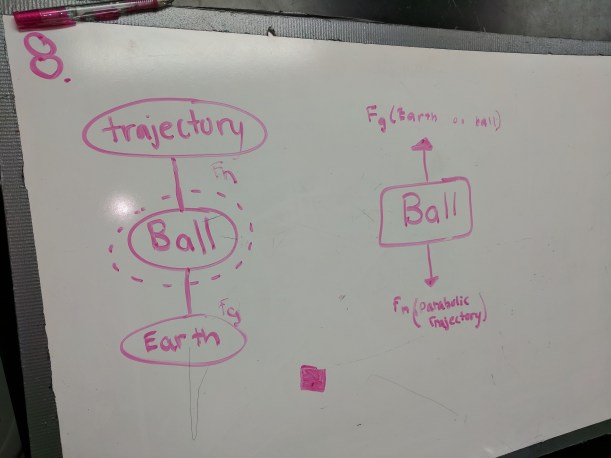
Students did the mistakes game (pretty much my default mode of whiteboarding if you can’t tell yet) for a free-body diagram worksheet. Both classes had some great discussion about whether there should be an upward force for a projectile while it is in the air and it helped a lot to frame forces as interactions. I ended up wishing I’d taken some time to revisit Newton’s 1st Law from the momentum unit since some students were having trouble with the idea that forces are balanced on an object rising with a constant velocity. I’ll probably spend some time reinforcing that tomorrow.

I also took this opportunity to introduce students to the idea of defining their system. Both sections had debates about different problems where they were trying to decide what was causing an upward force. That lead nicely into discussing how we could define our system to make each possible answer correct.

fbd mistake.jpg

Physics: v-t Graphs

Students worked on sketching velocity vs. time graphs based on motion maps and position vs. time graphs. The calculus class started v-t graphs at the end of last week, so I had some students who not only finished quickly, but were eager to exercise their new knowledge by helping their peers, which was great. I had a lot of students who struggled with the idea that the horizontal axis on the graph represents moving forward in time; I want to try getting out the motion detectors tomorrow so they can watch the graph form in real-time to see if that helps.

Chemistry Essentials: Good Questions

We spent some time working on asking good questions. I prepped a whiteboard with an intentional mistake, and asked students about what they saw. Some were able to use the question stems to immediately get to a good question. When a student had an observation or an idea of where to steer me next, I had them share it and we formed a question as a class. Then, we went back to the remaining student whiteboards and were much more successful and focused than yesterday.

Day 15: Rubber Bands & Mistakes Game

AP Physics: Rubber Bands

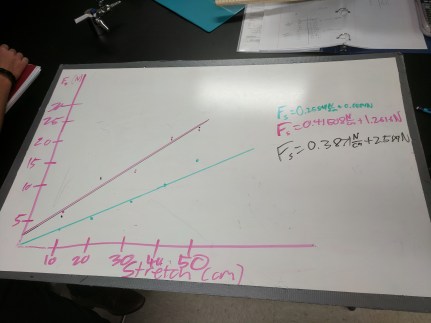
Both sections worked on drawing interaction diagrams and free-body diagrams, but one of my sections is about 30 minutes ahead and was able to get the problems mostly done last week. That section had asked about what the graph looks like when a spring is overstretched and Hooke’s Law breaks down, so we got out some rubber bands to try. I told students I hadn’t had a chance to collect my own data, so we’d be finding out together, and they seemed on board with that.

rubber band

Physics: CVPM Mistakes Game

Students played Kelly O’Shea’s mistakes game with Friday’s worksheet on translating between different representations of constant velocity. I really like this worksheet for introducing the mistakes game since its easy to direct students towards meaningful mistakes. I usually talk about some stems for good questions, but this time, I also projected them, which seemed to help. When the discussion lagged, I used Post-It notes to feed questions to students, but another student would usually ask the question I had in mind before I could finish writing, which is a good reminder to give them time.

phys mistake

Chemistry Essentials: Density Mistakes Game

This class played the mistakes game with Friday’s density problems. I also used the question stems with them, but they struggled a lot more with asking good questions. I think they need a little more scaffolding; I might put together a whiteboard and have students prep questions in their groups. A lot of students fell back into some of the behaviors I’ve been trying to push back against with the work on norms, and I think some of that was a result of some students feeling confused and frustrated with the discussion.

chem mistake

Day 14: Friction, Multiple Representations, & Density

Today is homecoming, so classes are shot and students are excited.

AP Physics: Friction

I decided not to take the time for a lab on friction, so I collected some data with a force sensor and motion detector and asked students for observations. I used the motion detector to help connect what the force was doing to what we know about momentum so far. Students pretty readily recognized the force of friction changed when the block when from being at rest to being in motion.

Afterwards, students took their second quiz. Last year, I had very few students complete retakes, so this year I’m giving them at least two in-class attempts at each learning target to try and normalize reassessment. So far, I’m hearing a lot of talk from students that suggests they are much more comfortable with reassessing than last year’s students.

friction take 1

Physics: Multiple Representations

Students worked on a Modeling worksheet to practice translating between position vs. time graphs, motion maps, and descriptions of motion. Overall, students did well and I think this helped reinforce the value of what came out of yesterday’s discussion. In the class where I see the most struggles with math skills, several groups chose to shuffle themselves today, and ended up needing much less support from me than usual. For the first time, however, I had some students who made graphs showing multiple positions for a single point in time. I need to probe their thinking a little more and think about how to address that when we go over the problems on Monday.

Chemistry Essentials: Density

Students worked on a Modeling worksheet connecting particle diagrams and density. I got a little nervous when a very large group gathered around the para who assists the class, but they had some good discussions. I do need to think about how that will impact whiteboarding on Monday when 1/3 of the class worked as part of the same group.

Day 13: Board Meeting, Motion Maps, & Density

AP Physics: Board Meeting

We whiteboarded the spring lab from yesterday. In both my sections, students had great observations and did a nice job of starting to talk about what the graphs mean with out too much prodding. There was a lot of great discussion about the limits of this model, as we tried to figure out whether the intercept on these graphs should be zero. One student also raised the point that if you overstretch a spring, it bounces back, so we was wondering if the linear relationship would still work. I might have them try it with rubber bands.

hooke wb.jpg

Physics: Motion Maps

We whiteboarded the buggy lab. I had a lot of trouble keeping students engaged in the large group discussion, I think partly because students didn’t use the ideas we developed in board meetings during the first unit, setting the tone that board meetings aren’t important. One thing that helped a lot was a student who was extremely willing to ask questions about what groups had done when their graphs were different from her group’s, which pulled a lot of students back into the discussion.

After the board meeting, I got out my Fridge Rover, a magnetic wind-up toy that maintains a pretty constant velocity, to introduce motion maps. I made marks on the board showing the rover’s position at regular time intervals, which drives home the connections between motion maps and the buggy lab students just did.

motion map

Chemistry Essentials: Density

Students found a relationship between mass and volume for water, which I used to introduce density. This was one of the times I really liked particle diagrams, since it made density much more concrete than an equation would. A lot of groups skipped finding the slope of their line, so I need to keep reinforcing that the slope is important.

water density.jpg

Day 12: Springs, Buggies, & Board Meeting

AP Physics: Springs

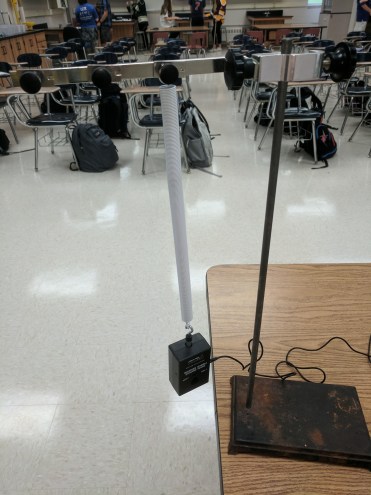
Students pulled on springs with force sensors to get data for Hooke’s Law. I usually have students who expect a horizontal spring to behave differently than a vertical one, so I took advantage of the force sensors to have students collect data for one of their springs in both orientations. When groups started to notice they have the same slope in both orientations, many of them started talking about whether that makes sense, which was fantastic.

spring.jpg

Physics: Buggies

Students finished their data collection and prepped whiteboards for the buggy lab. One student came up to tell me he was thinking about how he could use the data from this lab. In particular, he wants to give the slow buggy a head start, then figure out where the fast buggy will pass it. I let him know that will be our next lab practical.

I’ve got a decent number of students who are struggling with math skills, such as finding slope or plotting negative values, and I need to adjust how I’m addressing that. I’ve been giving small group instruction as needed, but I’m spending a lot of time with just a few groups and missed others who were on the wrong track with this lab until pretty late. I’m toying with some options like providing math “cheat sheets” or having some mini lessons during the class for groups who need help, but I’d really like to develop a culture where students are relying on each other for some of that.

buggy wb2.jpg

Chemistry Essentials: Board Meeting

Today went pretty smoothly; I think yesterday’s work on norms helped, though I need to make sure it doesn’t feel like a punishment next time. When I reviewed the norms at the start of class, a student asked if I actually like about teaching them, so I spent a few minutes sharing some examples of when I’ve really enjoyed their energy.

Students whiteboarded their results from this week’s volume lab. There are a big range of math skills in the class, but once groups compared the values on their data tables, they had an easier time getting at what the slope means. We hadn’t talked about the thickness of the sides, so I was excited when a student asked how it would change the results if the shapes were made of much thinner plastic.

vol wb2.jpg


Day 11: Uncertainty, Buggies, & Norms

AP Physics: Uncertainty

We had a board meeting on yesterday’s force of gravity lab, and the discussion was better than I expected at this point in the year. As we were talking about the slope, one student claimed “Gravity doesn’t change”, which lead nicely into what we mean by that and how we know. In response, another student shared that yesterday one of her group members said “The force goes up 10 N for every 1 kg of mass”; after finally reading Arons this summer, one of my goals is to have students make “for every” statements about slope, and I was thrilled it came up naturally.

I also introduced uncertainty during the board meeting. Students had a lot of great observations about the relative precision of measurements and how much mass it took to change the reading on the scale, which gave them a sound conceptual basis. I rushed the discussion since the end of the hour was coming, and it ended up more teacher-directed than I’d like, but I’m pleased with how the basic approach worked.

fg wb.jpg

Physics: Buggies

Students collected data for the buggy lab. Since when I ask for observations, there is usually a student who says the buggy is moving at a constant speed, I took a page from Michael Lerner and framed the lab as seeing how we can find out. A few groups are starting to make “for every” statements about their slope, which I did not see during the introductory unit and is great to see. I think the relationship is more obvious here than it was in the intro labs.

buggy.jpg

Chemistry Essentials: Norms

I’ve been struggling with classroom management. This is a very high-energy group, and there are a lot of things that are a lot of fun, but I’ve been having trouble keeping them on task and getting them to voices besides their own. I decided to pause today to spend some time developing norms as a class. I think a lot of students felt it was punitive, but many also agree that things aren’t working at the moment.

Day 10: Force of Gravity, Lab Practical, & Volume

AP Physics: Force of Gravity

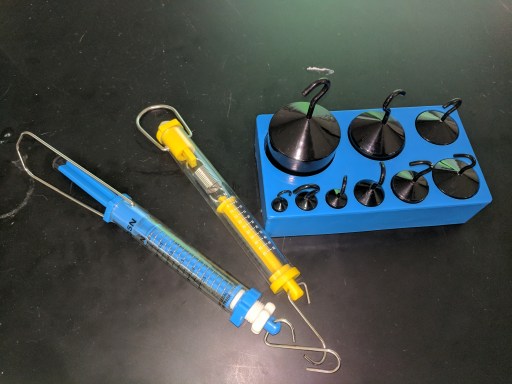
Students collected data to plot the force of gravity on an object vs. its mass. I had different groups use spring scales with two different ranges. Tomorrow, I’ll use the different levels of precision to motivate a discussion of uncertainty. Groups with the 50 N spring scale have already noticed that the smallest hanging masses don’t noticeably change the scale’s reading, which is exactly the kind of observation I was hoping for.

mass.jpg

Physics: Lab Practical

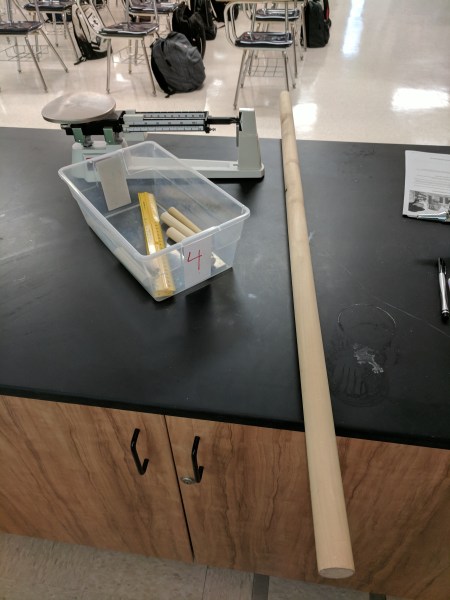
Students revisited the dowel lab, this time as a group assessment. Their results on the original lab weren’t as good as I was hoping, but they are looking much better now that students have had an opportunity to discuss the flaws in their original approach.

dowela.jpg

Chemistry Essentials: Volume

Students found the volume of several different shapes, then measured how much water was needed to fill each one. Some groups got beautiful results, but other groups struggled. I think the groups that struggled had trouble matching up their measurements to the formulas on the cheat sheet I gave them or the Google calculators I showed them. A lot of students also also had trouble measuring the amount of water they put into the shape. The groups that struggled with these measurements were also the groups that were the least focused, but I’m not quite sure which issue is the chicken and which is the egg.

shapes.jpg

Day 1: Bowling Balls, Dowels, & Steel Wool

The first day of school is in the books!

AP Physics: Bowling Balls

This concept development sequence comes from conversations with Michael Lerner, Kelly O’Shea, and the rest of the Physics! PLC!

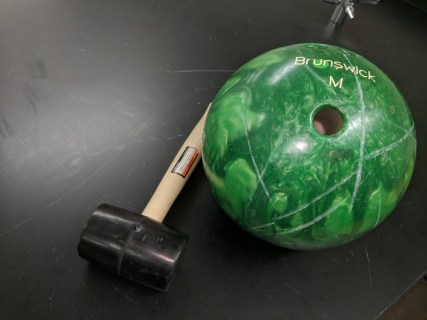
I’m starting the year with momentum, so the first idea I want students to build is the impulse-momentum theorem. Today, we started with a version of Frank Noschese’s bowling ball & mallets activity. For the first time, when I asked students to whiteboard the pattern or rule they’d found, I had multiple groups write out the classic wording of Newton’s 3rd Law. These groups struggled to connect their statement to the lab, but still resisted changing their whiteboard because they knew their statement was true. I think this happened because we don’t have the class culture yet for every student to feel comfortable taking an intellectual risk. Tomorrow, I want to spend some time on the difference between true statements and useful statements to push some of those students away from quoting textbooks.

bowling

Physics: Dowels

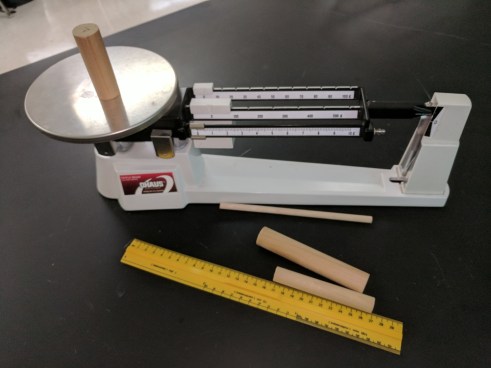
We’re starting the year with a unit on experimental design and graph interpretation based around a series of labs. For the first one, students are graphing mass vs. volume for some dowels. Things went well overall, but I should have spent a little more time on how to find the volume; I just told them to find it, and a lot of groups weren’t ready to make that leap on their own the first day of school.

dowel

Chemistry Essentials: Steel Wool

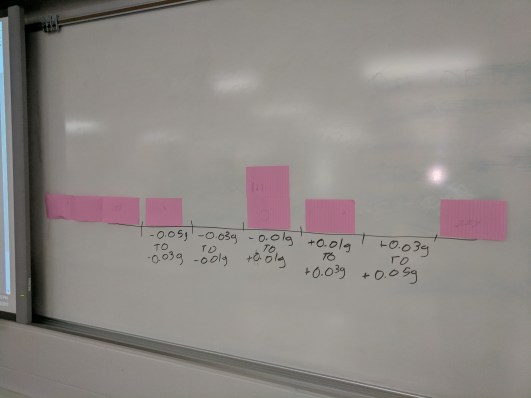
Students started the mass and change lab from the chemistry Modeling Instruction curriculum. To make the histogram, I had each group write their change on a Post-It, then place it in a physical bin matching their value before I transferred the Post-Its to the whiteboard. The balances were acting up, so most groups saw pretty big changes.

chem histo

Day 140: Types of Mass & Seismometers

AP Physics: Types of Mass
I wanted to revisit gravitational and inertial mass, so I got out the inertial balance and asked which type of mass a spring’s vibration should depend on. Finally, we used the motion detector to find the period with and without a string supporting the added mass and got beautiful results.

Afterward, students worked on some free-response problems in their groups. Tomorrow, they will get limited time with the scoring guides, then present their assigned problem.

Earth Science: Seismometers
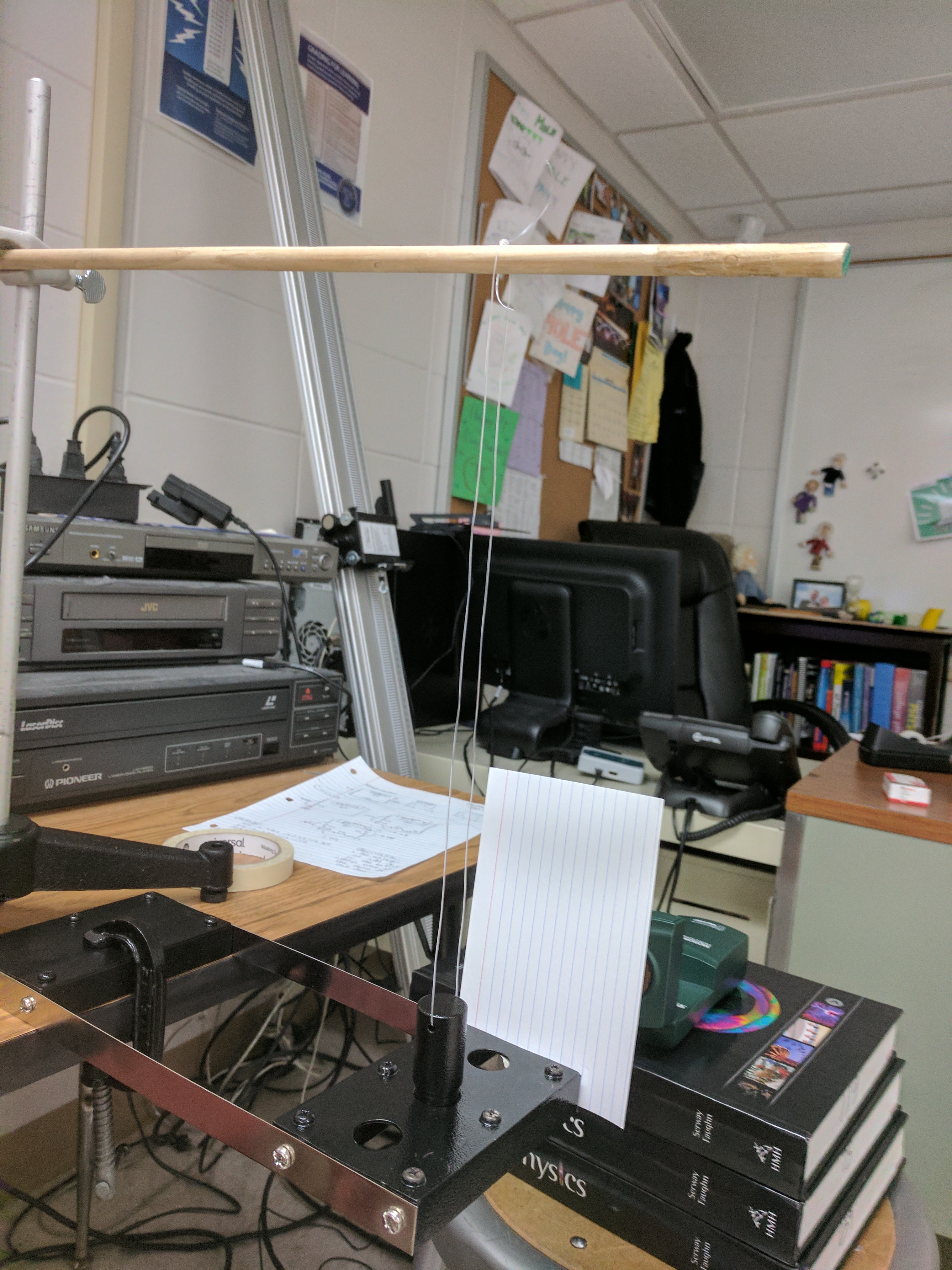
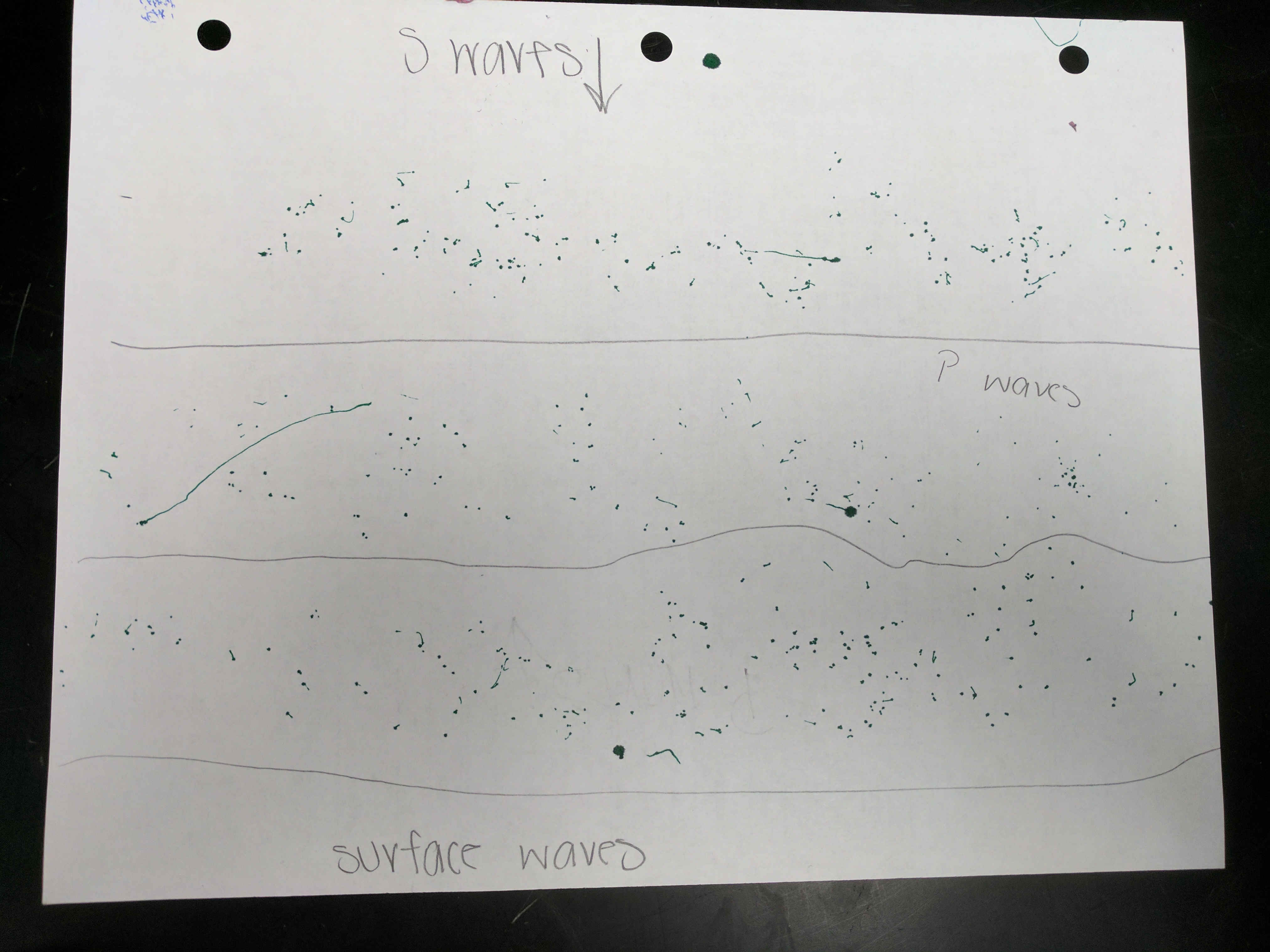
Students built a very basic seismometer, then experimented with recording different types of earthquake waves. The results varied a lot, but it did lead to some good discussion on the limitations of the earliest seismometers.