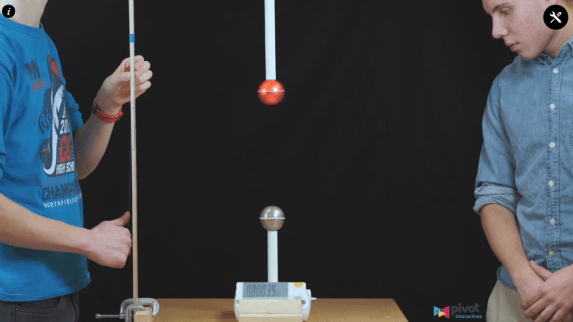
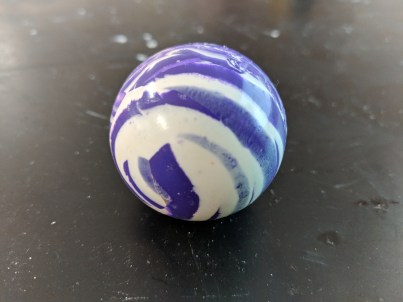
Day 67: Board Meeting, Representations Jeopardy, & Density of a Solid

AP Physics 1: Board Meeting

Students whiteboarded their results for the elastic potential energy lab we’d done earlier this week.

Physics: Representations Jeopardy

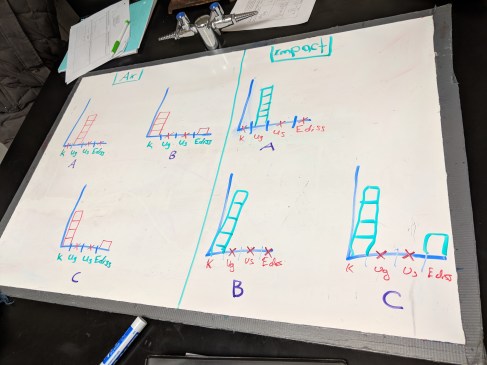
In both my sections, we started with mistakes whiteboarding for yesterday’s problems. My 6th hour is about 1/3 the size of my other section, so they got through the mistakes whiteboarding very quickly. I tried what I called Representations Jeopardy: each group came up with a scenario, and whiteobarded a set of representations, minus the sketches and any labels that would identify what the objects involved are. Then, groups traded whiteboards and had to come up with a scenario that matched the whiteboard they received. Students said they really liked that they had to think differently in order to work backwards from the diagrams.
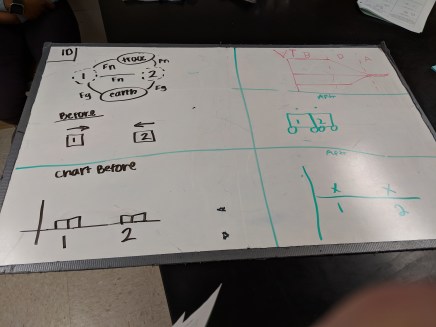
phys mistake

From mistakes whiteboarding

Chemistry Essentials: Density of a Solid

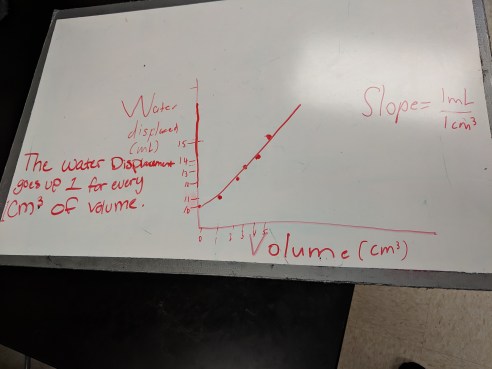
Students worked on finding the density of some metal dowels. I realized belatedly this is the first lab we’ve done where they didn’t need a container when measuring the mass, so it was actually a tricky leap for them to not tare something out on the balance.

volume

Day 66: Board Meeting, Momentum Representations, & Density

AP Physics 1: Kinetic Energy Board Meeting

I am being compensated by Pivot Interactives as part of their Chemistry Fellows program.

Students whiteboarded their results from this week’s Pivot Interactives activity with a puck on a ramp to get to a definition for kinetic energy. I definitely wish I’d done energy bar charts prior to this lab, but conservation of energy is emphasized enough across our science curriculum that it wasn’t too big of a leap for students to recognize the energy transformation happening. Students were really pleased when they realized their slope worked out to equal 1/(2g), which is exactly what the formulas predict.

ke lab.jpg

Physics: Momentum Representations

Students worked on representing momentum transfer using sketches, bar charts, and velocity vs. time graphs. The use of velocity vs. time graphs was influenced by Brian Frank’s work on momentum representations, and I really like the way it connects momentum to tools we’ve used earlier in the year. I’ve got one section with 30 students and one section with 8, and I’m quickly figuring out I need to be conscious about hanging back in my small class to encourage them to talk to each other about the problems before they talk to me.

Chemistry Essentials: Density

Students worked on finding a relationship between the mass and volume of water. Today really stretched my students since I had them design their own experiment and we started a board meeting on the lab, but students rose to the challenge. I’ve been having them use fill int he blank “for every” statements to talk about their slope, and that has been a big help for students to get a conceptual understanding of what their slope means. Yesterday, we had to pause the board meeting to define what the intercept of a graph is, so I got really excited when students not only brought up that groups had intercepts of either 0 g or 10 g, but came up with the idea that the intercept came down to whether groups hit tare after putting their graduated cylinder on the balance.

Day 65: Spring Energy & Board Meetings

AP Physics 1: Spring Energy

I am being compensated by Pivot Interactives as part of their Chemistry Fellows program.

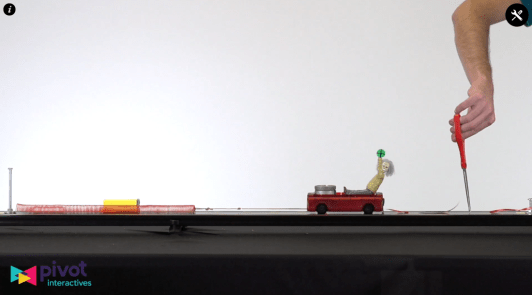
Students collected data for a relationship between a spring’s stretch and the final velocity of an attached cart using a lab in Pivot Interactives. While I took more time than yesterday on a pre-lab discussion, I think students were still a little confused since we haven’t talked much about energy types yet. I think it would have helped if we’d done the board meeting for yesterday’s lab prior to this activity. I’m also thinking about doing bar charts before these equations next time around.

pivot epe.PNG

Physics: Explosions Board Meeting

Students whiteboarded their results from yesterday’s lab to introduce conservation of momentum. This was a tricky discussion for a lot of my students since we were dealing with four variables simultaneously, but students did well with it. It was a nice reminder of the progress my students have made so far this year.

explosion board.jpg

Chemistry Essentials: Volume Board Meeting

Students whiteboarded their results from yesterday’s lab. I really hit “for every” statements about the slope hard, and that seemed to help students attach some conceptual meaning to the slope. There were a few groups who graphed the actual water level, rather than the water displaced, which gave a great opportunity to talk about what the intercept tells us in this lab. I think next time, I’ll make sure a couple of groups do that.

group 3.jpg

Day 64: Kinetic Energy, Exploding Carts, & Volume

AP Physics 1: Kinetic Energy

I am being compensated by Pivot Interactives as part of their Chemistry Fellows program.

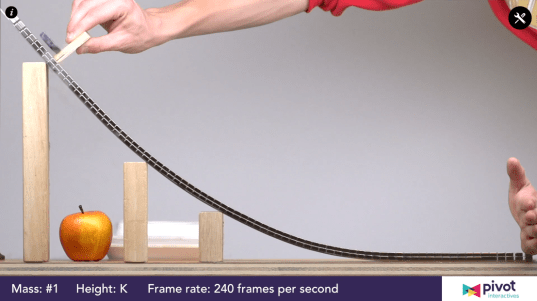
Students used Pivot Interactives to collect data for a relationship between an object’s starting height and its velocity at the bottom of a ramp to work toward a relationship for kinetic energy. Because the activity included directions for how to make each measurement, I got complacent and rushed through the pre-lab discussion, which meant some students were lost on the goal of the activity. I think I would have been better off taking a little more time, and pointing out connections between the directions in the activity and the measurements we discussed.

pivot ke.PNG

Physics: Exploding Carts

To start working toward momentum conservation, students launched pairs of carts off each other and plotted the ratio of the masses and the ratio of the velocities. Rather than measuring the velocity, we worked out that since the carts have a pretty constant velocity after the explosion, if they hit the end stops simultaneously, the ratio of the distances is the same as the ratio of the velocities. I like that this forces students to start making some predictions about how they need to adjust the distance, rather than waiting until the end to come up with a model.

explosion.jpg

Chemistry Essentials: Volume

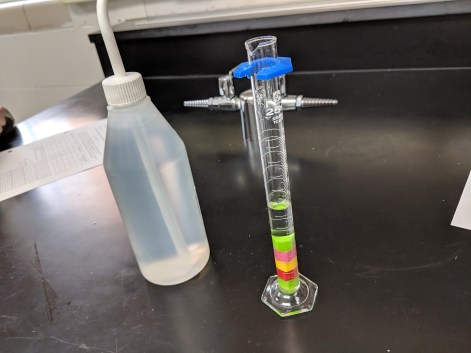
The Modeling Instruction chemistry curriculum has a lab I really like to show that 1 cm3 = 1 mL, but I’ve struggled to make it work for my students. Both when I’ve used empty geometric solids and a selection of cylinders, doing the math to calculate the volume in cubic centimeters has been a huge hurdle. Today, I tried the lab using plastic cubes that are 1 cm on each side and it finally went smoothly. Students were actually paying attention to the relationship, rather then getting lost in the math to calculate the solid volume.

volume.jpg

Day 63: Work, Quiz, & Histogram Interpretation

AP Physics 1: Work

To introduce work, I had students pull a cart up a ramp to a consistent height, but changing the angle. They then sketched force vs. distance graphs and saw the area was pretty consistent.

f-d graphs.jpg

Physics: Quiz

We wrapped up Friday’s mistakes whiteboarding, then moved into a quiz on impulse. I’m finding students are loosing track of the different variables we have, which is making it tough to use the equations accurately. I think we might take some time soon to do a “glossary” of all the variables we’ve gotten so far this year to see if having a reference like that helps.

Chemistry Essentials: Histogram Interpretation

To wrap up Friday’s labs on mass and change, I projected some histograms of the class results. The discussion ended up being a lot of me asking a question, followed by one student responding, which is not what I like to go for. I need to spend some time thinking about better prompts I can use on these graphs to get more student-to-student discussion going.

histogram.PNG

Day 138: Tic Tac Bounce, Board Meeting, & Problems

AP Physics: Tic Tac Bounce

As part of the toilet paper practical, I asked students to calculate the final velocity of their unwinding roll using a v-t graph and using an LOL diagram. The discrepancy between the two velocities prompted some good discussion, which lead nicely into Kelly O’Shea’s bouncing Tic Tac demo and the idea of rotational kinetic energy.

Physics: Board Meeting

Students whiteboarded their data from the snakey spring lab. There were still more groups than I’d like who had results that were definitely not an inverse relationship between wavelength and frequency. The big problem seems to be in finding the frequency; we haven’t made much use of that term, so I think students are not attaching much conceptual meaning to it, in spite of the pre-lab discussions. We also didn’t do as much as I usually do with position vs. time graphs for simple harmonic motion, which seems to be making wavelength a tough concept to grasp. Next year, I need to rethink my unit on springs and pendulums to build a better foundation.

Chemistry Essentials: Limiting Reactant Problems

Students worked on some written limiting reactant problems. It was a much tougher leap than in past years; this class isn’t as comfortable with using particle diagrams as a tool for thinking, and I think that made limiting reactants feel more like something new than a natural step in what we’ve been doing.

Day 95: Electric Potential Difference, Conservation of Energy, & Quiz

AP Physics: Electric Potential Difference

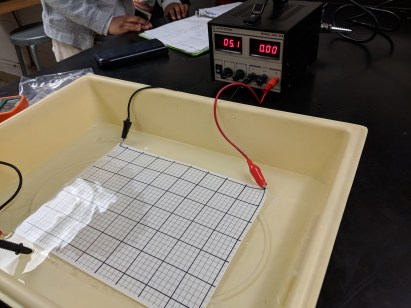
Students did a variation on the lab to map an electric field in a tray of water. Since I just wanted to define electric potential difference, they measured the voltage along a line with the multimeter’s ground probe in a few different positions (my article about this lab was in the January issue of The Physics Teacher). There was a lot of good discussion within lab groups about what negative voltages mean.

epd.jpg

Physics: Conservation of Energy

Before their quiz, students whiteboarded a couple of conservation of energy problems (which I spaced out on taking a picture of). For a lot of students, this reinforced the importance of the meaning-making steps and gave them a boost of confidence before starting the quiz. The downside is there are students who approach the pre-quiz problems as a chance to cram, rather than a warm-up. I’m trying to decide if I’m okay with that trade-off.

Chemistry Essentials: Quiz

Students took their quiz on atomic models and classifying matter. I’ve been working a lot on the class culture and finding ways to connect with students I’ve been clashing with, and it paid off today when, for the first time, I didn’t have to police students staying quiet after they finished their quiz.

Day 94: Whiteboarding, Bouncy Ball Energy, & Classifying Matter

AP Physics: Whiteboarding

Students whiteboarded their answers to yesterday’s problems. There were a couple of meaty ones on the worksheet, so I had all groups whiteboard the same problem and then we had several consensus-building conversations.

quantization.jpg

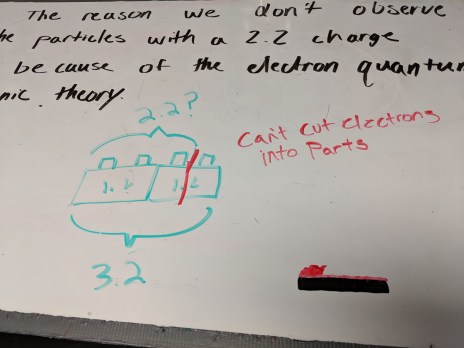
A visual for quantization of charge

Physics: Bouncy Ball Energy

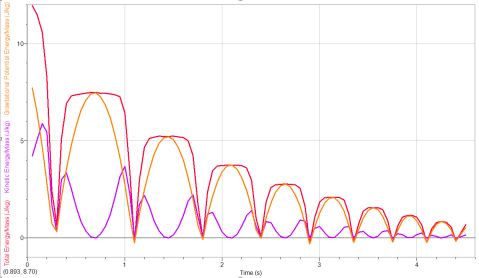
We wrapped up figuring out where a bouncy ball dissipates energy. As part of the follow-up, we dropped a kickball under a motion detector (thanks to Brian Frank for the idea!) to produce energy vs. time graphs and confirm the results from students’ video analysis.

kickball e-t graphs.PNG

Chemistry Essentials: Classifying Matter

Students worked on a worksheet to connect particle diagrams to the vocabulary for classifying matter that we introduced yesterday. I also was able to have really good individual interactions with a couple of students I’ve been butting heads with a lot, which helped make the whole classroom feel more relaxed and positive. I’ve been getting overwhelmed in chemistry a lot this year and have not done a good job of making time to talk to students about things besides chem, and I can’t underestimate the value of those conversations.

Day 92: Board Meeting, Dissipated Energy, & Mistakes Game

AP Physics: Board Meeting
Students whiteboarded their results from a Pivot Interactives activity on Coulomb’s Law. There was some debate over whether inverse or inverse-square was the right linearization; I usually don’t have students sketch their points on their whiteboards, but I think that would have been helpful today. Students did a nice job connecting their results to Newton’s Laws and their knowledge from chemistry.

force charge lab.jpg

This group ran out of space for their linearization, but I found their set of graphs very satisfying.

Physics: Dissipated Energy

We continued prep for determining which interaction causes a bouncy ball to dissipate energy (my article about this activity was published in the January issue of The Science Teacher) by whiteboarding key points of yesterday’s work. Today really seemed to help a lot of students see the connections between the energy bar charts, free-body diagrams, and velocity vs. time graphs, which is exactly what I was going for.

bouncy lol.jpg

Chemistry Essentials: Mistakes Game

We used the mistakes game to go over yesterday’s problems. There was some great discussion, but it was very tough to keep students from breaking into side conversations. Next time, I should spend a little more time making sure behavior expectations are explicit as possible and helping students see the value in those expectations. There were also some students who were extremely engaged and clearly developed a lot of confidence in sketching Borh models today, which was awesome.

Day 91: Coulomb’s Law, Bouncy Balls, & Bohr Model

AP Physics: Coulomb’s Law

Students worked on a Pivot Interactives activity to find a relationship between the force between two charged spheres and the distance between them. A few students started wondering about the limits of the model since they recognized an infinite force doesn’t make sense, which lead to some good discussion about what it would take to make the distance zero.

pivot force dist.PNG

Physics: Bouncy Balls

Students started working a lab to determine what interaction is dissipating energy for a bouncy ball (my article about this activity was published in the January issue of The Science Teacher). Today, students worked on sketching representations of the bouncy ball’s motion, including energy bar charts, free-body diagrams, and velocity vs. time graphs for each possible explanation in order to identify useful evidence they can get from video analysis of the bouncy ball. To scaffold this process, I had students sketch the representations on a worksheet today rather than going straight to whiteboards.

bouncy ball.jpg

Chemistry Essentials: Bohr Model

We talked about the results of last week’s simulation to find the links between the Bohr model and the periodic table, then students worked on a worksheet sketching Bohr models from the periodic table. I skipped over revisiting static electricity (which the Modeling Chemistry curriculum calls for) to help establish the concept of charge, but I think next time I’d like to make time for it.