Day 115: Final Exams

Physics: Collaborative Exam

Since physics is both very lab-based and very collaborative, we decided the final should be as well. We planned lab practicals based on the models from this trimester. Students are getting a test to complete individually that has descriptions of each lab practical, but no numbers. Students will have about an hour to set up equations and plan what they will need to do in the lab. For the last half hour, students will be placed into groups where they will actually complete each of the lab practicals.

IMG_1733

Chemistry: Final Exam

I went with a fairly traditional written exam, though there was enough time that I could have done a two stage collaborative exam. I might try that next trimester, though I’ll need to think about how I will make sure students make effective use of the collaborative time. I also need to rethink how I approach the review assignment. I allowed students to use their review on the final, and several students answered some questions by just copying over their answer from the review, even when the test question was looking at a different reaction or element. Many of my students read below grade level, so I’m wondering if that was a factor in students who missed the ways the test was different from the review.
Day 114: Gallery Walk

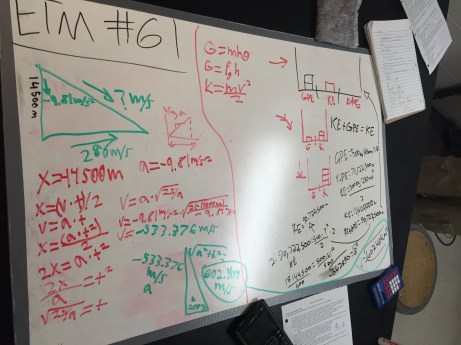
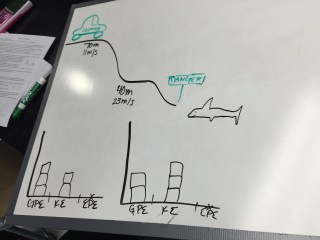
Tomorrow is the start of final exams, so both classes today went over their final review assignments. I decided to go with a gallery walk, with each group preparing a whiteboard for a different problem. Then, one member of each group stayed put to answer questions while the others moved around the room to check out the other whiteboards. Especially in my largest class, I really like that the gallery walk gets more students involved in the conversation. A few students decided to play the “reverse mistakes game” during the gallery walk by pretending to hold a misconception as they asked questions at a whiteboard.

IMG_1730

This group asked if they could try their problem with both constant acceleration and energy transfer.


Day 113: More Final Review

Students in both courses continued to work on their final review assignments. After a three-day weekend, both classes were much less focused than they were on Thursday. In chemistry, I talked to them a bit about the strategies I saw during class, and how they could improve on them. The students who were working pretty well on Thursday seemed receptive and tried to refine their approach. There were some groups that had great conversations about the problems on the review. In physics, I saw a lot less collaboration than on Thursday and a lot more off-task behavior in general. A lot of students talked about feeling fried from studying and working on final papers or projects over the weekend, and I saw more students working on other homework than usual. I think a lot of students are just feeling fried by the end of the tri. Tomorrow, I’ll switch to something more structured, especially since it will be time to go over the reviews.

Day 112: Final Review

We’re down to three class periods before finals (possibly two, if the basketball team makes the state tournament). In both of my courses, we started the final review. While both reviews were pretty similar, it was interesting to contrast how my two classes approached it. In physics, students were quick to grab whiteboards to collaborate on and pull out old quizzes and other work to jog their memory. I also saw a lot of students jumping around in the assignment, looking for the problems and questions they found most challenging to use those as a starting point. In chemistry, we talked about strategies to prioritize what to work on, but most students took a very linear approach and only a few pulled out work from earlier in the term. I saw much more variation in how students approached working together. Two students in particular did a really nice job of bouncing ideas off each other and challenging the other one’s thinking, but other groups “worked together” by agreeing to divide up who would do what portions of the review. No one opted to use a whiteboard for brainstorming and collaborating; when I asked some students about it, they saw it as extra work since they would have to transfer their work onto their paper.IMG_1713

Contrasting these classes really reinforced for me how important it is to work with students in this chemistry course on how to be a student. In physics, I have some of the top students in the school and they come to me expecting that they need to understand the daily work to do well on assessments and knowing that having the right answer down is very different from understanding how to answer the question. Many of my chemistry students don’t see that connection between assessments and what happens day-to-day, so don’t value the daily work as much. I need to keep working on making the value of daily work explicit to my students. There are a few who’ve bought into the idea that what they do today influences how their test will go, and they tell me chemistry is one of their highest grades. My challenge for next tri is to get more students to that point.


Day 111: TIPERs & Half-Life

Physics: TIPERs

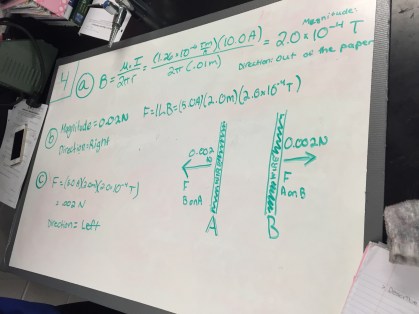
Students worked through some questions related to magnetic forces from TIPERs. I overheard a lot of good discussions, and students shifting their ideas as they went.

IMG_1711

Chemistry: Half Life

We spent some time going over the results of yesterday’s lab, then students worked on some half-life problems. Based on conversations with my students, many were struggling to connect the definition of half-life to the process for solving problems. I need to rework the lab discussion for next time to try and help students really get what half-life means.

Day 110: Motors & Half Life

Physics: Electric Motors

Students built simple electric motors, then experimented with how they could change the behavior of the motor. They drew a lot of nice connections between their observations and the previous work we’ve done on wires in magnetic fields. I let students use power supplies, and the sparks that showed up at higher voltages were very popular.

IMG_2206

A student took this photo that’s way cooler than anything I got

Chemistry: Half Life

Students simulated radioactive decay using M & M’s, with one side representing the parent isotope and other representing the daughter. To reinforce half-life is based on probabilities, rather than hard and fast rules, I wanted to have students compare several runs of this experiment. Each group did the experiment twice, then submitted their averages to a Google Form. Tomorrow, we’ll look at the class data to see how it compares to the results of individual groups.

Day 109: Wire Loops & Nuclear Reactions

Physics: Wire Loops

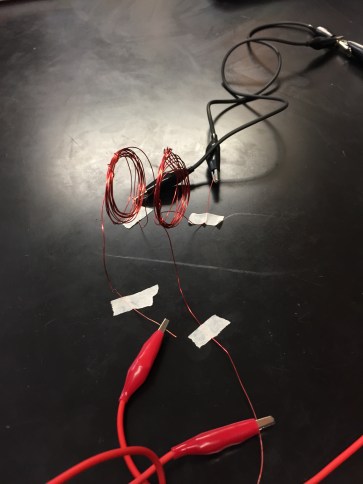
My plan was for students to experiment with interactions between two wire loops with currents running through them, but we were not able to get much to happen with two loops. Instead, we ended up using some YouTube videos of the experiment to make observations. Students did get good results observing interactions between the wire loops and a magnet. This lab did provide a nice opportunity to revisit a common misconception from last week’s quiz, where a lot of students struggled to identify how a charge at rest would respond to a magnetic field. We were able to use how a wire with no current running through it responded to revisit the idea that charges must be moving.

IMG_1707

Chemistry: Nuclear Reactions

Students did some problems predicting the products of nuclear reactions. This year, I really emphasized applying a conceptual understanding of conservation of mass to balancing chemical reactions, and that provided a good foundation for nuclear reactions. Even though the elements involved were changing, students were nicely primed to think about these reactions in terms of conserving protons and neutrons instead of elements.

Day 108: Balances & Isotopes

Physics: What does a balance measure?

A couple of students turned in their work from yesterday to my sub, and I saw they pretty consistently interpreted the balance in the video as measuring mass rather than force. To help clear that up, I took a balance on the school elevator and recorded some video. We started by drawing some free-body diagrams, then connected those to changes in the reading on the balance to get at what the balance is really measuring. From there, students whiteboarded and shared their answers to yesterday’s activity.

Chemistry: Isotopic Pennies

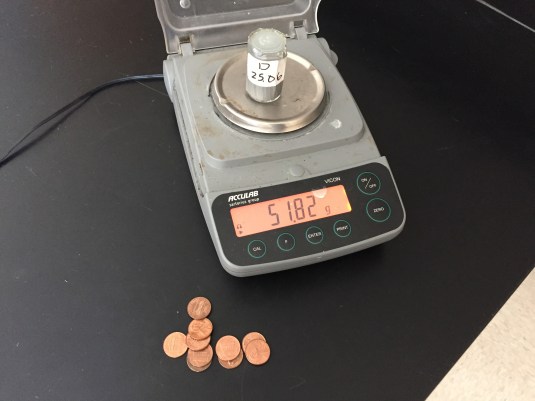
To introduce the idea of isotopes, students got sealed jars with 10 pennies and had to determine how many of their pennies were made before 1982 without opening the jar.

IMG_1702

Day 107: Wire in a B-Field & Hydrocarbons

I was chaperoning an AVID college visit today, so all my classes had subs.

Physics: Wire in a B-Field

Since we don’t have a current balance (and I haven’t had a chance to build one), I had students watch a YouTube video and work through some questions about the forces on the wire.


Chemistry: Hydrocabons

Students used the textbook to get an intro to some terms related to hydrocarbons and organic chemistry.

Day 106: Whiteboarding & pH Lab

Physics: Whiteboarding

Students whiteboarded their solutions to yesterday’s problem. In my class of 15, I had students present while in my class of 35, I tried a gallery walk, instead. I really liked the gallery walk with the big class; it gets hard to hear from everyone with that many people in the room, so talking about each board in smaller groups made it possible for more students to both ask and answer questions.

IMG_1682.JPG

Chemistry: pH Lab

Students did a lab to find the pH of household chemicals. Students did a nice job of connecting the properties of each chemical to the properties of acids and bases.